Table of contents
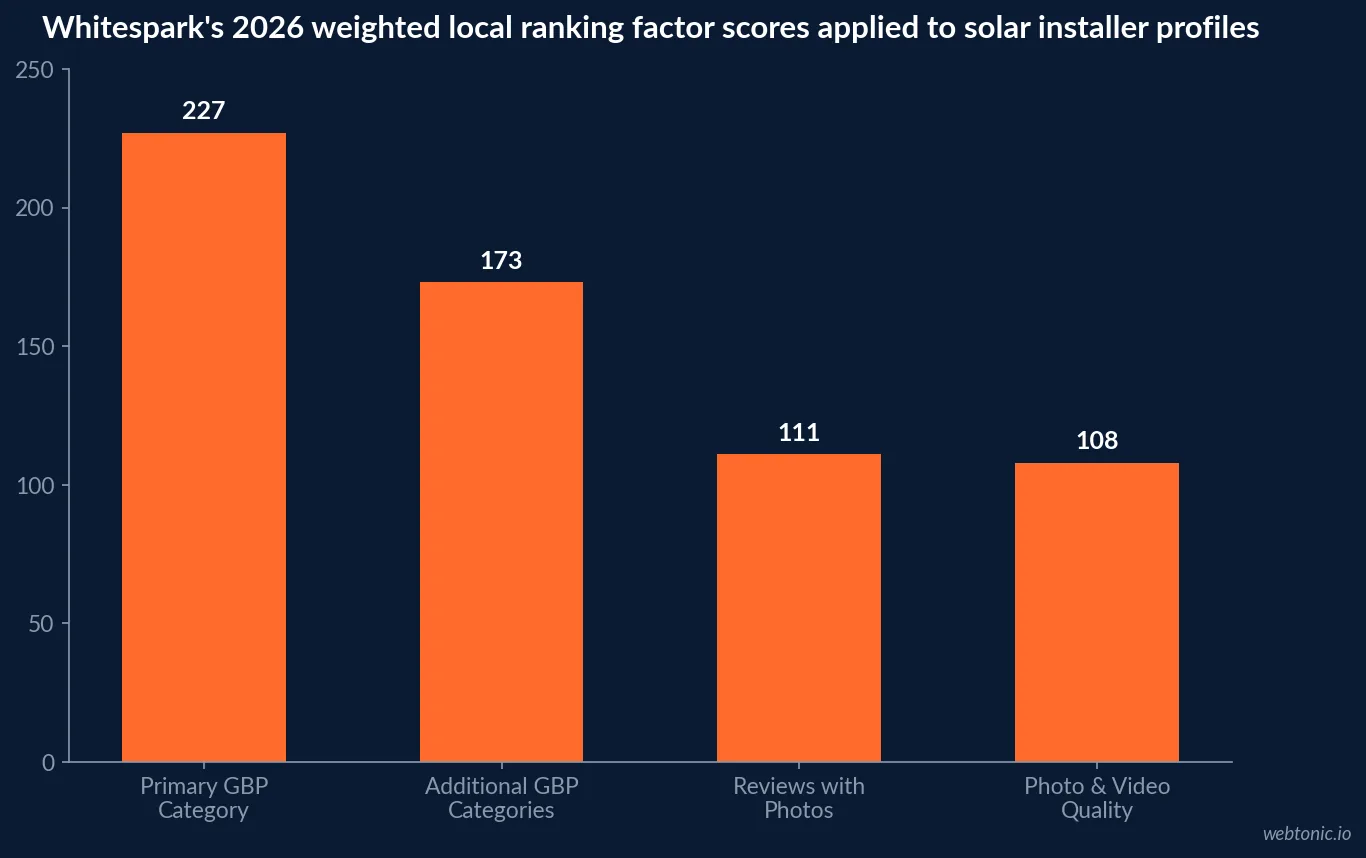
Primary GBP Category is the single highest-weighted local ranking factor surveyed in Whitespark's 2026 report, scoring 227 points - a free field most solar installers still leave on a generic default. That single fact should settle the in-house-versus-outsourced question before any invoice does.
Key Takeaways
- Primary GBP Category scores 227 points, Whitespark's highest-weighted 2026 local factor.
- Additional GBP Categories scores 173, the second-highest group.
- Quantity of Reviews with Photos scores 111; Photo and Video Quality scores 108.
- Solar is not on Google's Advanced Verification list, unlike locksmith and garage door services.
- Service-area businesses must remove their address if they don't serve customers there.
- 47% of consumers won't use a business with fewer than 20 reviews (BrightLocal 2026).
- 68% require at least 4 stars; 31% now require 4.5 or higher, up from 17%.
- 74% only weight reviews from the last three months.
- GBP software list prices run USD 49 to USD 349 a month (GBPcentral).
- Reputation platforms run USD 399 to USD 599 a month (Podium).
- US residential solar installed capacity grew just 6% year over year in Q1 2026 (SEIA).
- Overall US solar installations fell 27% year over year in Q1 2026.
- SEIA expects a 21% residential market contraction across 2026 before 2027 recovery.
- A second-largest national installer filed for bankruptcy, per SEIA's Q2 2026 report.
- Bulk verification applies once a business manages 10 or more profiles.
Why the decision matters more in a contracting market
The stakes on this decision rose in 2026 for a structural reason: fewer installers are competing for a smaller pool of local map-pack slots, but the pool of shoppers per slot has not shrunk as fast. SEIA's Solar Market Insight Report, Q2 2026 found the US installed 7.8 GWdc of total solar capacity in Q1 2026, down 27% year over year and 42% quarter over quarter, while residential installed capacity grew a modest 6% year over year to 1,179 MWdc. SEIA now projects a 21% residential market contraction across 2026, citing the bankruptcy of the second-largest national installer among the causes, before growth resumes in 2027.
A shrinking field of competitors makes the free, highest-leverage optimizations - category selection, review cadence - proportionally more valuable, because there are fewer installers left to out-rank for each surviving lead.
| Benchmark (2026) | Figure | Source |
|---|---|---|
| Total US solar installed, Q1 2026 | 7.8 GWdc (-27% YoY, -42% QoQ) | SEIA Solar Market Insight Q2 2026 |
| Residential solar installed, Q1 2026 | 1,179 MWdc (+6% YoY, -15% QoQ) | SEIA Solar Market Insight Q2 2026 |
| Projected 2026 residential contraction | 21% | SEIA Solar Market Insight Q2 2026 |
| GBP software, single profile | USD 49/month | GBPcentral pricing page |
| Reputation platform, Core plan | USD 399/month per location | Podium (podium.com) published pricing |
What Google's own rules allow a solar installer to show
Most residential solar work happens at the customer's roof, not at a storefront, which puts installers squarely under Google's service-area business rules: "If you don't serve customers at your business address, remove your address from your Business Profile." An installer with a genuine showroom or a walk-in design center is a hybrid business and can keep both an address and a defined service area; a warehouse-and-crew-only operation cannot show an address at all, and a service-area business is limited to one profile for the whole area it serves - not one per city.
A second, separate question is whether the vertical carries extra verification burden. Google's Advanced Verification policy currently restricts only garage door services and locksmith services (US and Canada) to a licence-and-interview check before running Local Services or Google Ads - solar installation carries no such extra requirement as of this writing.
| Business setup | Google's rule | What it means for a solar installer |
|---|---|---|
| Storefront with walk-in customers | Can show address, set staffed hours | Rare for residential-only installers |
| Hybrid (showroom + on-site installs) | Can show address and a service area | Common for installers with a design center |
| Service-area only (no walk-ins) | Must remove the address entirely | The default for most residential crews |
| 10+ locations under one account | Eligible for bulk verification | Regional and national installer groups |
| Garage door / locksmith (comparison) | Advanced Verification required | Not currently required for solar |
The free lever that outranks most paid tools: category selection
Whitespark's 2026 Local Search Ranking Factors report, based on a survey of 47 local search practitioners scoring 187 factors, puts Primary GBP Category at 227 points - the highest-scoring individual factor of the entire survey. Additional GBP Categories scores 173. Photo depth ranks next: Quantity of Reviews with Photos scores 111 and Photo and Video Quality scores 108, while Quantity of Photos on the profile scores 84. Keyword use inside Google Posts scores a comparatively modest 49.
Google's own category list distinguishes "Solar Energy Equipment Supplier" from "Solar Energy Installation Service" - most full-service residential installers should choose the installation category as primary and add equipment supply, electrical work, or roofing as secondary categories only where the business genuinely performs that work. None of this requires a vendor contract.
| Whitespark 2026 factor | Score | In-house achievable? |
|---|---|---|
| Primary GBP Category | 227 | Yes - a one-time, zero-cost setting |
| Additional GBP Categories | 173 | Yes - requires only accuracy, not a tool |
| Quantity of Reviews with Photos | 111 | Partly - needs a request workflow |
| Photo and Video Quality | 108 | Partly - benefits from a real camera, not stock images |
| Quantity of Photos on GBP | 84 | Yes - a recurring upload habit |
| Keywords in Google Posts | 49 | Yes, but lowest leverage of the group |
Pricing the outsourced options
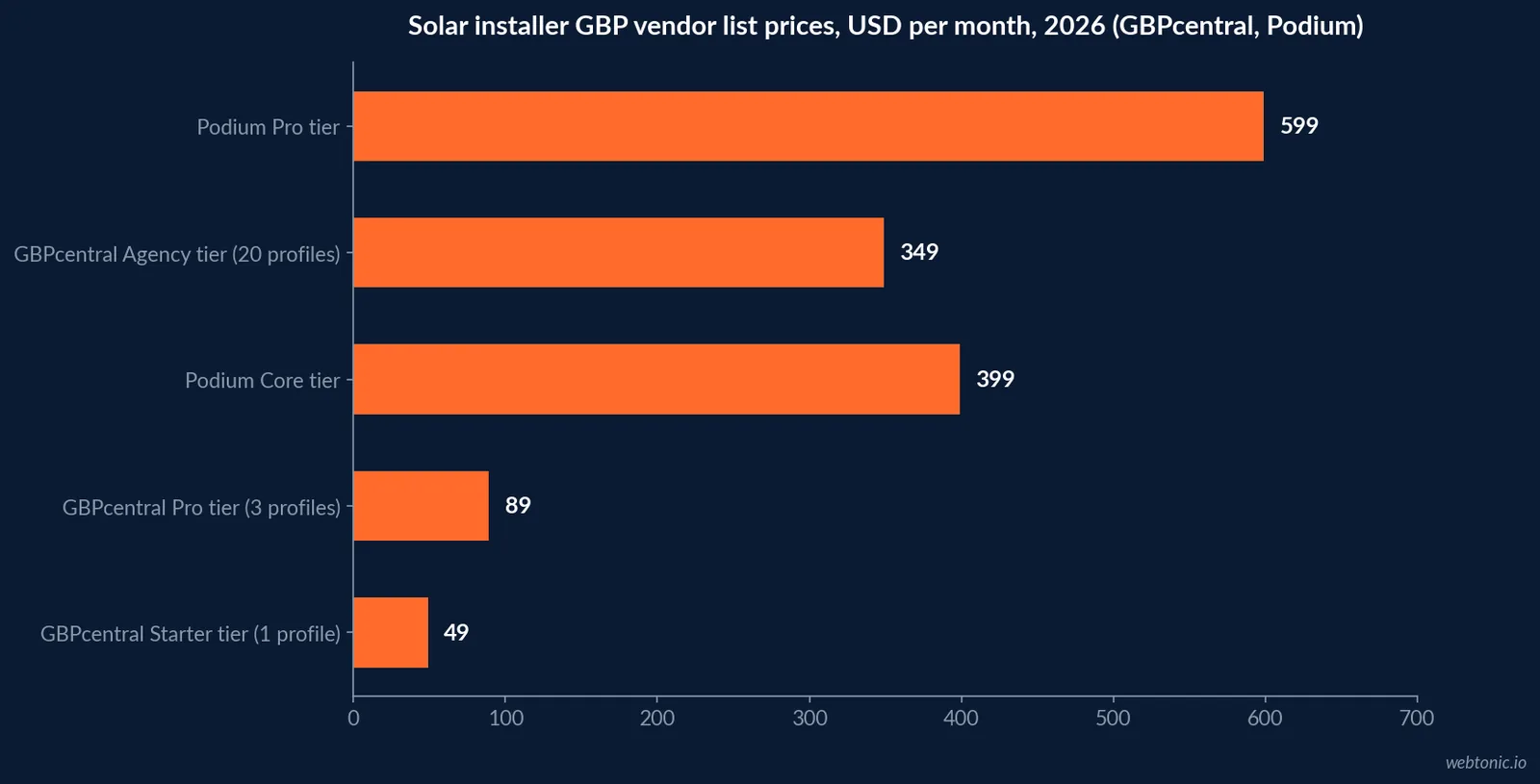
Once category and photo hygiene are handled, the remaining question is whether ongoing rank tracking, review requests and post scheduling justify a paid tool or an agency retainer. GBPcentral's published pricing lists a single-profile Starter tier at USD 49 a month, a three-profile Professional tier at USD 89, and a 20-profile Agency tier at USD 349. Podium's own published pricing runs USD 399 to USD 599 a month and bundle review requests with customer messaging - a broader, pricier product than pure GBP software. Neither vendor prices by industry vertical, so a single-location installer and a regional installer group with 15 branches land in very different tiers of the same price list.
No vendor publishes a standard agency-retainer rate for GBP management specifically - it is scoped by hours and location count, which is the honest reason "outsourced" resists a single headline price.
| Option | Published cost | Where it wins | Where it falls short |
|---|---|---|---|
| In-house, staff-managed | Staff time only (unbilled) | Single-location installers with light review flow | No rank tracking, inconsistent photo cadence |
| GBP software (GBPcentral tiers) | USD 49-349/month | Automating posting and rank tracking without an agency | No strategy or category audits included |
| Reputation platform (Podium tiers) | USD 399-599/month | Installers prioritizing review volume and messaging | Not built for deep local-pack ranking work |
| Agency retainer | No standard published rate; scoped by hours | Multi-branch installers competing for several map packs | Resists a simple monthly comparison |
The review bar that decides whether any of this pays off
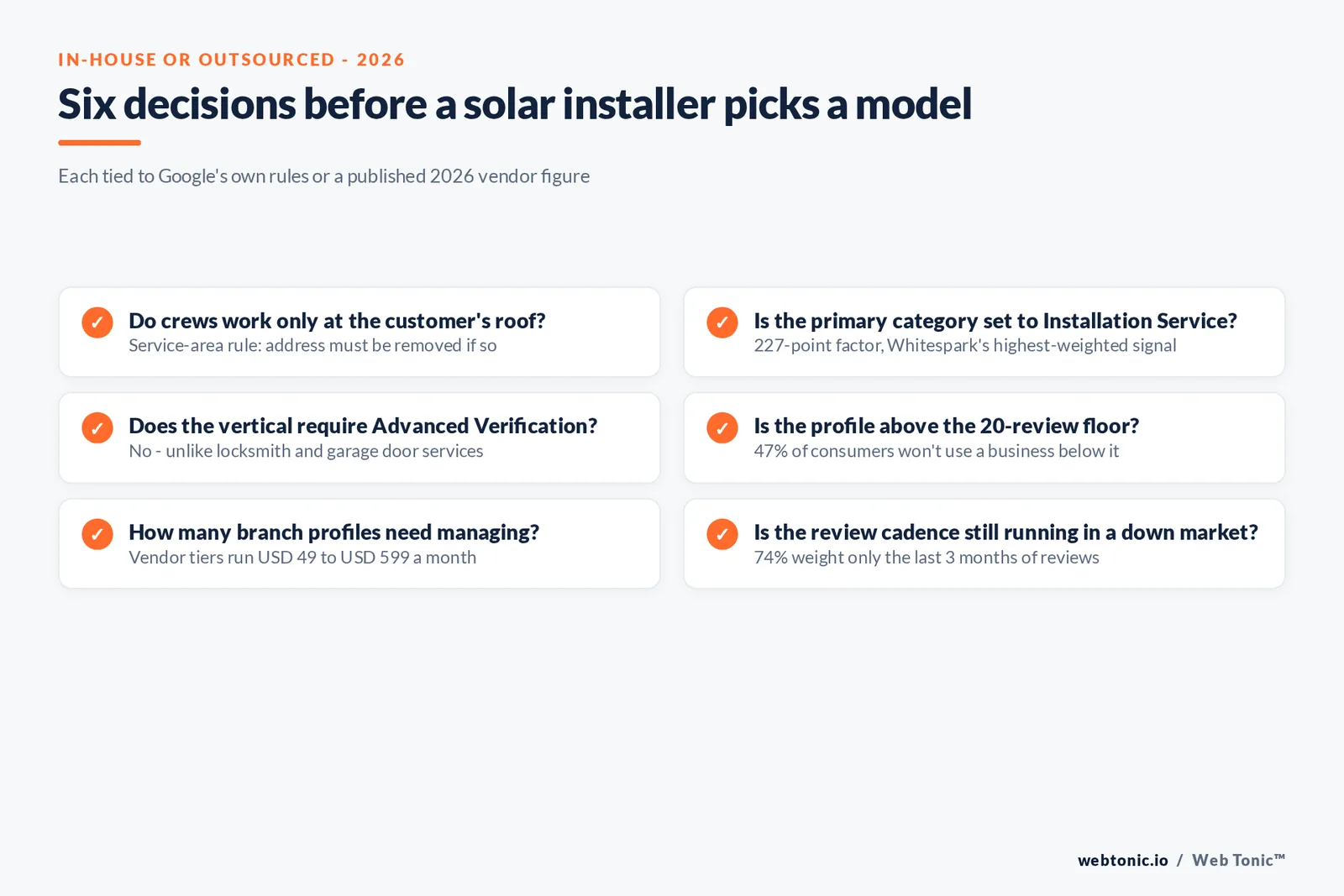
BrightLocal's 2026 Local Consumer Review Survey found 47% of consumers won't use a business with fewer than 20 reviews, 68% require at least 4 stars, and 31% now require 4.5 stars or higher - up from 17% a year earlier. Because 74% weight only reviews from the last three months, an installer that paused marketing during the 2026 downturn risks looking stale by the time residential demand recovers in 2027, regardless of its historical rating.
None of the category, photo or software decisions above matter if the review pipeline goes quiet - it is the one input that keeps degrading on a clock the installer does not control.
| Client expectation (BrightLocal 2026) | Share of consumers | Consequence for a paused program |
|---|---|---|
| Won't use a business with under 20 reviews | 47% | A stalled program eventually drops below the floor |
| Requires 4+ stars minimum | 68% | One cluster of bad reviews without replies compounds |
| Requires 4.5+ stars minimum | 31% | Even a 4.2-star profile becomes invisible to this group |
| Weights only the last three months | 74% | A quiet quarter erases the benefit of an older 5-star run |
Making the call without guessing
Do the zero-cost work first - category accuracy and address/service-area setup match Google's own rules - regardless of what happens next. Then size software or an agency to branch count and review volume, not to a generic industry rate, since neither GBPcentral nor Podium prices by vertical. If the installer wants category audits and review-request workflows executed rather than just documented, our growth marketing team builds that alongside broader local visibility work; see our related breakdown of cost per lead by industry for how GBP-driven calls compare against paid channels. Installers weighing the three options can also talk to us about scoping the work to branch count first.
Frequently Asked Questions
Can a solar installer even keep an address on its Google Business Profile?
Only if customers are actually served at that address. Google's service-area business rules require removing the address entirely if the business doesn't serve customers there - the common setup for an installer whose crews work at the customer's roof, not a public showroom. A solar company with a working showroom qualifies as a hybrid business and can keep both an address and a defined service area; a warehouse-only operation cannot show its address at all.
Does Google's Advanced Verification apply to solar installers the way it does to locksmiths?
No. Google's Advanced Verification policy currently names only garage door services and locksmith services (US and Canada) as verticals subject to the extra licence and video-interview check before running Local Services or Google Ads. Solar installation is not on that list as of this writing, which means ordinary profile verification - not the multi-week advanced process - is the applicable bar, though a heavily complained-about vertical could be added in a future policy update.
What single free change moves a solar installer's ranking the most?
Category selection. Whitespark's 2026 Local Search Ranking Factors survey of 47 practitioners scores Primary GBP Category at 227 points, the highest of any individual factor surveyed - ahead of proximity. For a solar company that means choosing 'Solar Energy Installation Service' as the primary category rather than a generic 'Contractor' or 'Energy Supplier,' and adding accurate secondary categories like 'Solar Energy Equipment Supplier' or 'Electrical Installation Service' where genuinely applicable.
Is it cheaper to manage the profile in-house or pay for software or an agency?
In-house costs only staff time, which is real but unbilled, so it looks free on a budget line even when it is not. Published software list prices start at USD 49 a month for a single profile (GBPcentral) and run to USD 349 for a 20-profile agency tier; reputation-and-messaging platforms like Podium run USD 399 to USD 599. There is no standard published agency retainer rate for GBP management alone - it is typically scoped by hours, so 'outsourced' is not automatically the pricier option once staff time is counted honestly.
How many reviews does a solar installer need before the profile stops costing it business?
BrightLocal's 2026 Local Consumer Review Survey found 47% of consumers won't use a business with fewer than 20 reviews, 68% require at least 4 stars, and 31% now require 4.5 stars or higher - up from 17% a year earlier. Because 74% of consumers weight only the last three months of reviews, an installer that scaled back marketing during the 2026 residential downturn also needs to keep the review-request cadence running, or its rating looks stale by the time demand recovers.
Sources
Google Business Profile Help - Manage your service areas
Google Ads Policy Help - Advanced Verification policies
Google Business Profile Help - Verify Business Profiles in bulk
Whitespark - 2026 Local Search Ranking Factors report
BrightLocal - 2026 Local Consumer Review Survey
GBPcentral - GBP management software pricing
Podium - Podium's own published Core/Pro pricing
SEIA - Solar Market Insight Report, Q2 2026