Table of contents
A solar cold email program should budget against a 3.43% average reply rate - Instantly's 2026 platform-wide figure - and against a commercial list, not a homeowner one. Residential solar sells to consumers who cannot legally be cold-emailed the way CAN-SPAM was written to allow, so the honest budget question is what a B2B sequence into EPCs, developers and facility managers actually costs to run compliantly.
Key Takeaways
- 3.43% is the average cold email reply rate across Instantly's 2026 benchmark.
- Top-quartile senders reach 5.5%, elite senders exceed 10.7%.
- Woodpecker's median reply rate is 1.5% across 56,614 tracked campaigns.
- Belkins' narrower 2026 dataset of 7,530,489 emails reports 0.45%.
- A cold call before the email lifts reply rate to 3.44%, nearly double email alone.
- Email alone replies at 1.81% in Gong's 28 million-plus email dataset.
- Corporate procurement is over 18% of total U.S. solar capacity, per SEIA.
- 20% of all 2023 U.S. solar installations had a corporate offtaker.
- Google requires under 0.3% spam complaints for bulk senders, ideally under 0.1%.
- 5,000+ messages/day to Gmail triggers mandatory SPF, DKIM and DMARC since Feb 2024.
- Yahoo requires the same DMARC floor, p=none at minimum, for bulk senders.
- CAN-SPAM (16 CFR 316) sets the federal floor for every commercial email to a US address.
- One-click List-Unsubscribe is mandatory under the 2024 bulk-sender rules.
- The FTC settled a solar telemarketing case in 2017 over Do-Not-Call violations.
- A 2023 FTC order against Solar Xchange LLC cited Telemarketing Sales Rule violations.
- LinkedIn InMail acceptance typically runs 10-25%, a different metric than email reply.
- A complete LinkedIn profile lifts InMail acceptance by 87%.
The list problem comes before the reply-rate problem
Solar sells overwhelmingly to homeowners, and a homeowner list is not one a solar seller should cold-email as an acquisition tactic - not because CAN-SPAM bans it outright, but because the channel was built for, and is regulated around, business-to-business outreach. The FTC has already litigated the residential-solar cold-outreach problem on the phone side: a 2017 settlement found a solar lead-generation operation had called numbers on the Do-Not-Call Registry, continued calling consumers who had opted out, and spoofed caller ID, all Telemarketing Sales Rule violations under 16 CFR Part 310. A 2023 stipulated order against Solar Xchange LLC cited the same rule for residential solar telemarketing.
Email is a different statute (CAN-SPAM, not the TSR), but the pattern - a residential solar list contacted by an unsolicited channel - is the exact fact pattern regulators have already gone after on the phone. A B2B list is the honest, defensible starting point.
| Audience | Can it be cold-emailed? | Governing rule | What still applies |
|---|---|---|---|
| Homeowners (residential solar buyers) | Legally allowed under CAN-SPAM, operationally risky | 16 CFR 316 (CAN-SPAM) | Reputation and complaint-rate exposure; TSR/DNC applies to any phone follow-up |
| EPC firms and subcontractor networks | Yes - standard B2B outreach | 16 CFR 316 | Volume caps and authentication rules below |
| Facility managers, commercial property owners | Yes - standard B2B outreach | 16 CFR 316 | Same as above |
| Project developers and corporate offtakers | Yes - standard B2B outreach | 16 CFR 316 | Same as above |
| Consumers who opted out or are on the DNC Registry | No for any telephone/SMS follow-up | 16 CFR 310 (TSR) | FTC has enforced this twice against solar telemarketers |
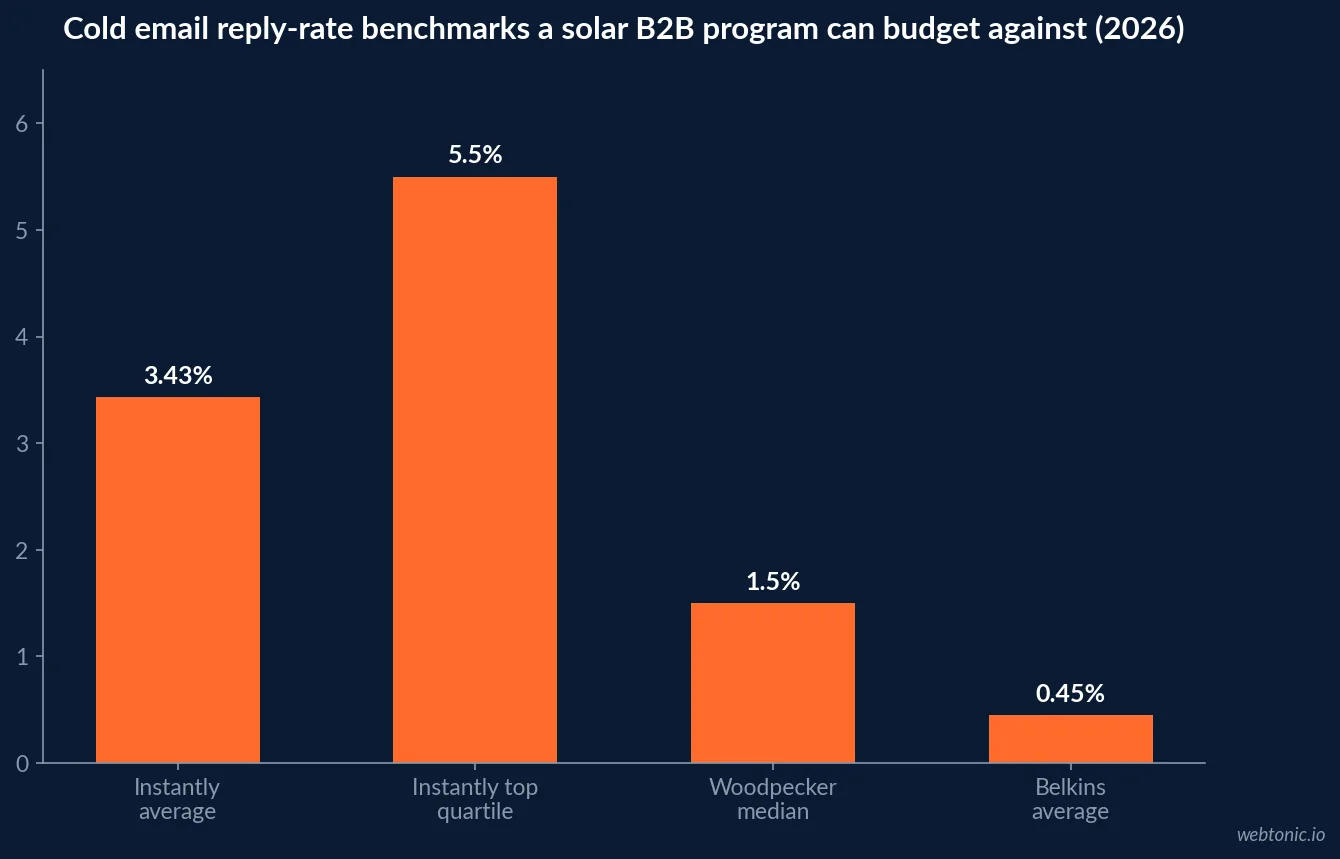
The reply-rate numbers a solar B2B sequence should plan against
Instantly's Cold Email Benchmark Report 2026 puts the platform-wide average reply rate at 3.43%, the top quartile at 5.5%, and elite senders (top decile) above 10.7%. Woodpecker's own benchmark tool, drawn from 56,614 tracked campaigns, reports a lower median of 1.5% alongside a 26% median open rate across 37,000 campaigns. Belkins' 2026 study of 7,530,489 of its own client emails reports a stricter 0.45% average, calculated as unique replies over total sends.
None of the three is wrong; they measure different sender populations and different denominators. A solar B2B program cold-emailing a tight, EPC-and-developer list should expect a number closer to Belkins' or Woodpecker's figure than to Instantly's platform-wide average, because the list is smaller and more scrutinized than a mass-market SaaS sequence.
| Vendor dataset | Reported figure | Sample | What it measures |
|---|---|---|---|
| Instantly 2026 | 3.43% average / 5.5% top quartile / 10.7%+ elite | Platform-wide sends through Dec 2025 | Reply rate |
| Woodpecker | 1.5% median / 26% open rate | 56,614 campaigns / 37,000 campaigns | Reply and open rate |
| Belkins 2026 | 0.45% average | 7,530,489 client emails | Unique replies / total sends |
| Gong (email alone) | 1.81% | 28M+ email dataset | Reply rate, no call paired |
| Gong (email + call) | 3.44% | Same dataset | Reply rate, call paired with email |
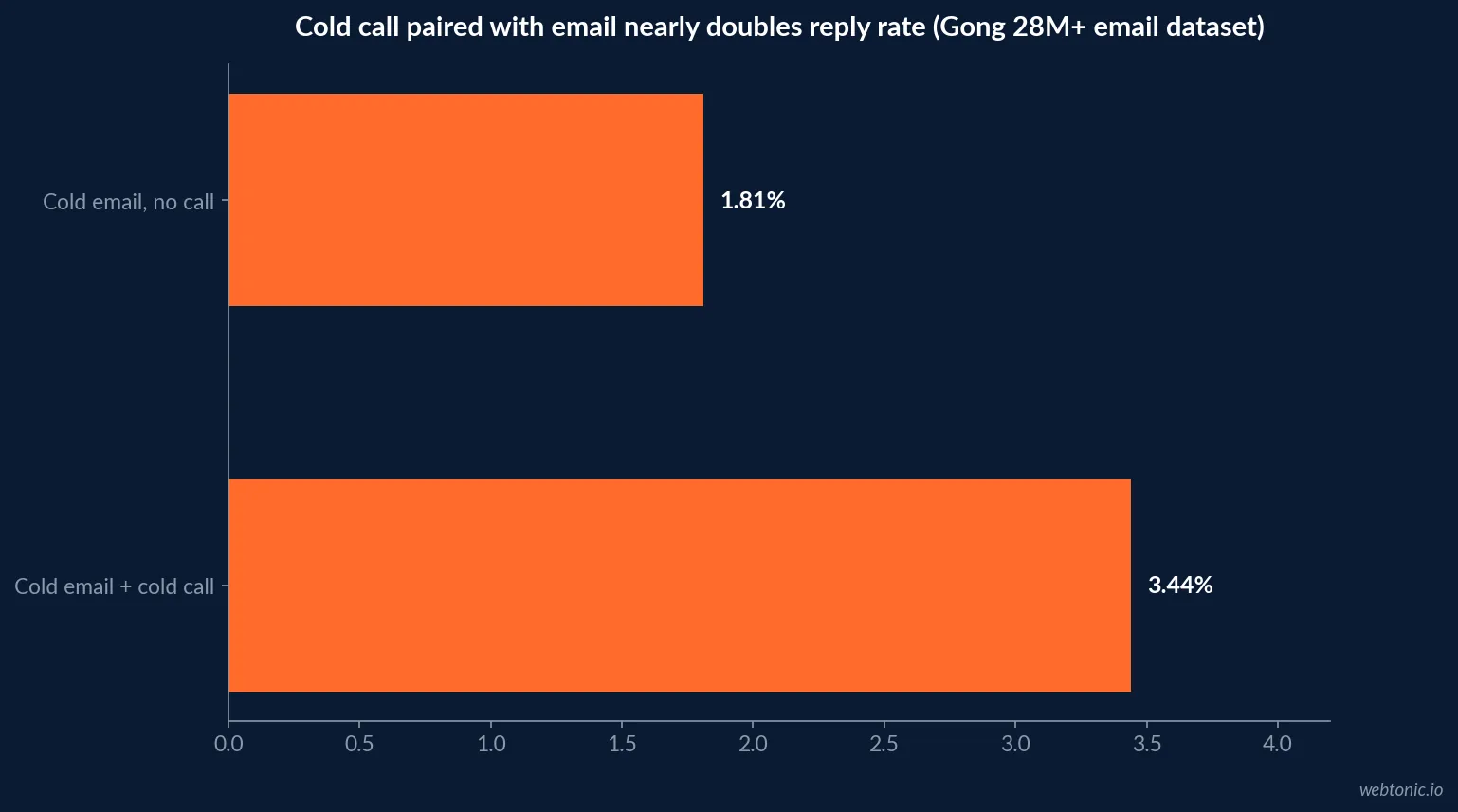
Why the call still matters for a high-ticket sale like commercial solar
Gong's own analysis of 28 million-plus cold emails found a cold email sent with no call replied at 1.81%, while the same rep's email backed by a cold call replied at 3.44%. Commercial solar is a long-cycle, high-consideration purchase decided by a facilities or procurement committee, which is exactly the kind of sale where a human voice ahead of the inbox message earns a materially higher reply rate than either channel alone.
LinkedIn's own data on InMail sending puts acceptance in the 10-25% range, with a complete profile lifting acceptance by 87% - a useful third touch in the same sequence, though it measures message acceptance rather than a completed reply and is not a substitute for either the call or the email.
Sizing the commercial list against SEIA's own numbers
The commercial solar list is smaller than it looks. SEIA's Solar Means Business 2024 report states that corporate procurement represents over 18% of total U.S. solar capacity, that 20% of all 2023 installations carried a corporate offtaker, and that the top 10 corporate solar buyers alone account for 16.8 GW of installed capacity - roughly the cumulative solar capacity of the state of Florida. A handful of large accounts already dominate the buyer side of that market, which argues for a short, well-authenticated list over a large blasted one.
| Solar corporate procurement fact (SEIA 2024) | Figure | What it implies for outbound |
|---|---|---|
| Corporate share of total U.S. solar capacity | Over 18% | The B2B list is real, not a rounding error |
| 2023 installations with a corporate offtaker | 20% | One in five deployments already has a named buyer |
| Top 10 corporate buyers, cumulative capacity | 16.8 GW | A small number of accounts hold outsized share |
| Meta's cumulative solar capacity (Q1 2024) | 5.1 GW+ | The largest single account is enormous relative to the list |
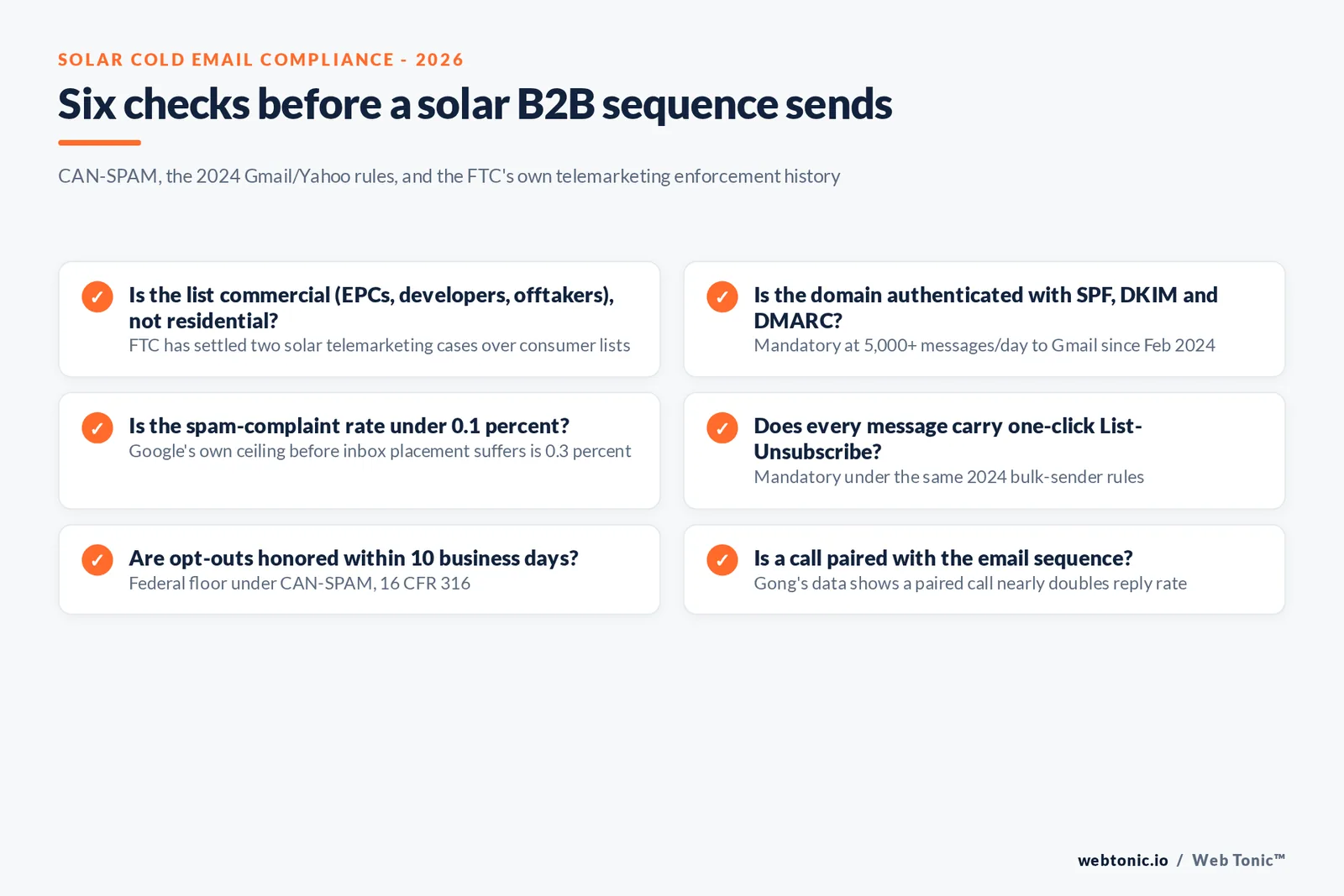
What Google and Yahoo require before that list can send at volume
Under the Gmail bulk-sender guidelines effective February 2024, any sender pushing 5,000 or more messages a day to Gmail addresses must authenticate with SPF, DKIM and a DMARC policy, support one-click unsubscribe, and keep the spam-complaint rate under 0.3% - Google's own guidance recommends staying under 0.1% to avoid inbox-placement problems before ever reaching that ceiling. Yahoo's Sender Hub requires the same authentication floor - SPF, DKIM and DMARC at minimum p=none with From: domain alignment.
A solar B2B list is small enough that most programs will never approach the 5,000-message-a-day threshold on a single domain - which is itself a reason to keep the list tight rather than padding it with marginal contacts to hit a volume target that was never the goal.
| Requirement (2024 rules) | Google threshold | Yahoo threshold | Consequence of missing it |
|---|---|---|---|
| SPF + DKIM + DMARC | Mandatory at 5,000+/day | Mandatory for bulk senders | Authentication failure, spam folder |
| Spam-complaint rate | Under 0.3%, target 0.1% | Same intent, no separate number published | Domain reputation damage |
| One-click unsubscribe | Mandatory at 5,000+/day | Mandatory for bulk senders | Non-compliant headers rejected |
| CAN-SPAM opt-out honor window | 10 business days (federal law) | 10 business days (federal law) | FTC enforcement exposure |
| From: domain alignment | Required for DMARC pass | Required for DMARC pass | Authentication failure |
The federal floor underneath both providers' rules
The FTC's Telemarketing Sales Rule guidance and 16 CFR Part 316, the CAN-SPAM Rule, apply to every commercial email sent to a US recipient at any volume - honoring opt-outs within 10 business days, including a working postal address, and never using a deceptive subject line. The two enforcement actions above show what happens when a solar seller treats the residential list as fair game for unsolicited outreach on a different channel (the phone); the same commission oversees both statutes, and the same list-hygiene discipline that keeps a phone program legal keeps an email program out of the spam folder.
Budgeting the program, not just the list
A defensible solar B2B cold email budget starts with domain warm-up and authentication before the first send, caps volume per inbox well under the 5,000-message provider ceiling on any single domain, and pairs the sequence with a call per Gong's finding that doing so nearly doubles reply rate. None of that requires a bigger list; a commercial solar list is inherently short, and a short, clean, authenticated list beats a large blasted one on every metric that matters - deliverability, complaint rate and, ultimately, reply rate.
See our growth marketing practice for how outbound typically sequences against a paid channel in a B2B pipeline, and our performance creative practice for how subject-line testing borrows from paid-ad copy testing discipline. Read more about the channel's baseline economics in our cold email outbound statistics hub. If a program needs to be audited against the 2024 sender rules above, talk to us.
Frequently Asked Questions
Can a solar installer cold email homeowners to generate leads?
Not under CAN-SPAM's intent, and not safely in practice. The FTC's 16 CFR Part 316 lets a business send commercial email to any address, but a residential solar seller cold-emailing a homeowner list still carries a deliverability and reputation cost the channel was never built for, and any SMS or robocall follow-up to that same list triggers the Telemarketing Sales Rule and Do-Not-Call Registry independently of the email. The FTC has already litigated this exact sequence: it settled with a solar telemarketing operation in 2017 for placing robocalls to numbers on the Do-Not-Call Registry, and in 2023 obtained a stipulated order against Solar Xchange LLC for TSR violations tied to residential solar sales.
What reply rate should a solar cold email program budget against?
Instantly's Cold Email Benchmark Report 2026, built from its platform-wide sending data through December 2025, puts the average reply rate at 3.43%, the top quartile at 5.5%, and elite senders (top 10%) above 10.7%. Woodpecker's own benchmark tool, drawn from 56,614 campaigns, puts the median lower, at 1.5%, with a 26% median open rate across 37,000 campaigns. Belkins' narrower 2026 study of 7,530,489 of its own client emails reports 0.45% on a strict unique-replies-over-sends basis - budget against the vendor dataset whose sender profile and measurement method looks like the program you are actually running.
Who is the legitimate commercial recipient list for a solar B2B sequence?
EPC firms and installers sourcing subcontractor or supplier relationships, commercial property owners and facility managers evaluating on-site solar, project developers assembling a portfolio, and the corporate offtakers SEIA tracks in its Solar Means Business report - over 18% of total U.S. solar capacity and 20% of 2023 installations carried a corporate offtaker. That list is B2B by definition and is exactly the audience CAN-SPAM assumes rather than the consumer audience it was written to protect.
What do Google and Yahoo require before a solar sequence can send at volume?
Since February 2024, any sender pushing 5,000 or more messages a day to Gmail addresses must authenticate with SPF, DKIM and a DMARC policy of at least p=none, support one-click unsubscribe, and keep the reported spam-complaint rate under 0.3% - Google's own guidance recommends staying under 0.1%. Yahoo's Sender Hub requires the same authentication floor for bulk senders. Below 5,000 messages a day the legal bar is lower but the deliverability bar is not: an unauthenticated domain lands in spam at both providers regardless of volume tier.
Does pairing a call with the email change the numbers?
Yes, and by a large margin. Gong's own analysis of 28 million-plus cold emails found a cold email sent alone replied at 1.81%, while the same rep's email backed by a cold call replied at 3.44% - nearly double. For a channel that sells a high-consideration, high-ticket purchase like commercial solar, that gap is the difference between a sequence that gets ignored and one that gets a callback.
Sources
Instantly - Cold Email Benchmark Report 2026
Woodpecker - Free cold email benchmarks tool
Belkins - B2B cold email response rates, 2026 study
Gong - Does cold email even work any more? (28M+ email dataset)
Gong - The hidden power of cold calling (300M+ call dataset)
LinkedIn - Data on sending InMails and acceptance rates
Google - Email sender guidelines (Gmail bulk-sender rules)
Yahoo - Sender Hub best practices
FTC - Complying with the Telemarketing Sales Rule
eCFR - 16 CFR Part 316, CAN-SPAM Rule
FTC - Solar panel lead-generation robocallers settle FTC charges (2017)
FTC - Stipulated order, Solar Xchange LLC (2023)
SEIA - Solar Means Business 2024 report