Table of contents

Solar rarely runs a classic content-affiliate program. Financiers and installers buy leads from marketplaces, gate co-op dollars behind manufacturer dealer tiers, and only sometimes bolt on a percentage-of-sale affiliate link for equipment retailers. This page prices all three against a single question every finance lead asks first: who should run it?
Key Takeaways
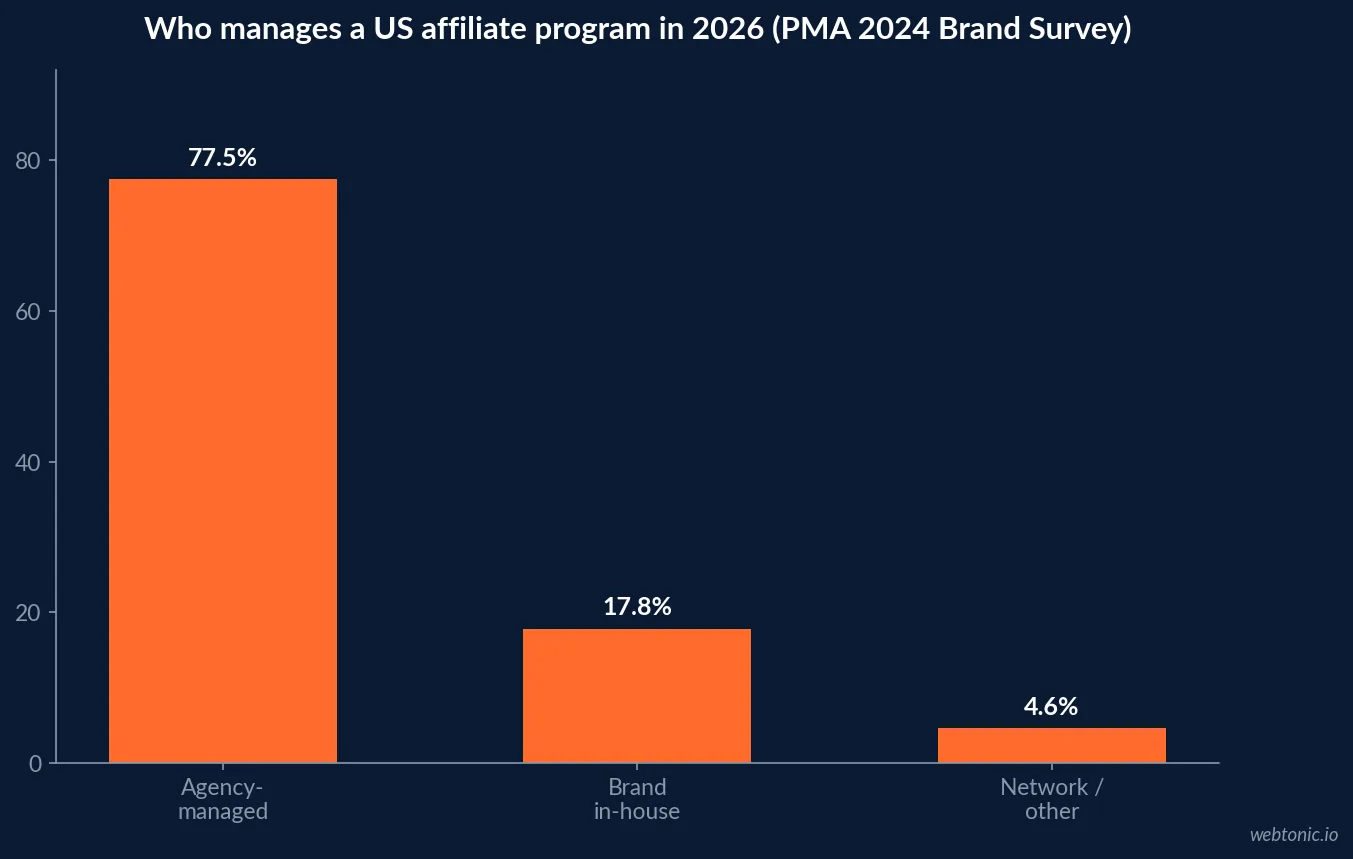
- 77.5% of U.S. affiliate programs are agency-managed, not brand-run (PMA 2024).
- 17.8% are managed directly in-house and 4.6% by a network or other party.
- U.S. affiliate spend hit USD 13.63 billion in 2024, up 49.8% from 2021.
- That spend drove an estimated USD 113 billion in U.S. e-commerce sales.
- A1 SolarStore pays 6% per sale, capped at USD 250 an order, 90-day cookie.
- Renogy averages 6% with no published cap on its own affiliate page.
- SanTan Solar pays a flat 5% on panels and accessories.
- SOLR US tiers commissions from 2% to 8% by monthly sales volume.
- Arka Energy advertises up to 10%, or a flat USD 500 per inspired sale.
- Generac's PWRpartner tiers gate perks behind 5, 60 or 120 annual activations.
- Outsourced management typically runs a 10% to 20% override on program revenue.
- The cross-industry median cookie window is 60 days in 2026 (Awin/CJ/Rakuten).
- 28% of affiliate programs use a 30-day-or-shorter window.
- The 2026 PMA Brand Survey drew about 150 respondents, smaller than 2024's 300+.
- 80.3% of surveyed brands run their program on a single network in 2026.
- The FTC's 16 CFR 255 requires disclosure next to the compensated recommendation.
- A dedicated in-house affiliate hire runs USD 70,000 to 104,000 loaded a year by market comparison, against a variable agency override.
Why solar's "affiliate channel" is really three channels
Ask a solar financier what their affiliate program looks like and you get three different answers depending on who is selling what. Equipment retailers such as A1 SolarStore and Renogy run a conventional percentage-of-sale affiliate link. Manufacturers such as Generac run tiered dealer programs with no cash commission at all, gating co-op dollars and lead flow behind training and volume thresholds instead. And installers buy leads outright from marketplaces. Treating all three as one "affiliate program" is how budgets get misallocated.
The wider affiliate channel grew to USD 13.63 billion in U.S. spend in 2024, a 49.8% jump from 2021 and a 14.42% compound annual growth rate - almost double the pace of e-commerce overall - according to the Performance Marketing Association's 2025 Industry Study. Solar sits inside that spend as a specialty vertical, not a line item the study breaks out on its own.
In-house vs agency: what the industry actually reports
No dedicated solar version of this question has been surveyed, so the honest benchmark is the cross-industry one. The Performance Marketing Association's 2024 U.S. Brand Survey (just over 300 respondents) found 77.5% of brand affiliate programs managed by an agency, 17.8% run by the brand's own team, and 4.6% handled by a network or other party. The follow-up 2026 Brand Survey (about 150 respondents) reports 80.3% of programs now run on a single network or platform, a separate but related consolidation signal.
Solar financiers with a small dealer network and a handful of retail affiliates can often track that manually. A program spanning installer partnerships, dealer co-op tiers and equipment affiliates across states is the shape of program the survey's agency-managed majority is built for.
| Management model | Share of programs (PMA 2024) | What it costs | Best fit for solar |
|---|---|---|---|
| Agency-managed | 77.5% | Retainer + 10-20% performance override (Track360) | Multi-state dealer + affiliate mix |
| Brand-managed in-house | 17.8% | USD 70,000-104,000 loaded salary (market comparison) | Single-region installer, few partners |
| Network/other-managed | 4.6% | Network take-rate on transacted volume | Programs already inside Awin/CJ/Rakuten |
What equipment-affiliate programs actually pay
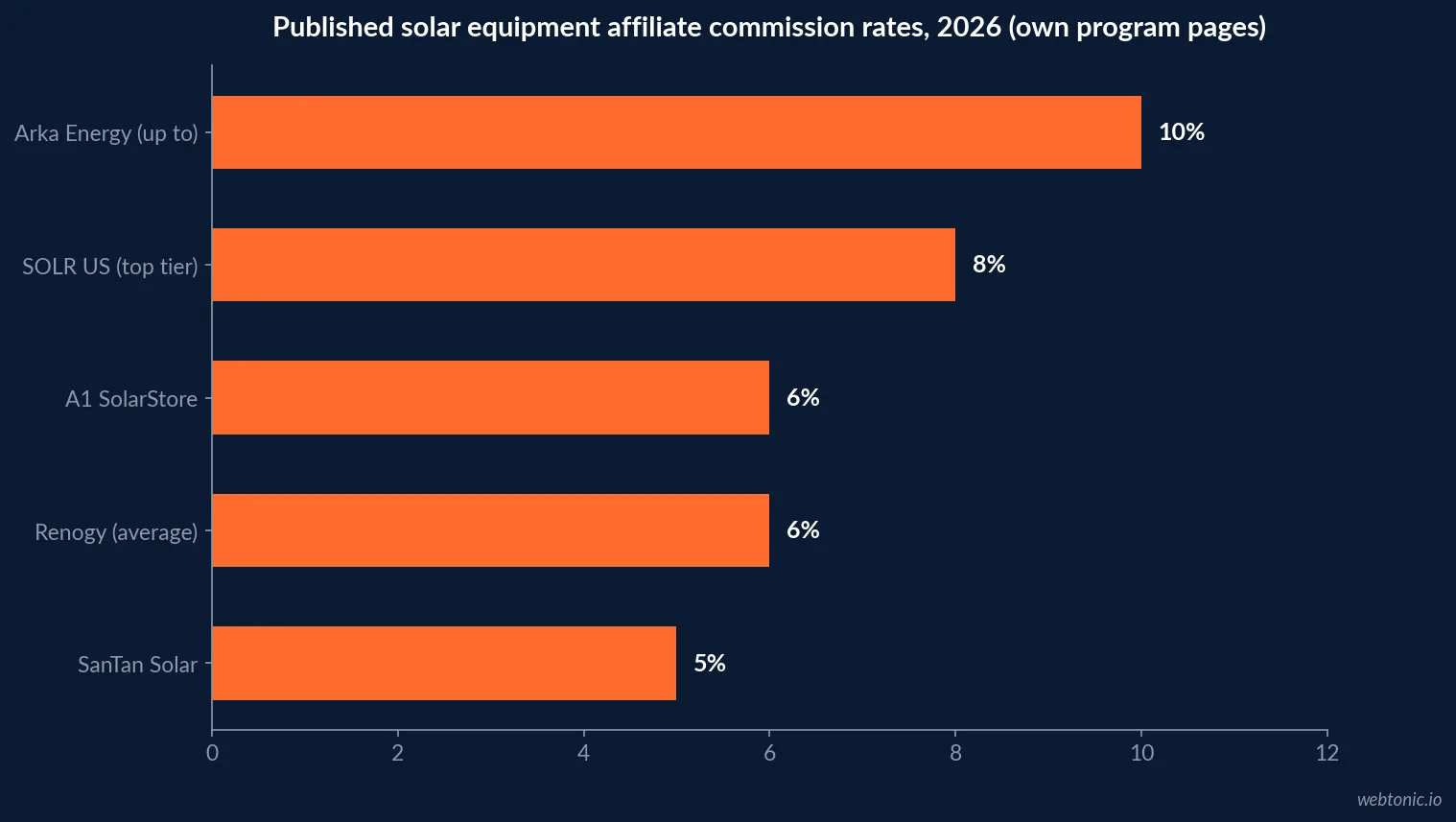
Every rate below is published on the program's own page, not a third-party estimate. A1 SolarStore pays 6% per qualified sale, capped at USD 250 an order, on a 90-day cookie. Renogy advertises an average 6% commission with "no maximum limit." SanTan Solar pays a flat 5% on panels and accessories. SOLR US tiers from 2% at low volume to 8% at eight-plus monthly sales, and Arka Energy advertises up to 10% per sale or a flat USD 500 per inspired deal.
| Program (own page, 2026) | Published rate | Cap / structure | Cookie window |
|---|---|---|---|
| A1 SolarStore | 6% per sale | Capped at USD 250 per order | 90 days |
| Renogy | Average 6% | No published cap | Not disclosed |
| SanTan Solar | 5% flat | Panels and accessories only | Not disclosed |
| SOLR US | 2% to 8% | Tiered by monthly sales volume | Not disclosed |
| Arka Energy | Up to 10% | Or flat USD 500 per sale | Not disclosed |
Dealer tiers pay in access, not commission
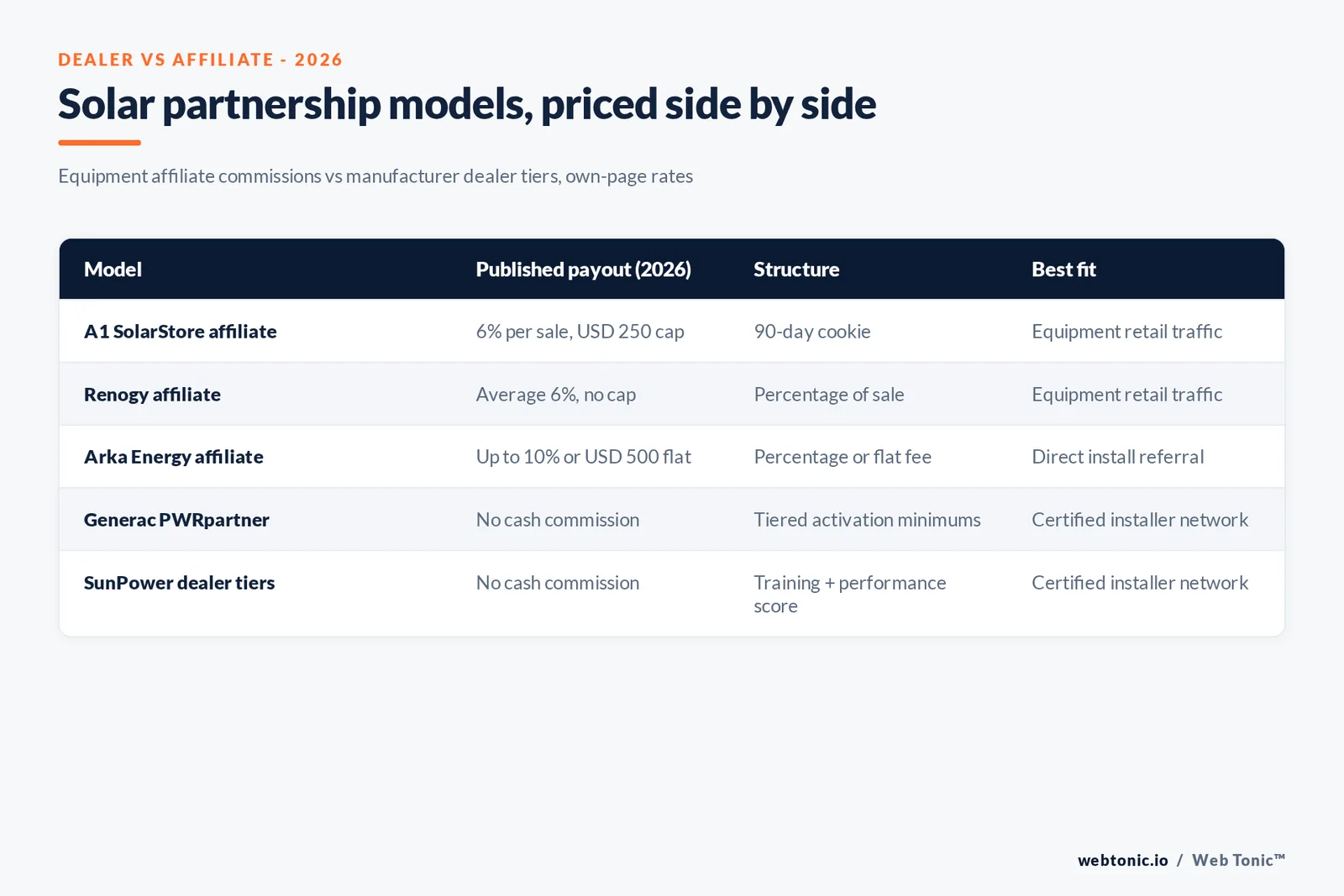
Manufacturer dealer programs are a different economic model entirely. Generac's PWRpartner loyalty program sets minimum annual PWRmicro activations of 5 for Silver, 60 for Gold and 120 for Platinum, gating certification-linked perks rather than paying a cash percentage. Industry endorsement documentation distributed to solar installers lists SunPower's own three-tier structure - Master, Elite and Authorized Dealer - built the same way, on training and performance thresholds rather than a per-sale payout.
Treat these as partnership infrastructure, not affiliate spend: the "commission" is qualification for co-op marketing dollars and priority lead routing, which only shows up on the P&L as reduced customer acquisition cost, not as a line-item payout.
| Dealer tier program | Gating mechanism | What the tier unlocks | Cash commission? |
|---|---|---|---|
| Generac PWRpartner Silver | 5+ annual PWRmicro activations | Base loyalty perks | No |
| Generac PWRpartner Gold | 60+ annual activations | Higher-tier rewards | No |
| Generac PWRpartner Platinum | 120+ annual activations | Top-tier rewards, co-op access | No |
| SunPower Authorized Dealer | Training + satisfaction scores | Brand use, base lead flow | No |
| SunPower Master/Elite Dealer | Higher performance thresholds | Priority leads, marketing funds | No |
Disclosure is not optional on either model
Whether the payout is a 6% affiliate commission or dealer-tier co-op access, the FTC's 16 CFR Part 255 Endorsement Guides apply whenever the recommendation carries any material connection. The rule text on eCFR requires the disclosure to sit next to the claim, in the same format the audience actually sees - not in a linked policy page. For dealer-referral content and review sites recommending a specific installer or panel brand, that means disclosing the relationship in the same post, not just in a site-wide footer.
What outsourced management actually costs
Affiliate-management guidance widely used across the tracking-platform industry frames outsourced management as a monthly retainer plus a 10% to 20% performance override on program-generated revenue, against a fixed in-house cost of salary, benefits and tracking software. At low volume the variable cost is usually cheaper; at scale, the override on revenue can pass the cost of a dedicated hire, which is the same crossover point the wider PMA agency-share data implies.
Our growth marketing practice models that crossover against a dealer network's own lead volume before recommending either model - the math changes with every certified-installer count added to the roster.
Sizing the spend this channel sits inside
Solar-specific affiliate spend is not broken out on its own in any published study, but the channel it belongs to is sized every year. The Performance Marketing Association's 2025 Industry Study puts total U.S. affiliate spend at USD 13.63 billion for 2024, driving an estimated USD 113 billion in e-commerce sales - 9.4% of all U.S. e-commerce and an estimated 15% to 20% of sales for companies that actively run the channel. A solar dealer or affiliate program is a small, high-ticket slice of that spend rather than a separately tracked category, which is exactly why no solar-specific in-house-vs-agency survey exists yet.
| Affiliate channel sizing metric (PMA 2025) | Figure | What it implies for solar |
|---|---|---|
| Total US affiliate spend, 2024 | USD 13.63 billion | Growing base a solar program competes inside |
| Growth since 2021 | 49.8% | Nearly double the pace of e-commerce overall |
| Compound annual growth rate | 14.42% | Category still expanding, not maturing |
| Sales driven through the channel | USD 113 billion | Scale that justifies dedicated management either way |
| Share of sales at companies using it | 15-20% | Material enough to warrant the PMA's management-cost data above |
| Cost structure | Who typically uses it | Cost basis | Where it wins |
|---|---|---|---|
| In-house hire | 17.8% of programs (PMA 2024) | USD 70,000-104,000 loaded/year | Predictable, low volume |
| Agency retainer + override | 77.5% of programs (PMA 2024) | Retainer + 10-20% of revenue | Multi-partner, multi-state |
| Network-managed | 4.6% of programs (PMA 2024) | Network take-rate | Already inside Awin/CJ/Rakuten |
Attribution: cookie windows in the field vs the industry median
Published solar cookie windows sit either side of the wider benchmark. A1 SolarStore states a 90-day window; the aggregated 2026 benchmark from Awin, CJ Affiliate and Rakuten data, compiled by TrackRev, puts the cross-industry median at 60 days, with 28% of programs at 30 days or shorter. A solar sale rarely closes inside a 30-day window given the quote-comparison cycle installers describe, which is the practical case for the longer end of that range.
| Attribution window | Share of programs (2026 cross-industry) | Solar-specific example |
|---|---|---|
| 30 days or shorter | 28% | Standard default on most equipment affiliate terms |
| 60 days (industry median) | Largest single band | Not explicitly stated by surveyed solar programs |
| 90 days | Smaller share, longer-cycle categories | A1 SolarStore |
Fraud and invalid-lead risk in a lead-heavy category
Solar's lead-marketplace overlap makes it exposed to the same invalid-traffic problem affecting any high cost-per-lead category. Affiliate-tracking vendor Scaleo's 2026 fraud report, built from its own tracked data across 500-plus programs, flags form-fill fraud and fake lead submissions as the dominant pattern in lead-generation-heavy verticals - the same failure mode a solar affiliate or dealer-referral form is exposed to whenever a payout is tied to a submitted lead rather than a verified, funded installation.
Structuring payout around a funded contract rather than a form submission removes most of that exposure, at the cost of a longer payment cycle for the affiliate or dealer.
Building the program without overpaying either model
Price the in-house-vs-agency decision against actual partner count, not program ambition. A single-market installer with a handful of dealer relationships and one equipment-affiliate link rarely needs the 77.5% majority's agency model; a financier running certified-dealer tiers across multiple states, plus consumer-facing equipment affiliates, is exactly the shape the PMA's agency-managed majority describes. Pair whichever model you choose with disclosure language that matches 16 CFR 255, and tie payout to a funded install wherever the channel allows it.
If you want the acquisition math modeled against your own dealer and affiliate mix before you commit a retainer, talk to us, or read how our performance creative team builds the disclosure-compliant assets partners actually use.
Frequently Asked Questions
Is a solar affiliate or partnership program usually run in-house or through an agency?
Across U.S. affiliate programs generally, the Performance Marketing Association's 2024 Brand Survey found 77.5% managed by an agency, 17.8% managed directly by the brand, and 4.6% managed by a network or other party. Solar has no dedicated version of that survey, so the honest reading is that solar financiers and installers follow the wider industry pattern: agency-run unless the program is small enough for one internal hire to track manually.
What commission rates do solar affiliate and dealer programs actually publish?
Published, vendor-own rates run from 5% to 10% of sale value for equipment affiliates - SanTan Solar pays 5%, A1 SolarStore pays 6% up to USD 250 per order with a 90-day cookie, Renogy averages 6% with no cap, SOLR US tiers from 2% to 8% by monthly sales volume, and Arka Energy advertises up to 10% or a flat USD 500 per inspired sale. Manufacturer dealer programs such as Generac's PWRpartner do not pay a commission at all - they gate co-op marketing funds and lead flow behind activation minimums instead.
How much does agency-managed affiliate management cost versus hiring in-house?
Affiliate-management guidance from tracking platform Track360 puts outsourced program management at a monthly retainer plus a 10% to 20% performance override on the revenue the program generates, versus a dedicated in-house hire's fixed salary, benefits and tooling cost. Neither is free: the tradeoff is variable cost that scales with revenue against fixed cost that scales with headcount.
What must a solar affiliate or dealer disclose under FTC rules?
The FTC's 16 CFR Part 255 Endorsement Guides require anyone paid or otherwise compensated for referring a sale - including a solar equipment affiliate or a lead-generation partner - to clearly and conspicuously disclose that material connection near the recommendation itself, not buried in a footer or an about page.
How long is the typical cookie or attribution window for a solar affiliate link?
Solar-specific vendor pages range from 30 to 90 days: A1 SolarStore states 90 days, most equipment affiliate terms default to 30. That sits inside the broader industry median: aggregated 2026 data from Awin, CJ Affiliate and Rakuten (via TrackRev) puts the cross-industry median cookie window at 60 days, with 28% of programs at 30 days or shorter.
Sources
Performance Marketing Association - 2024 U.S. Brand Survey
Performance Marketing Association - 2026 U.S. Brand Survey results
Performance Marketing Association - 2025 Industry Study
A1 SolarStore - Affiliate program
Renogy - Affiliate program
SanTan Solar - Affiliate program FAQ
SOLR US - Become an affiliate
Arka Energy - Referral program
Generac - PWRpartner dealer loyalty program
Federal Trade Commission - 16 CFR Part 255 Endorsement Guides
TrackRev - Affiliate program benchmarks 2026
Scaleo - State of Affiliate Fraud 2026