Table of contents
Only 250 companies have ever signed a corporate clean-energy deal in the U.S. since 2014, per CEBA's own tracker - and that number of new entrants fell 40% in the most recent year. A solar ABM program is not choosing a targeting philosophy; it is working a short, shrinking, named list, and the budget benchmarks below are cross-industry figures applied honestly to that reality.
Key Takeaways
- 250 cumulative unique corporate buyers have signed a U.S. clean-energy deal since 2014.
- First-time buyer announcements fell 40% from 2024, the lowest since 2016.
- Corporate procurement is over 18% of total U.S. solar capacity, per SEIA.
- 20% of all 2023 U.S. solar installations had a corporate offtaker.
- The top 10 corporate solar buyers hold 16.8 GW of cumulative capacity.
- Four tech companies each exceed 1 GW of cumulative solar capacity alone.
- CEBA members represent 88% of all announced U.S. clean-energy commitments.
- 40% of 2024 marketing budgets went to ABM among B2B ABM practitioners, per Momentum ITSMA.
- 87% plan to increase ABM spend in 2025, by an average of 9%.
- 81% of marketers report ABM delivers higher ROI, averaging 6.5% above other initiatives.
- 61% of ABM practitioners run more than one type of ABM program at once.
- 71% of B2B marketers overall now run an ABM strategy, per Demand Gen Report's 2025 survey.
- Sales teams select the account list at 70% of organizations running ABM.
- Proving ROI is the top ABM challenge, cited by 47% of practitioners.
- 92% of ABM practitioners use email as an account-engagement channel.
- Major ABM platforms publish no rate card - pricing is custom-quoted across the category.
The account list is the whole strategy here
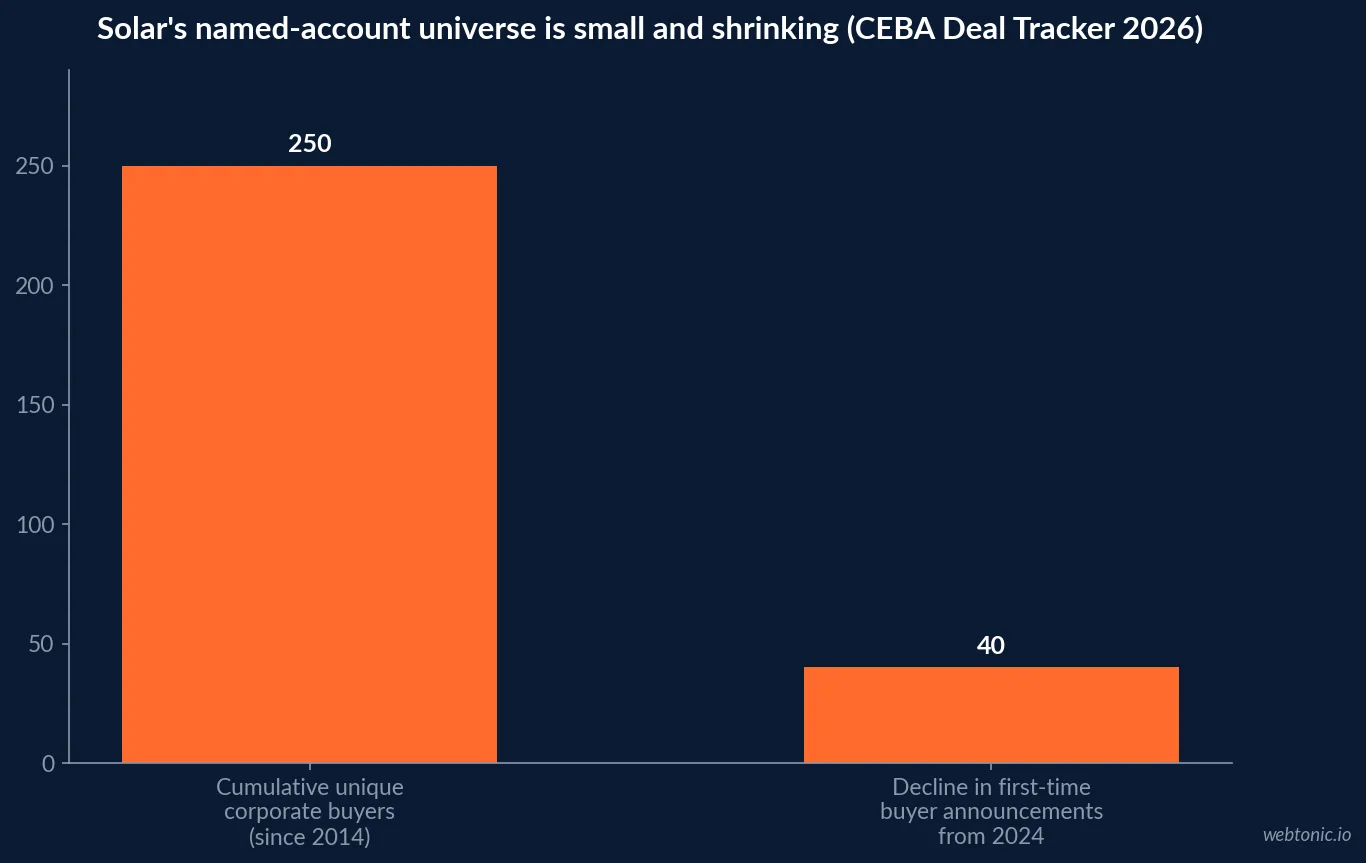
Account-based marketing usually starts with a selection exercise: which of thousands of possible accounts deserve dedicated budget. Solar skips that step, because the universe is already small. CEBA's Deal Tracker counts 250 cumulative unique corporate buyers that have signed a U.S. clean-energy procurement deal since 2014, and its 2026 State of the Market report notes that the number of buyers making a first-time announcement fell 40% from 2024, the lowest level since 2016, driven by rising PPA prices, constrained transmission infrastructure, and policy uncertainty.
That is an account-based marketer's dream list on paper - small, named, and researchable - and a demand-generation manager's nightmare, because there is no volume to fall back on if the named-account approach does not land.
| Solar named-account fact (CEBA, SEIA) | Figure | Source |
|---|---|---|
| Cumulative unique corporate clean-energy buyers, since 2014 | 250 | CEBA Deal Tracker / 2026 State of the Market |
| Decline in first-time buyer announcements from 2024 | 40% | CEBA 2026 State of the Market |
| Corporate share of total U.S. solar capacity | Over 18% | SEIA Solar Means Business 2024 |
| 2023 U.S. solar installations with a corporate offtaker | 20% | SEIA Solar Means Business 2024 |
| Top 10 corporate solar buyers, cumulative capacity | 16.8 GW | SEIA Solar Means Business 2024 |
| CEBA members' share of all announced U.S. commitments | 88% | CEBA 2026 State of the Market |
Who actually holds the accounts worth targeting
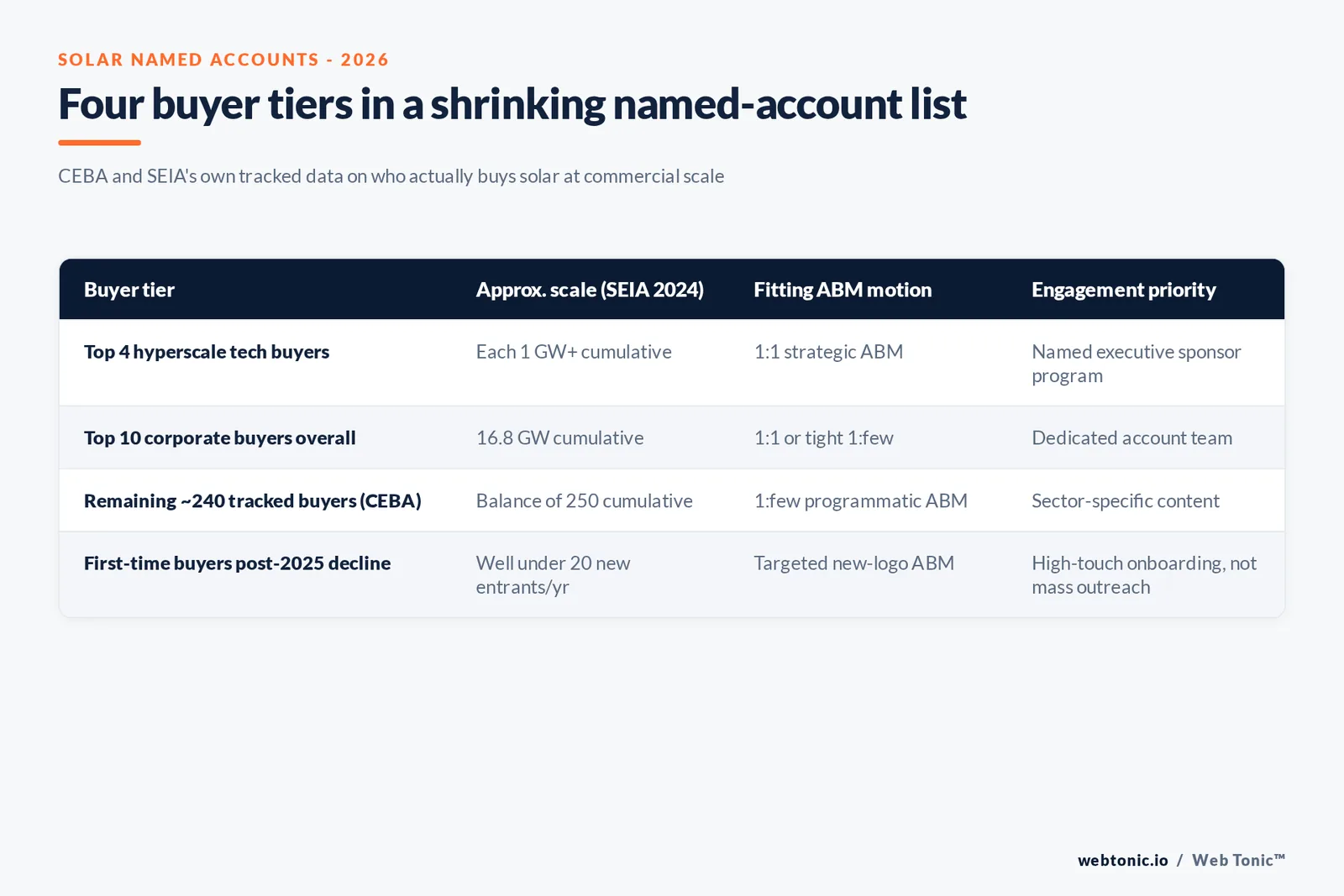
SEIA's Solar Means Business 2024 report shows just how concentrated that list already is: the top 10 corporate solar buyers hold 16.8 GW of cumulative capacity - roughly the installed solar capacity of the state of Florida - and four technology companies alone (Meta, Amazon, Google and Apple) each exceed 1 GW. Meta's own procurement had passed 5.1 GW by Q1 2024. A handful of named accounts, mostly hyperscale data-center operators, drive a disproportionate share of the entire commercial solar market.
That concentration argues for a genuinely 1:1 ABM motion on the largest handful of accounts, with a 1:few motion for the mid-tier developers and EPCs beneath them - not a 1:many program built for a list this short.
| Buyer tier | Approx. scale (SEIA 2024) | Fitting ABM motion |
|---|---|---|
| Top 4 hyperscale tech buyers (Meta, Amazon, Google, Apple) | Each 1 GW+ cumulative | 1:1 strategic ABM, named executive sponsors |
| Top 10 corporate buyers overall | 16.8 GW cumulative | 1:1 or tight 1:few, dedicated account teams |
| Remaining ~240 tracked corporate buyers (CEBA) | Balance of 250 cumulative buyers | 1:few programmatic ABM |
| First-time buyers each year (post-2025 decline) | Well under 20 new entrants/year (est.) | Targeted new-logo ABM, not mass outreach |
What cross-industry ABM benchmarks say about budget and ROI
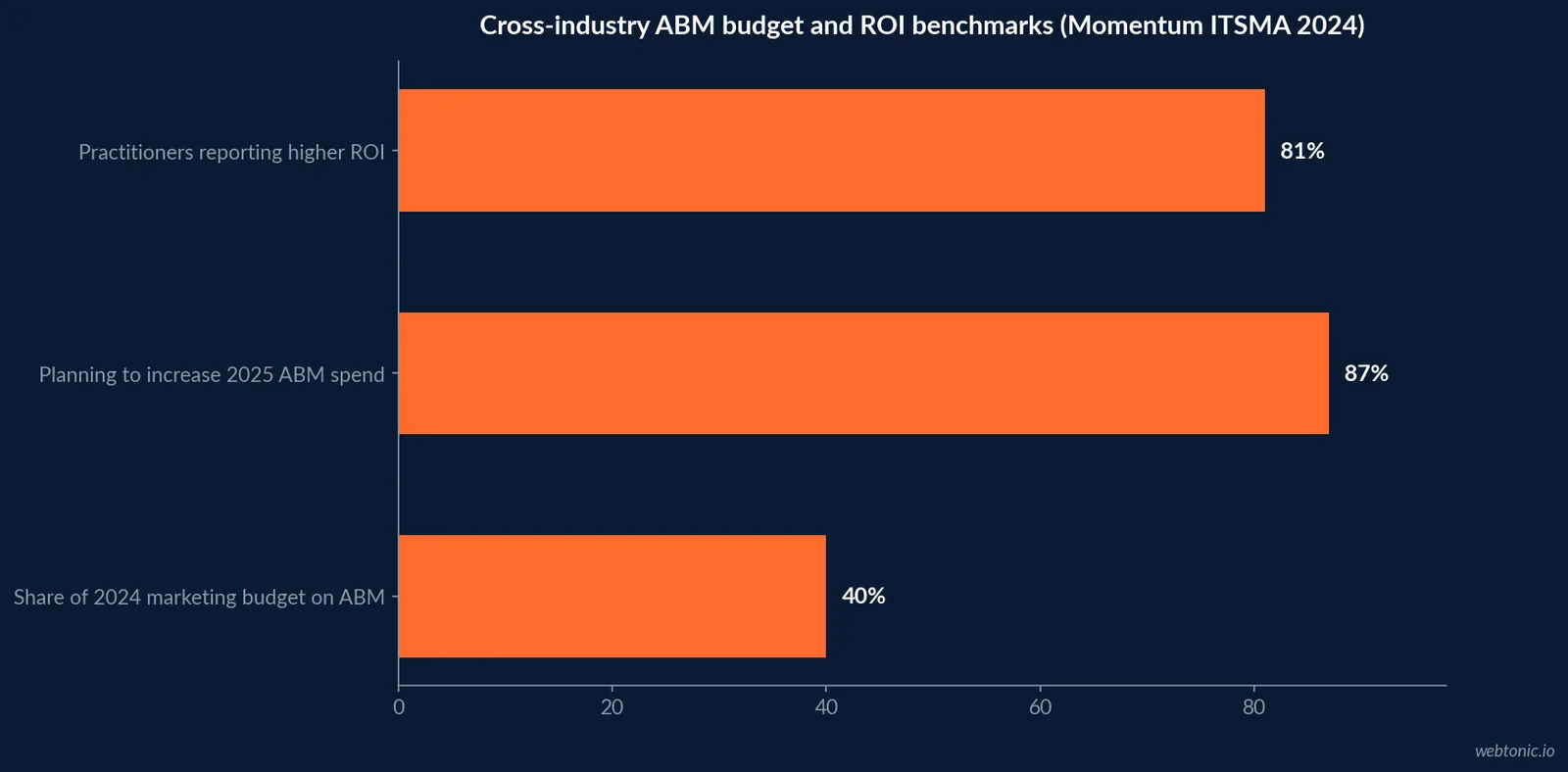
No public study prices ABM specifically for solar. What exists is B2B-wide: Momentum ITSMA's own 2024 Global State of Account-Based Marketing Benchmark reports that practitioners already running ABM dedicate 40% of their 2024 marketing budget to it, that 87% plan to increase spend in 2025 by an average of 9%, and that 81% of marketers report ABM delivering an average 6.5% higher ROI than other marketing initiatives. Separately, 61% of practitioners already run more than one type of ABM program (1:1, 1:few, 1:many combined).
Applied honestly to solar: a program should scale that budget share against the size of the actual named list, which is far smaller than the SaaS or enterprise-software base most of that survey population represents - meaning the dollar figure is proportionally smaller even where the percentage benchmark holds.
| ABM benchmark (Momentum ITSMA 2024, cross-industry) | Reported figure |
|---|---|
| Share of 2024 marketing budget dedicated to ABM | 40% |
| Practitioners planning to increase 2025 ABM spend | 87% |
| Average planned spend increase | 9% |
| Practitioners reporting ABM delivers higher ROI | 81% |
| Average reported ROI lift over other initiatives | 6.5% |
| Practitioners running more than one ABM type at once | 61% |
How B2B marketers broadly select and run ABM accounts
Demand Gen Report's 2025 Account-Based Marketing Benchmark Survey found 71% of B2B marketers currently run an ABM strategy, up four points year over year, with an additional 23% planning to add one. Account lists skew small across the board - 30% of respondents target 1-25 accounts and 21% target 26-50 - which happens to be the same scale as the solar corporate buyer universe even before any deliberate narrowing. Sales teams drive account selection at 70% of organizations, ahead of firmographic data (66%) and intent signals (58%).
The same survey's top challenge, cited by 47% of practitioners, is proving ROI or attribution - a harder problem on a named list this small, where a single lost or won account can swing the whole program's reported return.
| ABM practice (Demand Gen Report 2025 survey) | Reported figure |
|---|---|
| B2B marketers currently running an ABM strategy | 71% |
| Target 1-25 accounts | 30% |
| Target 26-50 accounts | 21% |
| Sales team selects the account list | 70% |
| Use firmographic data to build the list | 66% |
| Cite proving ROI/attribution as the top challenge | 47% |
| Use email to engage the account list | 92% |
The overall marketing budget this has to fit inside
Any ABM allocation is a slice of a shrinking pie. The CMO Survey 2026 reports marketing budgets have fallen to 9.0% of revenue and 9.6% of overall company budgets, their lowest share in several years, with companies now spending almost 60% of that budget on selling more to existing customers rather than pursuing new accounts. The standard-bearer for ABM-specific benchmarking, ITSMA and the ABM Leadership Alliance, has published an annual benchmark study series since before ABM was mainstream - the 2024 figures above are the latest in that series.
Read together: a solar ABM program is competing for share of an already-compressed marketing budget, inside a company culture currently biased toward retention over new-account acquisition - which makes the named-account discipline this list demands even more of an argument for the budget, not less.
What a cross-industry ABM tech stack looks like, applied to a list this short
Demand Gen Report's 2025 survey found 62% of ABM practitioners run a CRM as their core supporting technology, 52% a marketing automation platform, and only 37% have added an AI tool - with 24% running a dedicated account-based advertising tool and 46% using intent-monitoring software. For a list of 250 named accounts, most of that stack is already overkill: a solar developer or EPC does not need programmatic account-based advertising built for a 1,000-account list, and the intent-monitoring layer matters far less when the entire buyer universe is already known by name from SEIA and CEBA's own published data.
What the same survey does flag as broadly useful regardless of list size: 45% of practitioners say AI has improved personalization at scale, and 92% still use email as the primary account-engagement channel, ahead of in-person events at 72% - both apply directly to a solar ABM program working a named list of EPCs and facility managers.
| ABM tech-stack component (Demand Gen Report 2025, cross-industry) | Adoption | Fit for a 250-account solar list |
|---|---|---|
| CRM | 62% | Sufficient on its own for most solar programs |
| Marketing automation platform | 52% | Useful once the list needs cadence, not scale |
| Intent-monitoring tools | 46% | Lower value - the buyer list is already named |
| Account-based advertising tools | 24% | Rarely justified below a few hundred accounts |
| AI tools | 37% | Improves personalization at scale per 45% of respondents |
Tooling: no rate card exists
None of the major ABM platforms publishes pricing. Demandbase's own pricing page states outright that a plan is customized after a form submission, with no tier or dollar figure disclosed publicly. RollWorks (AdRoll ABM), 6sense and Terminus (now part of DemandScience) follow the same custom-quote pattern. For a named list this short, several solar go-to-market teams run the program inside CRM and marketing automation tools they already license rather than adding a dedicated ABM platform - the size of the list, not the platform's feature set, should decide that call.
Our data and analytics practice builds the account-scoring layer most solar teams are missing before they license anything new, and our growth marketing practice sequences that named-account motion against paid demand for the accounts not yet ready to buy. For the cross-industry ABM baseline this page draws on, see our account-based marketing statistics hub. Talk to us about sizing a program against your own tracked buyer list.
Frequently Asked Questions
What does account-based marketing mean for a solar company?
Not targeting homeowners - targeting the named commercial accounts that actually buy solar at scale: EPC firms, project developers, corporate offtakers signing power purchase agreements, and the facility or energy managers inside those organizations. CEBA's Deal Tracker counts a cumulative 250 unique corporate buyers in the U.S. since 2014, which is a target account list in the classic ABM sense - small, named and researchable - not a demand-generation funnel.
How big is the actual addressable list of solar commercial accounts?
Smaller than most B2B categories and shrinking. CEBA's 2026 State of the Market report puts cumulative unique corporate clean-energy buyers at 250 since 2014, but first-time buyer announcements fell 40% from 2024, the lowest level since 2016. SEIA's Solar Means Business 2024 report shows the concentration at the top: the 10 largest corporate solar buyers alone hold 16.8 GW, and four technology companies - Meta, Amazon, Google and Apple - each exceed 1 GW of cumulative capacity on their own.
What do cross-industry ABM benchmarks say about budget share and ROI?
Momentum ITSMA's 2024 Global State of Account-Based Marketing Benchmark, surveying B2B marketers running ABM programs, reports 40% of 2024 marketing budgets dedicated to ABM among respondents, 87% planning to increase ABM spend in 2025 by an average of 9%, and 81% saying ABM delivers on average a 6.5% higher ROI than other marketing initiatives. None of that is solar-specific - it is B2B-wide data from companies that already run ABM, and should be read as a directional benchmark, not a solar sector figure.
Is there a solar-specific ABM benchmark study?
No. No public benchmark study prices ABM by solar-industry deal size, win rate or budget share the way Momentum ITSMA and Demand Gen Report do for B2B software and services broadly. The honest approach pairs the cross-industry ABM benchmarks with solar's own named-account data (CEBA, SEIA) rather than presenting a blended number as if it were solar-specific.
What does ABM tooling cost for a solar go-to-market team?
The major platforms - Demandbase, 6sense, RollWorks (AdRoll ABM) and Terminus (now DemandScience) - do not publish a rate card. Demandbase's own pricing page states plainly that a plan is customized after a form submission, with no published tier or dollar figure; the same custom-quote pattern holds across the category. For a list this small, several practitioners run the program on CRM and marketing automation tools they already own rather than adding a dedicated ABM platform - a decision the small addressable list, not the tooling budget, should drive.
Sources
CEBA - Deal Tracker
CEBA - 2026 State of the Market report
SEIA - Solar Means Business 2024 report
Momentum ITSMA - 2024 Global State of Account-Based Marketing Benchmark
Demand Gen Report - 2025 Account-Based Marketing Benchmark Survey
Demandbase - Pricing (custom quote, no published tier)
The CMO Survey 2026 - Highlights and Insights Report
ABM Leadership Alliance / ITSMA - ABM benchmark study series