Table of contents
Snapchat ads are the paid placements advertisers buy inside Snapchat's camera, Stories, Spotlight and Chat surfaces, sold through Snapchat Ads Manager from a $5 minimum daily budget. This guide covers every current ad format, real cost benchmarks, the campaign build itself, and how the platform's targeting and privacy rules actually work.
Key Takeaways
- Snap reported 483 million daily active users and 956 million monthly active users in Q1 2026, with advertising revenue of $1.24 billion for the quarter.
- Median Snapchat CPC sits near $0.84 and CPM around $8, materially below comparable Meta inventory for the same 18-34 audience.
- The minimum spend is $5 per day, but campaigns need roughly $20-$50 per day to exit the learning phase in about 4 days.
- 7 core ad formats matter: Single Image or Video, Story Ads, Collection Ads, Sponsored Snaps, Commercials, AR Lenses and Filters.
- Pew Research found 55% of US teens use Snapchat and 46% use it daily — the reason the platform still wins Gen Z briefs.
Why advertisers still buy Snapchat in 2026
Snap's own numbers are the honest starting point. In its Q1 2026 results, the company reported total revenue of $1.53 billion, up 12% year over year, with advertising revenue of $1.24 billion and average revenue per user of $3.17. Daily active users returned to growth at 483 million, a net gain of 23 million year over year, as CNBC reported. On the earnings call, management singled out direct-response demand and said Dynamic Product Ads revenue grew more than 30%.
The audience is the real argument, though. Pew Research Center data shows Snapchat skews sharply young, with adoption among US adults aged 18-29 far above every older bracket, and its teen survey put usage at 55% of US teens with 46% opening the app daily. If your brief says Gen Z, Snapchat is one of a very small number of places you can buy that attention at scale without paying Instagram or TikTok prices.
Every Snapchat ad format, and what each is for
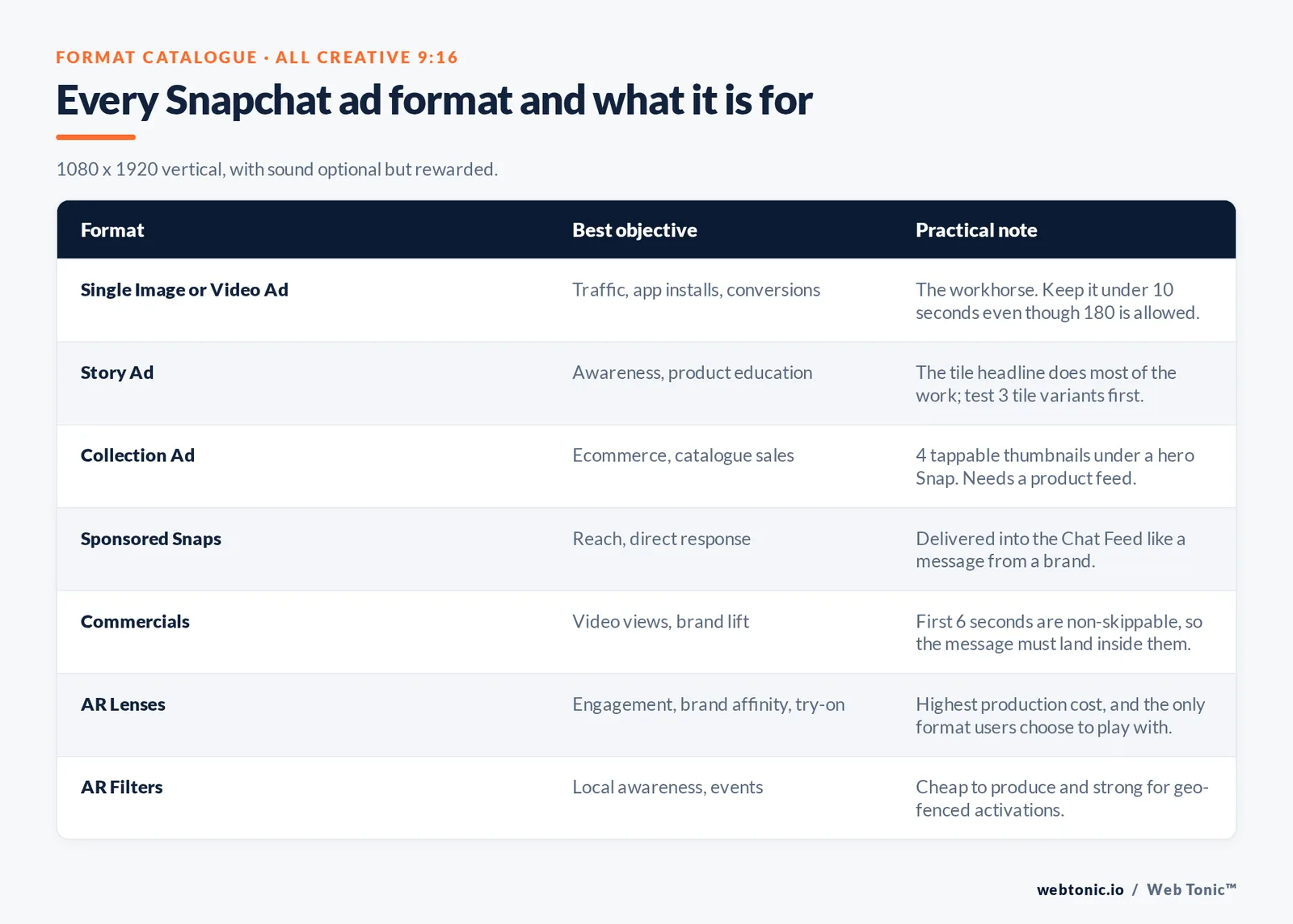
Snapchat's ad formats page is the authoritative spec list. All creative is vertical: 9:16, 1080 x 1920 pixels, with sound designed to be optional but rewarded.
| Format | Where it appears | Best objective | Practical note |
|---|---|---|---|
| Single Image or Video Ad | Between Stories, in Spotlight, in Discover, and in the Chat Feed | Traffic, app installs, conversions | The workhorse. Keep it under 10 seconds even though the format allows up to 180. |
| Story Ad | A branded tile in the Discover feed opening 3-20 Snaps | Awareness, product education | The tile headline does most of the work; test 3 tile variants before touching the Snaps. |
| Collection Ad | 4 tappable product thumbnails under a hero Snap | Ecommerce, catalogue sales | Needs a product feed. Pairs with Dynamic Product Ads, the fastest-growing format on Snap. |
| Sponsored Snaps | Delivered into the Chat Feed like a message from a brand | Reach, direct response | Snap's newer high-attention inventory; see the ads in Chat eligibility rules. |
| Commercials | Inside curated Snap content | Video views, brand lift | First 6 seconds are non-skippable, so the whole message must land inside them. |
| AR Lenses | The camera itself | Engagement, brand affinity, try-on | Highest production cost of the 7 formats and the only one users actively choose to play with. |
| AR Filters | Overlaid on a user's own Snap | Local awareness, events | Cheap to produce and strong for geo-fenced activations such as a store opening. |
Advertisers running the API rather than Ads Manager should read Snap's creatives documentation, which maps each format to its allowed call-to-action types.
What Snapchat ads cost
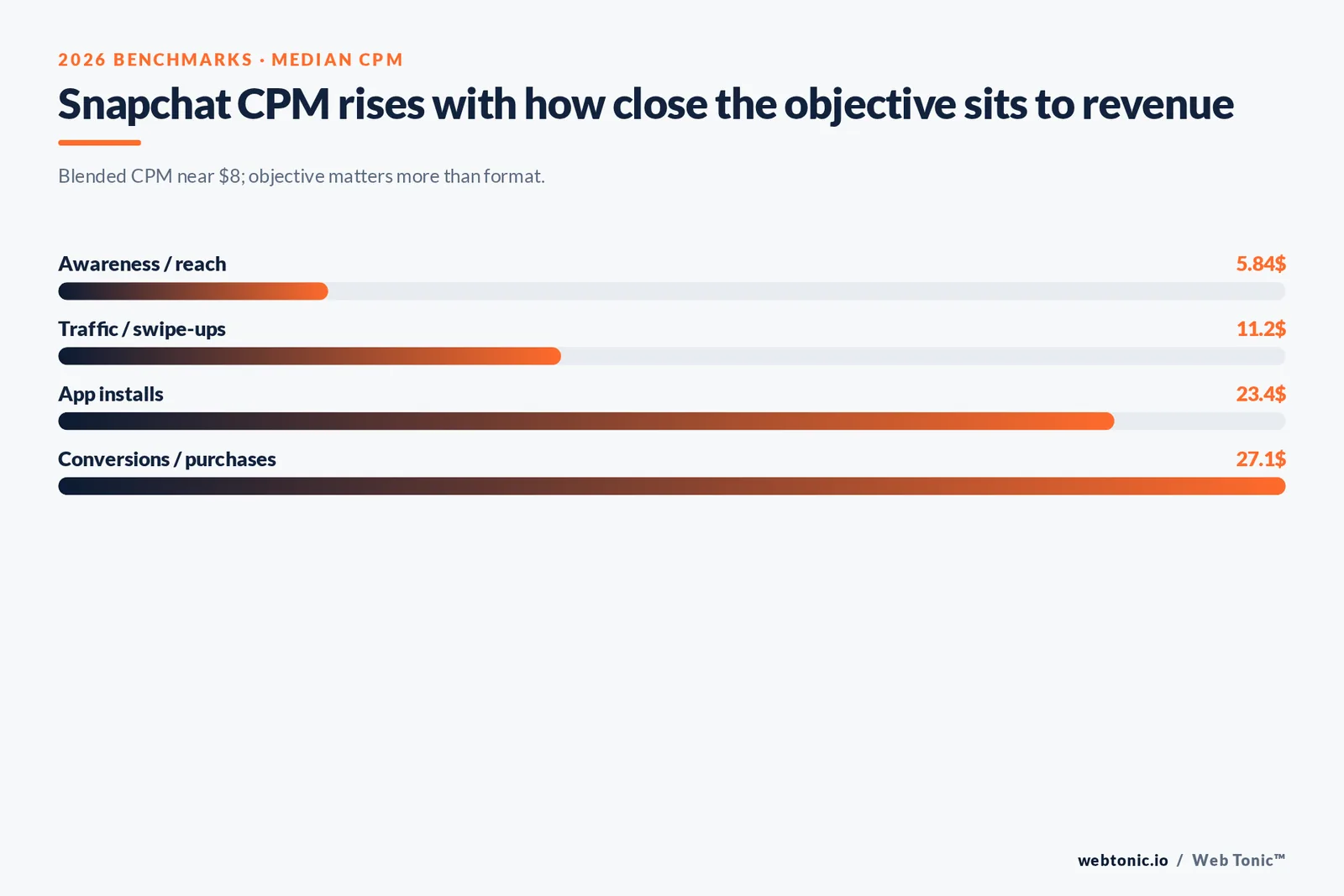
Costs vary by objective more than by format. Aggregated 2026 benchmarks put median CPC around $0.84 with an interquartile range of roughly $0.51 to $1.34, and blended CPM near $8. Objective is the variable that matters.
| Objective | Typical CPM | What drives it |
|---|---|---|
| Awareness / reach | ~$5.84 | Broadest inventory, lowest bid competition |
| Traffic / swipe-ups | ~$11.20 | Optimising toward clicks narrows delivery |
| App installs | ~$23.40 | Competes with gaming budgets; needs SDK signal |
| Conversions / purchases | ~$27.10 | Smallest qualified pool, highest advertiser value |
Against comparable 18-34 inventory that is cheap: Instagram Stories commonly runs $12-$25 CPM and TikTok in-feed $10-$20. Snapchat's blended click-through rate of roughly 1.04% also compares well with the cross-platform paid-social medians published by Sprout Social and Socialinsider. Cheap traffic is not the same as cheap revenue, so hold the account to cost per purchase, not CPM.
How to set up a Snapchat ads campaign
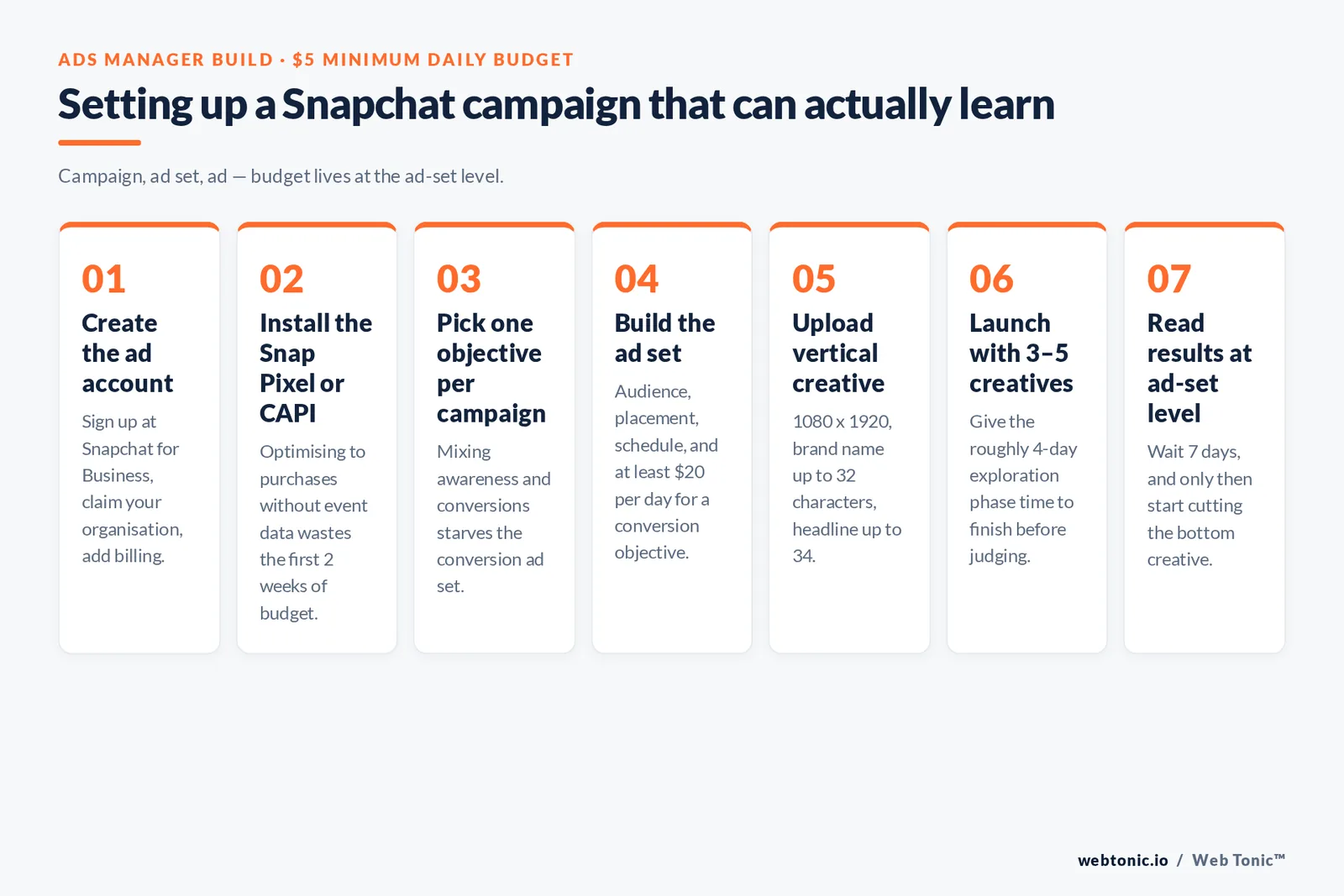
The build follows the standard three-level hierarchy of campaign, ad set, and ad. Budget lives at the ad-set level.
- Create the ad account at Snapchat for Business and claim your organisation, then add billing.
- Install the Snap Pixel or the Conversions API before you spend anything. Optimising to purchases without event data wastes the first 2 weeks of budget.
- Pick one objective per campaign. Mixing awareness and conversions in the same campaign starves the conversion ad set.
- Build the ad set: audience, placement, schedule, and a daily budget of at least $20 if the objective is a conversion.
- Upload vertical creative at 1080 x 1920 with a brand name of up to 32 characters and a headline of up to 34.
- Launch with 3-5 creatives per ad set so the algorithm has something to choose between, then let the roughly 4-day exploration phase finish before judging anything.
- Read results at the ad-set level after 7 days, and only then start cutting the bottom creative.
Sprout Social's format walkthrough is a useful second reference for the Ads Manager screens, and WordStream's guide remains a decent primer on bid mechanics.
Targeting, and the privacy rules that shape it
Snapchat's targeting stack is smaller than Meta's but covers the essentials: demographics, location down to a radius or a geo-fence, Snap Lifestyle Categories built from in-app behaviour, Snap Audience Match from your own hashed customer list, Lookalikes, and device or connection filters.
| Targeting type | Use it for | Watch out for |
|---|---|---|
| Demographic + geo | Local retail, events, store openings | Radius targeting under 3 miles can starve delivery |
| Lifestyle Categories | Interest-led prospecting at scale | Stacking 5+ categories broadens rather than sharpens |
| Snap Audience Match | Retention, winbacks, exclusions | Match rates need lists in the tens of thousands to be usable |
| Lookalikes | Scaling a proven purchaser seed | Seed lists under 1,000 produce unstable audiences |
| Predefined / Advanced auto | Small accounts with limited data | Give it 4 days before intervening |
All of it operates inside Snap's published data rules. The Snap Privacy Center and its privacy policy set out what advertiser data can be used for, and creative is additionally governed by Snap's advertising policies — alcohol, gambling, financial services and anything aimed at minors carry hard restrictions and age-gating requirements. Assume a manual review on regulated categories and build 3-5 days of approval time into the launch plan.
Measuring Snapchat ads properly
Snapchat's reporting is only as good as the signal you feed it. The Snap Pixel handles web events, the Conversions API sends server-side events that survive browser restrictions, and the App Ads Kit or a mobile measurement partner covers in-app purchases. Accounts running all three typically recover a meaningful share of conversions that pixel-only setups miss.
Attribution defaults matter as much as the tags. Snapchat's swipe-up and view-through windows credit differently from Meta's, so a like-for-like comparison across the two platforms needs the windows aligned first. Three habits keep the numbers honest:
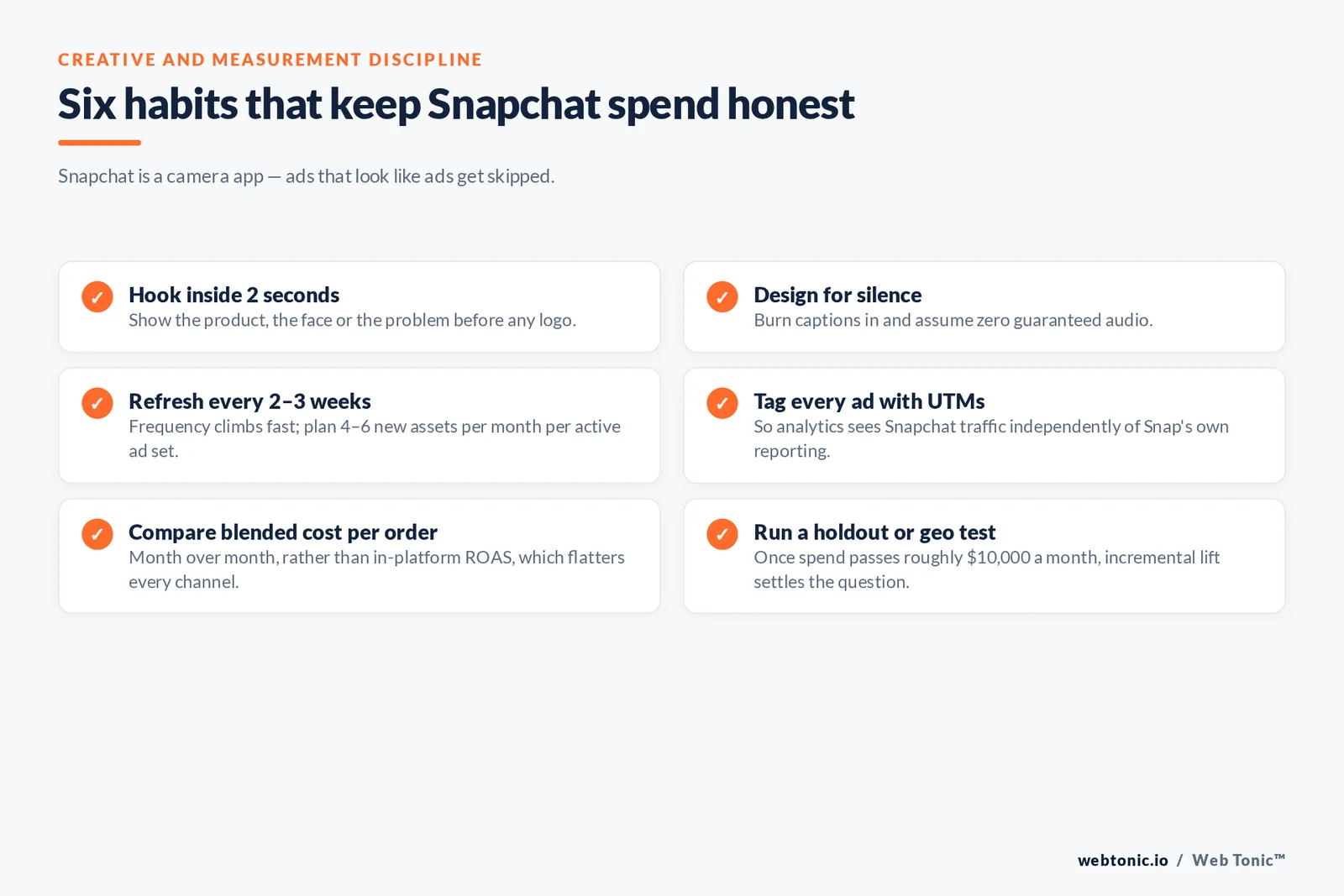
- Tag every ad with UTMs so your analytics platform sees Snapchat traffic independently of Snap's own reporting.
- Compare blended cost per order month over month rather than in-platform ROAS, which flatters every channel it measures.
- Run a holdout or geo test once spend passes roughly $10,000 a month; incremental lift is the only number that settles whether Snapchat is additive to Meta or cannibalising it.
For catalogue advertisers, Dynamic Product Ads are the format to instrument first — Snap called out revenue growth above 30% year over year for DPA in Q1 2026, and adoption among small and medium advertisers more than doubled. That growth is a signal about where the platform is investing its ranking and delivery improvements.
Creative that works on Snapchat
Snapchat is a camera app, so ads that look like ads get skipped. The pattern that survives is user-generated in feel, vertical by default, and legible without sound. Three rules do most of the work.
- Hook inside 2 seconds. Show the product, the face, or the problem before any logo.
- Design for silence. Burn captions in; assume 0 guaranteed audio.
- Refresh every 2-3 weeks. Snapchat's audience is small enough that frequency climbs fast, so plan 4-6 new assets per month per active ad set.
Commercials are the exception worth naming: because the first 6 seconds cannot be skipped, treat them as a 6-second ad with an optional tail rather than a 15-second film. For AR, a Lens that people use is earned media — the play is a simple mechanic, not a technical showpiece.
Should Snapchat be in your media mix?
Snapchat earns a line in the plan when your buyer is under 35, your creative can be produced vertically at volume, and your target cost per acquisition leaves room for testing. It is a poor fit for narrow B2B, high-consideration purchases with 6-month cycles, or accounts that cannot produce fresh video monthly. Industry spend trackers such as EMARKETER, put it firmly in the challenger tier of social budgets, which is exactly where incremental reach usually hides.
A sensible test is $3,000 to $5,000 over 4 weeks: one prospecting ad set, one retargeting ad set, 6 creatives, measured against your existing paid-social cost per purchase. If you want that structured and run properly, our growth marketing and performance creative teams handle both halves of the problem, and there are more platform breakdowns on the Web Tonic blog. If you would rather talk it through first, get in touch.
Snapchat ad policies and account requirements
Before your first ad goes live, get familiar with the requirements. Every creative goes through review, and the categories most likely to be rejected are predictable. Snap's advertising policies and its Privacy Center together define what you can promote, how you can use third-party data, and how Snapchatters control their own ad preferences.
- Age gating. Alcohol, gambling and other restricted products require age-based targeting; the minimum age you must set varies by market.
- Political and issue ads. Snapchat allows political advertising but requires disclosure, and every political ad is human-reviewed and published in a public archive.
- Prohibited products. Tobacco, weapons, prescription drugs and unsupported health claims will not clear review, regardless of how the creative is worded.
- Data and consent. Customer lists uploaded for targeting must be collected lawfully, and Snapchatters can adjust their ad activity and preferences at any time — which is why first-party signal quality, not third-party data, is what keeps performance stable.
- Creative rules. No fake user-interface elements telling people to tap the screen, no misleading before-and-after claims, and clear disclosure of any subscription pricing.
Practically, this means building 3-5 days of review time into any launch in a regulated category, and keeping a second creative set ready in case the first is rejected. Snap's business help centre is the place to check eligibility before you build, not after.
Getting started for ecommerce: catalogue, website and app
For retail advertisers, the fastest path to relevant, targeted delivery is a clean product catalogue. Once your products are connected, Snapchat can promote individual items dynamically instead of forcing you to create a new ad for every SKU.
- Connect the catalogue. Shopify merchants can install the official Snapchat Ads app and sync products directly; other platforms use a scheduled feed URL. Keep titles under 65 characters so they stay readable on a phone screen.
- Install the Snap Pixel on your website and confirm page-view, add-to-cart and purchase events are firing before you spend. Accounts that skip this step routinely waste their first $500.
- Build one prospecting and one retargeting ad set. Retargeting people who tapped a product but did not buy is usually the cheapest sales you will get on the platform.
- Create Collection Ads so users can tap four products directly from the Snap. This format consistently drives more qualified traffic than a single hero image for catalogue businesses.
- Review results weekly at the ad-set level, including new-customer versus returning-customer share, and only then adjust budgets.
Snap's own reporting points the same way: Dynamic Product Ads were the standout growth story of Q1 2026, which means catalogue-based advertisers are where the platform's delivery improvements will help you first. If you want the setup, the creative and the measurement handled as one job, our data intelligence team covers the tracking side.
FAQ: Snapchat advertising questions
How much do Snapchat ads cost?
The minimum is $5 per day, and 2026 benchmarks put median CPC near $0.84 with blended CPM around $8. Cost varies mostly by objective: awareness inventory runs near a $5.84 CPM while conversion campaigns are closer to $27.10. For a meaningful test, budget $20 to $50 per day per ad set so the campaign can clear its exploration phase.
What types of ads can you run on Snapchat?
Seven core formats: Single Image or Video Ads, Story Ads, Collection Ads, Sponsored Snaps delivered into the Chat Feed, Commercials with a non-skippable first six seconds, AR Lenses, and AR Filters. All creative is vertical at 1080 x 1920. Single Image or Video Ads carry most direct-response budgets, while Collection Ads and Dynamic Product Ads serve ecommerce catalogues.
Who can you target with Snapchat ads?
Demographics, location including geo-fences, Snap Lifestyle Categories based on in-app behaviour, your own customer lists through Snap Audience Match, Lookalikes built from a purchaser seed, and device or connection attributes. Targeting operates within the data rules published in Snap's Privacy Center, and regulated categories such as alcohol and gambling carry additional age-gating requirements.
Are Snapchat ads effective for reaching Gen Z?
Yes, and that remains the platform's strongest case. Pew Research found 55% of US teens use Snapchat with 46% using it daily, and adoption among adults aged 18 to 29 is far higher than any older bracket. Combined with CPMs well below comparable Instagram Stories inventory, that makes Snapchat one of the cheaper routes to incremental young reach.
How long does it take Snapchat ads to work?
Expect roughly four days of exploration while delivery stabilises, then judge performance on seven days of data at the ad-set level. Pausing creative inside the first four days is the most common way advertisers waste a Snapchat budget. Plan four to six fresh assets a month per active ad set, because frequency builds quickly on a smaller audience.
Sources
Snap Inc., Quarterly results · CNBC, Snap Q1 2026 earnings · PPC Land, Snap Q1 2026 revenue · Snapchat for Business, Ad formats and Advertising · Snapchat Business Help, Sponsored Snaps · Snap Developers, Creatives · Snap Values, Privacy Center and Privacy policy · Pew Research Center, Social media fact sheet · Sprout Social, Snapchat ads and Benchmarks by industry · Socialinsider, Social media benchmarks · EMARKETER, Snapchat users · WordStream, Snapchat ads guide. Accessed July 2026.