Table of contents

A Canadian SEO budget should be set from three numbers: how fast Canadian retail is moving online, how concentrated Canadian search actually is, and what Canadian agencies charge for the work. This page pulls all three from primary sources - Statistics Canada, Statcounter and a 2024/2026 national pricing survey - so the number is defensible, not guessed.
Key Takeaways
- Canadian retail e-commerce hit CAD 5.7 billion in June 2026, 7.7% of total retail trade.
- That share was 7.1% in May 2026, a 9.9% month-over-month jump in e-commerce sales.
- Google holds 85.7% to 86.7% of Canadian search share through 2026.
- Bing sits at roughly 9% to 9.8%, Yahoo under 2.5%.
- Canada's paid digital ad market reached CAD 21.1 billion in 2025, up 16% year over year.
- It is forecast to reach roughly CAD 26.2 billion in 2026.
- Retail and e-commerce is the largest digital ad category at 22% of Canadian spend.
- Search captures an estimated 50% SMB budget share, the highest of any channel measured.
- 62.4% of Canadian SEO work is bought through agencies rather than run fully in-house.
- Digital PR / link-building runs even higher agency share, at 64.2%.
- Typical Canadian SEO retainers run CAD 2,500 to 5,000 a month.
- National average hourly SEO rate is about CAD 120.
- Entry-tier local SEO packages start at CAD 500 to 1,500 a month.
- 42.8% of SEO buyers globally pay USD 501 to 2,000 monthly, per Ahrefs.
- SEO captures 9.4% of mean marketing budget among owned/earned channels globally (Gartner 2026).
- Canadian B2B firms typically budget 7.7% to 8% of revenue for total marketing.
Start with how fast Canadian retail is moving online
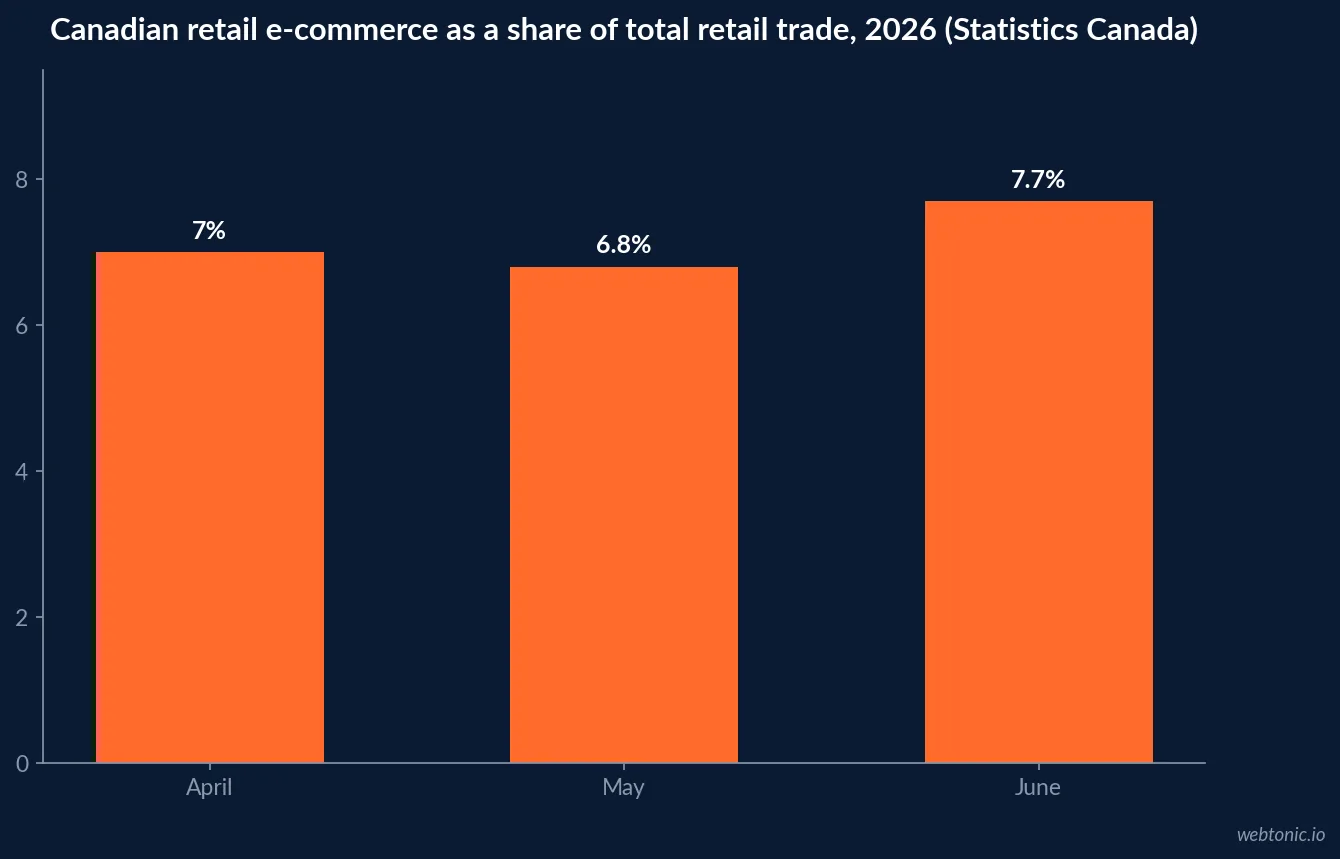
Statistics Canada's retail trade release for June 2026 reported total retail sales of CAD 74.3 billion, up 0.6% on the month, with seasonally adjusted e-commerce sales rising 9.9% to CAD 5.7 billion - now 7.7% of total retail trade, up from 7.1% the month before. The series moves noticeably from month to month, which understates how much demand is already searching and shopping online rather than in-store.
| Month (2026) | Total retail trade | E-commerce sales | E-commerce share |
|---|---|---|---|
| April | CAD 72,951M | CAD 5,102M | 7.0% |
| May | CAD 73,708M | CAD 5,025M | 6.8-7.1%* |
| June | CAD 74,300M | CAD 5,700M | 7.7% |
*Statistics Canada revised the May e-commerce share between its May and June releases; both published figures are shown. Source: Statistics Canada, The Daily - Retail trade, June 2026.
Search in Canada is a Google-only conversation
Statcounter's rolling measurement shows Google holding 85.7% to 86.7% of the Canadian search engine market across 2026, with Bing at roughly 9% to 9.8% and Yahoo under 2.5%. That concentration has not moved meaningfully in years - Google sat at 89.5% as recently as April 2025 and has drifted down only a few points since, still leaving every other engine combined under 15% of the market.
| Search engine | Canada market share (2026) |
|---|---|
| 85.7% - 86.7% | |
| Bing | 8.9% - 9.8% |
| Yahoo! | 2.3% - 2.5% |
| DuckDuckGo | 1.4% - 1.5% |
| YANDEX | 0.3% |
| Ecosia | 0.2% |
Source: Statcounter Global Stats, Search Engine Market Share Canada.
What the Canadian paid digital ad market spends on, for context
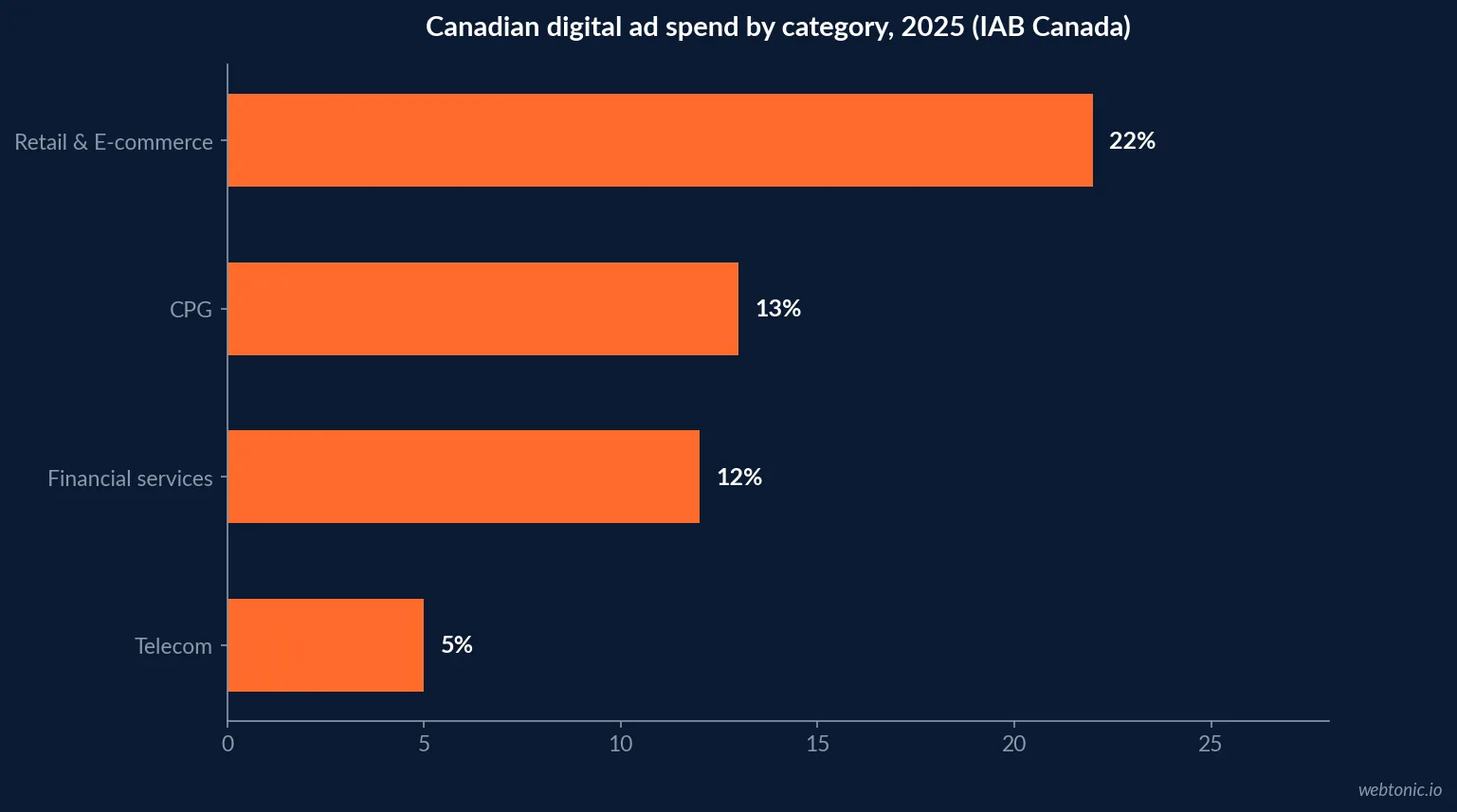
IAB Canada's 2025 Internet Ad Revenue Survey, with a 2026/27 forecast, measured Canada's digital advertising market at CAD 21.1 billion in 2025, growing 16% year over year, with an additional CAD 3.47 billion in newly measured digital-advertising-adjacent economic activity. The market is forecast to reach roughly CAD 26.2 billion in 2026. SEO sits outside this paid-media figure as an owned-channel investment, but the category split shows where growth-stage dollars are already concentrated:
| Category | Share of Canadian digital ad spend |
|---|---|
| Retail & E-commerce | 22% |
| CPG | 13% |
| Financial services | 12% |
| Telecom | 5% |
The same report estimates SMB penetration by channel is highest for search at 50% and social at 40%, against 20% for display and 10% for retail media - search remains the most self-serve, most SMB-accessible channel in the Canadian market, which is also why organic search competition at the local-business level stays intense.
Where SEO sits inside the broader Canadian marketing budget
Canadian B2B marketing budgets, per Directive Consulting's Canadian benchmark, most commonly land between 7.7% and 8% of revenue - Forrester's global anchor at roughly 8% and Gartner's CMO Spend Survey at 7.7% both hold up as reasonable Canadian starting points, since neither figure is industry-specific enough to be wildly off for most sectors. Inside that total, a Canadian SMB is also weighing SEO against the Association of Canadian Advertisers' 2026 Canada Media Budget Survey, run with Ebiquity and the World Federation of Advertisers across 518 marketers, which tracks how Canadian media investment priorities are shifting as the broader advertising landscape adjusts to AI-driven disruption across every channel, not just search.
Who does the SEO work: in-house versus agency
Cross-market agency-share data (not Canada-exclusive, but the closest sourced benchmark) shows SEO and digital PR concentrated more heavily with agencies than most other channels: 62.4% of SEO work and 64.2% of digital PR / link-building work is bought externally, compared with just 8.4% for email and 12.6% for MarTech operations. That pattern matches what Canadian pricing data shows separately - SEO retainers are structured as ongoing agency engagements far more often than as a single in-house hire, especially below the enterprise tier.
| Channel | Agency share | In-house share |
|---|---|---|
| Digital PR / link-building | 64.2% | 35.8% |
| SEO | 62.4% | 37.6% |
| Paid search | 48.6% | 51.4% |
| Paid social | 34.2% | 65.8% |
| Content marketing | 24.6% | 75.4% |
| Email & lifecycle | 8.4% | 91.6% |
What Canadian SEO actually costs
The StorytellerMedia 2024 Canada SEO pricing survey, cited by Unalike Marketing's 2026 pricing breakdown, found the most common Canadian monthly retainer sits between CAD 2,500 and 5,000, with a national hourly average around CAD 120. Ahrefs' global buyer survey, referenced in the same analysis, found 42.8% of SEO buyers worldwide pay USD 501 to 2,000 a month - a range that roughly overlaps the Canadian growth tier once converted.
| Tier | Monthly price (CAD) | Typical buyer |
|---|---|---|
| Entry / local | 500 - 1,500 | Solo founder, under CAD 500K revenue, single location |
| Growth | 1,500 - 3,500 | 1-5 employees, CAD 500K-2M revenue, local service business |
| Competitive | 3,500 - 6,000+ | 6-25 employees, CAD 2M-10M revenue, multi-location or competitive vertical |
At a CAD 2,500 monthly retainer, a business needs roughly 5 new customers a month to break even, assuming CAD 600 profit per customer - a useful gut check before committing to a tier that a Google Business Profile and a handful of blog posts cannot realistically support.
How SEO budget compares against Canadian paid media
A Canadian marketer weighing SEO against paid search is weighing an owned channel that took 62.4% agency delivery against a paid channel where Google Ads pricing keeps climbing in the same auctions U.S. and global advertisers compete in - Canadian CPCs are not immune to that trend. The practical planning question is not "SEO or paid search" but how much of a limited budget goes to each, and Web Tonic's Facebook Ads ROI analysis runs the same build-versus-buy math for the social side of that split.
A quick sanity check before signing a retainer
Three questions catch most of the bad Canadian SEO budget decisions before they happen. First, does the retainer tier match the customer math - a CAD 3,500 growth-tier package only makes sense if the business can realistically absorb the roughly 7 new customers a month needed to clear it profitably. Second, is the scope Google-only by design, since spending meaningful budget optimizing for Bing or Yahoo in a market where they combine for under 12% of search volume is close to wasted effort. Third, does the agency report against e-commerce or lead-volume movement specifically, not just keyword rank - Statistics Canada's own retail data shows online spend share moving by whole percentage points month to month, and a Canadian SEO program should be able to show its own traffic and conversion curve tracking that same directional shift, not a rankings report disconnected from it.
Setting the budget inside a broader growth plan
None of the Canadian figures above work in isolation. A retail brand riding the 7.7% e-commerce share increase needs its SEO spend integrated with the rest of its growth marketing program, not run as a disconnected retainer line, and a services business bidding against Bing's growing 9% share still needs its measurement stack - the data intelligence layer that ties organic traffic to actual leads and revenue - built before the retainer is signed, not after the first invoice.
How to size a 2026 Canadian SEO budget
- Anchor to revenue first: Canadian B2B benchmarks cluster at 7.7% to 8% of revenue for total marketing spend, with SEO as one line inside that.
- Expect an agency-heavy delivery model: 62.4% of SEO work nationally is bought externally, so budget for a retainer, not a single hire, below the enterprise tier.
- Treat Google as the only search engine that matters: with 85%+ share, a Bing-specific strategy is a rounding error next to Google technical and content work.
- Match the retainer tier to the break-even math: a CAD 2,500/month retainer only pencils out once the new-customer volume it needs is realistic for the business.
- Watch the e-commerce share trend: a rising online-retail share is a leading indicator that more category demand is searchable, which raises the ceiling on what SEO can return.
Frequently Asked Questions
How much does SEO cost in Canada in 2026?
Per the StorytellerMedia 2024 Canada SEO pricing survey, the most common monthly retainer nationally sits between CAD 2,500 and 5,000, with a national hourly average of about CAD 120. Entry-tier local packages run CAD 500 to 1,500 a month, and competitive multi-location or high-value verticals (personal injury law, cosmetic dentistry in major metros) push past CAD 6,000. Ahrefs' global buyer survey, cited in the same source, found 42.8% of SEO buyers worldwide pay between USD 501 and 2,000 a month, a range that roughly brackets the Canadian growth tier.
Is Google still the dominant search engine in Canada?
Yes, overwhelmingly. Statcounter puts Google at 85.7% to 86.7% of the Canadian search engine market through 2026, with Bing a distant second at roughly 9% to 9.8% and Yahoo under 2.5%. That concentration means a Canadian SEO program is, in practice, almost entirely a Google-ranking program, with Bing Webmaster Tools work as a secondary line item rather than a parallel strategy.
How fast is e-commerce growing as a share of Canadian retail?
Statistics Canada's June 2026 retail trade release put seasonally adjusted e-commerce sales at CAD 5.7 billion for the month, 7.7% of total retail trade, up from 7.1% in May 2026 - a jump of 9.9% month-over-month. That share moves noticeably month to month, which is itself evidence that Canadian shoppers keep shifting spend online, and organic search is a primary discovery channel for that shift.
What share of Canada's digital ad market goes through SEO versus paid channels?
IAB Canada's 2025 Revenue Survey, with a 2026/27 forecast, measured the paid digital advertising market at CAD 21.1 billion in 2025, growing 16% year over year, forecast to reach roughly CAD 26.2 billion in 2026. That figure only covers paid media; SEO investment sits outside it as an owned-channel budget line, but it competes for the same growth-stage dollars, and Search captures the highest estimated small and medium-business budget share of any channel at 50%.
Does SEO spend in Canada match the global CMO benchmark?
Broadly yes on trajectory. Gartner's 2026 CMO Spend Survey (global, not Canada-specific) found SEO capturing 9.4% of mean marketing budget among owned and earned channels, its largest share in that group. Canadian B2B benchmarks tracked by Directive's Canadian arm put total marketing spend at 7.7% to 8% of revenue, consistent with the Forrester and Gartner CMO Spend anchors - meaning Canadian marketers sizing an SEO line against 8-10% of a revenue-based marketing budget are working from real, if not Canada-exclusive, benchmarks.
Sources
Statistics Canada, The Daily - Retail trade, June 2026
Statcounter Global Stats, Search Engine Market Share Canada
IAB Canada, 2025 Internet Ad Revenue Survey & 2026/27 Forecast
Unalike Marketing, Canada SEO pricing (citing StorytellerMedia 2024 survey)
Directive Consulting Canada, B2B Marketing Budget Benchmarks 2026
Chief Marketer / Gartner 2026 CMO Spend Survey
Association of Canadian Advertisers, 2026 Canada Media Budget Survey