Table of contents
Shopify powers roughly 29 percent of all US ecommerce websites (Magedelight, 2026), making it the dominant platform in North America. Owning a Shopify store and ranking on Google are two entirely different things, though. Most merchants install a theme, list their products, and wait for traffic that never arrives, because Shopify's built-in tools handle only the basics.
SEO for Shopify is the work of closing that gap: making sure your store, your product pages, and your content actually show up when search engines send people looking for what you sell. It combines technical fixes, on-page product data, structured data, and a link building strategy suited to an online store rather than a blog. Get it right, and organic search becomes the highest-margin channel your online store has.
Key Takeaways
- 96.55 percent of all indexed pages receive zero organic traffic from Google (Studio 36 Digital, via Charle 2026), which means simply publishing a page is nowhere close to enough on its own.
- Organic search drives 43 percent of all ecommerce traffic and roughly 23.6 percent of online orders (industry-wide 2026 ecommerce SEO data), more than any other single channel.
- The first organic result captures an average 27.6 percent click-through rate; by position five, that drops to roughly 6.3 percent (Backlinko's analysis of 4 million Google search results) — the gap between page one and page two is almost always the gap between steady revenue and paying for ads to fill it.
- Site speed has an outsized effect on conversion: pages loading in 1 second convert at 3.05 percent, compared to just 0.67 percent at 4 seconds (Ringly.io, 2026).
- 60 percent of US shoppers now use AI tools like ChatGPT or Gemini during their purchase journey (SeoProfy, citing Shopify's own data, 2026), and brands cited inside an AI Overview see roughly 35 percent more organic clicks.
- Top-ranking pages carry about 3.8 times more backlinks than lower-ranked competitors (Reboot Online, 2026) — link building still matters, it just needs to be earned, not bulk-purchased.
What Is SEO for Shopify?
SEO for Shopify, short for search engine optimization, is the process of optimizing a store's technical foundation, product data, and content so it ranks in Google for the terms shoppers actually search. Shopify handles some of this automatically, generating sitemaps and managing robots.txt by default, but that only covers the basics. Everything from title tags and meta descriptions to alt text on product images, structured data, and internal link architecture still requires deliberate work. Set up both Google search console and Bing Webmaster Tools so you can see indexing status across the search engines that actually send traffic, not just the dominant one.
The platform difference matters here. Shopify SEO is ecommerce-focused, built around products, collections, and transactional search intent, unlike a content-led website where blog posts do most of the ranking work. The product descriptions, collection pages, and catalog structure carry more of the SEO weight than they would on a typical blog-driven site.
Why Most Shopify Pages Never Get Found
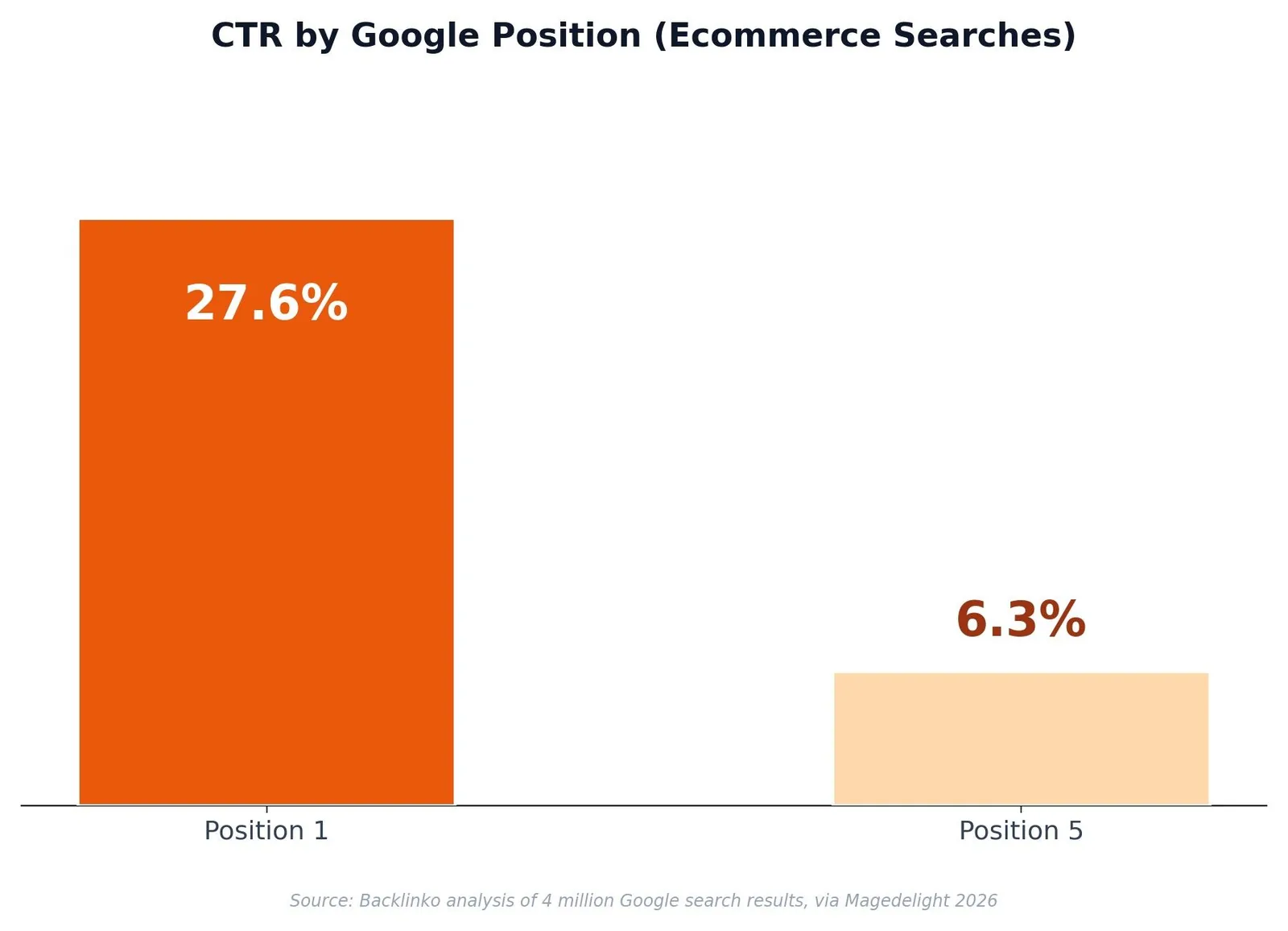
The starting point for any Shopify SEO strategy has to be this: 96.55 percent of all indexed pages get zero organic traffic from Google. Being live and being indexed isn't the same as ranking, and even ranking doesn't guarantee you're high enough to matter. Backlinko's analysis of 4 million Google search results found that the first organic result captures an average 27.6 percent click-through rate, dropping to roughly 6.3 percent by position five. For a Shopify store competing in a crowded product category, that gap is usually the difference between consistent monthly revenue and paying for ads to cover the shortfall.
That reality changes how keyword targeting should work. Broad, high-volume terms are the hardest to win and often the least valuable; long tail keywords make up more than 91 percent of all web searches and convert roughly 2.5 times higher than broad head terms (Ringly.io, 2026), precisely because a newer or smaller store can realistically compete for them.
Shopify SEO vs. Paid Search (Google Shopping / PPC)
| Factor | Shopify SEO (organic) | Google Shopping / PPC |
|---|---|---|
| Cost model | Time investment in content, structured data, and technical fixes | Cost-per-click, scales directly with ad spend |
| Conversion rate | Organic search converts at roughly 2.8% on average | Varies by campaign; strong intent but ongoing cost |
| Time to results | Weeks to months; compounds over time | Immediate, live same day |
| Longevity | Product and collection pages keep ranking after publication | Stops the moment ad spend stops |
| ROI over time | Ecommerce SEO can generate roughly 5.2x ROI over 36 months | Strong short-term, but doesn't compound the same way |
| Best fit | Long-term, compounding traffic for a growing catalog | Filling gaps fast, seasonal pushes, new product launches |
Most established Shopify stores run both. Paid search fills immediate gaps around launches and seasonal spikes, while organic SEO keeps producing traffic and orders long after any given campaign budget runs out. Ecommerce SEO can generate roughly 5.2x ROI over 36 months, a return that compounds in a way paid spend simply doesn't.
The Shopify SEO Roadmap
Step 1: Fix technical foundations first
Confirm indexing in Google search console, and check Core Web Vitals specifically. The average store in one 2026 analysis of the top 1,000 Shopify stores failed Google's Core Web Vitals standard, with a median Largest Contentful Paint of 3.4 seconds. No amount of content fixes this if pages are slow or blocked from crawling.
Step 2: Map every keyword to the right page type
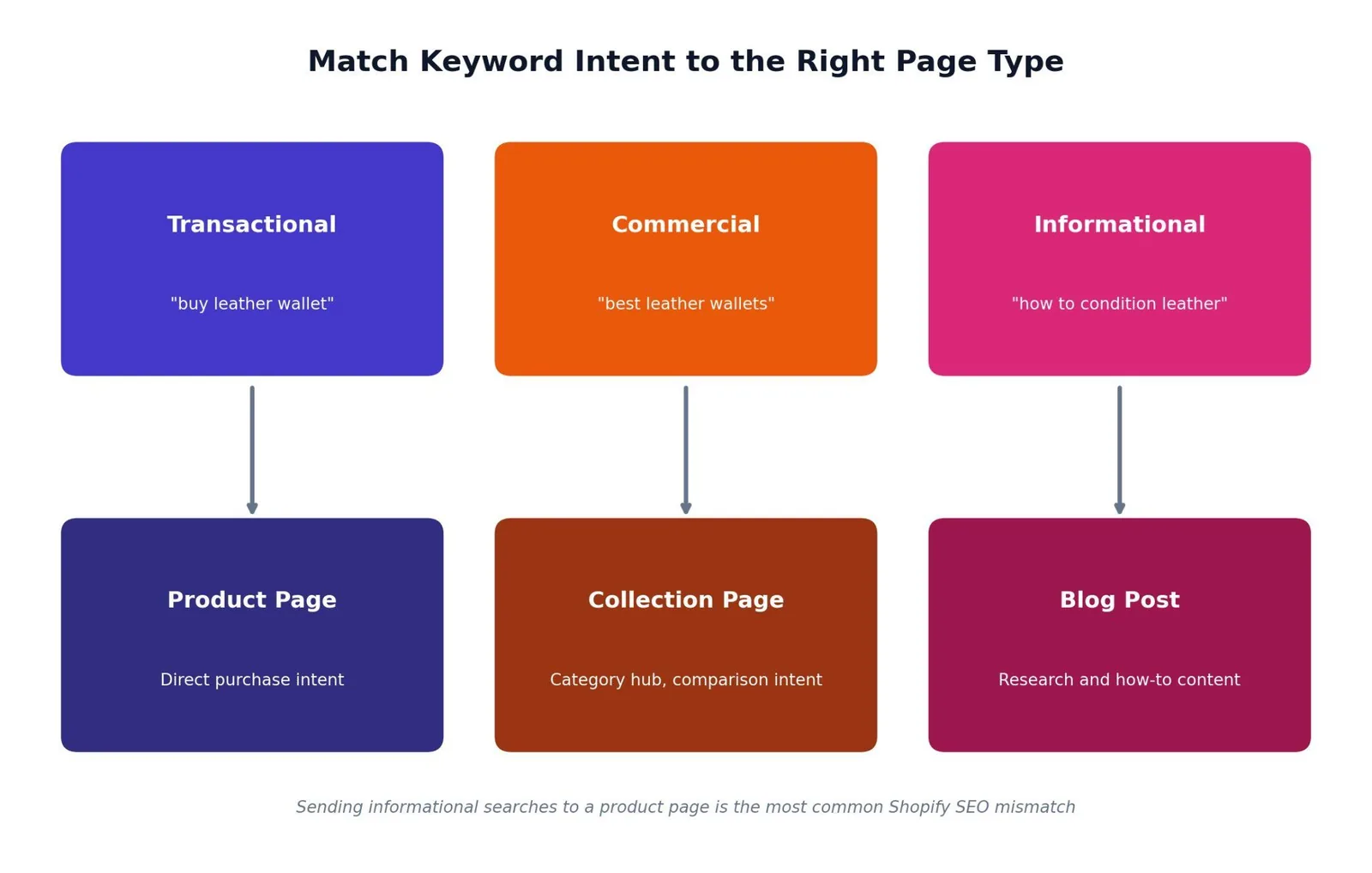
Transactional searches ("buy leather wallet") belong on product pages. Commercial searches ("best leather wallets") belong on collection pages. Informational searches ("how to condition leather") belong on blog posts. Sending an informational search to a product page produces thin content that satisfies no one, which is the single most common mismatch on Shopify stores.
Step 3: Complete the product data Shopify doesn't finish for you
Write specific alt text images for every product photo ("brown leather bifold wallet open showing card slots" beats "wallet" on every dimension), and add structured data for product schema. Rich results with proper schema markup see up to 82 percent higher click-through rates than standard listings, and Shopify's default schema output rarely covers everything Google can use.
Step 4: Build collection pages as real category hubs, not filters
For many stores, collection pages drive more organic traffic than individual product pages. A well-built collection page supports internal linking, captures broader keywords, and guides shoppers into the catalog, rather than just filtering a product grid.
Step 5: Earn backlinks instead of buying them
Top-ranking pages carry roughly 3.8 times more backlinks than lower-ranked competitors, and high quality backlinks from genuinely relevant sites still move rankings. Digital PR and expert commentary are the two most common tactics among ecommerce sites that build links successfully.
Step 6: Structure content for AI-assisted shopping
With 60 percent of US shoppers now using AI tools during their purchase journey, product and category content written to directly answer real buyer questions has a real shot at citation, and citation currently drives about 35 percent more organic clicks for the brands that earn it.
Is Your Shopify Store SEO-Ready?
Shopify SEO tool
Is your store SEO-ready?
Check off what's already true for your store. Your score updates as you go.
0 of 5
Check off items above to see how ready your store is.
Speed: The Ranking Factor Most Shopify Stores Ignore
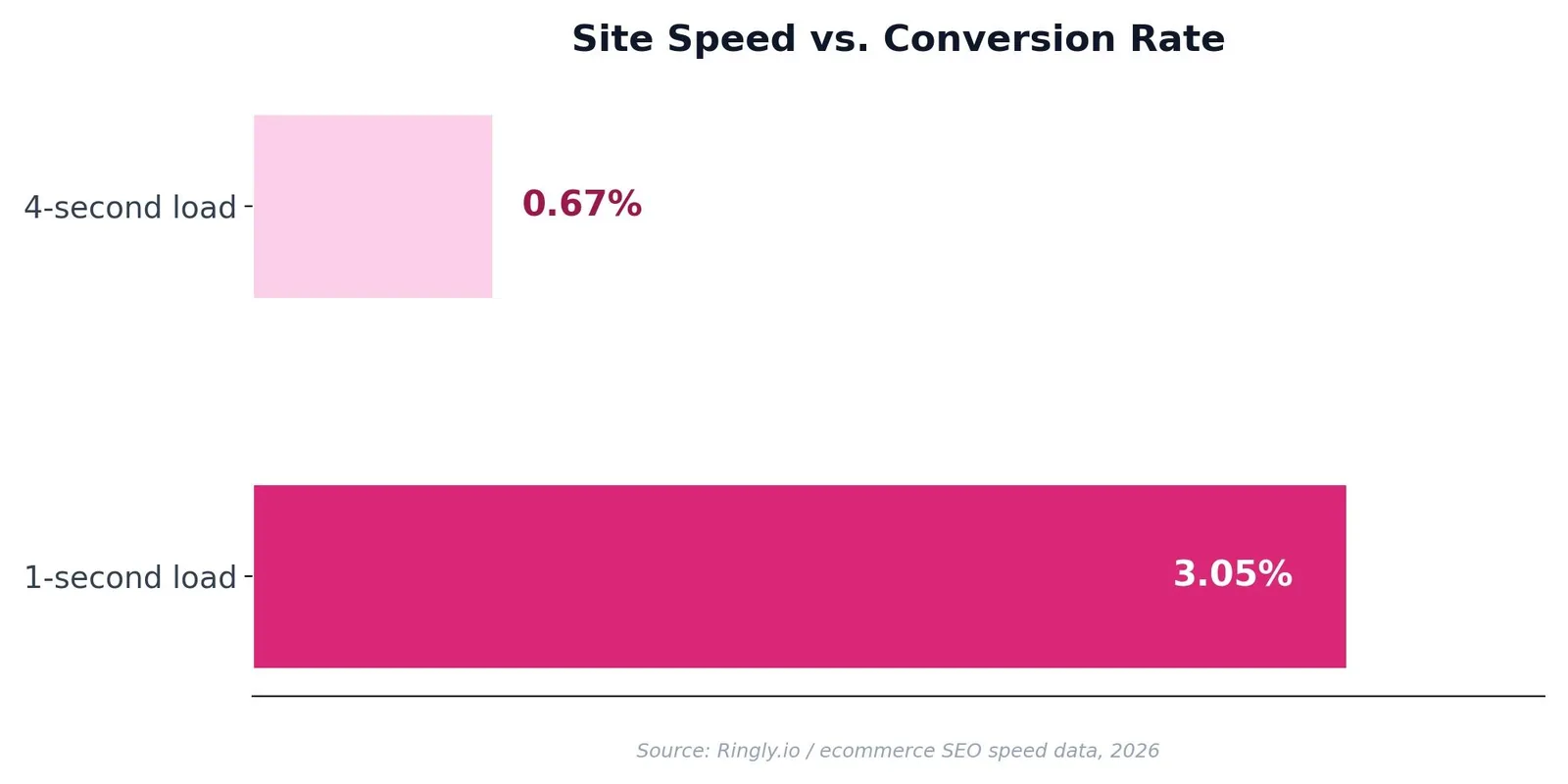
Speed is a ranking factor Google has weighed since 2021 through Core Web Vitals, but it's also a direct revenue lever on its own. Pages that load in 1 second convert at roughly 3.05 percent, compared to just 0.67 percent for pages that take 4 seconds (Ringly.io, 2026). Google's own "Milliseconds Make Millions" case study, a 2020 study conducted by Deloitte Digital, found that a 0.1-second improvement in mobile site speed produced an 8.4 percent increase in retail conversion rate. On Shopify, the usual culprits are bloated apps, oversized images, and heavy themes, not the platform itself.
SEO Tools Every Shopify Merchant Should Use
Google search console and Google analytics are free and essential: Search Console shows indexing status and which queries already bring traffic, while Analytics (with ecommerce tracking enabled) shows revenue by channel. Most merchants are surprised to discover organic search is their most consistent, highest-converting source once it's properly tracked. A dedicated rank tracker or platform like Ahrefs or Semrush adds visibility into competitor keywords and backlink profiles, useful before committing content resources to a term someone else already owns. Beyond tooling, a fast, well-structured site is also what shopify store owners point to when they talk about a better user experience, and the same product content that ranks well tends to travel further when shared on social media.
Common SEO Mistakes Shopify Merchants Make
The most common one is trusting that Shopify's default setup handles SEO completely. It generates a sitemap and manages robots.txt, but product schema, alt text, and internal linking still require deliberate work.
Targeting every keyword at product pages regardless of intent is a close second. Informational and commercial searches sent to a product page produce thin content that satisfies neither the searcher nor Google.
Installing SEO apps as a substitute for strategy is the quieter mistake. Apps can help with bulk metadata edits or image optimization, but a poorly configured one can slow a site down or create conflicts, and none of them replace a real content and technical plan.
And ignoring collection pages in favor of product pages alone wastes one of the highest-traffic page types available on the platform.
Frequently Asked Questions
Does Shopify handle SEO automatically?
Partially. Shopify generates sitemaps and manages robots.txt by default, but titles, meta descriptions, alt text, structured data, and internal linking all require manual or app-assisted work.
How much does Shopify SEO cost?
Costs vary by store size and market competitiveness; there's no single figure that applies everywhere. What's consistent is the payoff: ecommerce SEO can generate roughly a 5.2x return on investment over 36 months, which is a useful benchmark when weighing the investment against paid alternatives.
How long does it take to see results?
Content refreshes and topic clusters can show initial ranking improvement in 2 to 4 months. Larger initiatives like programmatic SEO for long-tail category pages typically take 6 to 9 months to generate meaningful traffic.
Do collection pages really matter more than product pages?
For many stores, yes. Collection pages act as category hubs, capture broader commercial-intent keywords, and often drive more organic traffic than individual product pages.
Does AI-assisted shopping change Shopify SEO strategy?
It's starting to. With 60 percent of US shoppers now using AI tools during their purchase journey, and brands cited in AI Overviews seeing roughly 35 percent more organic clicks, structuring product and category content to directly answer real buyer questions is becoming as important as traditional keyword targeting.
The Bottom Line on SEO for Shopify
Shopify handles the basics, but basics aren't what separates a store that ranks from one that doesn't. The stores that will keep winning treat product data, collection pages, technical performance, and backlinks as an ongoing system, not a one-time setup, and the 96.55 percent of pages getting zero traffic are proof of how much room most stores are leaving on the table.
Start with a Core Web Vitals check and a quick audit of whether your top keywords are actually mapped to the right page type. That's a workable starting point regardless of catalog size.
Ready to Turn Store Traffic Into Sales?
Coordinating technical fixes, structured data, collection page strategy, and AI search visibility all at once is where most merchants run out of time. Web Tonic's growth marketing team handles the technical SEO, content structuring, and paid search work covered in this playbook as part of a full-funnel approach, so your store's growth doesn't depend on one channel alone.
More from Web Tonic: growth marketing services, data & analytics.
Sources: magedelight.com · charleagency.com · bloggersideas.com · backlinko.com · ringly.io · seoprofy.com · rebootonline.com · 1digitalagency.com · web.dev