Table of contents
Someone types a question into Google. Somewhere in your back catalog, an episode answers that exact question in detail. But if that episode has no transcript, no real show notes, and a title like "Episode 47," Google will never connect the two. That gap, between what a podcast actually covers and what search engines can see, is the entire problem SEO for podcasts exists to solve.
SEO for podcasts means optimizing a show's titles, descriptions, show notes, and transcripts so both search engines and podcast platforms can understand and surface episodes to the people searching for them. It spans two related but distinct battlegrounds: ranking inside podcast apps like Apple Podcasts and Spotify, and ranking on the open web through a website Google can actually crawl. Best practices here shift with trends faster than most podcasters realize, and some older advice about how to optimize podcast episodes will actively hurt results in 2026. This guide focuses on the best SEO moves that still work in podcast search today. Most podcasters only ever work on one of the two battlegrounds, and lose real audience because of it.
Key Takeaways
- There are now an estimated 4.5 to 5+ million podcasts worldwide — estimates vary by research firm — competing for a global audience that multiple sources put at over half a billion listeners in 2025, so relying on great audio alone to stand out is no longer realistic. (SASPod)
- Apple Podcasts and Spotify use meaningfully different ranking signals: Apple leans heavily on show titles, episode titles, and author fields, while Spotify weighs descriptions and completion rate more heavily. (Truth Work Media, PodSEO)
- YouTube now functions as a genuine second search engine for podcasts, with more than 1 billion people discovering podcast content there every month, and uploads get indexed in Google search too. (SASPod)
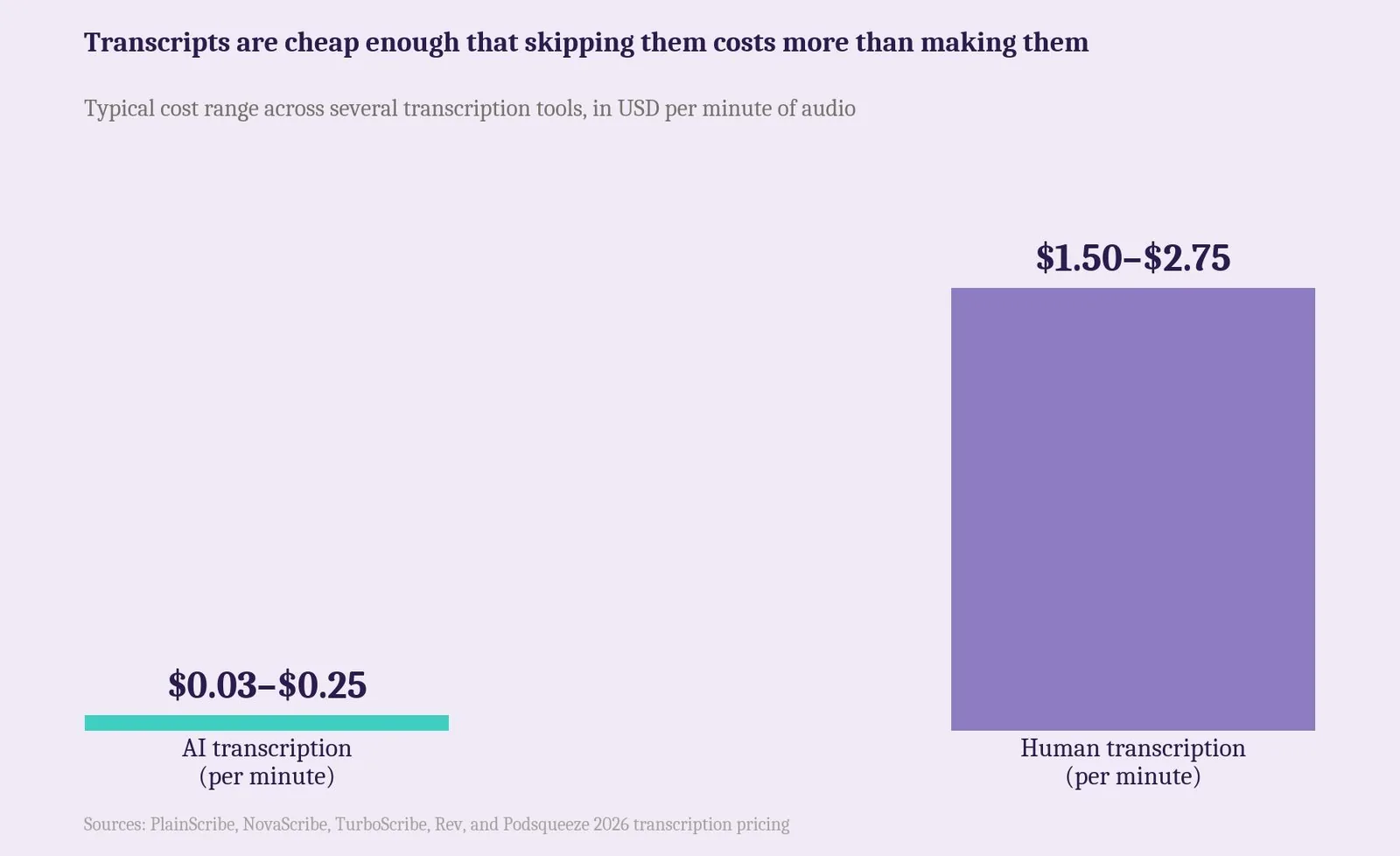
- Transcripts remain one of the highest-leverage, lowest-cost fixes available: AI transcription tools typically run $0.03 to $0.25 per minute depending on the tool, versus $1.50 to $2.75 per minute for human transcription — and a transcript turns an entire episode into content search engines can actually index. (PlainScribe, NovaScribe)
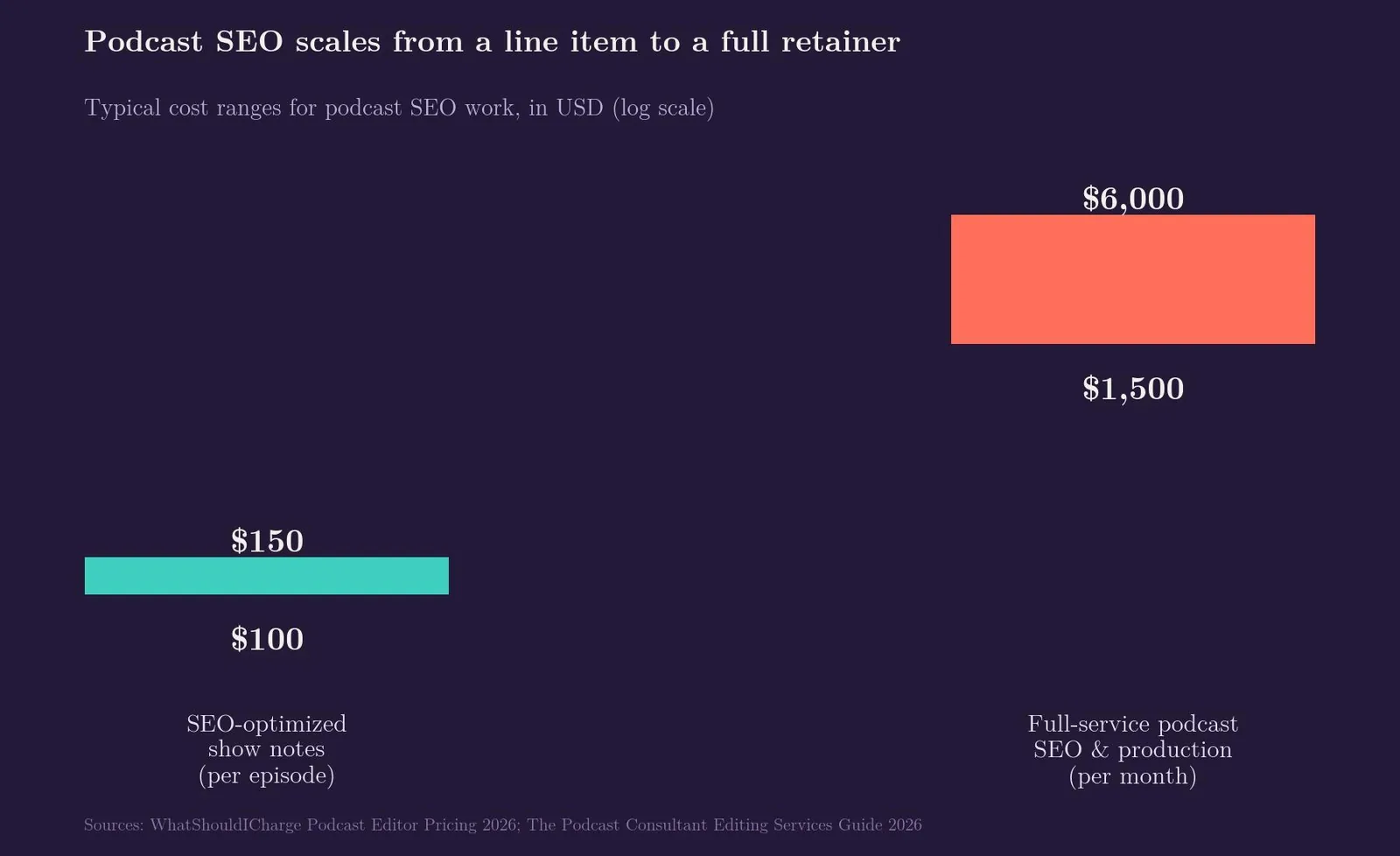
- SEO-optimized show notes typically cost $100 to $150 per episode, while a full-service podcast SEO and production retainer runs $500 to $6,000+ a month. (WhatShouldICharge, The Podcast Consultant)
- Episode titles carry outsized weight with both listeners and algorithms: vague titles like "Episode 10" get outperformed by specific, keyword-rich titles that tell both a search engine and a potential listener exactly what the episode covers.
Why Podcast SEO Requires a Different Playbook
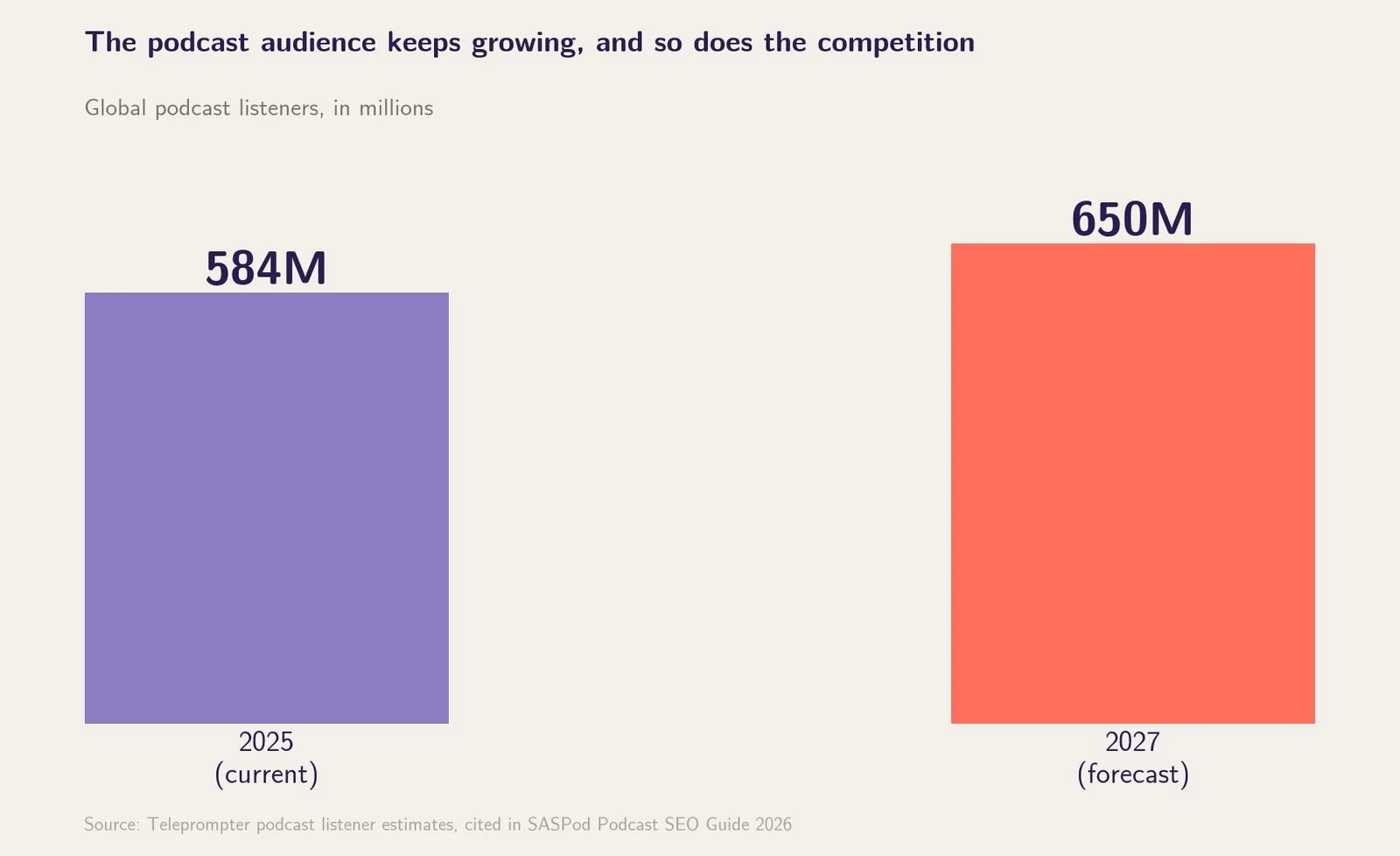
The competitive picture has shifted fast. There are now several million podcasts worldwide, and the audience, while still growing, isn't growing fast enough to make discoverability automatic. Podcast SEO is what separates a show that gets found from one that gets lost in a directory alongside millions of others.
Optimizing podcast content isn't the same discipline as optimizing a blog, and it's worth investing real effort into SEO. Podcasts that skip this step compete purely on production quality, which is a much harder way to win an audience. Search engines can't listen to audio directly, so every ranking signal has to come from text: titles, descriptions, show notes, and transcripts. That's true whether the goal is ranking inside Apple Podcasts and Spotify, or ranking a podcast episode page on Google search itself.
How Podcast SEO Differs From Website SEO
| Factor | Website SEO | Podcast SEO |
|---|---|---|
| Primary content search engines see | HTML text on the page | Titles, descriptions, show notes, and transcripts |
| Ranking surfaces | Google, Bing | Apple Podcasts, Spotify, YouTube, and Google |
| Core content asset | The page itself | The audio, plus everything written around it |
| Freshness signal | Content updates | New episode publishing cadence |
| Biggest missed opportunity | Thin content | No transcript at all |
Platform-Specific SEO: Apple Podcasts vs. Spotify vs. YouTube
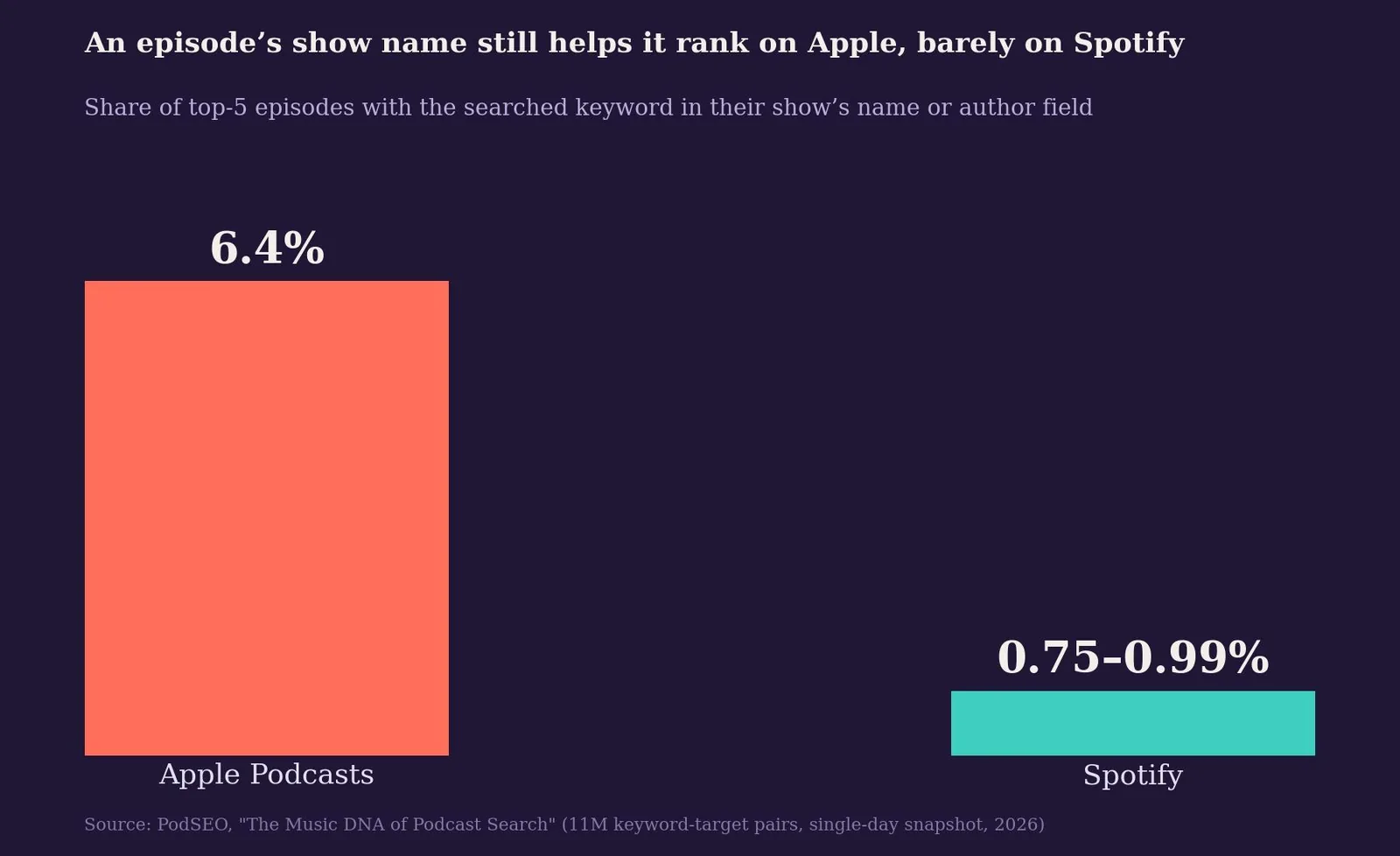
Apple Podcasts and Spotify inherited their search behavior from music apps, and it shows in how differently they rank content. A detailed analysis of roughly 11 million keyword-and-target pairs found that 6.4% of top-5 episodes on Apple Podcasts had the searched keyword in their show's name or author field, compared to just 0.75% to 0.99% on Spotify, a meaningfully lower rate. (PodSEO) Apple's search algorithm leans heavily on show titles, episode titles, and author name, and largely ignores the show description as a ranking signal. Spotify works differently: it does weigh descriptions, and it tracks completion rate, how much of an episode people actually finish, as a real ranking input. (Truth Work Media)
Episode Titles and Show Notes That Get Found
Most shows title episodes for existing listeners: guest name, episode number, an inside joke. Search does not reward that. Since Apple leans on show and episode titles, and Spotify weighs descriptions, the fix is to lead with the topic and keep the branding at the end, for example "How to Price a Retainer (with Jane Doe) — Ep. 142" instead of "Ep. 142 — Jane Doe". Keep the searchable phrase inside the first 40 characters, because that is roughly what survives truncation in most app listings, and follow the field limits published in Apple's podcast requirements.
Show notes then do the heavy lifting on the open web. A useful set of notes runs 300 to 600 words, opens with a two-sentence summary that answers the episode's core question, then lists timestamped topics, guest links, and any resource mentioned on air. That structure gives Spotify description text to weigh, gives Google a crawlable page, and gives you internal linking opportunities into your service and pillar pages.
Turn Every Episode Into an Indexable Page
The single highest-leverage podcast SEO move is giving each episode a real URL on your own domain: /podcast/episode-slug with the player embed, the edited transcript, the show notes, and internal links. That page can rank for long-tail questions your episode answers, which the audio file alone never will. Spotify auto-generates transcripts for many shows, and you can review and correct them before they display (Spotify for Creators) — export that corrected version rather than paying to transcribe twice.
A few structural details separate an episode page that ranks from one that just exists. Give the page a descriptive H1 that matches the searchable episode title. Break the transcript into H2 segments rather than a single block. Compress the cover art and lazy-load the player so the page still passes Core Web Vitals, since a heavy embed above the fold is a common cause of a poor Largest Contentful Paint score. And link each episode page to the two or three related episodes on the same theme, which builds a topic cluster instead of 140 orphan pages.
A Repeatable Weekly Podcast SEO Routine
Podcast SEO fails on consistency, not on tactics. The routine that holds up looks like this, per episode, in under an hour: pick the primary question the episode answers and confirm people search for it; write the title topic-first; publish the episode page with corrected transcript and notes; mirror the episode to YouTube with the same primary keyword; then link the new page from one older, better-performing episode page. Every four to six weeks, pull your top-performing episode pages and re-optimize the titles and intros of the ones sitting on page two.
Done this way, each episode contributes a durable indexable asset rather than a spike of downloads that decays in a week. That compounding library, not any single viral episode, is what turns a podcast into a search channel.
Frequently Asked Questions
Does podcast SEO actually affect Google rankings, or only in-app search? Both, but through different assets. Apple Podcasts and Spotify search rank your show and episode metadata inside their own apps. Google ranks the episode page on your website — the transcript, show notes, and headings are what it can crawl. If every episode lives only inside a podcast app, Google has almost nothing to index, which is why the episode page matters as much as the feed.
How long should a podcast episode transcript be edited before publishing? Enough to fix speaker labels, obvious mis-transcriptions of names and product terms, and paragraph breaks. Raw machine transcripts rank poorly because they are one unbroken wall of text with no headings. Budget 15 to 30 minutes per episode: add H2s for each topic segment, bold the key questions, and leave the wording otherwise intact.
Should I publish podcast episodes on YouTube as well? For most shows, yes. YouTube gives an episode a second searchable surface with its own captions, chapters, and description, and video episodes can surface in Google as well as in YouTube search. Treat the YouTube description as a shortened version of your show notes, with the same primary keyword in the title.
More from Web Tonic: growth marketing services, data & analytics, performance creative.
Sources: saspod.com · truthworkmedia.com · blog.podseo.com · plainscribe.com · novascribe.ai · whatshouldicharge.io · thepodcastconsultant.com · podcasters.apple.com · support.spotify.com · web.dev