Table of contents
No published study prices senior living video production as a line item, so this page builds the number from two inputs: Wyzowl's 2026 marketer-wide spend survey, and two named senior living case studies with disclosed results. Treat every dollar figure below as a case result, not a guaranteed outcome.
Key Takeaways
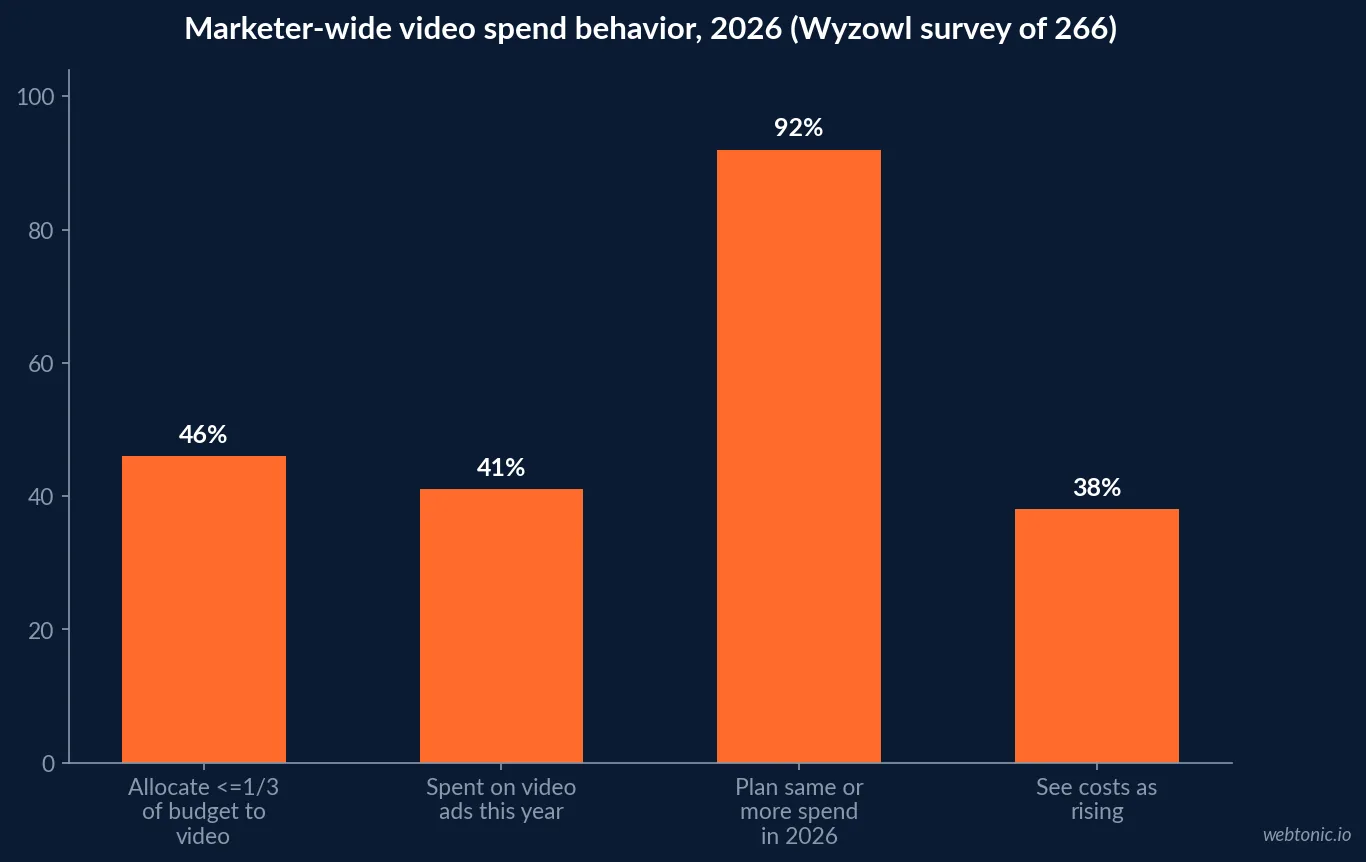
- 46% of marketers allocate a third of budget or less to video (Wyzowl, 2026).
- 41% of marketers spent money on video ads this year, up from 36% last year.
- 91% of businesses use video as a marketing tool, back at a joint all-time high.
- 93% call video an important part of their strategy.
- 82% of marketers say video gave them a good ROI, down from 93% the year before.
- 67% of marketers quantify video ROI through video views, the most common method, ahead of engagement (63%) and leads/clicks (52%).
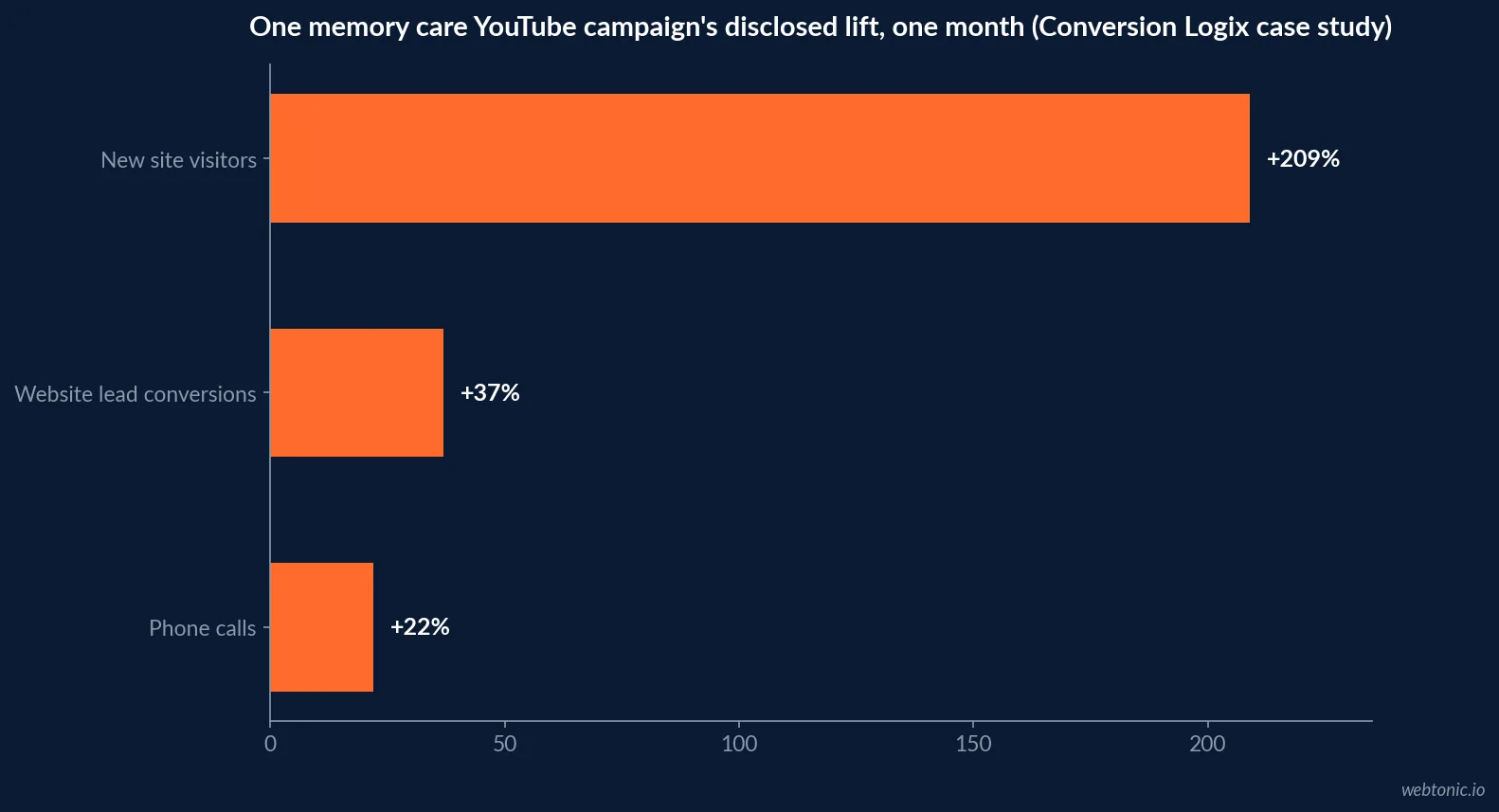
- One memory care YouTube campaign drove a 209% rise in new visitors (Conversion Logix case study).
- The same campaign lifted lead conversions 37% and calls 22% in one month.
- One resident-story video lifted tour requests 18% (OneDay case study).
- The same video doubled email click-through rate and was shared 47 times.
- YouTube adoption runs 85% among 50-64 year-olds versus 64% among 65-plus.
- 53% of assisted living residents are 85 or older - the audience is the family, not the resident (AHCA/NCAL).
- 63 million family caregivers nationwide now research and coordinate care online (AARP).
- Senior housing occupancy hit 89.9% in Q2 2026, raising the value of every tour a video generates (NIC MAP).
- 71% of adults 50-plus bought new technology in 2025, up from 67% in 2024 (AARP).
Why there is no published price for this
Senior living video is sold as a production service, and production services are not benchmarked by vertical the way ad platforms are. The nearest published data is marketer-wide: Wyzowl's 2026 State of Video Marketing survey of 266 marketing professionals, and two disclosed senior living case studies from vendors who work in the category. Neither substitutes for a category-specific benchmark, and this page treats them accordingly - case evidence, not an average to expect.
| Spend signal (2026) | Figure | Source | What it implies for budgeting |
|---|---|---|---|
| Marketers allocating <=1/3 of budget to video | 46% | Wyzowl | Video sits inside the existing budget, not on top of it |
| Marketers who spent on video ads this year | 41% | Wyzowl | Up from 36% last year - adoption is still rising |
| Marketers planning same-or-more spend in 2026 | 92% | Wyzowl | Cuts to video budget are rare |
| Marketers unsure how much they spend on video | 17% | Wyzowl | Tracking spend is itself a gap worth closing |
| Marketers who see costs as rising | 38% | Wyzowl | Budget for inflation on production costs |
What a resident-story video is worth in one disclosed case
The clearest senior living-specific evidence available names its own numbers. OneDay's own resident-story case study reported that one Midwest community's short resident video, shared over email, Facebook and the community homepage, lifted tour requests 18%, doubled email click-through rates, and was shared 47 times, mostly by family members, in the first two months. That is one operator's case, not an industry rate card - useful as a method to replicate with a community's own numbers, not as a number to copy.
| Metric | Before | After | Source |
|---|---|---|---|
| Tour requests (OneDay resident-story case) | baseline | +18% | OneDay case study |
| Email click-through rate (same case) | baseline | 2x (doubled) | OneDay case study |
| New site visitors (Conversion Logix case, one month) | baseline | +209% | Conversion Logix case study |
| Website lead conversions (same campaign) | baseline | +37% | Conversion Logix case study |
| Phone calls (same campaign) | baseline | +22% | Conversion Logix case study |
A single YouTube campaign's disclosed funnel lift
Conversion Logix's disclosed case study for one memory care community found that a YouTube ad campaign generated 125,750 ad impressions, 3,411 video views and 2,612 ad clicks in the month after launch, translating to a 209% increase in new visitors, a 37% increase in website lead conversions and a 22% increase in phone calls. The same case study cites YouTube adoption at 85% among 50-64 year-olds against 64% among adults 65 and older as the reason the format works for this category: the ad is reaching the adult child doing the research, not the eventual resident.
What marketers say video delivers, industry-wide
Cross-industry, Wyzowl's 2026 survey found 82% of marketers say video marketing gave them a good ROI - a real drop from the prior year's all-time high of 93%, but still a dominant result. Marketers measure that return unevenly: 67% via video views, 63% via engagement, 52% via leads or clicks, and only 32% via bottom-line sales - which means most of the industry is not actually tying video spend to revenue, a gap a senior living operator can close by measuring against Aline's own inquiry-to-tour data instead of view counts.
| How marketers quantify video ROI | Share using this method | Source |
|---|---|---|
| Video views | 67% | Wyzowl 2026 |
| Engagement (likes/shares/reposts) | 63% | Wyzowl 2026 |
| Leads/clicks | 52% | Wyzowl 2026 |
| Customer engagement/retention | 40% | Wyzowl 2026 |
| Bottom-line sales | 32% | Wyzowl 2026 |
Pricing the production calendar, not a single video
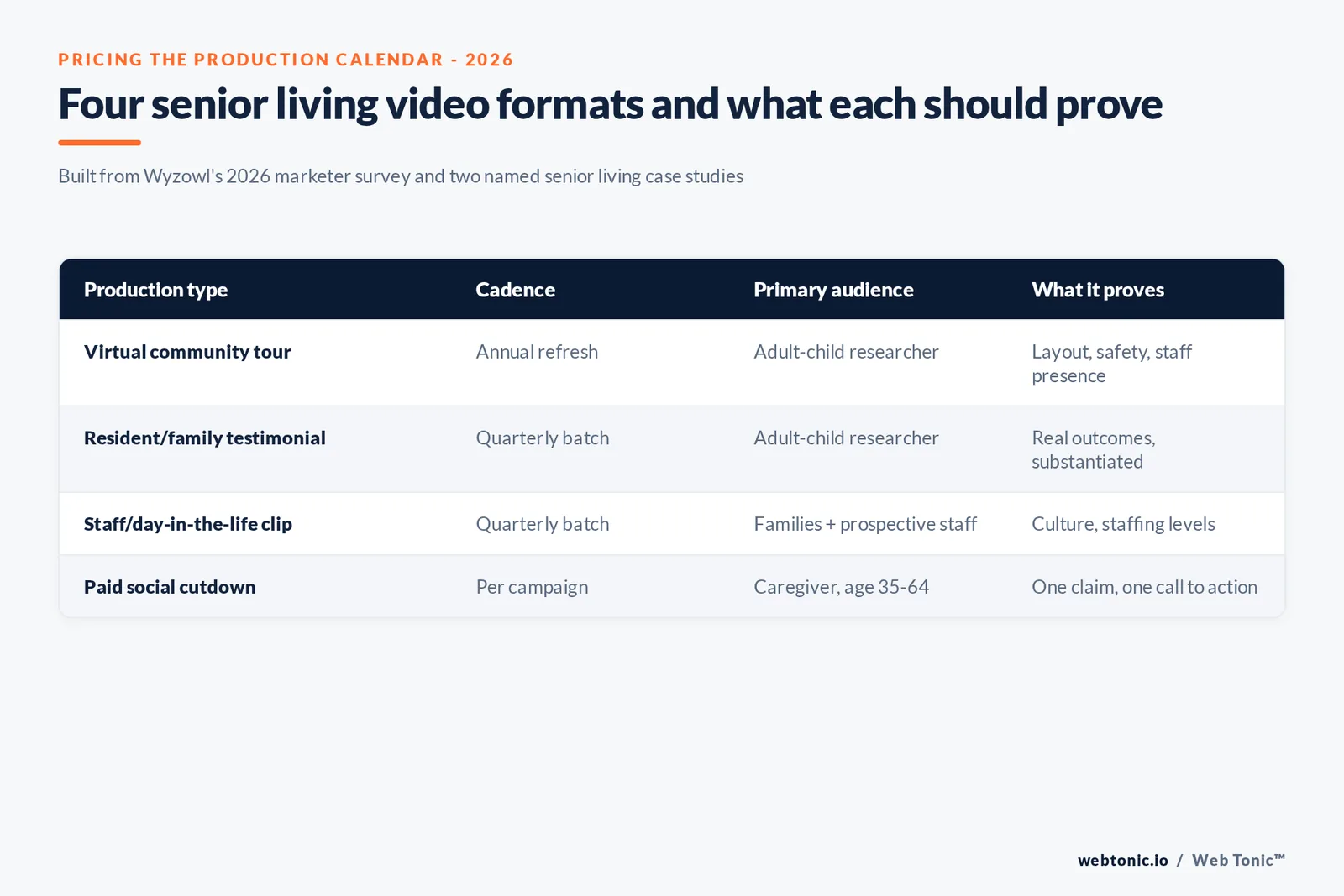
Because 46% of marketers already run video inside a third of their existing budget, the practical planning unit for a senior living operator is a production calendar - a virtual tour refreshed annually, resident/family testimonial clips shot in shorter batches, and paid social cutdowns for whichever platform is carrying the ad spend that quarter - rather than one large annual shoot. That calendar shape also matches the 38% of marketers who see video production costs rising: shorter, more frequent pieces are easier to re-budget mid-year than a single six-figure production.
| Production type | Typical cadence | Primary audience | What it should prove |
|---|---|---|---|
| Virtual community tour | Annual refresh | Adult-child researcher | Layout, safety, staff presence |
| Resident/family testimonial | Quarterly batch | Adult-child researcher | Real outcomes, not scripted lines |
| Staff/day-in-the-life clip | Quarterly batch | Prospective staff + families | Culture, staffing levels |
| Paid social cutdown (15-30s) | Per campaign | Adult-child researcher, 35-64 | One claim, one CTA |
The consent question video always raises
Filming current residents for marketing use is the one part of a senior living video program with no clean industry benchmark and a real compliance question attached: residents with cognitive decline may not be able to give informed consent, and the FTC's Health Products Compliance Guidance requires that any testimonial used in advertising reflect the honest, substantiated experience of the endorser - not a scripted outcome the operator cannot back up. A signed, per-resident release kept on file, refreshed if the resident's care level changes, is the practical answer; a blanket release signed at move-in is not.
Why the timing favors investing now
NIC MAP's Q2 2026 data put senior housing occupancy at 89.9%, the highest level since 2015, and AARP's 2026 research found 71% of adults 50-plus bought new technology in 2025, up from 67% in 2024 - the audience watching a virtual tour on a phone is more comfortable with the format every year. Combined with tight inventory, a video that shortens the research phase for an already-scarce inquiry is worth more today than it was even two years ago. Our performance creative practice builds that production calendar against a community's own funnel data rather than a generic video brief, and our take on whether paid social is worth the spend is a useful read before committing a video budget to a specific platform.
What channels carry the finished video
A production budget is only half the plan; the other half is where the finished asset runs. Cross-industry, healthcare-adjacent paid social sits in a narrow cost band that gives a rough sense of what distributing a senior living video will cost once it is cut for paid placement: WordStream's 2025 Facebook Ads Benchmarks put the Health and Fitness category's average cost per click at USD 2.64 and cost per lead at USD 52.98 for lead-objective campaigns, against an all-industries average cost per lead of USD 27.66. A video cut for a Facebook or Instagram lead campaign is entering a category that already runs roughly double the blended average cost per lead, which argues for a tightly targeted list (care type, radius, caregiver age) rather than a broad boost.
| Distribution channel | Cross-industry cost signal | Fit for senior living video |
|---|---|---|
| Owned website (virtual tour page) | No direct media cost | Highest-intent viewer, already researching |
| Facebook/Instagram lead ads | CPL ~USD 52.98, Health & Fitness (WordStream) | Reaches caregiver 35-64 at a premium CPL |
| YouTube in-stream ads | Case result: +209% new visitors (Conversion Logix) | Proven in one disclosed memory care case |
| Organic social (TikTok, Reels) | No media cost, time cost only | Builds perception before the search starts |
Budgeting the shoot day itself
Neither Wyzowl nor the two named case studies price a shoot day directly, which is the honest gap in this data: there is no senior-living-specific day rate published anywhere in the industry research this page draws from. What the evidence does support is sequencing - a virtual tour shoot benefits from natural light and minimal narration, and testimonial and staff-culture clips are cheaper to produce in short batches than as one long-form annual film, which is also why 46% of marketers keep video inside a third of their existing budget rather than treating it as a separate line item requiring new approval each time. See our team for a scoped estimate once a care-type and format list is set.
Frequently Asked Questions
What should a senior living community budget for video in 2026?
No published study prices senior living video production as a line item, so the honest starting point is marketer-wide behavior: Wyzowl's 2026 survey of 266 marketers found 46% allocate a third of their total marketing budget or less to video, and 41% have spent money on video ads this year, up from 36% the year before. Applied to a community's existing marketing budget, that puts a realistic video line in the same range most operators already spend on photography and print - the shift is toward more frequent, shorter pieces rather than one large annual production.
Does video actually move tours and move-ins, or just impressions?
The named case evidence says yes on both counts, though each is a single case, not an industry average. Conversion Logix's YouTube ad campaign for one memory care community drove a 209% increase in new site visitors, a 37% increase in website lead conversions and a 22% increase in phone calls in the month after launch. A separate OneDay resident-story video for one community lifted tour requests 18% and doubled the email click-through rate in the two months after it was shared. Neither figure is a benchmark to expect by default.
Who is the video actually for - the resident or the family?
Mostly the family. Conversion Logix's own case data cites an 85% YouTube adoption rate among 50-64 year-olds against 64% among adults 65 and older, and AHCA/NCAL puts 53% of assisted living residents at 85 or older - an age group unlikely to watch and share a video ad. The buyer researching options on a phone at night is the adult child, which argues for videos that answer their questions (cost, safety, staff-to-resident ratio) rather than lifestyle footage aimed at the resident.
Is virtual-tour video a nice-to-have or a required asset now?
Wyzowl's 2026 survey puts video adoption back at a joint all-time high, with 91% of businesses using video as a marketing tool and 93% calling it an important part of their strategy. For senior living specifically, a virtual tour answers the single most time-consuming step in the sales process - the in-person walkthrough - before a family commits to visiting, which is why Argentum-affiliated operators increasingly treat it as baseline collateral rather than an add-on.
What privacy issues come up when filming residents for marketing video?
Filming current residents raises consent questions that a standard model release does not fully cover - residents with cognitive decline may not be able to give informed consent, and family members, not the resident, are often the ones who need to sign off. There is no federal senior-living-specific rule for this, so operators should treat resident video consent with the same rigor state health departments apply to photography in licensed care settings, and keep signed releases on file per resident, not per shoot.
Sources
Wyzowl - Video Marketing Statistics 2026
Conversion Logix - YouTube Ads Drive Traffic for Memory Care Community (case study)
OneDay - Resident Stories That Sell (case study)
AHCA/NCAL - Assisted Living Fast Facts and Figures, June 2026
AARP - 2026 Tech Trends and Adults 50-Plus
NIC - Senior Housing Occupancy Climbs in Second Quarter 2026
FTC - Health Products Compliance Guidance