Table of contents
Senior housing occupancy reached 89.9% in the second quarter of 2026, the highest level in over a decade, while more than a third of caregivers still search for care entirely on their own. That combination - tight supply and self-directed, time-pressured search - is what actually shapes senior living SEO in 2026, built here from NIC MAP, A Place for Mom, AHCA/NCAL, BrightLocal and Pew's own published 2025-2026 data.
Key Takeaways
- Senior housing occupancy hit 89.9% in Q2 2026, the highest since late 2015.
- Assisted living occupancy rose to 88.4%, independent living to 91.3%.
- New supply growth stayed under 1% annually for a fifth straight quarter.
- There are about 41,465 assisted living communities in the US.
- Those communities hold nearly 1.4 million licensed beds.
- 66% of family caregivers are women, most often adult daughters.
- More than two-thirds of caregivers who found care searched 60 days or less.
- 73% of care searches start from gradually increasing needs, not a single event.
- 54% of caregivers wish they had started planning sooner.
- 34% of caregivers take a fully do-it-yourself search approach.
- 47% lean on health workers, friends or family for recommendations.
- 88% say families need more guidance navigating the search.
- Trust in reviews as much as personal recommendations fell to 42% in 2025.
- That is down from 79% in 2020.
- 75% of adults 65 and older are internet users, versus 96% of those 50-64.
- The 65+ internet-use gap versus 18-29 year olds narrowed to 24 points.
Why occupancy pressure raises the stakes for organic search
The competitive backdrop for senior living SEO changed materially in 2026. NIC's Q2 2026 data put overall senior housing occupancy at 89.9%, up 0.4 percentage points and only 10 basis points from crossing 90% for the 31 NIC MAP Primary Markets - a level last seen at the end of 2015. Independent living occupancy reached 91.3% and assisted living 88.4%, the narrowest gap between the two property types since 2014. Inventory growth, meanwhile, stayed below 1% year over year for a fifth consecutive quarter.
When most communities are nearly full and few new units are coming online, the organic search result that wins the click is competing for a genuinely scarcer pool of available beds - which is a direct argument for treating local SEO as lead-generation infrastructure, not a brand-awareness nice-to-have.
| Occupancy metric (Q2 2026) | Figure | Source | SEO implication |
|---|---|---|---|
| Overall senior housing occupancy | 89.9% | NIC MAP, Q2 2026 | Highest since 2015; competition for remaining units is fierce |
| Independent living occupancy | 91.3% | NIC MAP, Q2 2026 | IL communities can be more selective in who they target |
| Assisted living occupancy | 88.4% | NIC MAP, Q2 2026 | Still the largest gap-to-full among major property types |
| Markets above 90% occupancy | 15 of 31 primary markets | NIC MAP, Q2 2026 | Local, market-specific SEO strategy matters more than a national template |
| Assisted living communities in the US | ~41,465 | AHCA/NCAL Facts & Figures 2025 | Local pack competition is dense in most metros |
Who is actually typing the search query
A Place for Mom's 2025 Senior Care Search Trends report, based on 1,104 caregiver surveys, found that 66% of family caregivers are women, with adult daughters and daughters-in-law most often leading the search. About 34% of caregivers are simultaneously raising children of their own - the "sandwich generation" - and 45% are themselves 60 or older. Most care recipients (83%) live within a 30-minute drive of the caregiver searching for them.
That profile argues for content built around a caregiver's decision criteria - cost transparency, care level comparisons, proximity - rather than resident-facing lifestyle marketing alone.
| Caregiver profile (2025) | Figure | Source |
|---|---|---|
| Family caregivers who are women | 66% | A Place for Mom, 2025 Senior Care Search Trends |
| Caregivers also raising their own children | 34% | A Place for Mom, 2025 |
| Caregivers age 60 or older themselves | 45% | A Place for Mom, 2025 |
| Care recipients within a 30-min drive of caregiver | 83% | A Place for Mom, 2025 |
| Care recipients who are women, ages 75-84 | 37%, the largest single band | A Place for Mom, 2025 |
The search window is shorter than most SEO plans assume
The same A Place for Mom report found that 73% of caregivers begin their search because of gradually increasing needs rather than one specific trigger, yet more than two-thirds of those who ultimately found care searched for 60 days or less. Meanwhile, caregivers who have not yet started expect far more time: 44% think they are more than a year away from a decision, a gap that leads 54% of all caregivers to wish they had started sooner - a figure that rises to 77% among those currently searching.
A senior living page therefore has to front-load the exact information (level of care, approximate cost, current availability) that a 60-day, high-urgency search needs, rather than a slower-funnel content strategy built for a multi-month decision cycle. Pair that page-level clarity with a working, tracked phone number - our breakdown of cost-per-lead benchmarks by industry shows how expensive a missed senior-living call already is relative to other verticals.
| Search-timeline fact (2025) | Figure | Source |
|---|---|---|
| Search prompted by gradual need, not one event | 73% | A Place for Mom, 2025 |
| Caregivers who found care in 60 days or less | More than two-thirds | A Place for Mom, 2025 |
| Not-yet-searching caregivers expecting 1+ year runway | 44% | A Place for Mom, 2025 |
| All caregivers wishing they'd started sooner | 54% | A Place for Mom, 2025 |
| Currently-searching caregivers wishing they'd started sooner | 77% | A Place for Mom, 2025 |
How families actually navigate the search, and where reviews fit
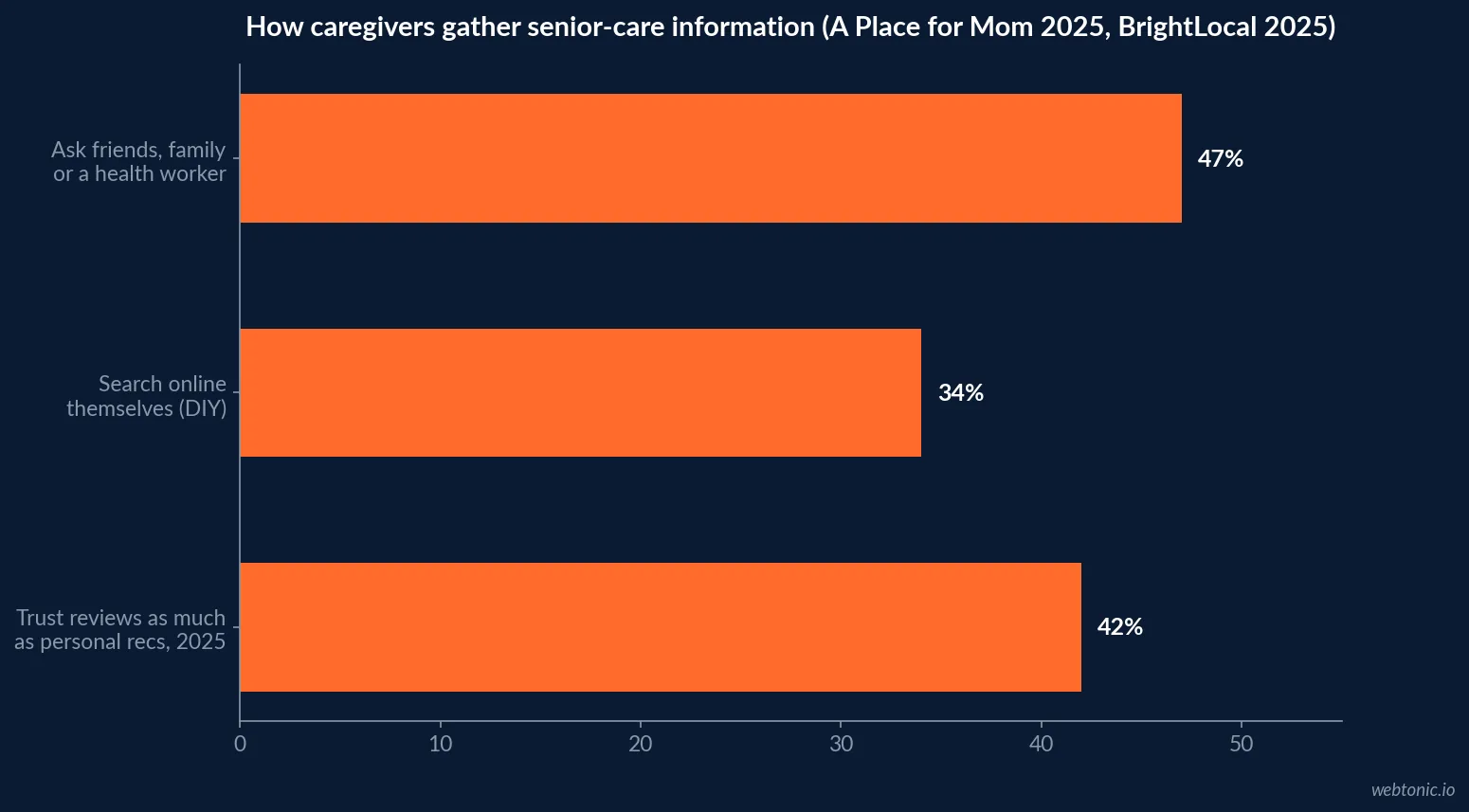
A Place for Mom found 88% of caregivers agree families need more guidance navigating the senior care search, with 34% taking a fully do-it-yourself online approach and 47% leaning on conversations with health professionals, friends or family. Review trust is shifting at the same time: BrightLocal's 2025 Local Consumer Review Survey found that the share of consumers who trust reviews as much as personal recommendations fell to 42%, down from 79% in 2020, even as review volume continues to climb.
Reviews still matter for local pack visibility and click-through, but the BrightLocal trend line argues against treating review count alone as a trust silver bullet - accurate Google Business Profile category selection and transparent, current information now carry more of the trust-building weight than they did five years ago.
| How families search for senior care (2025) | Figure | Source |
|---|---|---|
| Families needing more guidance in the search | 88% | A Place for Mom, 2025 |
| Caregivers taking a fully DIY online approach | 34% | A Place for Mom, 2025 |
| Caregivers relying on professionals/friends/family | 47% | A Place for Mom, 2025 |
| Consumers trusting reviews as much as personal recs (2025) | 42% | BrightLocal, 2025 |
| Same trust figure in 2020 | 79% | BrightLocal, 2025 (historical comparison) |
The connectivity gap the content itself has to account for
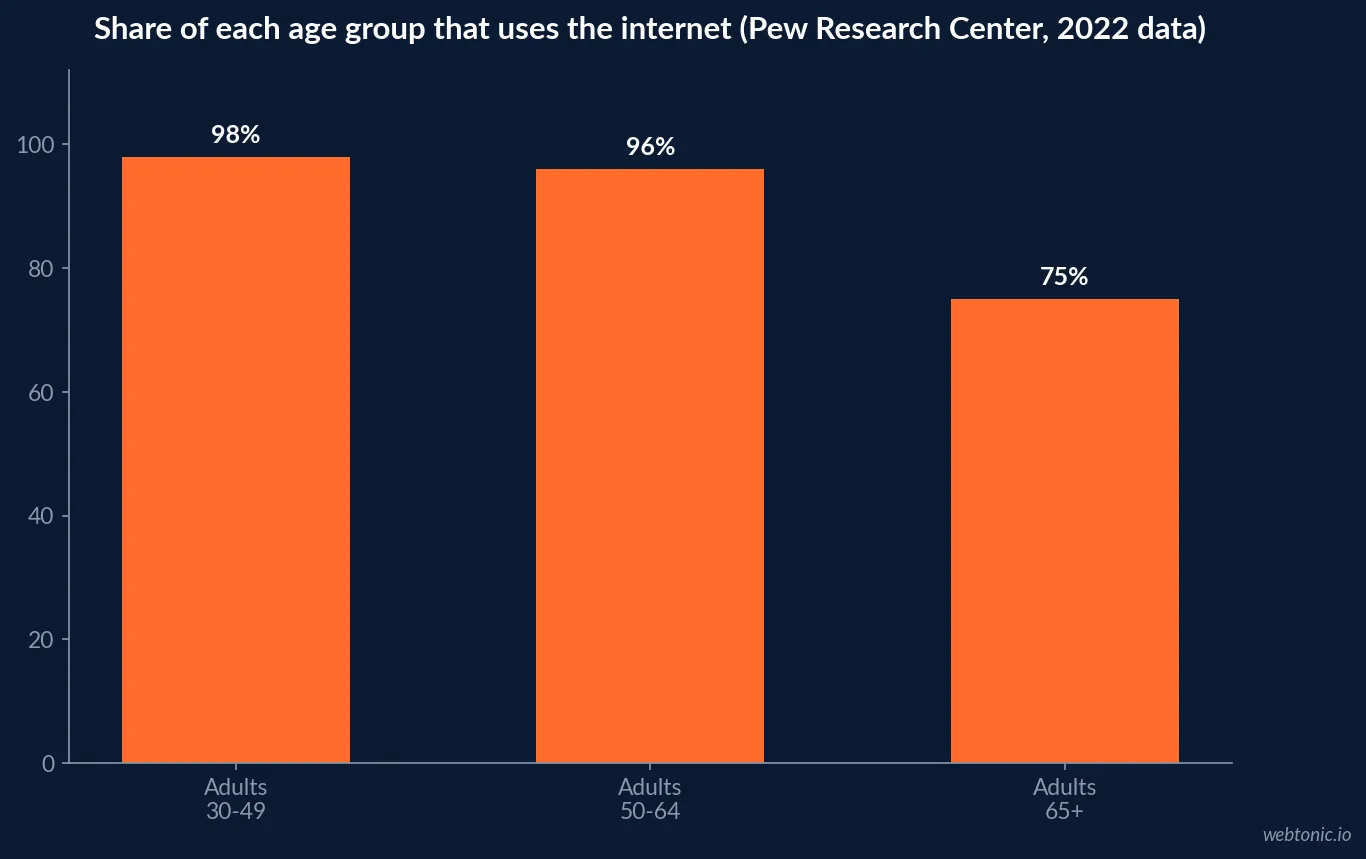
Pew Research found that 75% of adults 65 and older were internet users, versus 96% of those 50 to 64 and 98% of those 30 to 49 - still the widest generational gap Pew measures, even as it has narrowed from 56 points to 24 points since 2000. Since the caregiver data above shows most searches are led by adult children rather than the prospective resident, that gap matters less for who finds the page and more for making sure any resident who does click through can still use it: larger type, simple navigation, and a phone number that works without a form.
| Age group | Internet users | Source |
|---|---|---|
| 18-29 | 99% | Pew Research Center (2022 data) |
| 30-49 | 98% | Pew Research Center (2022 data) |
| 50-64 | 96% | Pew Research Center (2022 data) |
| 65+ | 75% | Pew Research Center (2022 data) |
What a senior living SEO plan should prioritize in 2026
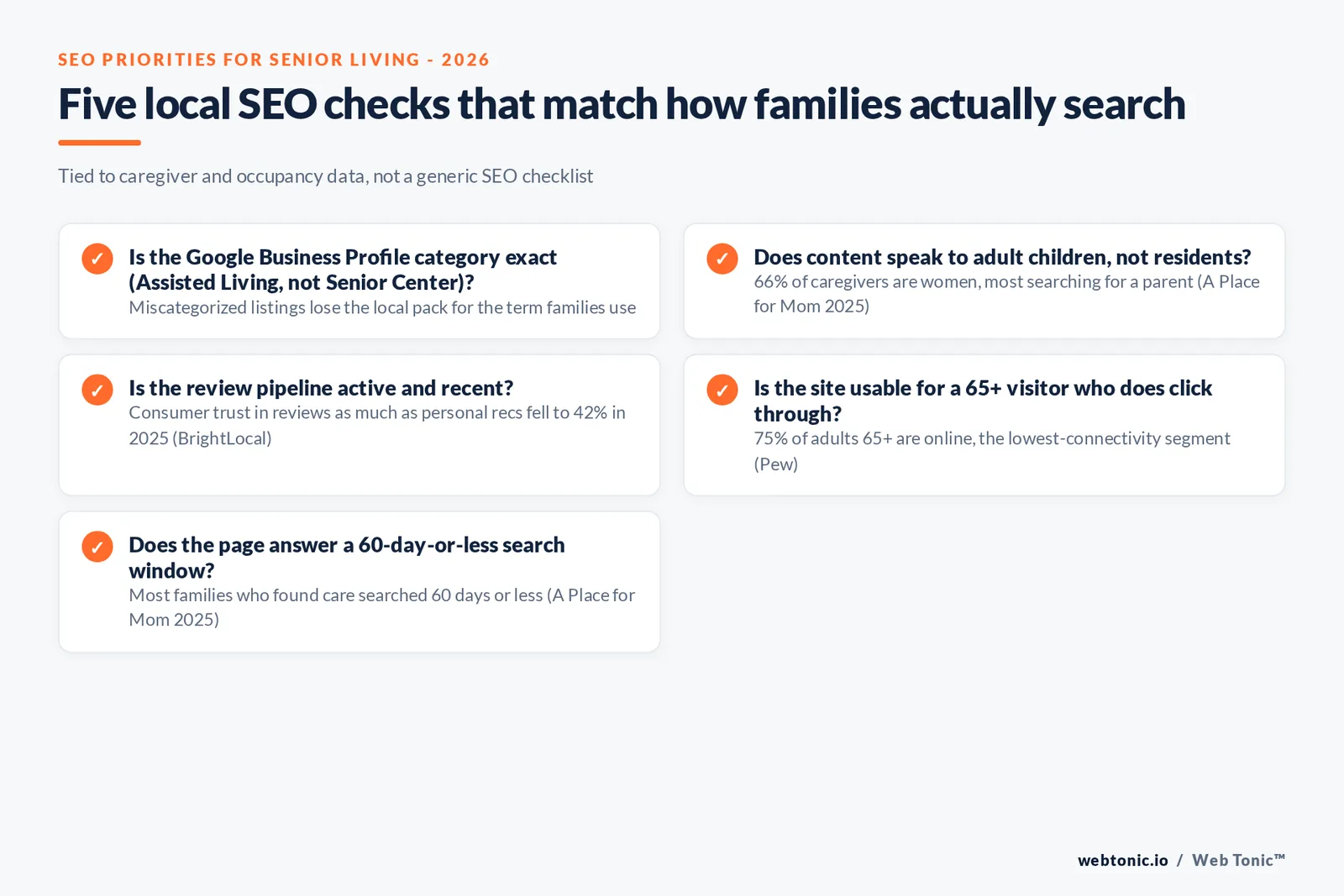
Given tight occupancy, a compressed search window, and shifting review trust, the priority order is: an exactly-matched Google Business Profile category for each property type, cost and care-level clarity inside the first screen of the page, a current and specific review pipeline rather than volume alone, and accessible page design for the minority of searches led directly by an older adult. Our growth marketing practice builds senior living local SEO around that caregiver-first search behavior rather than a generic local-business template - talk to us if you want that audit run against your own market's occupancy numbers.
Frequently Asked Questions
Who is senior living SEO actually written for?
Adult children, not residents. A Place for Mom's 2025 Senior Care Search Trends report found that women make up 66% of family caregivers and that adult daughters and daughters-in-law most often lead the search for professional care. Content, meta descriptions and even the tone of a senior living site's service pages should be written for a searcher researching on behalf of a parent, not for the resident who will eventually move in.
Why does occupancy data matter to an SEO strategy?
Because it changes the competitive stakes of ranking. NIC MAP's Q2 2026 data put senior housing occupancy at 89.9%, the highest level since the end of 2015, with new supply growing below 1% annually for a fifth straight quarter. When most communities are nearly full and new supply is scarce, the operators fighting for the same local search visibility are fighting over a shrinking pool of open units, which raises the value of every organic lead a well-optimized page captures.
How long is the actual search window an SEO strategy has to work with?
Shorter than most teams plan for. A Place for Mom's 2025 data found that more than two-thirds of caregivers who found care searched for 60 days or less, even though caregivers who had not yet started expected to have far more runway. A senior living page has to answer the family's core questions - cost, care level, availability - inside that compressed window, not over a multi-month nurture sequence.
Do online reviews still matter for senior living local SEO?
Yes, though trust in them is shifting. BrightLocal's 2025 Local Consumer Review Survey found that consumers trusting reviews as much as personal recommendations fell from 79% in 2020 to 42% in 2025, even as review volume keeps growing. That argues for treating reviews as one trust signal among several - alongside a specific, accurate Google Business Profile category and clear pricing information - rather than the single lever that wins local search.
Does SEO content need to account for a 65+ audience reading it directly?
Partly. Pew Research found that 75% of adults 65 and older were internet users, compared with 96% of those 50 to 64 - the widest generational connectivity gap of any age band Pew tracks. Some senior living searches are done by the prospective resident directly, so pages should stay legible and low-friction for an older visitor, even though the caregiver data above shows the primary searcher is usually younger.
Sources
NIC - Senior Housing Occupancy Climbs in Second Quarter 2026
AHCA/NCAL - Assisted Living Facts & Figures
A Place for Mom - Senior Care Search Trends: Navigating Options in the U.S., 2025
BrightLocal - Local Consumer Review Survey 2025
Pew Research Center - Share of tech users among Americans 65 and older