



Table of contents
66.2% of roofing contractor websites run on WordPress, yet the average roofing site scores just 45 out of 100 on Google PageSpeed with a 13.9-second Largest Contentful Paint — creating a massive performance gap that costs contractors leads every day. Below are the most important roofing WordPress statistics for 2026, covering CMS adoption rates, site performance benchmarks, security vulnerabilities, costs, and how roofing websites compare to industry averages.
Key Takeaways
- 66.2% of roofing contractor websites run on WordPress, the highest CMS concentration of any home services trade, with Gutenberg Blocks as the most common page builder at 60.8% (Fervor Studio).
- The average roofing website scores 45 out of 100 on Google PageSpeed, with a Largest Contentful Paint of 13.9 seconds — 5.6× over Google's 2.5-second passing threshold (Borah Labs).
- 11,334 new vulnerabilities were discovered in the WordPress ecosystem in 2025, a 42% increase over 2024, with 91% of those vulnerabilities found in plugins (Patchstack).
- A solo 6-page WordPress roofing website costs $2,200–$3,800 to build, while storm-response sites with 10+ metro pages run $4,500–$9,500 and regional commercial sites reach $9,500–$18,000+ (Project Cost Estimator).
- Professional WordPress maintenance costs $50–$150 per month, covering real human oversight, security patching, backup verification, and performance monitoring — sub-$50 plans deliver only automated bot updates (PC Designs TX).
- Organic search accounts for 38–54% of total inbound lead volume for contractors with established SEO programs running 12 months or longer, making WordPress site performance directly tied to revenue (Authority Specialist).
- 40–60% of contractor websites sit on cheap shared hosting, where 80+ sites share a single server and page builders like WPBakery add 400–600KB of extra JavaScript (PipelineOn).
Roofing WordPress Benchmarks at a Glance
| Metric | Roofing Average | Industry / Platform Average | Source |
|---|---|---|---|
| WordPress Adoption | 66.2% | 43.4% (global web) | Fervor Studio / W3Techs |
| PageSpeed Score | 45/100 | 50/100 (passing) | Borah Labs |
| Largest Contentful Paint | 13.9s | 2.5s (Google threshold) | Borah Labs |
| First Contentful Paint | 3.97s | 1.8s (Google threshold) | Borah Labs |
| SSL Adoption | 93.3% | ~95% (web average) | Borah Labs |
| Plugin Vulnerabilities (2025) | 11,334 new | 7,966 (2024) | Patchstack |
| Build Cost (6-Page Site) | $2,200–$3,800 | N/A | Project Cost Estimator |
| Monthly Maintenance | $50–$150 | N/A | PC Designs TX |
WordPress Adoption Statistics Among Roofers
WordPress's dominance in the roofing industry is more pronounced than in any other contractor category, driven by the platform's SEO flexibility and the availability of affordable developers.
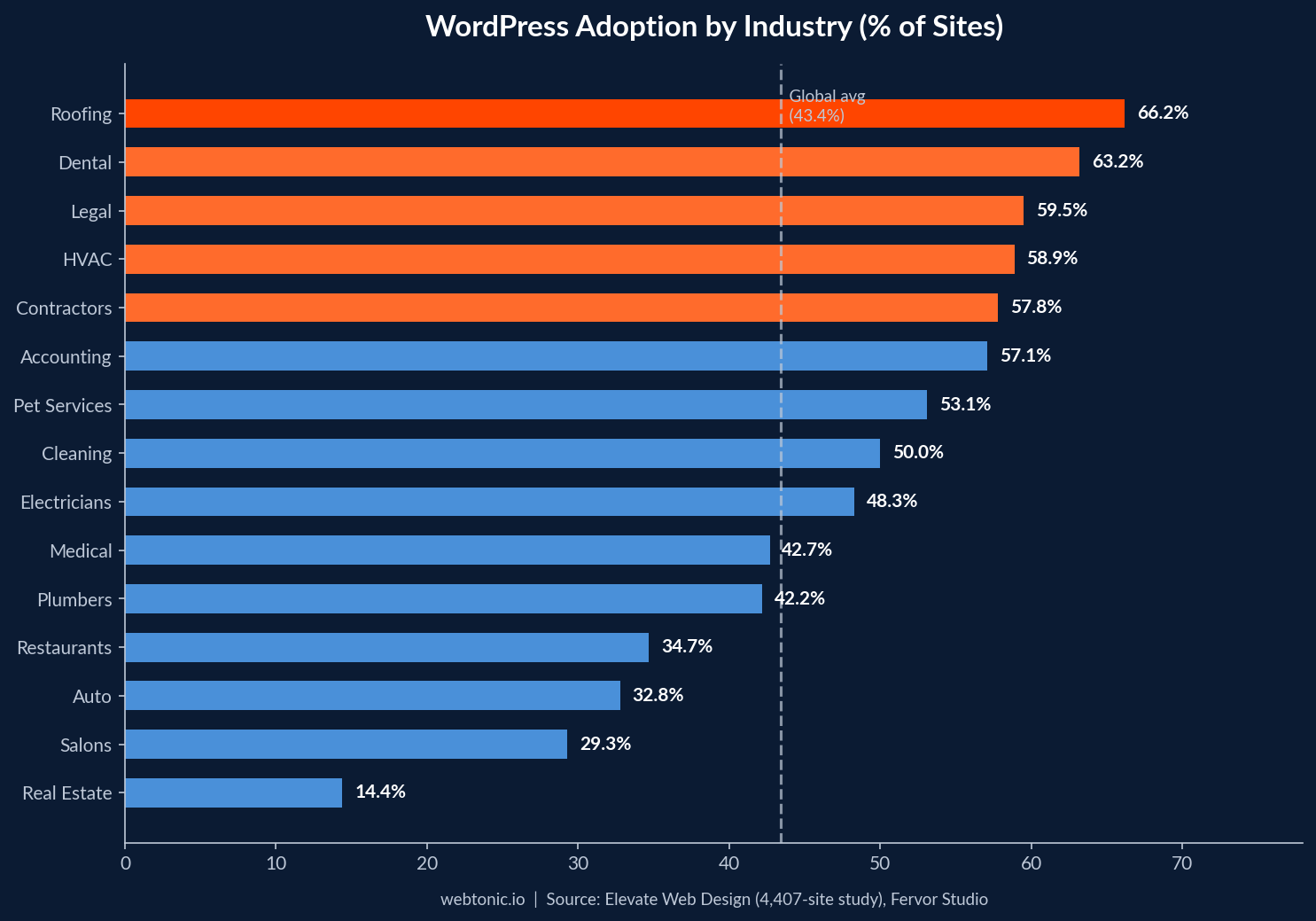
- 66.2% of roofing websites use WordPress, according to Fervor Studio's analysis of 130 roofing sites across the U.S. Gutenberg Blocks is the most common page builder at 60.8% (Fervor Studio).
- Across all contractor verticals, WordPress holds 57.8% market share — 14.2 percentage points above the 43.6% share among all small businesses. HVAC sits at 58.9% and plumbing at 42.2% (Elevate Web Design).
- WordPress powers 43.4% of all websites globally as of 2025, making it the world's most widely used CMS. The roofing industry over-indexes by more than 20 percentage points.
- The remaining roofing sites are split across Shopify, Wix, Squarespace, Webflow, Duda, and custom builds, collectively representing roughly a quarter of the market (Fervor Studio).
- Industries with visual-first needs show lower WordPress adoption: salons at 29.3%, restaurants at 34.7%, and real estate at just 14.4%. Roofing's high WordPress share reflects the industry's emphasis on SEO and lead generation over visual branding.
Site Performance and Core Web Vitals Statistics
Performance is where WordPress roofing sites consistently fail — and where the biggest revenue gains are hiding.
| Core Web Vital | Roofing Average | Google Passing Threshold | Overshoot |
|---|---|---|---|
| Largest Contentful Paint (LCP) | 13.9s | 2.5s | 5.6× |
| First Contentful Paint (FCP) | 3.97s | 1.8s | 2.2× |
| Cumulative Layout Shift (CLS) | 0.10 | 0.10 | Borderline |
| Time to First Byte (TTFB) | 0.03s | 0.80s | Well under |
| Google PageSpeed Score | 45/100 | 50/100 | 5 points under |
| Lighthouse SEO Score | 94/100 | 90/100 | Passing |
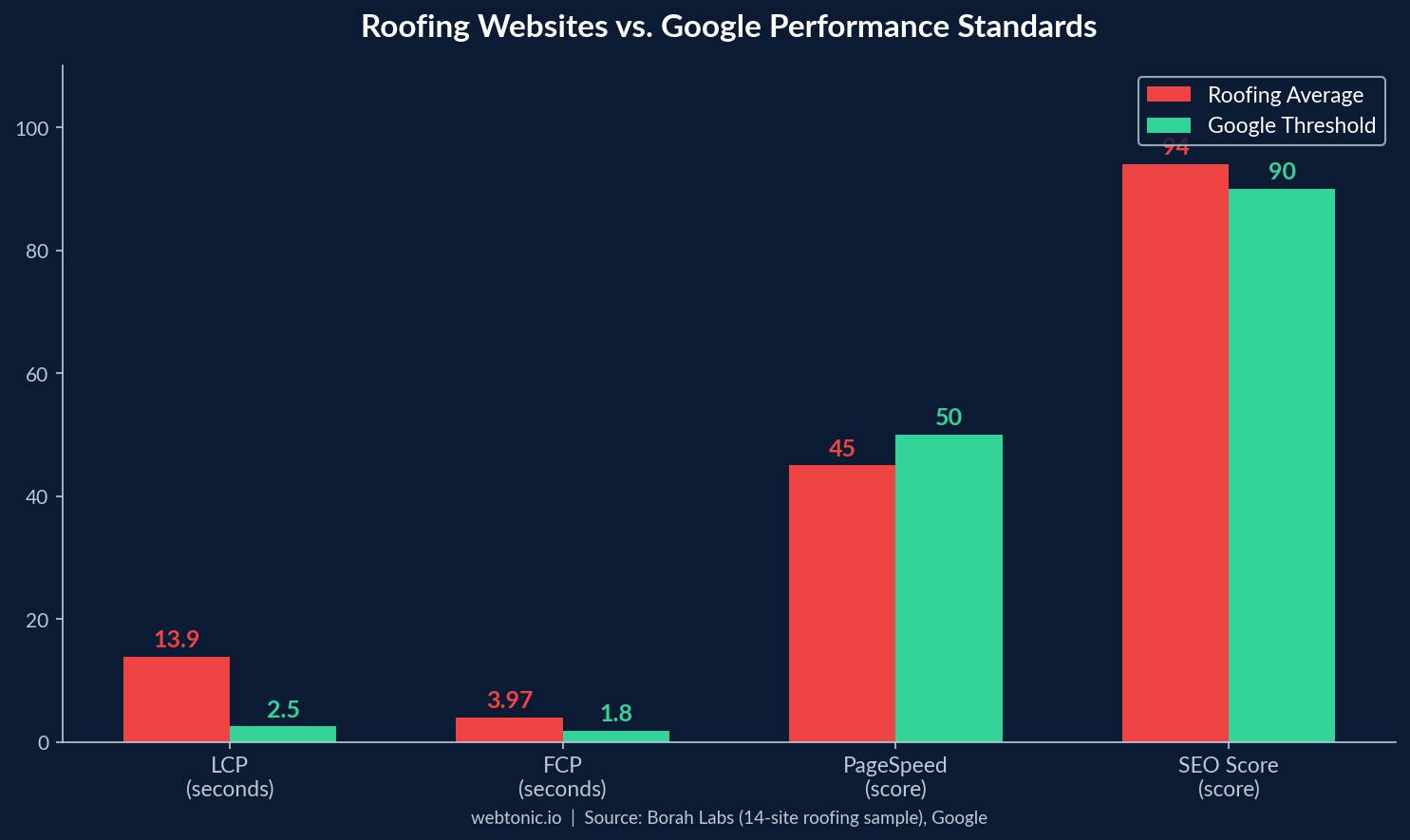
- The average roofing website takes 13.9 seconds to render its main content (LCP), placing it 11.4 seconds above Google's 2.5-second threshold. This is 5.6 times the acceptable limit (Borah Labs).
- First Contentful Paint averages 3.97 seconds, more than double Google's 1.8-second threshold, meaning visitors see a blank screen for nearly 4 seconds before any content appears.
- PageSpeed scores average 45 out of 100 across the roofing sample — below Google's 50-point passing bar. Only Lighthouse SEO (94/100) and accessibility (89/100) scores meet industry standards (Borah Labs).
- 40–60% of contractor WordPress sites run on cheap shared hosting (Bluehost, GoDaddy, HostGator), where 80+ sites share a single server. Upgrading to managed WordPress hosting alone can cut LCP by 40–60% (PipelineOn).
- Page builders like WPBakery inject 400–600KB of extra JavaScript, creating render-blocking payloads that compound the hosting problem. Sites built with Gutenberg or lightweight themes consistently outperform page-builder sites (PipelineOn).
- Every 1-second improvement in page load time increases conversions by approximately 7% — meaning a roofing WordPress site that cuts its LCP from 13.9 seconds to 2.5 seconds could see dramatic lead volume increases.
WordPress Security Statistics for Contractor Websites
Security is the hidden cost of WordPress dominance — and the vulnerability data for 2025 should concern every roofing company running an unpatched site.
- 11,334 new vulnerabilities were discovered in the WordPress ecosystem in 2025, a 42% increase over the 7,966 found in 2024. The growth rate is accelerating, not slowing (Patchstack).
- 91% of WordPress vulnerabilities are found in plugins, not WordPress core. The average roofing WordPress site runs 15–25 plugins, each representing an attack surface.
- 93.3% of roofing websites have SSL certificates, but the remaining 6.7% trigger Chrome security warnings that immediately destroy trust — a critical failure for any contractor trying to generate leads online (Borah Labs).
- 92.9% of tested WordPress sites had at least one known vulnerability when scanned by GuardingWP, indicating that most contractor sites are running outdated plugins with known security holes.
- Patchstack received 1,983 valid vulnerability reports for premium or freemium components in 2025, making up 29% of total reports — meaning paid plugins are not inherently more secure than free ones.
- WAF (Web Application Firewall) adoption reached approximately 23.9% among WordPress sites, with Cloudflare, Imunify360, and Sucuri being the most common solutions for contractor websites.
- Across the roofing sample, 66.7% of sites use Cloudflare and 60% support HTTP/3, while only 40% implement HSTS (HTTP Strict Transport Security), leaving a significant portion vulnerable to downgrade attacks (Borah Labs).
WordPress Website Cost Statistics for Roofers
| Website Type | Build Cost | Monthly Maintenance | Annual Total (Year 1) |
|---|---|---|---|
| Solo 6-Page WordPress | $2,200–$3,800 | $50–$150/mo | $2,800–$5,600 |
| Storm-Response (10+ Metro Pages) | $4,500–$9,500 | $100–$250/mo | $5,700–$12,500 |
| Regional Commercial | $9,500–$18,000+ | $150–$400/mo | $11,300–$22,800 |
| Below $2,200 (Wix/Squarespace) | $500–$2,000 | $15–$50/mo | $680–$2,600 |
- A solo 6-page WordPress roofing website costs $2,200–$3,800, including design, development, basic SEO setup, and content for core pages (home, about, services, contact, reviews, blog) (Project Cost Estimator).
- Storm-response sites with 10+ metro pages and financing integration run $4,500–$9,500, reflecting the additional complexity of multi-location targeting and lead routing.
- Professional WordPress maintenance costs $50–$150 per month for a human reviewing updates, verifying backups, monitoring security, and checking performance — sub-$50 plans deliver only automated bot updates with no real oversight (PC Designs TX).
- Sites built below $2,200 are typically Wix or Squarespace templates, not WordPress — the lower floor reflects the limited customization and SEO ceiling of template builders (Project Cost Estimator).
- The true annual cost of a WordPress roofing site (build + hosting + maintenance) ranges from $2,800 to $22,800 depending on scope, hosting quality, and maintenance level — but the lead generation ROI dwarfs the investment for properly optimized sites.
Best Practices for WordPress Roofing Websites
- Upgrade from shared hosting immediately. With 40–60% of contractor sites on shared hosting and average LCP at 13.9 seconds, moving to managed WordPress hosting is the single highest-ROI improvement available.
- Audit and remove unnecessary plugins. With 91% of WordPress vulnerabilities in plugins, every unused plugin is an attack surface. Keep the total under 15 and update weekly.
- Replace heavy page builders. WPBakery and similar builders add 400–600KB of JavaScript. Switch to Gutenberg, Bricks, or a lightweight theme framework to cut load times significantly.
- Invest in professional maintenance ($50–$150/month). Bot-only update services miss compatibility issues, security context, and performance regressions that a human reviewer catches.
- Install a WAF (Cloudflare, Sucuri, or Patchstack). With 11,334 new vulnerabilities in 2025, a web application firewall provides essential protection between plugin updates.
- Optimize images and enable lazy loading. Unoptimized hero images are the primary contributor to the 13.9-second average LCP. WebP format and proper sizing can cut image payload by 60–80%.
- Implement HSTS and HTTP/3. Only 40% of roofing sites enforce HSTS. Combined with HTTP/3 (already at 60% adoption), these server-level changes improve both security and load times at zero ongoing cost.
Related reading
- WordPress for Mold Removal Companies: 2026 Website Statistics & Performance Data
- Mortgage WordPress Statistics
- Painting WordPress Stats 2026 | Web Tonic™
- Custom Web Development services at Web Tonic
FAQ
Why do so many roofing companies use WordPress?
WordPress dominates at 66.2% because of its SEO flexibility, vast developer ecosystem, and the availability of affordable agencies who specialize in contractor websites. Unlike template builders (Wix, Squarespace), WordPress allows custom schema markup, unlimited landing pages for local SEO, and deep integration with lead tracking tools — all critical for roofing companies that depend on organic search for 38–54% of their leads.
How much does a WordPress roofing website cost?
A basic 6-page WordPress roofing site costs $2,200–$3,800 to build, with ongoing maintenance at $50–$150 per month. Storm-response sites with 10+ metro pages run $4,500–$9,500, and regional commercial sites can reach $9,500–$18,000+. Below $2,200, contractors are typically getting a Wix or Squarespace template, not a WordPress build.
Is WordPress secure enough for a roofing contractor website?
WordPress core is secure, but the plugin ecosystem introduces significant risk — 11,334 new vulnerabilities were discovered in 2025, with 91% in plugins. A roofing WordPress site is adequately secure with regular updates, a web application firewall (Cloudflare or Sucuri), strong passwords, two-factor authentication, and professional maintenance. Without these measures, the site is exposed to the same vulnerabilities affecting 92.9% of WordPress installations.
Why are roofing websites so slow?
Three factors combine: cheap shared hosting (40–60% of contractor sites), heavy page builders adding 400–600KB of JavaScript, and unoptimized images. The result is an average LCP of 13.9 seconds — 5.6× Google's threshold. TTFB is actually fast (0.03 seconds), meaning the server responds quickly but the browser takes too long to render the bloated page.
Should a roofing company switch from WordPress to another platform?
For most roofers, optimizing WordPress is more cost-effective than switching platforms. The 66.2% market share means abundant developer talent, established SEO authority, and existing content. However, roofing companies primarily selling materials online may benefit from Shopify's superior ecommerce features, and companies willing to invest in premium development may see better performance on Webflow or headless architectures.
Sources
Fervor Studio — Digital State of the Roofing Industry 2026
Borah Labs — Roofing Website Benchmarks
Patchstack — State of WordPress Security 2026
Elevate Web Design — Small Business CMS Statistics 2026
Project Cost Estimator — Roofing Contractor Website Cost 2026
PC Designs TX — WordPress Maintenance Cost 2026
PipelineOn — Contractor Website Speed Optimization
Authority Specialist — Roofer SEO Statistics 2026


