



Table of contents
Key Takeaways
- WordPress powers 43.5% of all websites globally, including the majority of mold remediation company websites built by agencies and freelancers (W3Techs).
- A mold removal company migrated from Wix to WordPress and reduced CPC by 34.11% while increasing clicks per ad by 317% — demonstrating the platform's SEO and performance advantages (Logic Inbound).
- Optimizing a WordPress site from 6 seconds to 1.5–2 seconds load time delivers 20–35% conversion lifts over 60 days (PipelineOn).
- A restoration company's organic traffic grew from under 100 to 1,200+ monthly visitors after launching a new WordPress website with strategic SEO (Hook Agency).
- Slow page loads, buried phone numbers, and missing mobile trust signals leak 30–60% of conversion potential on mold remediation websites (ClicksGeek).
- Restoration websites that reduce load time from 4.2 to 1.8 seconds see measurable ranking improvements alongside improved Core Web Vitals (LCP from 3.8s to 1.9s) (Tygart Media).
- Schema markup integration drove a 60% increase in organic search traffic for a large restoration franchise website (Zenith Point).
WordPress Performance at a Glance — Mold Removal Industry
| Metric | Value | Source |
|---|---|---|
| WordPress global market share | 43.5% | W3Techs |
| CPC reduction after Wix → WP migration | −34.11% | Logic Inbound |
| Conversion lift from speed optimization | 20–35% | PipelineOn |
| Organic traffic growth (new WP site) | 100 → 1,200+ visits/mo | Hook Agency |
| CVR leak from poor mobile UX | 30–60% | ClicksGeek |
| Load time optimization result | 4.2s → 1.8s | Tygart Media |
| Organic traffic lift from schema | +60% | Zenith Point |
WordPress Market Share and Adoption in Home Services
WordPress dominates the website platform landscape for home service businesses, including mold remediation companies. Its market position reflects both its flexibility and the extensive ecosystem of SEO tools, plugins, and themes available for service-based businesses.
W3Techs reports that WordPress powers 43.5% of all websites globally, maintaining its position as the most widely used content management system (W3Techs). For mold removal companies specifically, WordPress is the default platform recommended by most digital marketing agencies due to its SEO flexibility, plugin ecosystem, and the ability to implement structured data, fast-loading pages, and conversion-optimized layouts.
Stingray Branding's Patriot Restoration case study demonstrates a typical agency approach: building a high-performing WordPress website as the foundation for a restoration company's digital marketing system, integrating CRM, booking systems, and local SEO infrastructure from launch (Stingray Branding).
Website Speed and Conversion Impact
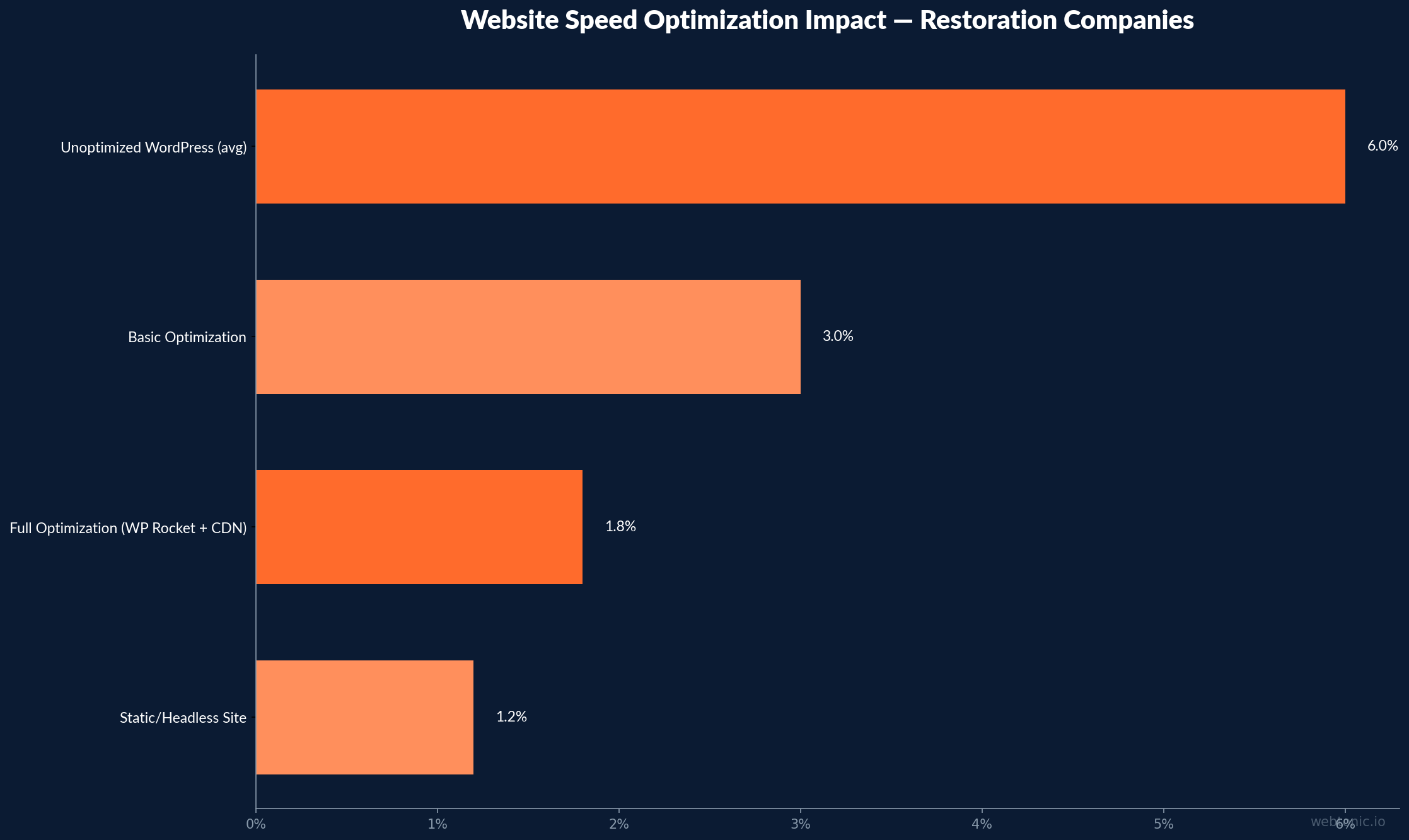
Page speed is the single most impactful technical factor for mold removal websites. The data from contractor website optimization studies shows clear, measurable relationships between load time and both ranking performance and lead conversion.
PipelineOn's contractor website speed optimization guide provides the clearest benchmarks: basic optimization steps drag a 6-second WordPress site down to 2.5–3 seconds over a weekend, and the full optimization playbook (WP Rocket, Perfmatters, theme audit, plugin cleanup) achieves 1.5–2 seconds with conversion lifts of 20–35% over the following 60 days (PipelineOn).
Tygart Media's restoration company case study documented the specific metrics: page load time decreased from 4.2 seconds to 1.8 seconds through lazy loading, image compression, and CDN implementation. Core Web Vitals improved simultaneously — LCP dropped from 3.8 seconds to 1.9 seconds — with direct impact on mobile search rankings (Tygart Media).
WordPress Speed Optimization Roadmap for Mold Removal Sites
| Speed Optimization Step | Time Reduction | Effort Level | Conversion Impact |
|---|---|---|---|
| Image compression + lazy loading | −1.5–2.0s | Low (1–2 hours) | +5–10% |
| Caching plugin (WP Rocket) | −1.0–1.5s | Low (30 min setup) | +8–15% |
| CDN implementation | −0.5–1.0s | Medium (1–2 hours) | +5–8% |
| Theme/plugin audit + cleanup | −0.5–1.5s | Medium (2–4 hours) | +10–20% |
| Full optimization playbook | 4.2s → 1.8s total | High (full weekend) | +20–35% |
Case Studies: WordPress Migrations and Redesigns
Real-world case studies from mold remediation and restoration companies demonstrate the measurable impact of WordPress optimization and migration on business performance.
Logic Inbound's case study documents a mold removal company that migrated from Wix to WordPress, which enhanced readability, usability, and overall performance. The combined SEO and paid media effort reduced CPC by 34.11% while increasing clicks per ad by 317% (Logic Inbound). The same agency's SEO case study for a mold company showed organic traffic increasing by 627% from 2,725 users, driven by WordPress's superior SEO capabilities (Logic Inbound).
Hook Agency's Johnson Restoration case study shows similar transformation: organic traffic grew from fewer than 100 visitors per month to over 1,200 engaged site visits after a new custom WordPress website combined with strategic SEO and targeted content (Hook Agency).
Blue Ocean HQ's Total Dry Restoration case study demonstrates early results from a WordPress-based approach: 268 total clicks, 71,000 impressions, and 12.5 average position in Google Search Console for a new local restoration brand, with growing visibility across service and location-based searches (Blue Ocean HQ).

Mobile Performance and Local Search
Mobile performance is critical for mold remediation WordPress websites because the majority of local emergency searches happen on smartphones. A site that loads slowly or has poor mobile UX loses leads to faster competitors.
ClicksGeek's web design analysis for mold remediation found that slow page loads, buried phone numbers, and missing mobile trust signals routinely leak 30–60% of conversion potential on identical traffic. They note that the majority of local mold remediation searches happen on phones, making mobile-first WordPress design non-negotiable (ClicksGeek).
PM Consulting's contractor website speed data shows that static/headless sites deliver pre-built HTML that renders immediately, offering a benchmark that WordPress sites should target through aggressive caching and CDN usage (PM Consulting). For mold companies running WordPress with heavy page builders like Elementor, switching to a lightweight theme can cut load time by 40–60% and eliminate the oversized HTML that suppresses crawlability.
SEO Capabilities and Schema Markup
WordPress's SEO plugin ecosystem gives mold remediation companies technical advantages that are difficult to replicate on proprietary platforms like Wix, Squarespace, or GoDaddy builders.
Zenith Point's 911 Restoration case study documented how incorporating structured data (schema markup) drove a 60% increase in organic search traffic for the franchise's website (Zenith Point). WordPress plugins like Yoast SEO and Rank Math make schema implementation accessible to non-developers, allowing mold companies to add LocalBusiness, Service, and FAQ schema without custom code.
Tygart Media's SiteBoost for restoration companies analysis highlights the growing importance of AI search optimization and Answer Engine Optimization (AEO) for WordPress sites. SpyFu domain intelligence data shows a significant organic gap between optimized restoration websites and typical independent contractors — the gap that WordPress's advanced SEO tools help close (Tygart Media).
WordPress SEO Features for Mold Removal Companies
| WordPress SEO Feature | Impact | Plugin/Tool | Difficulty |
|---|---|---|---|
| Schema markup (LocalBusiness) | +60% organic traffic | Yoast / Rank Math | Easy |
| XML sitemaps + auto-submission | Faster indexing | Yoast / Rank Math | Easy |
| Internal linking optimization | +15–25% crawl efficiency | Link Whisper | Easy |
| Core Web Vitals optimization | Ranking + CVR boost | WP Rocket + CDN | Medium |
| AEO / AI citation optimization | AI search visibility | SiteBoost / manual | Advanced |
WordPress vs. Other Platforms for Mold Removal Websites
Mold remediation companies choosing between website platforms should consider SEO flexibility, speed performance, and long-term cost of ownership.
Website Platform Comparison for Mold Removal Companies
| Platform | SEO Flexibility | Speed Potential | Best For |
|---|---|---|---|
| WordPress (optimized) | Excellent | 1.5–2.0s | Full SEO control + scalability |
| Webflow | Very good | 1.2–1.8s | Design-first + clean code |
| Wix | Limited | 3.0–5.0s | DIY on a budget |
| Squarespace | Moderate | 2.5–4.0s | Simple portfolio sites |
| Custom/Headless | Maximum | Under 1.5s | Enterprise-scale operations |
The Logic Inbound case study proved the platform matters: migrating from Wix to WordPress directly improved ad performance (−34% CPC, +317% clicks) because WordPress allowed technical optimizations — faster page loads, better landing page experiences, and cleaner URL structures — that Wix's closed platform architecture could not support (Logic Inbound).
WordPress Maintenance and Security for Mold Removal Sites
Maintaining a WordPress website requires ongoing attention to updates, security, and performance monitoring — areas where many mold removal companies fall behind, creating ranking and conversion vulnerabilities.
PipelineOn's contractor website analysis notes that WordPress sites running more than 20 plugins typically experience significant speed degradation, with each unnecessary plugin adding 0.1–0.5 seconds to load time. Mold remediation companies should audit their plugin stack quarterly, removing inactive plugins and replacing heavy ones with lightweight alternatives (PipelineOn).
Tygart Media's restoration company work demonstrates that ongoing WordPress maintenance — including regular Core Web Vitals monitoring, security patches, and content updates — is essential for maintaining the organic traffic gains achieved through initial optimization (Tygart Media). A well-maintained WordPress site serves as the foundation for all other digital marketing channels, from paid ads to social media to email marketing.
For mold removal companies specifically, website security is a trust signal — homeowners dealing with health concerns need to feel confident sharing their contact information. An SSL certificate, regular malware scanning, and a professional design signal credibility that directly impacts lead conversion rates on your WordPress site.
Frequently Asked Questions
Is WordPress a good platform for mold removal company websites?
Yes — WordPress is the most widely used CMS globally (43.5% market share) and the default recommendation for mold remediation companies by most digital marketing agencies. Its SEO plugin ecosystem, speed optimization tools, and schema markup capabilities give mold companies technical advantages over proprietary platforms. Case studies show mold companies on WordPress achieving 627% organic traffic growth and 34% CPC reductions after migration.
How fast should a mold removal WordPress site load?
Target 1.5–2.0 seconds load time for optimal performance. The average unoptimized WordPress site loads in 6 seconds, but a full optimization (caching, CDN, image compression, theme cleanup) brings this to 1.5–2.0 seconds with 20–35% conversion improvement. Core Web Vitals should target LCP under 1.9 seconds for mobile mold searches.
How much does a WordPress website cost for a mold removal company?
A professional WordPress website for a mold remediation company typically costs $3,000–$10,000 for design and development, plus $100–$300/month for hosting, maintenance, and plugin licenses. This investment pays for itself quickly — case studies show organic traffic increasing from under 100 to 1,200+ monthly visitors, with each visitor worth $10–$50 in potential job revenue.
Should a mold removal company use WordPress or Wix?
WordPress significantly outperforms Wix for mold remediation businesses. A case study showed a mold company that migrated from Wix to WordPress reduced their ad CPC by 34.11% and increased clicks by 317%. WordPress offers superior SEO control, faster page speeds, and schema markup capabilities that closed platforms like Wix cannot match.
What WordPress plugins are essential for mold remediation websites?
Essential plugins include Yoast SEO or Rank Math (schema + on-page SEO), WP Rocket (caching + speed), and a CDN integration. Schema markup alone drove a 60% organic traffic increase in a restoration franchise case study. Additional plugins for local SEO, review management, and form optimization complete the mold remediation WordPress toolkit.
Sources
w3techs.com — WordPress usage statistics
logicinbound.com — mold removal CPC case study
logicinbound.com — mold removal SEO case study
pipelineon.com — contractor website speed optimization
tygartmedia.com — restoration company SEO case study
clicksgeek.com — web design for mold remediation
hookagency.com — Johnson restoration case study
zenithpoint.eu — 911 Restoration case study
blueoceanhq.com — Total Dry Restoration case study
tygartmedia.com — SiteBoost for restoration companies
stingraybranding.com — Patriot Restoration launch
pmconsulting.ca — website speed performance


