Table of contents
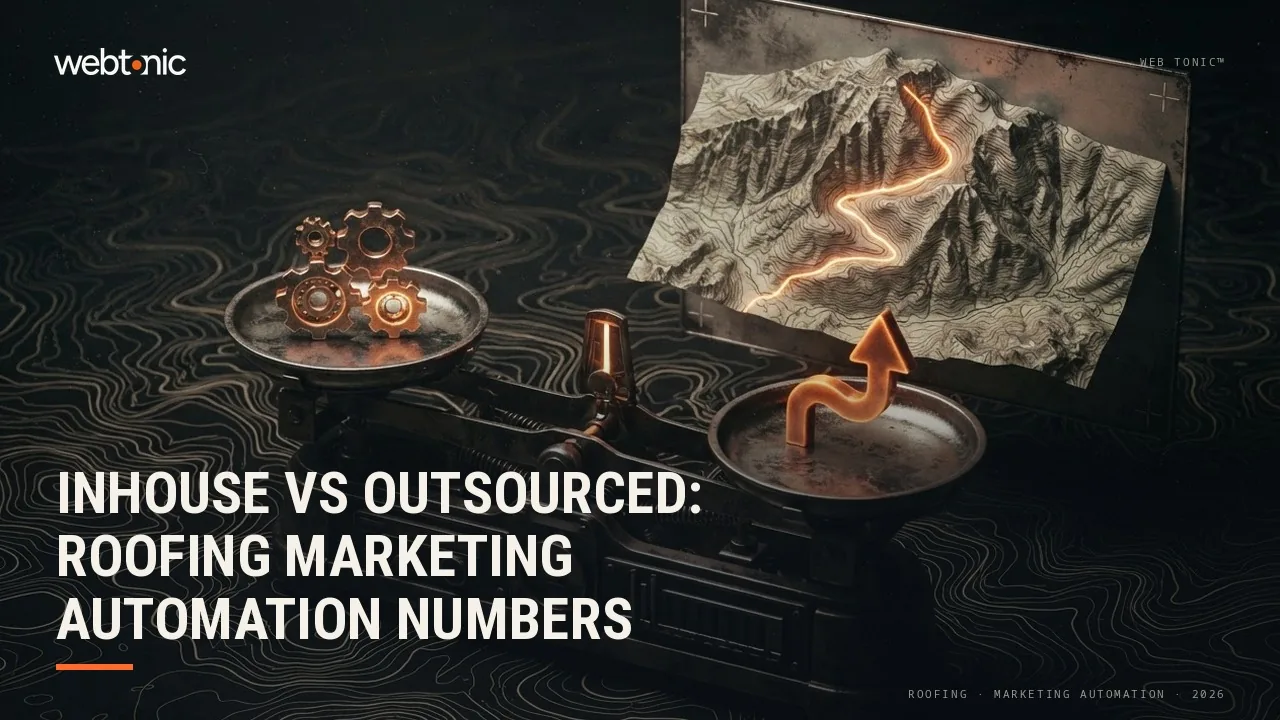
Roofing marketing automation is really two separate numbers: how fast the company responds, and what the tooling behind that speed actually costs. JobNimbus's own 2026 contractor data answers the first question; vendors' own pricing pages answer the second, without inventing a number ServiceTitan and Podium do not publish.
Key Takeaways
- 86% of roofers respond to new leads within 12 hours, per JobNimbus's 2026 report.
- The highest-rated companies respond in under 30 minutes, the same report finds.
- Automation use nearly doubled year over year among roofing contractors.
- 79% of roofers now use a CRM, up sharply from prior years.
- Contacting a lead in 5 vs. 30 minutes: odds drop 100x, per the 2007 MIT/InsideSales.com study.
- Qualifying a lead in 5 vs. 30 minutes: odds drop 21x in the same cross-industry study.
- From 5 to 10 minutes alone, qualify odds drop 4x - the first minutes matter most.
- ServiceTitan publishes no dollar figures; pricing is per-technician, quote-only.
- Podium's own pricing page is quote-only by industry, with no published starting price.
- HubSpot Marketing Hub Starter is USD 20/month per seat, a published, fixed figure.
- HubSpot Professional starts at USD 890/month for three seats.
- Roofers running 3+ automations report fewer missed steps and smoother handoffs.
- January 24, 2025: the 11th Circuit vacated the FCC's one-to-one consent rule before it took effect; TCPA prior express written consent still gates automated texts.
- Most roofers run 21% to 40% gross profit, with automation tied to staying above 30%.
The response-time gap that automation is built to close
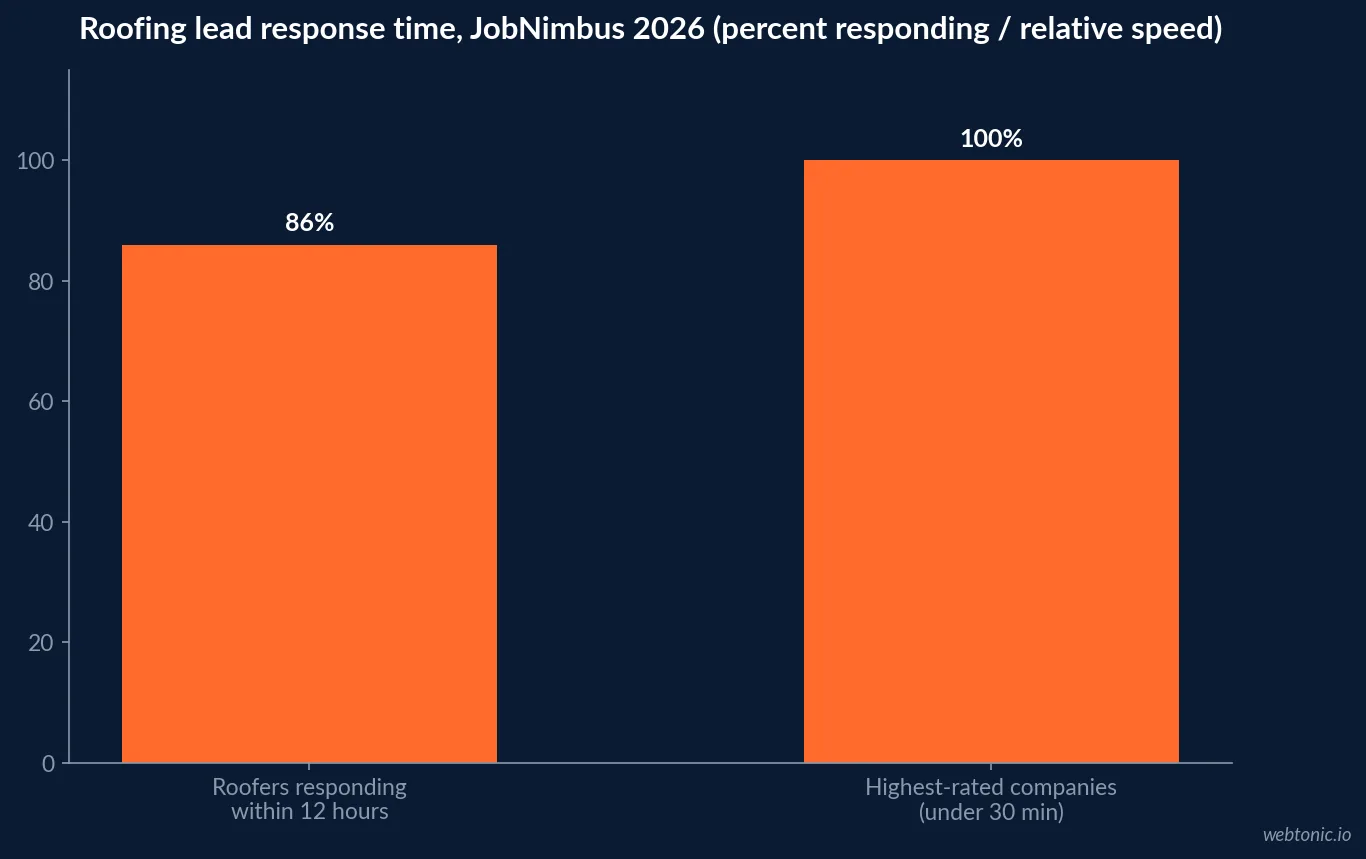
JobNimbus's Peak Performance 2026 report, built from thousands of contractor data points, found 86% of roofers respond to new leads within 12 hours - a respectable-sounding number until you see that the highest-rated companies respond in under 30 minutes. That gap between "eventually" and "immediately" is the entire commercial case for automated lead routing, instant-response texting and missed-call-to-text tooling in roofing marketing, not a nice-to-have feature.
| Response benchmark (JobNimbus 2026) | Figure | What it measures | Automation lever |
|---|---|---|---|
| Roofers responding within 12 hours | 86% | Average industry response window | Baseline manual follow-up |
| Highest-rated companies' response time | Under 30 minutes | Top-tier performance | Automated routing/texting |
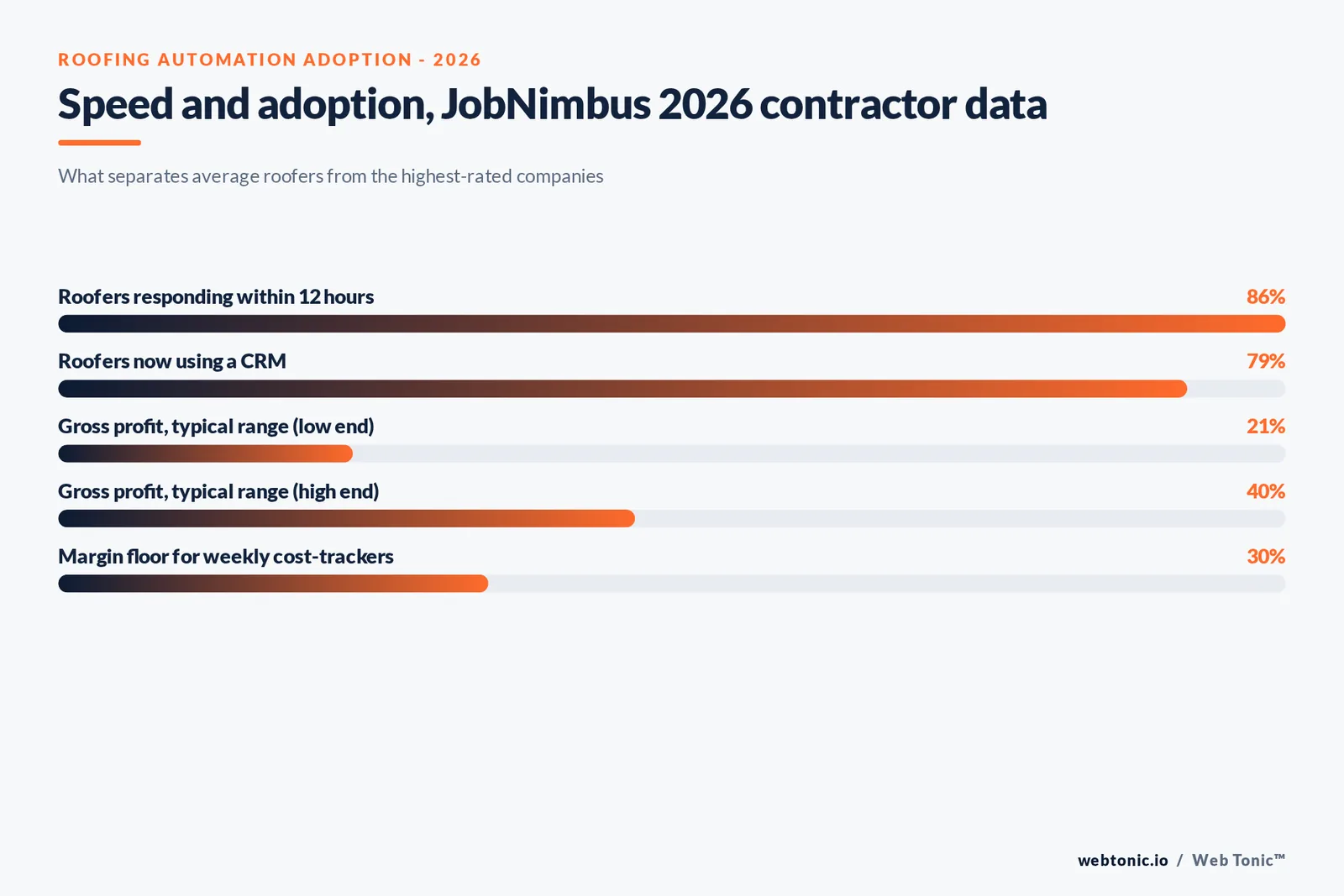
| Roofers now using a CRM | 79% | Adoption level | Foundation for automation |
| Year-over-year change in automation use | Nearly doubled | Adoption growth | Category still expanding fast |
Why the first minutes matter this much (a cross-industry study, not a roofing one)
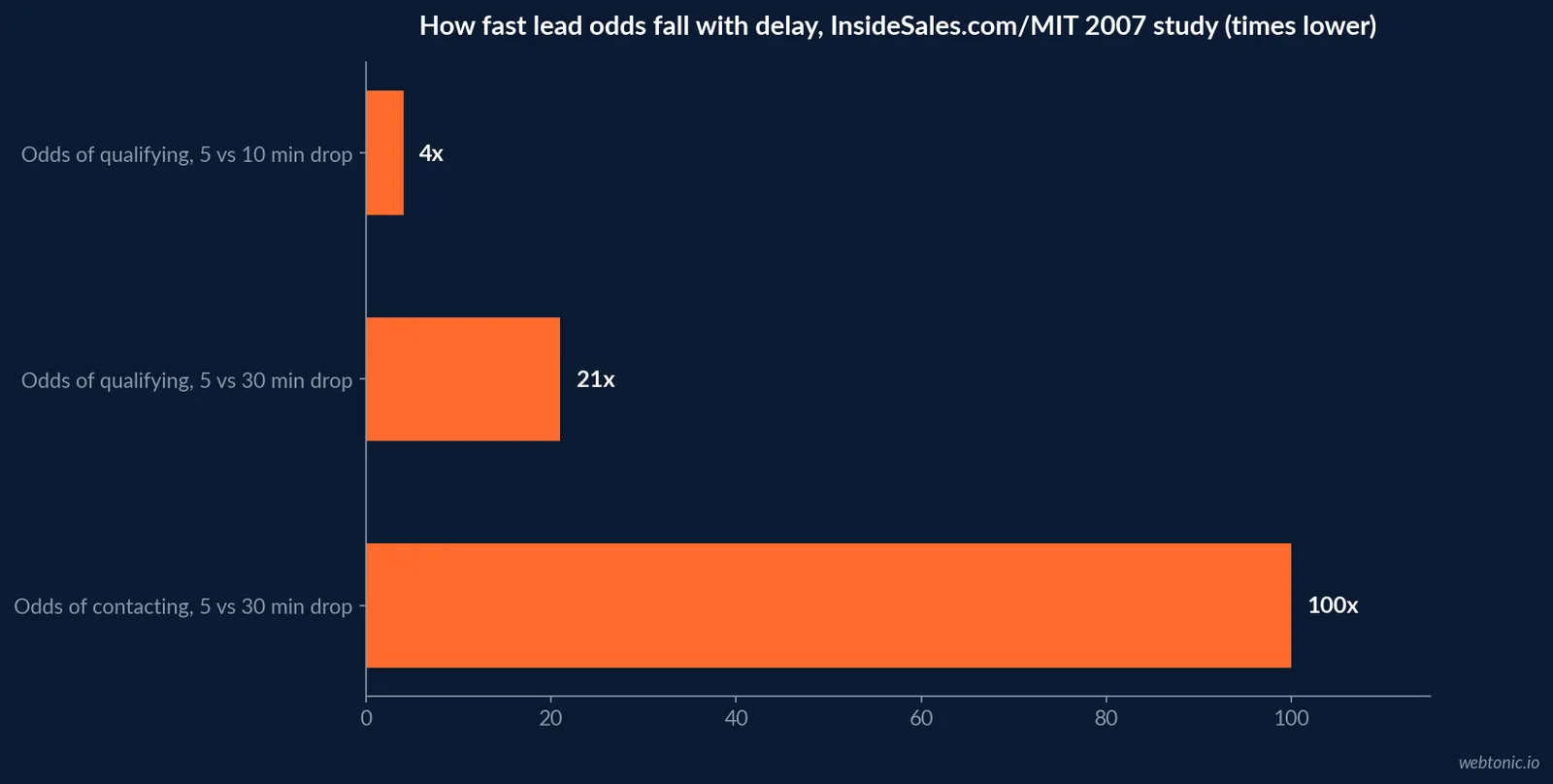
No roofing-specific study has measured the value of speed to lead, so the honest source is older and cross-industry: the 2007 InsideSales.com/MIT Lead Response Management study by James Oldroyd and Dave Elkington, built from over 15,000 web-generated leads and more than 100,000 call attempts across six companies. It found the odds of contacting a lead dropped 100 times between a 5-minute and a 30-minute callback, and the odds of qualifying that lead dropped 21 times over the same window - with 4x of that qualify-odds drop happening in just the first five-to-ten-minute stretch. Harvard Business Review later summarized related lead-response research in its 2011 article "The Short Life of Online Sales Leads." Treat the multiples as directional and old, not as a number Oldroyd re-measured for roofing in 2026.
| Callback delay comparison | Odds of contacting a lead | Odds of qualifying a lead | Source |
|---|---|---|---|
| 5 minutes vs. 30 minutes | 100x lower at 30 min | 21x lower at 30 min | InsideSales.com/MIT, 2007 |
| 5 minutes vs. 10 minutes | Drops within first hour | 4x lower at 10 min | InsideSales.com/MIT, 2007 |
| First hour of a lead's life | Odds decrease 10x+ | Steepest single window measured | InsideSales.com/MIT, 2007 |
What the tools actually cost - some vendors publish it, some do not
Two of the CRMs most used in home-services roofing marketing simply do not publish a price. ServiceTitan's own pricing page lists three packages - Starter, Essentials, The Works - and every one carries a "Request Pricing" button; the only detail disclosed is that pricing is per-technician. Podium's own pricing page is the same shape: choose an industry (Home Services is one of them), get a custom quote, no published starting number. HubSpot is the outlier that actually prices its Marketing Hub in public: USD 20 a month per seat at Starter, USD 890 a month for Professional (3 core seats, plus a USD 3,000 one-time onboarding fee), and USD 3,600 a month for Enterprise (5 core seats).
| Vendor (own pricing page, 2026) | Published price | Model | Roofing relevance |
|---|---|---|---|
| ServiceTitan | None published - quote only | Per-technician, quote-based | Full field service + CRM suite |
| Podium | None published - quote only | Custom quote by industry | Home Services vertical, reviews + texting |
| HubSpot Marketing Hub Starter | USD 20/mo per seat | Per seat | Marketing automation, not field ops |
| HubSpot Marketing Hub Professional | USD 890/mo (3 seats) | Per seat + base | Adds workflow automation |
Automation adoption is now the norm, not the exception
JobNimbus's 2026 data frames this as an operational shift rather than a marketing trend: automation use nearly doubled year over year, with 79% of roofers now running a CRM and a record adoption of automated texts, reminders and AI-driven scheduling tools. Roofers running three or more automations report fewer missed steps and smoother handoffs between sales, production and billing - the same report ties that discipline to staying above 30% gross margin, versus a 21% to 40% range for the industry overall.
The compliance layer under every automated text
An automated missed-call-to-text or estimate-follow-up program still has to clear the same rules as any other SMS marketing. The FCC's 2023 one-to-one consent rule was due to start on January 27, 2025, but the 11th Circuit vacated it on January 24, 2025 (Insurance Marketing Coalition v. FCC), so it never took effect; automated marketing texts still need the consumer's prior express written consent under the TCPA. CTIA's Messaging Principles add a registered-sender requirement (10DLC) for Non-Consumer messaging, which covers appointment reminders and estimate follow-ups sent through a CRM, not just cold outreach.
Technology adoption is rising industry-wide, not just at the top
Roofing Contractor's 2026 State of the Roofing Industry Report, based on a survey of contractors run with myCLEARopinion Insights Hub, found 67% of contractors now use enterprise or accounting software, 63% use estimating software and 61% use cloud computing. Artificial intelligence use jumped to 40% of contractors in 2025, up from 29% in 2024 - a one-year adoption jump that lines up with JobNimbus's separate finding that automation use nearly doubled over the same period.
| Technology (RC 2026 State of Industry survey) | 2025 adoption | 2024 adoption | Trend |
|---|---|---|---|
| Enterprise / accounting software | 67% | Not separately broken out | Now the top tech category |
| Estimating software | 63% | Not separately broken out | Near-universal among larger firms |
| Cloud computing | 61% | Not separately broken out | Foundation for remote/mobile crews |
| Artificial intelligence | 40% | 29% | +11 points in one year |
What automation actually changes about a crew's day
The JobNimbus data frames automation as an operations fix before it is a marketing one. Roofers running three or more automations report fewer missed steps and smoother handoffs between sales, production and billing - the same discipline that JobNimbus ties to staying above 30% gross margin instead of drifting toward the lower end of the 21% to 40% range most roofers report. A missed-call-to-text automation, an automated appointment reminder, and an automated review request are the three most common entry points, because each replaces a manual step a crew or office admin would otherwise have to remember under time pressure.
| Automation entry point | Manual step it replaces | Who it frees up | Compliance layer |
|---|---|---|---|
| Missed-call-to-text | Office staff calling back voicemails | Front-office admin | One-to-one consent, 10DLC |
| Appointment reminder | Manual reminder calls/texts | Scheduler / dispatcher | 10DLC registered sender |
| Automated review request | Manually asking each customer | Sales rep post-install | Standard opt-out required |
| Estimate follow-up sequence | Rep remembering to call back | Sales rep | One-to-one consent, 10DLC |
Where this fits against the wider automation picture
None of the roofing-specific figures above are unique to the trade - they are the same speed-to-lead and CRM-adoption pattern showing up across service businesses. For the cross-industry marketing automation baseline this sits inside, see our marketing automation statistics page. Our data and analytics practice builds the reporting layer that actually proves whether a specific automation moved response time or just added another tool to the stack.
In-house speed versus a paid platform: what is actually published
No study splits roofing companies into "in-house automation" versus "outsourced/paid platform" cohorts with a cost or speed comparison, so this page will not invent one. What is published is that the companies clearing JobNimbus's under-30-minute response bar are, per the same report, the ones running more connected tools and more automations - not necessarily the ones with the largest marketing budget. The honest reading is that speed correlates with system discipline, not with in-house versus outsourced status specifically. Our growth marketing practice builds the lead-routing and follow-up sequencing regardless of which CRM sits underneath it.
For the customer-lifetime side of the same roofing lifecycle - re-roof cycles, referrals and reviews rather than tooling - see our companion breakdown of roofing lifecycle and retention benchmarks. That page prices what a referral-and-review program protects over a 20-to-30-year shingle life; this page prices what gets a lead answered inside the first 30 minutes instead of the first 12 hours. Talk to us about either piece.
Frequently Asked Questions
How fast do roofing companies actually respond to a new lead?
JobNimbus's Peak Performance 2026 report, drawn from thousands of contractor data points, found 86% of roofers respond to new leads within 12 hours - but the highest-rated companies do it in under 30 minutes. That gap between the average and the top performers is the entire argument for automated lead routing and instant-response texting rather than a manual callback queue.
Does responding faster actually change whether a lead converts?
The best available evidence is cross-industry, not roofing-specific, so treat it as directional. The InsideSales.com/MIT Lead Response Management study (2007, Oldroyd and Elkington, based on over 15,000 web-generated leads across six companies) found the odds of contacting a lead dropped 100 times between a 5-minute and a 30-minute callback, and the odds of qualifying that lead dropped 21 times over the same window. No roofing-specific version of this study has been published - the mechanism is old and cross-industry, but the direction has held up in every response-time study since.
How many roofing companies actually use automation and a CRM today?
JobNimbus's 2026 data reports automation use nearly doubled year over year, with 79% of roofers now using a CRM and record adoption of automated texts, reminders and AI tools. Roofers running three or more automations report fewer missed steps and smoother handoffs - the report frames automation as tied to operational discipline, not just marketing spend.
What do the actual CRM and communication tools cost?
It varies by vendor structure, not just by feature list. ServiceTitan's own pricing page lists three packages (Starter, Essentials, The Works) but publishes no dollar figures - pricing is per-technician and quote-only. Podium's own pricing page is the same: industry-specific custom quotes, no published starting price. HubSpot's Marketing Hub, by contrast, publishes exact tiers: USD 20 a month per seat at Starter, USD 890 a month for Professional (3 seats), and USD 3,600 a month for Enterprise (5 seats).
What compliance rule does an automated SMS follow-up program have to clear?
The FCC's 2023 one-to-one consent rule was due to start on January 27, 2025, but the 11th Circuit vacated it on January 24, 2025 (Insurance Marketing Coalition v. FCC), so it never took effect; automated marketing texts still need the consumer's prior express written consent under the TCPA. CTIA's Messaging Principles layer a registered sender identity requirement (10DLC) on top for any Non-Consumer (business) messaging, including appointment reminders and estimate follow-ups sent through a CRM.
Sources
JobNimbus - Peak Performance 2026: Roofing Industry Benchmarks for Success
Roofing Contractor - 2026 State of the Roofing Industry Report
InsideSales.com / MIT - Lead Response Management Study (2007, Oldroyd and Elkington)
ServiceTitan - Pricing (own page, 2026)
Podium - Pricing and Plans (own page, 2026)
HubSpot - Product and Services Catalog (own pricing)
FCC - One-to-One Consent Rule for TCPA Prior Express Written Consent FAQs
CTIA - Messaging Principles and Best Practices