



Table of contents
Key Takeaways
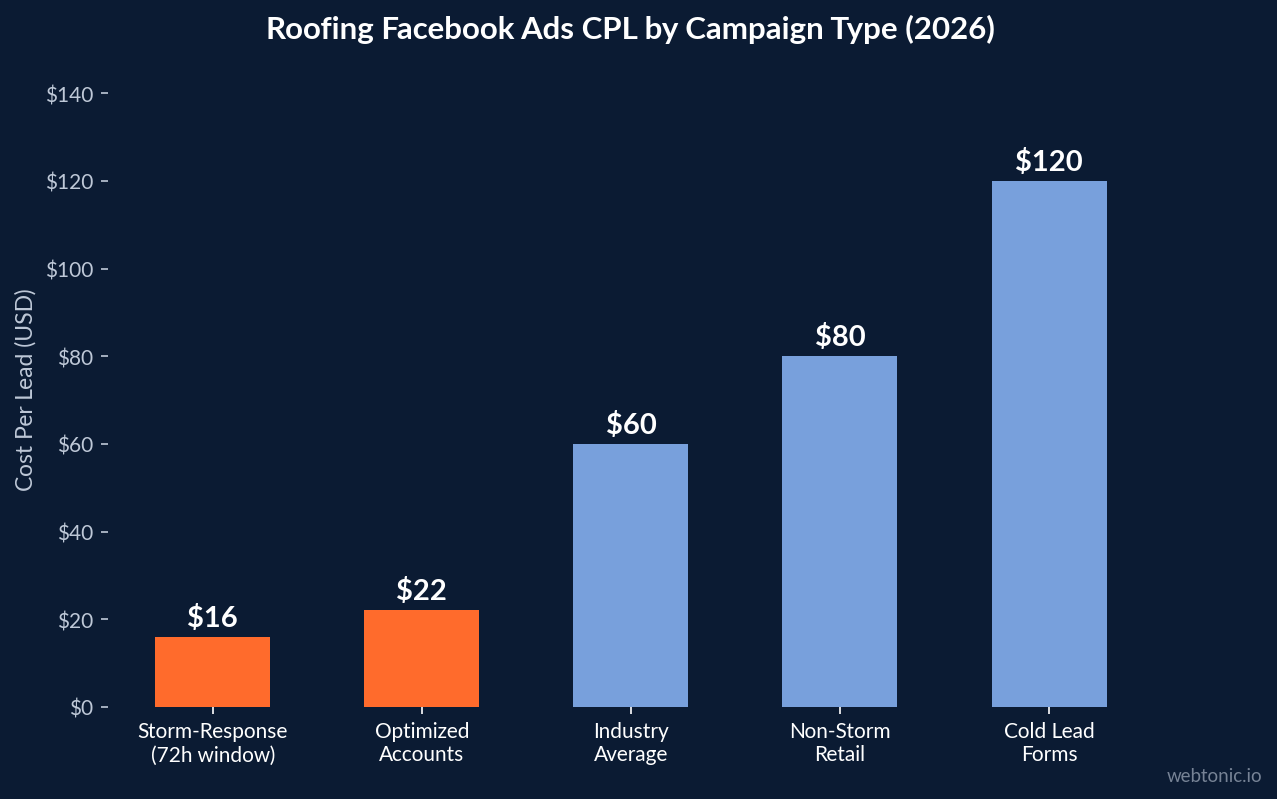
- Roofing Facebook Ads average $40–$80 per lead in 2026, with optimized accounts hitting as low as $21.98 CPL on well-tuned campaigns.
- Storm-response Meta campaigns produce $10–$22 per lead during the 72-hour post-hail window — the lowest CPL of any roofing ad channel.
- Cost per booked roof on Meta Ads sits at $185–$420, consistently beating Google Ads on retail re-roof work when creative and targeting are dialed in.
- Insurance-claim retargeting audiences close at 25–35% versus 8–15% for cold lead forms, because the funding is already approved.
- Before/after Reels and vertical video outperform horizontal creative by 2–4× on CTR, with the first 3 seconds carrying 80% of engagement.
- Lookalike audiences seeded from past insurance-claim customers outperform interest targeting by 3–5× on close rate and can hit $0.21 CPC in dense storm metros.
Roofing Meta Ads Benchmarks at a Glance
| Metric | Benchmark | Source / Context |
|---|---|---|
| Average CPL | $40–$80 | AdAmigo 2026 industry data |
| Optimized Account CPL | $21.98 | Built Right Digital |
| Storm-Response CPL | $10–$22 | 72-hour post-hail window |
| Cost Per Booked Roof | $185–$420 | Full-funnel including close rate |
| Storm Lead Close Rate | 25–35% | Insurance-claim audience |
| Retail Re-Roof Close Rate | 15–22% | Non-storm direct-to-consumer |
| Cold Form Close Rate | 8–15% | No prior touchpoint |
| Storm Campaign CPC | $0.21–$1.50 | Dense metro areas post-event |
| Avg. Roofing Ticket Size | $11,000–$25,000 | Insurance + retail combined |
Why Meta Ads Work for Roofing Companies
Roofing is the one home-service trade where Facebook and Instagram Ads consistently outperform Google Ads on cost per booked job. The reason is structural: roofing's visual creative — before/after drone shots, hail-damage close-ups, time-lapse installations — matches the way Meta's algorithm rewards engaging content. Homeowners scroll past a polished roof transformation and stop. That pause triggers the algorithm to push the ad further.
Unlike HVAC or plumbing, where the service is invisible, roofing companies sell a visible, high-ticket transformation. A homeowner can see the difference between a battered roof and a brand-new one in a single photo. This visual advantage, combined with storm-response timing, makes Meta Ads a primary lead generation channel for roofing contractors who understand how to use it — and a wasted budget for those who treat it like generic paid search.
Storm-Response Campaigns: The Highest-ROI Facebook Ads Strategy for Roofers
When hail or high winds hit a metro area, the 72-hour window that follows is the most profitable advertising period in roofing. Storm-response Meta campaigns deployed within 24–48 hours of a hail event produce dramatically different economics than always-on campaigns:
- CPL drops to $10–$22 during peak response windows (Graphed, OptiFOX 2026 benchmarks)
- CPCs spike 30–60% due to competitor bidding, but tickets of $8,500–$25,000 at 45–65% close rates make the math overwhelmingly positive
- Lead quality peaks because homeowners in affected zip codes have visible damage and insurance coverage — they need a roofing contractor now, not eventually
The winning playbook, validated by roofing Facebook ads specialists like PinPoint Promote and DG Agency, involves three layers:
- Geo-targeted storm ads within 4–12 hours: Target zip codes hit by hail with "Free Storm Damage Inspection" offers. Use Facebook lead ads with instant lead forms pre-filled from the user's profile for maximum conversion speed.
- Retargeting within 24–72 hours: Serve before/after transformation Reels and testimonial videos to anyone who engaged with the initial ads but did not submit a form.
- Insurance guidance follow-up (days 3–14): Educational ads explaining how to file a roof insurance claim build trust and position your roofing company as the knowledgeable local expert.
Facebook Ads CPL vs. Other Roofing Lead Channels
| Channel | Avg. CPL | Avg. Close Rate | Cost per Booked Job |
|---|---|---|---|
| Meta Ads (Storm) | $10–$22 | 25–35% | $30–$90 |
| Meta Ads (Always-On) | $40–$80 | 15–22% | $185–$420 |
| Google Search Ads | $124–$228 | 20–30% | $410–$760 |
| Local Services Ads | $75–$150 | 30–40% | $190–$500 |
| SEO (Mature) | $10–$50 | 25–35% | $30–$200 |
The key comparison is cost per booked job, not just cost per lead. Meta Ads for roofing companies produce cheaper leads than Google Search Ads, and storm-response campaigns close at rates competitive with SEO — making Facebook the best short-term paid channel for contractors who operate in storm-prone markets. Even always-on Meta campaigns produce booked jobs at roughly half the cost of Google Search when creative and targeting are properly managed.
Creative Performance: What Works for Roofing Facebook Ads
Creative is the single biggest lever in roofing Facebook ads performance. Before/after Reels and 9:16 vertical video outperform produced 16:9 horizontal creative by 2–4× on CTR, with the first 3 seconds carrying 80% of engagement. The creative formats that generate the most roofing leads on Meta in 2026:
- Before/after Reels: Drone footage showing a damaged roof transforming into a finished project. The contrast creates an irresistible visual hook.
- Hail-damage close-ups: Detailed shots of pitted shingles or dented flashing, paired with copy like "Your roof might look like this after last night's storm."
- Time-lapse installations: A 15-second time-lapse of a full roof replacement builds credibility and showcases the team's speed.
- Customer testimonial clips: Homeowners on camera describing the claims process and praising the crew. Authenticity outperforms polish on Meta.
- Carousel with project gallery: Multiple completed projects in a single ad unit let homeowners swipe through examples relevant to their home style.
The common mistake roofing companies make with Facebook ads creative is over-producing content. A shaky iPhone video of a crew member pointing at hail damage on a roof consistently outperforms a $5,000 produced commercial — because Meta's algorithm rewards content that looks native to the feed, not content that looks like an ad.

Targeting Strategies for Roofing Meta Campaigns
Effective targeting separates a $20 roofing lead from a $120 one. The most successful roofing Facebook ads campaigns layer three targeting approaches:
| Strategy | Audience Source | Expected CPL | Close Rate |
|---|---|---|---|
| Insurance-Claim Lookalike | Past customers with insurance jobs | $15–$35 | 25–35% |
| Website Retargeting | Visitors who viewed estimate or gallery pages | $20–$45 | 20–30% |
| Storm Geo-Targeting | Zip codes hit by recent weather events | $10–$22 | 25–40% |
| Interest-Based (Homeowners) | Home improvement, home repair interests | $50–$90 | 8–15% |
| Broad / Advantage+ | Meta's AI targeting with creative signals | $35–$70 | 12–20% |
Lookalike audiences seeded from prior insurance-claim customers outperform interest targeting by 3–5× on close rate and hit $0.21 CPC in dense storm metros (Coldlytics 2026). The reason is simple: homeowners who look like past insurance-claim customers are more likely to own homes in storm-prone areas, carry appropriate coverage, and respond to damage-related messaging.
Since Facebook removed direct "homeowner" targeting options, roofing contractors must target homeowners indirectly — through home improvement interests, home repair behavior, and location-based signals in suburban residential zip codes. The most effective roofing companies build custom audiences from their CRM and use Meta's Advantage+ audience expansion to find similar homeowners automatically.
Ad Spend Allocation and Budget Strategy
How much should a roofing company spend on Facebook ads? The answer depends on market size and storm activity, but these spend benchmarks provide a starting framework:
- Small-market roofing contractor (1 crew, local area): $1,500–$3,000/month on Meta Ads, generating 20–40 leads
- Mid-market roofing company (3–5 crews, metro area): $5,000–$10,000/month, targeting 80–150 leads with a split between always-on and storm-response campaigns
- Large roofing operation (multi-market): $15,000–$40,000/month with dedicated storm-response budgets activated by weather triggers
The critical budgeting principle: keep 30–40% of your monthly Meta budget in reserve for storm events. When hail hits, shift reserved dollars to storm-response campaigns within hours. The CPL during these windows is so low that overspending during storms and underspending during calm periods produces a lower blended cost than evenly distributed daily budgets. Roofing marketing campaigns that follow this pattern report 25–40% lower annual blended CPL than those running consistent daily spend.
Roofing vs. Other Home Services: Facebook Ads Comparison
| Industry | Avg. Meta CPL | Avg. Ticket Size | Visual Creative Advantage |
|---|---|---|---|
| Roofing | $40–$80 | $11,000–$25,000 | High (before/after, drone, storm) |
| HVAC | $45–$65 | $3,500–$12,000 | Low (invisible service) |
| Plumbing | $50–$90 | $500–$5,000 | Low |
| Landscaping | $25–$50 | $2,000–$15,000 | High (outdoor transformations) |
| Solar | $30–$60 | $15,000–$35,000 | Medium |
Roofing's combination of high ticket size and high visual creative advantage makes it uniquely suited for Meta Ads. A $60 lead that converts to a $15,000 roof replacement produces a 250:1 revenue-to-ad-cost ratio — numbers that HVAC and plumbing companies cannot match at similar CPLs because their ticket sizes are smaller.
Facebook Lead Ads vs. Landing Page Campaigns for Roofers
One of the most common decisions roofing contractors face when running Facebook ads is whether to use instant lead forms (Facebook Lead Ads) or drive traffic to a dedicated landing page. Both approaches work, but they serve different segments of the funnel and produce leads with different quality profiles.
Facebook Lead Ads with instant lead forms generate the highest volume of roofing leads because the form pre-fills the homeowner's name, email, and phone number from their Meta profile. There is zero friction — the prospect never leaves the app. The trade-off is lead quality: because submission requires so little effort, a portion of these leads will be unqualified or unresponsive. Roofing companies using lead ads should implement a speed-to-lead follow-up — contacting the homeowner within 5 minutes of form submission — to maximize close rates. Leads contacted within 5 minutes convert at 8–10× the rate of those contacted after 30 minutes.
Landing page campaigns send the prospect to your website, where they must actively fill out a form or call. This higher friction filters out casual clicks, producing fewer but more qualified leads. The cost per lead is typically 30–50% higher than instant forms, but the cost per booked job can be lower because each lead is more intentional. Landing pages also let you deploy conversion tracking, retargeting pixels, and longer-form content like project galleries and financing options that Meta's native forms cannot support.
The optimal strategy for most roofing companies is a hybrid approach: run instant lead form ads for storm-response campaigns (where speed matters more than qualification) and landing page ads for always-on retail re-roof campaigns (where lead quality drives ROI). This split lets the marketing team capture surge demand quickly while maintaining a steady flow of higher-intent prospects during calm periods.
Seasonal Patterns in Roofing Facebook Ads Performance
Roofing Facebook ads do not perform uniformly across the year. Ad spend efficiency follows predictable seasonal patterns driven by weather and homeowner behavior:
- Spring (March–May): CPLs drop as homeowners plan summer projects. Competition increases but so does demand. The best roofing marketing campaigns launch early spring before competitors ramp up spending.
- Storm Season (April–September): Hail belt states (Texas, Oklahoma, Colorado, Kansas) see dramatic CPL drops during active storm periods. Contractors with weather-triggered campaigns capture disproportionate market share.
- Summer Peak (June–August): Highest search and social volume, but also highest competition and ad costs. CPLs can spike 20–35% in saturated markets.
- Fall (September–November): A second planning window as homeowners address damage before winter. CPLs moderate, and campaigns emphasizing "before winter" urgency perform well.
- Winter (December–February): Lowest volume in most markets. Smart roofing contractors use this period for retargeting campaigns targeting past website visitors and nurturing leads that did not close during peak season — the cost per impression drops 40–60% compared to summer.
Related reading
- Veterinary Facebook Ads Statistics: Key Benchmarks for 2026
- Facebook Video Ads: Specs, Formats, Examples and What Performs
- Facebook Ads for Events: The Four-Phase Playbook That Fills Seats
- Meta Ads Agency services at Web Tonic
FAQ
How much do Facebook Ads cost for roofing companies?
Roofing Facebook Ads average $40–$80 per lead in 2026 based on industry benchmarks. Optimized accounts with strong creative and targeting can achieve $21.98 CPL, while storm-response campaigns during the 72-hour post-hail window regularly produce leads at $10–$22. Total cost per booked roof from Meta typically ranges from $185 to $420.
Do Facebook Ads work for generating roofing leads?
Yes — Meta Ads outperform Google Ads on cost per booked job for roofing companies in most markets. Roofing's visual creative (before/after photos, drone footage, storm damage) aligns with how Meta's algorithm rewards engaging content. Storm-response campaigns and insurance-claim lookalike audiences drive the best results.
What is the best Facebook ad format for roofers?
Before/after Reels in 9:16 vertical format outperform all other creative types by 2–4× on CTR. Facebook lead ads with instant lead forms pre-filled from the user's profile produce the highest volume of roofing leads because they reduce friction — the homeowner can submit their information without leaving the app.
How should roofing contractors target homeowners on Facebook?
Since direct homeowner targeting was removed, use lookalike audiences from past insurance-claim customers (3–5× better close rate than interests), website retargeting of estimate-page visitors, and geo-targeting zip codes hit by recent storms. Combine with Advantage+ audience expansion for Meta's AI to find additional homeowners automatically.
What is a good conversion rate for roofing Facebook ads?
Storm-damage roofing leads from Meta close at 25–35% because homeowners have visible damage and insurance coverage. Retail re-roof leads close at 15–22%, and cold lead form fills without prior touchpoints close at 8–15%. The blended conversion rate depends heavily on your campaign mix and how quickly your team follows up.
Sources
pipelineon.com — Facebook Ads for Roofing: Strategies and Cost in 2026
profitroofingsystems.com — Facebook Ads Roofing Case Study
baadigi.com — Roofing Marketing Benchmarks 2026
wordstream.com — Google Ads Industry Benchmarks
webfx.com — Roofing Marketing Benchmarks
roofpredict.com — Data-Driven Roofing Marketing Budgets
ibisworld.com — Roofing Contractors Industry Report


