Table of contents
Roofing is a one-and-done purchase bought by nervous homeowners who call several companies at once. 66% of homeowners gather three quotes and 3.4 contractors get contacted after a storm, so the brand is not a mood board - it is whatever makes one of those three memorable and credible. The 2026 data says that is the proposal, the review count, the response time and the truck. Here are the numbers.
Key Takeaways
- A professional proposal ranks #1 in the final hiring decision (45%) and in the top three trust factors for 66% of homeowners.
- 74% of homeowners say responsiveness and communication beat price, and 74% would not hire a roofer without an inspection first.
- 74% follow a neighbour, friend or family recommendation; 62% would rehire a past roofer and 50% use search engines.
- The 2026 review benchmark is 200+ reviews at 4.9 stars - the median roofing company sits at 51-100.
- Referrals are the top lead source for 95% of roofing companies, which is also a single-channel risk.
- A wrapped truck delivers 30,000-70,000 impressions a day at under $0.50 CPM versus $15-$40 CPM for contractor digital ads.
- Full fleet wraps cost $2,500-$6,500 per vehicle; break-even is under one job at a $13,700 average roofing ticket.
- 65% of homeowners are more likely to call a roofer showing pricing, yet 33% of contractors publish none.
What homeowners judge, ranked
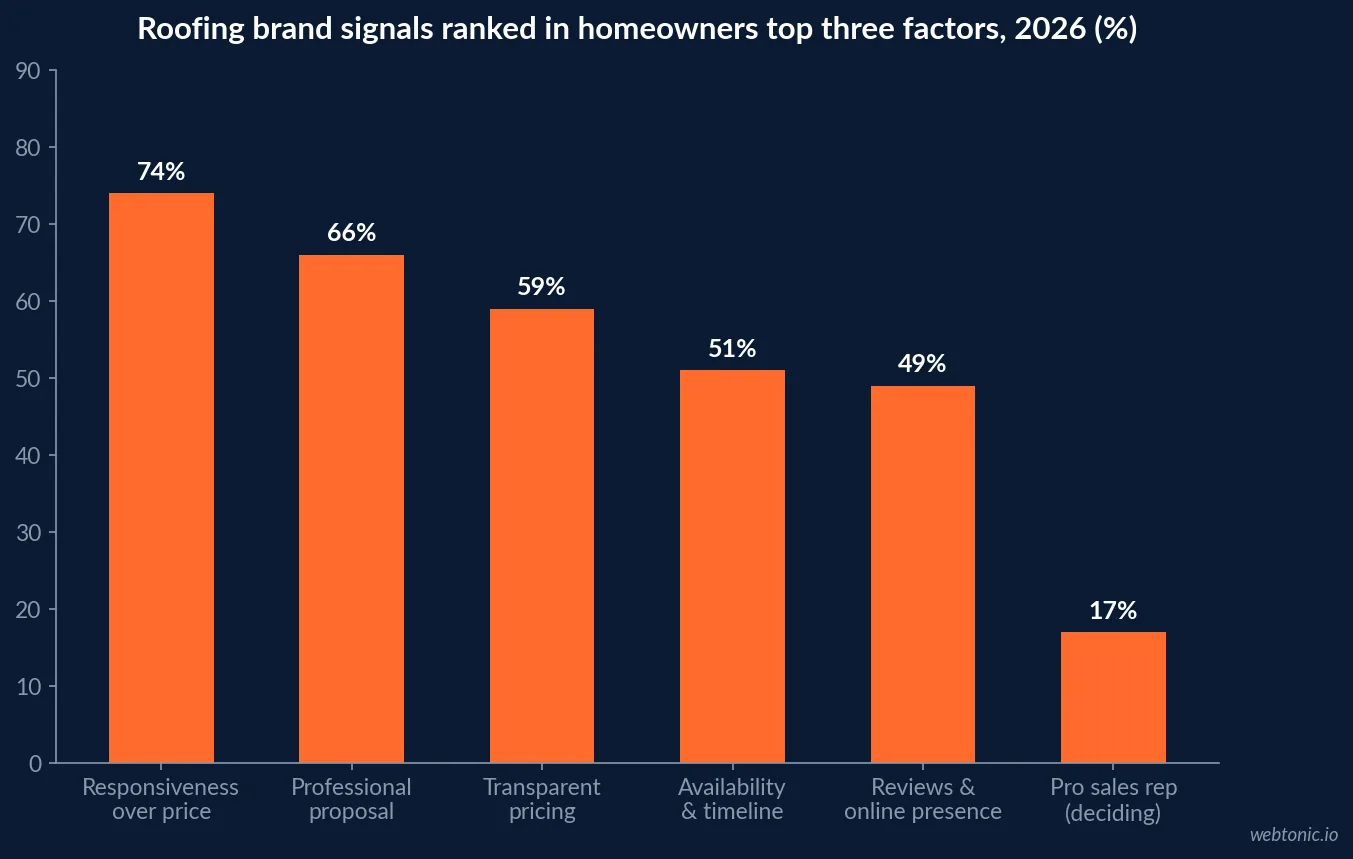
The 2026 Roofing Contractor homeowner study asked homeowners to rank the factors behind reaching out, trusting and finally hiring a roofer. The ranking is uncomfortable for anyone who thinks branding stops at a logo file: the highest-scoring asset in the whole study is the estimate document.
| Brand signal | Share ranking it top-three | Where it acts |
|---|---|---|
| Professional proposal / estimate | 66% (45% cite it in the final decision) | Trust and close |
| Transparent pricing and detailed estimates | 59% | First contact |
| Availability and timeline | 51% | First contact |
| Positive reviews and online presence | 49% (48% as a trust factor) | Shortlisting |
| Proven experience and roofing-specific certifications | 46% decide on this between two finalists | Final choice |
| Knowledgeable, professional sales rep | 17% as the deciding factor | In-home visit |
| Responsiveness over price | 74% agree | Every stage |
Two implications follow. First, the proposal template is a brand asset with a higher measured impact than the logo, so it deserves the same design budget. Second, 74% of homeowners will not hire a roofer without an inspection first - the inspection is the brand experience, and whatever you leave behind after it is the deciding artefact.
How homeowners find roofers - and where brand memory lives
Discovery in roofing is still overwhelmingly interpersonal, which is exactly why recall matters more than reach. In the 2026 homeowner journey survey, 74% said they follow a recommendation from a neighbour, friend or family member, 62% would contact a roofer they had used before, and exactly half start with a search engine.
| Discovery route | Share of homeowners | What the brand has to do |
|---|---|---|
| Neighbour, friend or family recommendation | 74% | Be nameable and recognisable |
| A roofer they have worked with before | 62% | Stay in memory between 20-year purchases |
| Internet search engines | 50% | Match the remembered name to a findable brand |
| Online reviews as a decision input | 62% call them very or extremely important | Volume, recency, rating |
| Pricing published on the website | 65% more likely to call | Transparency as positioning |
Contractor behaviour is not aligned with that. 70% of roofers advertise on social media, 55% rely on word of mouth, 49% run Google Ads, 42% use home-services marketplaces, 41% still buy local print and only 11% report using AI search services to generate leads. The gap between a referral-driven market and a paid-media-driven budget is where brand investment quietly pays. Compare that with the channel mix in our roofing digital marketing statistics breakdown.
Reviews are the measurable part of a roofing brand
Reviews are the only brand asset with a public scoreboard, and the bar moved in 2026. The JobNimbus Peak Performance 2026 industry report puts the trust threshold at 200+ reviews with a 4.9-star average, while the median roofing company sits between 51 and 100 reviews total.
| Review metric | 2026 benchmark | Typical roofing company |
|---|---|---|
| Total reviews | 200+ | 51-100 (median) |
| Average rating | 4.9 stars | 4.6-4.8 |
| Share of completed jobs producing a review | 60% or higher | Ad hoc, rep-dependent |
| Response to reviews | Within 48 hours, including positives | Negative-only, if at all |
| Recency | Continuous flow | Bursts, then months of silence |
| Reviews shown on own website | 91% of contractors do this | Common, often un-updated |
Two structural notes. High-volume shops completing 400+ roofs a year run a review engine - multiple touchpoints per job, requests automated to completion and invoice payment, and a named person accountable for the count. And review text matters for commercial work: profiles whose reviews name the property type or roof system rank better for those queries, a mechanic explained in our roofing local SEO statistics analysis.
Wrapped trucks: the cheapest impressions in the trade
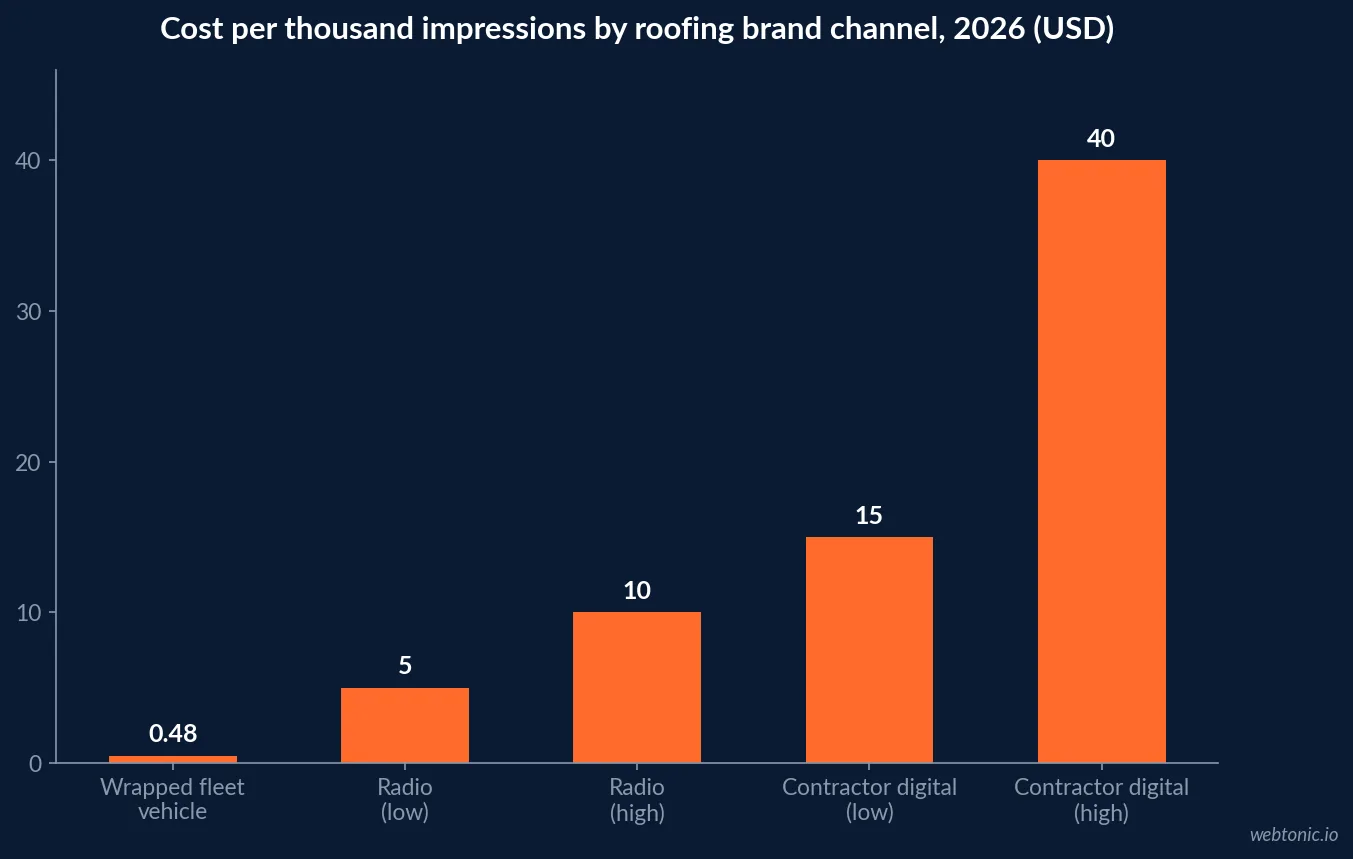
A roofing fleet is an outdoor media buy that also carries crews. Per Outdoor Advertising Association of America figures cited by JedHead, one wrapped vehicle on a standard local route produces 30,000 to 70,000 impressions per day - up to 25 million a year - at a cost per thousand under $0.50 once amortised.
| Channel | Cost per thousand impressions | Notes |
|---|---|---|
| Wrapped fleet vehicle | Under $0.50 | $4,000 wrap over a 5-year vinyl life |
| Radio | $5-$10 | Rented attention, no residual asset |
| Contractor-category digital advertising | $15-$40 | Highest intent, highest ongoing cost |
| Roofing Google Ads click | $14.66 per click | $313 average cost per lead |
| Local Services Ads lead | ~$222 per lead | Cheapest paid Google demand for roofers |
Wrap pricing in 2026, per JedHead’s fleet wrap cost guide and Silvermine’s vehicle wrap breakdown: $1,500-$3,000 for a sedan, $2,500-$4,500 for a standard pickup, $3,500-$6,000 for a full-size work van and $4,500-$6,500 for a box truck. Partial wraps covering 25-50% of the surface cost 40-60% less; vinyl lettering runs $300-$800; major metros add 15-25%. Quality vinyl lasts five to seven years.
The published ROI math uses a $2,500 generic contractor ticket and lands at a 1.6-job break-even. Roofing is kinder: at the $13,700 average roofing job reported by GetX Media’s 2026 roofing benchmarks, a $4,000 wrap is repaid by roughly one third of one job. Documented outcomes include a roofing contractor adding $2.5 million in year-over-year revenue with a 20% lift in inbound calls after a full brand and fleet rollout, and a $5,000 trade rebrand reporting 500% ROI and 160 five-star reviews inside six months with no paid advertising.
Where branding fails in roofing
Three failure modes recur, and all three are strategy failures dressed as design problems.
- Logo-and-phone-number wraps. They buy impressions and produce no recall, which is why two contractors in the same town can wrap identical trucks and see completely different call volumes.
- Interchangeable taglines. "Professional, reliable, affordable" describes every competitor equally and therefore positions nobody.
- Design before strategy. Wrapping, printing and signing before deciding what the brand claims locks in a five-year asset that says nothing specific.
- Silent proposals. The document ranked #1 in hiring decisions is still a spreadsheet export at most shops - unbranded, un-illustrated, no scope photos.
- Referral dependence. Referrals lead the mix for 95% of roofing companies; when they are the only channel, brand equity has nowhere to convert during a slow storm year.
Response speed is a brand attribute, not an ops metric
Because homeowners contact several companies, the brand that answers first is often the only brand evaluated. 86% of roofers respond within 12 hours, but the shops that outperform on reviews, referrals and close rate hold a sub-30-minute standard. Homeowner expectations are looser than contractor capability - 56% expect contact within one to two days and 39% expect same day - which makes speed a cheap differentiator rather than a hygiene factor.
| Response behaviour | Contractors | Homeowner expectation |
|---|---|---|
| Under 5 minutes | 14% of contractors | 2% expect it |
| Under 1 hour | 28% of contractors | 2% expect within an hour |
| Same day | 45% aim for it (21% arrive same day) | 39% expect it |
| One to two days | 14% of contractors | 56% expect it |
| Within 12 hours (any response) | 86% of roofers | - |
Post-storm the same asset breaks: call volume spikes 5x to 10x, the first responder books 62% of jobs and every missed call is worth $8,000-$15,000 in potential revenue, per CallJolt’s 2026 roofing industry statistics. Also worth noting: 48% of homeowners now prefer text for scheduling and follow-up, while contractors still lead with email at 90%.
What roofing brand work should cost against the unit economics
Roofing carries the most expensive paid leads in home services, which is precisely the argument for brand investment: every point of recall or referral removes a $313 lead from the budget.
| Economic input | 2026 figure | Brand implication |
|---|---|---|
| Average roofing job value | $13,700+ | One extra job repays most brand projects |
| Google Ads cost per lead | $313 (highest in home services) | Referral and recall arbitrage is large |
| Google Ads cost per click | $14.66 | Weak brand pays twice: click and low close |
| Local Services Ads cost per lead | ~$222 | Reviews and Guaranteed badge gate it |
| Lead-to-sale close rate on paid leads | 3-7% | Trust assets move this more than discounts |
| Gross margin | 35-50% | Room to fund brand from job contribution |
| Marketing budget benchmark | 7.7-9.4% of revenue | Growth shops run above it |
| US roofing industry revenue | $56-$58.4 billion | 103,000 contractors, 68% under 10 staff |
Because 68% of roofing businesses employ fewer than ten people, brand differentiation is usually available cheaply - most competitors are not doing it. A $6,000 identity and proposal system judged against a $313 lead cost has to displace roughly 19 paid leads to break even, and any single one of the trust factors above moves that faster than a bid discount. Our performance creative team builds these systems for trades; HVAC branding statistics shows the same pattern in an adjacent trade.
A 90-day roofing brand build
| Window | Work | Measured outcome |
|---|---|---|
| Weeks 1-2 | Positioning: property types, systems and neighbourhoods you actually want | One claim no competitor can copy |
| Weeks 2-4 | Proposal redesign - scope photos, options, pricing bands, warranty | Track close rate on the 45% decision factor |
| Weeks 3-5 | Review engine: automated requests at completion and payment, owner accountable | Path to 200 reviews at 4.9 |
| Weeks 4-6 | Identity refresh, then wrap design for the priority vehicles | Recall, not just impressions |
| Weeks 6-8 | Print and install wraps, yard signs, crew apparel | 30,000-70,000 daily impressions per truck |
| Weeks 8-10 | Publish pricing ranges and inspection process on the site | 65% call-likelihood lift |
| Weeks 10-12 | 30-minute response SLA with text as the default channel | First-responder share of the 3.4 contractors contacted |
Sequence matters: strategy, then proposal, then reviews, then vinyl. Reversing it produces a five-year asset that says nothing. If you want the whole system built once and measured properly, get in touch.
Brand metrics worth reporting monthly
- Review count and rating against the 200 / 4.9 benchmark, plus reviews added this month.
- Share of completed jobs producing a review, targeting 60%+.
- Referral share of booked revenue - and whether it is drifting past 90% single-channel risk.
- Direct and branded-search volume, the cleanest proxy for recall.
- Close rate on proposals sent, split by the redesigned and legacy templates.
- Median first-response time against the 30-minute standard, and missed-call count at $8,000-$15,000 each.
- Cost per booked job from brand-driven channels versus the $313 paid benchmark.
Frequently Asked Questions
What do homeowners actually judge a roofing brand on in 2026?
Not the logo. In the 2026 Roofing Contractor homeowner study, a professional proposal was ranked in the top three trust factors by 66% of homeowners and was the single most-cited factor in the final hiring decision at 45%. Transparent pricing and detailed estimates landed in the top three for 59%, availability and timeline for 51%, positive reviews and online presence for 49%, and 74% said responsiveness and communication mattered more to them than price. The brand is the estimate document, the response time and the review wall.
How many online reviews does a roofing company need?
The 2026 JobNimbus Peak Performance benchmark is 200 or more reviews at a 4.9-star average, while the median roofing company still sits between 51 and 100 reviews. Recency matters as much as volume: a profile whose last review is eight months old reads as stagnant to homeowners and to Google. Because 66% of homeowners gather three quotes, a 340-review competitor beside your 67 reviews frequently settles the decision before anyone reads your website.
Is a truck wrap worth it for a roofing company?
The impression math is the cheapest in the trade. A wrapped vehicle on a normal local route generates 30,000 to 70,000 impressions per day, up to roughly 25 million a year, at a cost per thousand under $0.50 once a $4,000 wrap is amortised over five years - against $15 to $40 CPM for contractor-category digital advertising. At a $13,700 average roofing job, a full wrap pays for itself with less than one attributable job. The failure mode is a logo-and-phone-number wrap that buys impressions without recall.
How much does roofing branding and a fleet wrap cost?
Fleet wraps run $2,500 to $6,500 per vehicle for a full wrap in 2026 - $2,500 to $4,500 for a standard pickup, $3,500 to $6,000 for a full-size work van - with partial wraps 40 to 60% cheaper and vinyl lettering at $300 to $800. Major metros run 15 to 25% higher. Design is typically quoted separately at $300 to $1,000. Budget the strategy first: contractors who wrap before deciding what the brand says get impressions without recall.
Does branding actually change lead volume in roofing?
It changes which of the three quoting contractors gets the call back. Documented contractor rebrands report a 20% lift in inbound calls and $2.5 million in added year-over-year revenue after a full brand and fleet rollout, and a $5,000 locksmith rebrand produced 160 five-star reviews in six months with no paid advertising. The mechanism is not decoration: 74% of homeowners act on a neighbour's recommendation, and they can only recommend a company whose name and truck they remember.
Sources
Roofing Contractor - What Homeowners Actually Want From Their Roofer (2026 study)
Roofing Contractor - The Homeowner's Roofing Journey in 2026
Contractor Marketing Pros - JobNimbus Peak Performance 2026 roofing industry data
JedHead - Do Fleet Wraps Increase Business?
JedHead - Fleet Wrap Cost Guide 2026
Silvermine - Home Service Vehicle Wrap Marketing
GetX Media - 2026 Roofing Marketing Benchmarks
CallJolt - Roofing Industry Statistics 2026
Gitnux - Roofing Industry Statistics 2026
Roofr - Roofing Sales Metrics to Track (2026 Homeowner Survey)