Table of contents
Branding is the one HVAC marketing line item with no impression counter attached — which is exactly why it gets cut first. The 2026 data says that is backwards: consistent branding is associated with a 23% revenue lift, a wrapped van buys impressions at $0.48 CPM, and 47% of homeowners will not call a contractor with fewer than 20 reviews. Here are the numbers.
Key Takeaways
- Consistent brand presentation lifts revenue ~23%; 68% of businesses credit brand consistency with 10-20%+ of growth.
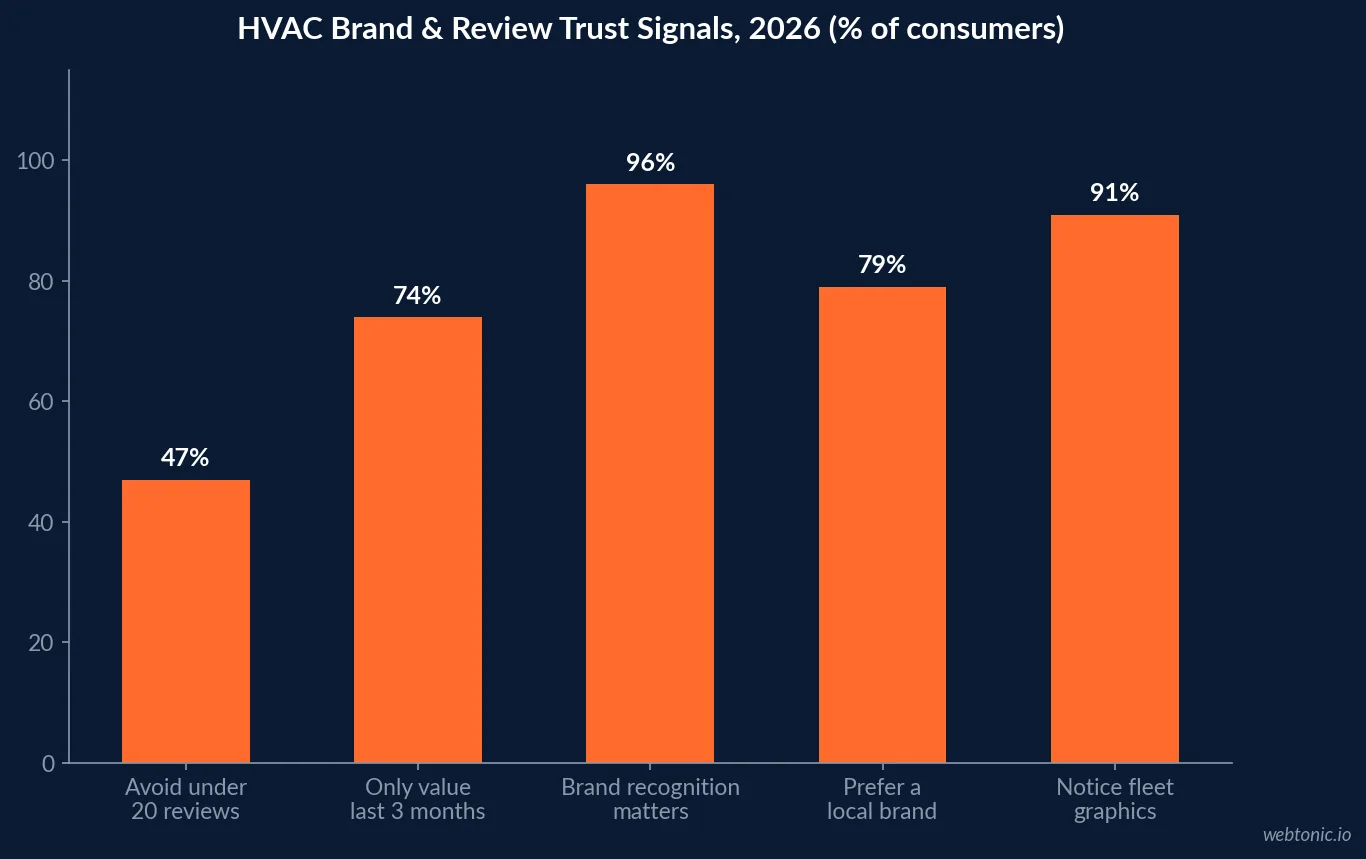
- 96% of homeowners say a recognizable brand matters; 79% prefer a local brand over a national one.
- Fleet wrap CPM is $0.48 versus $3.56 billboard and $7.45 transit.
- One wrapped van produces 30,000-70,000 daily impressions; 91% notice fleet graphics.
- A full wrap runs $2,500-$6,500 and lasts 5-7 years.
- 47% avoid businesses under 20 reviews; 74% only value reviews from the last 3 months.
- Branded search converts 2-3x non-branded; stronger visual identity correlates with 17-19% higher local CTR.
- 20-25% of companies rebrand within a decade, most often after acquisition.
1. Does Brand Move Money in a Trade Business?
The honest answer is that brand effects in home services show up indirectly — in close rate, in price tolerance, in how many people type your company name into Google instead of “AC repair near me”. Industry reporting on brand importance and home-services consumer research put numbers on it.

| Brand effect | Measured figure | Where it shows up |
|---|---|---|
| Revenue lift from consistent branding | +23% | Blended close rate and pricing power |
| Businesses crediting brand for 10-20%+ growth | 68% | Self-reported attribution |
| Homeowners saying brand recognition matters | 96% | Shortlist stage |
| Preference for a local brand | 79% | Beats national franchise recall |
| Branded vs non-branded search conversion | 2-3x | Paid and organic search |
| Local listing CTR lift from stronger identity | 17-19% | Map pack and organic snippets |
| Price premium tolerance | Documented but variable | Quote acceptance without discounting |
The mechanism worth internalising is the branded-search flywheel. Every wrapped van, yard sign and uniformed technician creates name recall; recall creates branded queries; branded queries convert at two to three times the rate and cost a fraction of a competitive non-branded click. Brand spend is therefore not an alternative to performance media — it is the input that makes performance media cheaper, a dynamic we unpack in our HVAC SEO statistics.
2. Fleet Wraps: The Cheapest Impressions in the Trade
No other channel available to a contractor prices reach this low. Vehicle wrap advertising data and wrap effectiveness research agree on the order of magnitude.
| Medium | CPM | Notes |
|---|---|---|
| Vehicle wrap | $0.48 | Lowest measured CPM of any outdoor medium |
| Billboard | $3.56 | 7.4x the wrap CPM |
| Transit advertising | $7.45 | 15x the wrap CPM |
| Newspaper | $19.70 | Declining reach |
| Magazine | $22.00 | Wrong audience for local trades |
| Daily impressions per wrapped vehicle | 30,000-70,000 | Metro driving patterns |
| People who notice fleet graphics | 91% | Recall of words and images |
The cost side is equally favourable. 2026 wrap pricing puts a full wrap at $2,500 to $6,500, partial wraps at $1,500 to $3,000 and simple lettering at $300 to $900, with a 5-to-7-year service life on quality vinyl. Amortised, a full wrap costs roughly $40 to $100 per vehicle per month — less than a single Google Ads click in most HVAC auctions. ROI modelling for service trucks notes that even a handful of attributable jobs per year clears the investment, and a replacement install ticket alone can exceed the cost of the wrap.
3. What Actually Belongs on the Van
Wrap design is where most contractors destroy their own CPM advantage, cramming five services, three certifications and a QR code onto a moving object read at 40 mph in under three seconds.
| Element | Guidance from wrap research | Why |
|---|---|---|
| Company name | Largest element, readable at 100 ft | Name recall drives branded search |
| Phone number | Second largest, one number only | Multiple numbers kill recall |
| Service category | Three words maximum | “Heating & Cooling” beats a service list |
| Colour contrast | High contrast, two dominant colours | Legibility at speed |
| Website URL | Short, no http or www | Typed later from memory |
| Trust marks | One or two maximum | Licence and warranty outperform badges |
| Body copy / bullet lists | Avoid entirely | Unreadable in motion |
Fleet consistency matters more than any single design choice. A ten-truck fleet with three generations of livery reads as three small companies; the same ten trucks in one identity read as the market leader. That is the cheapest available lever on perceived scale, and it is why wrap replacement should be budgeted as a rolling capital line rather than a one-off project.
4. Reviews Are the Brand Now
For a homeowner choosing a contractor, the star rating and the recency of reviews function as the brand. Local consumer review research quantifies the thresholds.
| Review behaviour | Share of consumers | Operational implication |
|---|---|---|
| Will not use a business with fewer than 20 reviews | 47% | 20 reviews is a hard floor |
| Only value reviews from the last 3 months | 74% | Velocity beats lifetime volume |
| Read reviews before choosing a local business | Large majority | Reviews precede the phone call |
| Expect a response to negative reviews | Majority | Unanswered complaints read as neglect |
| Filter by rating before reading | Common behaviour | Below 4.0 removes you from the set |
| Trust a local name over a national brand | 79% | Franchise branding is not automatically an asset |
The practical target for a multi-truck HVAC company is a steady drip — five to fifteen new reviews a month per location, requested at job completion while the technician is still on site. That cadence keeps the last-90-days window populated, which is the only window 74% of consumers care about. It also feeds the local-pack ranking signals that determine whether the brand is visible at all.
5. Trust Signals Ranked by Influence
| Signal | Relative influence | Cost to fix |
|---|---|---|
| Recent reviews and rating | Highest | Process change, near zero |
| Recognizable local name | High | Naming and consistency work |
| Technician and vehicle presentation | High | Uniforms, wraps, van cleanliness |
| Licensing, insurance, warranty visibility | High | Website and print copy edits |
| Transparent pricing / upfront quotes | Moderate-high | Pricing page and script |
| Consistent visual identity | Moderate | Design system |
| Awards and manufacturer badges | Lower | Often already available free |
Manufacturer brand equity is a real but secondary asset. 2026 trust research surveying 12,328 shoppers scores equipment brands on a net trust quotient — with the leading brand at 113.7 against a 100 baseline — and dealers of high-trust brands can borrow some of that credibility. But the equipment brand is not your brand: two dealers of the same manufacturer in the same metro compete on their own identity, reviews and presentation.
6. Rebrand Economics for a Service Company
Rebranding research and rebrand cost analysis give a defensible budget frame.
| Company profile | Realistic rebrand budget | Biggest line item |
|---|---|---|
| Owner-operator, 1-2 trucks | $3,000-$12,000 | Wrap and uniforms |
| Small contractor, 3-8 trucks | $8,000-$45,000 | Fleet wraps |
| Mid-market, 10-30 trucks | $50,000-$200,000 | Fleet plus signage plus site |
| Multi-location / roll-up | $200,000+ | Change management and print |
| Rebrand frequency | 20-25% within a decade | Acquisition is the top trigger |
| Full wrap per vehicle | $2,500-$6,500 | 5-7 year life |
| Website rebuild | $6,000-$40,000 | Depends on page count |
The trap in service-business rebrands is discarding accumulated search equity. A contractor whose name has been on trucks for fifteen years owns branded query volume, review history and citation consistency; renaming resets all three. Where consolidation forces a change, the sequenced approach — dual branding for six to twelve months, then retirement — preserves recall while redirects and citations catch up. The technical side of that migration is covered in our HVAC technical SEO statistics.
7. Where Branding Meets Paid Performance
| Interaction | Effect | How to verify in your account |
|---|---|---|
| Branded search volume | Grows with offline brand exposure | Search terms report, branded segment |
| Branded CPC | Typically a fraction of non-branded | Compare campaign-level CPC |
| Branded conversion rate | 2-3x non-branded | Segment conversions by query type |
| Local pack CTR | +17-19% with stronger identity | Google Business Profile insights |
| Direct traffic share | Rises with fleet and yard-sign density | Channel report, direct sessions |
| Assisted conversions | Brand touches appear mid-path | Multi-touch path reports |
| Cost per acquisition | Falls as branded mix rises | Blended CAC over 12 months |
This is measurable, and most contractors never measure it. Segment the search terms report into branded and non-branded, then track the branded share of total conversions month over month against your offline brand investments — new wraps, sponsorships, yard signs. If branded share is not climbing after a year of visible brand spend, the creative or the consistency is at fault, not the strategy. Our data intelligence work builds exactly that split.
8. Brand Consistency Audit Checklist
| Touchpoint | Consistency test | Common failure |
|---|---|---|
| Website header | Same logo file and colours as the van | Old logo left on the site |
| Google Business Profile | Name matches legal and van exactly | “LLC” or city suffix mismatch |
| Fleet | One livery across all vehicles | Three generations of design |
| Uniforms | Logo, colour, name badge | Plain shirts on subcontractors |
| Invoices and estimates | Branded template | Software default template |
| Yard signs and door hangers | Same palette and typeface | Printer-chosen colours |
| Ad creative | Same visual system as offline | Stock imagery with no identity |
| Email and phone greeting | Consistent company name phrasing | Staff shorthand names |
Run this quarterly. The audit takes an hour and typically surfaces two or three cheap fixes that recover the consistency premium the 23% revenue lift figure depends on. Consistency is not a design preference — it is the mechanism by which fifty thousand daily van impressions accumulate into one memory rather than five.
9. Budget Framing for 2026
HVAC brand identity analysis suggests treating brand as a fixed percentage of marketing rather than a discretionary project.
| Budget line | Suggested share of marketing spend | Notes |
|---|---|---|
| Fleet graphics (rolling) | 5-10% | Replace on a 5-7 year cycle |
| Review generation systems | 2-5% | Highest measured trust return |
| Uniforms and presentation | 2-4% | Directly observed by customers |
| Creative and design system | 3-8% | One-time, then maintenance |
| Local sponsorships and signage | 3-7% | Neighbourhood-level recall |
| Website brand refresh | Project-based | Bundle with technical work |
| Total brand allocation | 15-25% | Balance stays in demand capture |
Against total revenue, HVAC marketing benchmarks commonly run 6% to 9% for stable operators and 10% to 18% for growth-mode companies, so a 20% brand allocation on a 10% marketing ratio is roughly 2% of revenue spent on being remembered. That is the correct order of magnitude for a business where the average replacement ticket runs into five figures and the buying cycle is measured in years.
10. The Bottom Line
- Consistency pays about 23%. It is the cheapest brand lever available.
- Wrap the fleet. $0.48 CPM against $3.56 for a billboard.
- Hit 20 reviews, then never stop. 47% screen you out below it; 74% only read the last 90 days.
- Design for three seconds. Name, number, category — nothing else on the van.
- Brand feeds paid. Branded queries convert 2-3x and cost less.
- Protect the name. Renaming resets search equity; dual-brand through transitions.
- Audit quarterly. Most inconsistencies are free to fix.
- Budget 15-25% of marketing to brand. Roughly 2% of revenue.
Branding in heating and cooling is not a logo exercise; it is the accumulation of recall across vans, reviews, uniforms and search results until a homeowner types your company name instead of a category. The data says that accumulation is measurable, cheap relative to media, and directly reduces the cost of every lead you buy — the same conclusion reached in our HVAC digital marketing statistics. If you want the brand and demand-capture mix modelled against your own numbers, talk to our team.
Frequently Asked Questions
How much does branding actually affect HVAC revenue?
The most-cited measurement is a 23% average revenue increase from consistent brand presentation across touchpoints, with 68% of businesses attributing 10% to 20% or more of their revenue growth to brand consistency. In heating and cooling specifically, 96% of homeowners say a recognizable brand matters when choosing a contractor and 79% prefer a locally branded company over a national name. Branded search traffic converts at two to three times the rate of non-branded queries, which is where the revenue effect becomes measurable in an ad account.
Are vehicle wraps worth it for an HVAC company?
On a cost-per-impression basis they are the cheapest outdoor medium available to a contractor. A wrapped service van delivers a CPM around $0.48 against $3.56 for a billboard and $7.45 for transit advertising, and generates roughly 30,000 to 70,000 daily impressions in a metro service area. A full wrap costs $2,500 to $6,500 in 2026 and lasts five to seven years, so the amortized monthly cost is typically under $100 per vehicle. Around 91% of people report noticing the words and images on fleet graphics.
How many reviews does an HVAC company need to be credible?
Twenty is the practical floor. Consumer research shows 47% of people will not use a business with fewer than 20 reviews, and 74% say they only care about reviews written in the last three months. That makes review velocity, not lifetime count, the operative metric — a company with 400 reviews and nothing in the last quarter reads as less trustworthy than one with 60 reviews updated weekly.
What does an HVAC rebrand cost?
For a single-location or small multi-truck contractor, a practical range is $8,000 to $45,000 covering logo, colour system, uniforms, vehicle wraps and web assets, with fleet wraps usually the largest line item at $2,500 to $6,500 per vehicle. Mid-market service companies commonly land between $50,000 and $200,000 once signage, print and a site rebuild are included. Around 20% to 25% of companies rebrand within a decade, and the most common trigger is acquisition or roll-up consolidation.
Which brand signals matter most in the buying decision?
Ranked by measured influence: recent reviews and star rating, a recognizable local name, technician and vehicle presentation, transparent pricing, and consistent visual identity across the website, van and invoice. Trust indicators outperform aesthetics — licensing, insurance and warranty language visibly displayed move conversion more than a logo refresh. Stronger visual branding correlates with 17% to 19% higher click-through on local search listings, which compounds every other channel.
Sources
ACHR News — Brand Importance in the HVAC Industry
Lifestory Research — 2026 America's Most Trusted HVAC Brands
Leads4Build — Home Services Industry Statistics
BrightLocal — Local Consumer Review Survey
LookupAPlate — Vehicle Wrap Advertising Statistics
4over4 — Vehicle Wrap Effectiveness Data
JedHead — 2026 Fleet Wrap Cost Guide
PipelineOn — Truck Wrap ROI
Bynder — Rebranding Statistics
Shopify — How Much Does a Rebrand Cost
Journela — HVAC Brand Identity