Table of contents
96% of consumers say they are open to leaving a business a review, and just 7% say they don't expect a reply when they do - yet most businesses still treat review management as an afterthought. This hub sets the cross-industry benchmarks for volume, recency, rating thresholds and response behavior that every industry-specific reputation page in this series measures against.
Key Takeaways
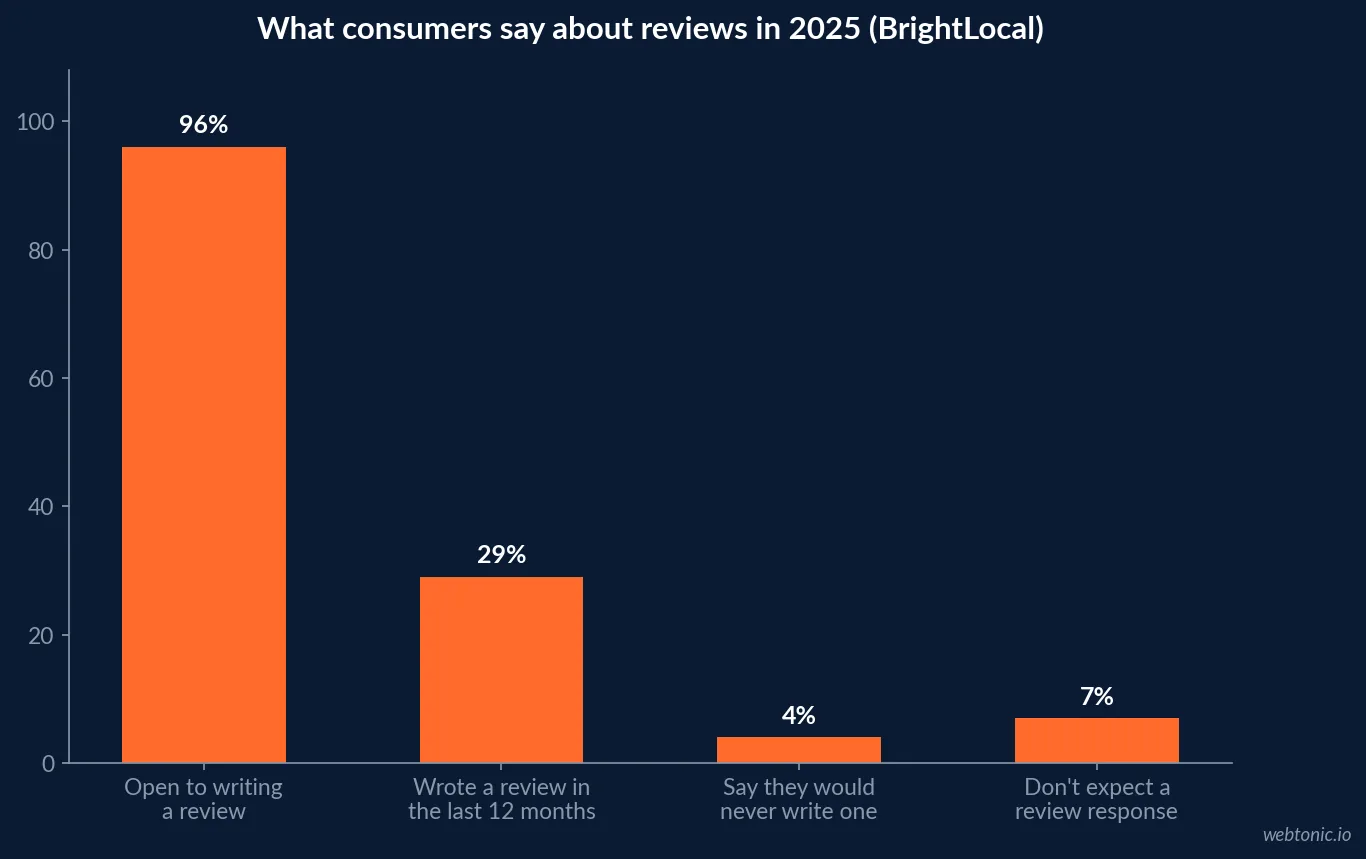
- 96% of consumers are open to writing a business a review.
- 29% of consumers wrote a business review in the last 12 months.
- Only 4% say they never would write one.
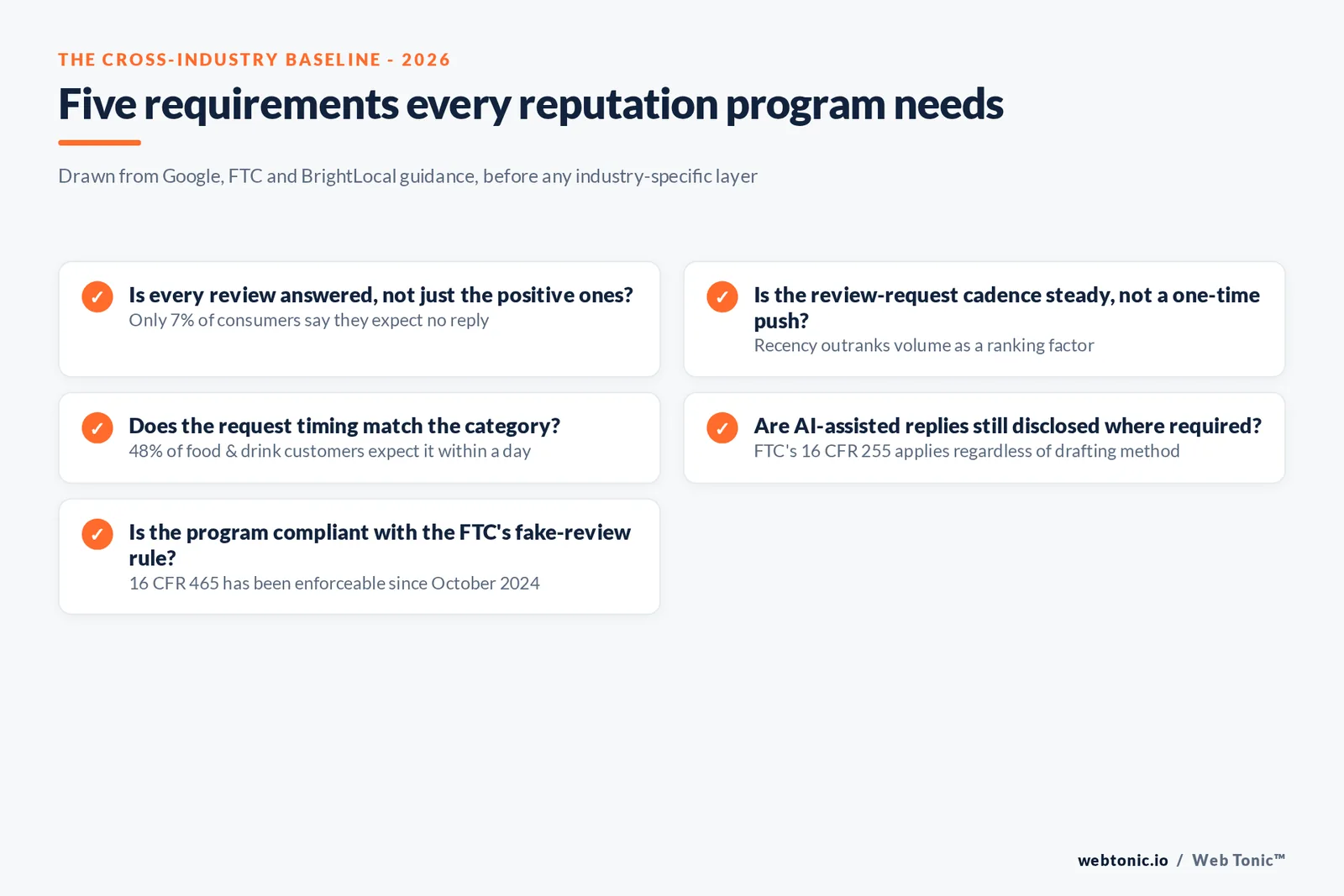
- Just 7% of consumers say they don't expect a review response.
- 40% of consumers say email is their most likely format to respond to a review request.
- 48% of food and drink customers expect a review request within a day.
- 24% of those expect the request the same day.
- Consumers now use an average of at least two review sites before deciding.
- 27% of consumers rely on just one review site, up 4 points year over year.
- Consumers preferred an AI-written Google reply over a human one, for the second year running.
- Review recency outranks review volume as a ranking signal, per Whitespark.
- Google can suspend new reviews entirely on profiles found to violate its fake-engagement policy.
- The FTC's 16 CFR 465 fake-review rule has been in force since October 21, 2024.
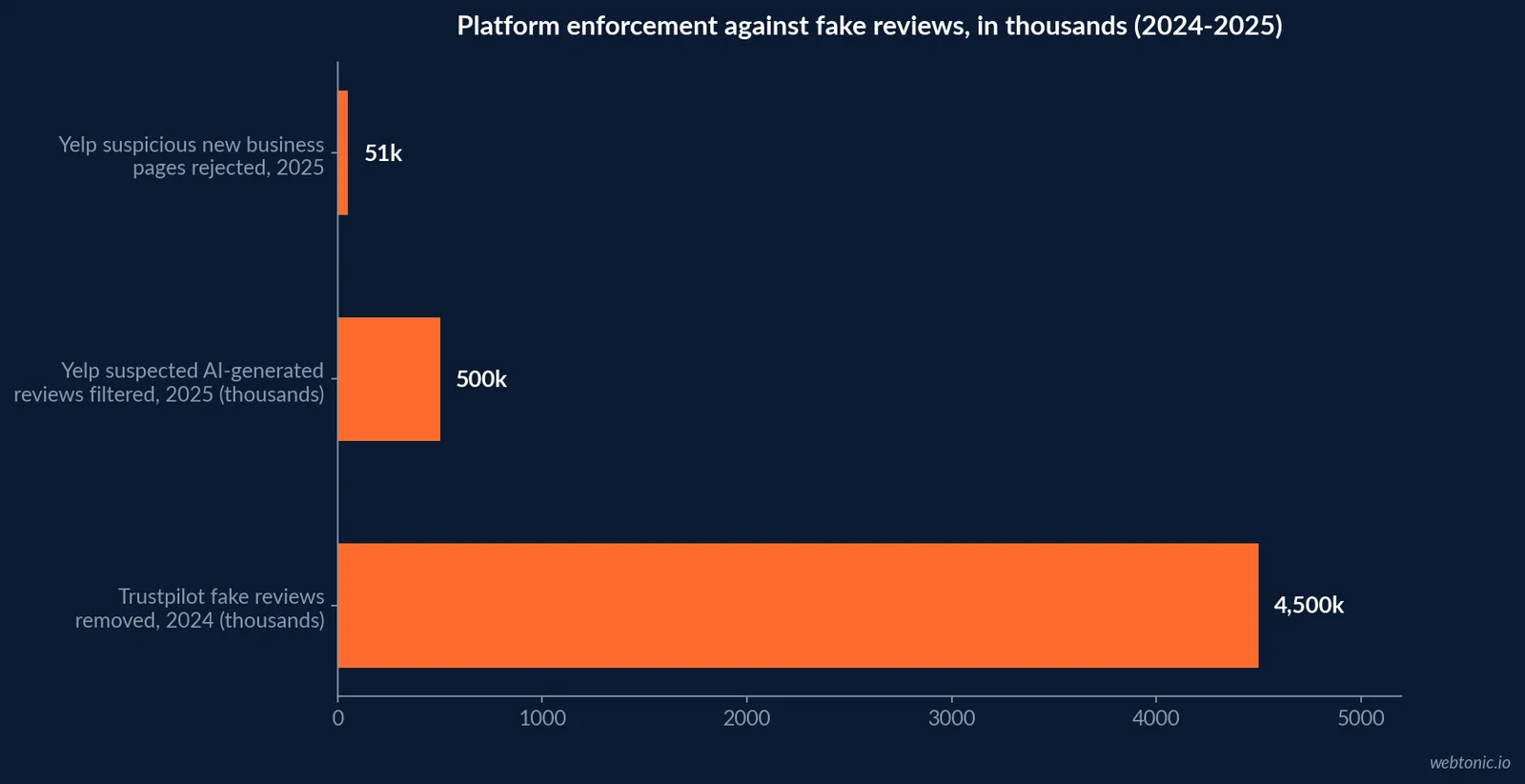
- Trustpilot removed 4.5 million fake reviews in 2024, 7% of all reviews posted.
- Yelp filtered out nearly 500,000 suspected AI-generated reviews in 2025.
- Yelp rejected 50,700+ suspicious new business pages in 2025, up 29% year over year.
What consumers actually expect, per BrightLocal's 2025 survey
BrightLocal's Local Consumer Review Survey 2025 - now in its 15th year - found 96% of consumers are open to writing a business a review, though only 29% actually did in the past year (up from 27% in 2024), and just 4% say they never would. Expectations around volume and recency are easing slightly: a 4-percentage-point increase in consumers who say star rating doesn't affect their decision at all, which BrightLocal reads as a shift toward reading review content rather than counting stars or scanning a single number.
Timing matters more in some categories than others: 48% of food and drink customers expect a review request within a day of their visit, with 24% of that group expecting it the same day - a much tighter window than entertainment or beauty categories, where BrightLocal found consumers are comfortable with a request arriving around three days later.
| Consumer behavior signal (BrightLocal 2025) | Figure |
|---|---|
| Consumers open to writing a review | 96% |
| Consumers who wrote a review in the last 12 months | 29% |
| Consumers who say they never would write one | 4% |
| Consumers who don't expect a review response at all | 7% |
| Consumers whose preferred request format is email | 40% |
| Food & drink customers expecting a request within a day | 48% |
Recency beats volume as a ranking signal
Whitespark's 2025 Local Search Ranking Factors analysis argues review recency is "the most underrated local ranking factor," citing case evidence that rankings track new-review cadence almost in real time: when a business's review requests stop, rankings slip within weeks; when they resume, rankings recover. Whitespark's guidance for review-ask ratio is blunt: if every customer is asked for a review, expect at least a 30-to-1 ratio of positive to negative; if a business never asks, it should expect to hear mostly from unhappy customers.
The practical implication for any review-request program: a steady, ongoing cadence of new reviews outperforms a one-time push to a large total, both for consumer trust and for local ranking.
Reply rate: what businesses actually do
Google's own Manage customer reviews guidance instructs verified businesses to reply promptly and says replies "usually take up to 10 minutes to review, but sometimes ... up to 30 days" before appearing - an internal moderation delay businesses need to plan around when measuring their own response time. Google's companion Tips to get more reviews guidance frames replying to all feedback types, not just positive, as best practice for building trust.
The AI-reply finding from BrightLocal's blind test is worth reading carefully: in a test where consumers judged a real business owner's Google reply against an unlabeled ChatGPT-generated one, for a vet clinic in 2025 (repeating a 2024 restaurant test), the majority preferred the AI-written response - even though separate BrightLocal findings show consumers associate "AI-written" with "fake" when they know the source. The practical read: tone and clarity in a reply matter more than who or what drafted it, but disclosure obligations under FTC rules apply regardless of drafting method.
Platform-side enforcement: fake reviews are being actively policed
Trustpilot's 2025 Trust Report states the platform held 301 million total active reviews at the end of 2024 (up 23% year over year), received 61 million new reviews in 2024 alone, and removed 4.5 million fake reviews - about 7% of all reviews posted that year - with 90% of detected fake reviews caught automatically. Yelp's 2025 Trust & Safety Report reports filtering out nearly 500,000 suspected AI-generated reviews and rejecting 50,700+ potential new business pages for spammy behavior, a 29% increase from 2024, with high-risk categories such as locksmiths, garage door repair and plumbing flagged as especially targeted by scam submissions.
Google's own Business Profile restrictions for policy violations page confirms the enforcement mechanism on its own platform: a profile found to violate the Fake Engagement policy can be blocked from receiving new reviews for a set period, have existing reviews unpublished, and display a public warning that fake reviews were removed - with an appeal path but no guaranteed timeline for restoration.
| Platform enforcement signal (2024-2025) | Figure | Source |
|---|---|---|
| Trustpilot total active reviews, end of 2024 | 301 million | Trustpilot 2025 Trust Report |
| Trustpilot fake reviews removed, 2024 | 4.5 million (7% of postings) | Trustpilot 2025 Trust Report |
| Share of Trustpilot fake reviews caught automatically | 90% | Trustpilot 2025 Trust Report |
| Yelp suspected AI-generated reviews filtered, 2025 | ~500,000 | Yelp 2025 Trust & Safety Report |
| Yelp suspicious new business pages rejected, 2025 | 50,700+ | Yelp 2025 Trust & Safety Report |
The legal backstop: FTC rules on fake and incentivized reviews
The FTC's Trade Regulation Rule on the Use of Consumer Reviews and Testimonials (16 CFR Part 465), effective October 21, 2024, prohibits selling or buying fake reviews, insiders posting undisclosed reviews of their own business, a company running a review site that falsely claims independence, suppressing genuine negative reviews through unfounded legal threats, and buying fake social media indicators of influence. Separately, the FTC's long-standing Endorsement Guides (16 CFR Part 255) require any material connection between a reviewer and the business be disclosed "clearly and conspicuously" in both visual and audible portions of any endorsement.
Both rules apply to every industry in this series - a plumbing company incentivizing reviews and a B2B SaaS vendor running a customer advisory program face the same disclosure standard.
What review-management software actually costs
Neither of the category's two largest platforms publishes a flat rate. Birdeye's own pricing page and Podium's own pricing page both structure cost by location-count tier (both list bands such as 1-3, 4-9, 10-39, and so on) and require a quote rather than publishing a fixed monthly figure - so any specific dollar amount quoted in a third-party blog post should be treated as unverified until confirmed directly with the vendor. The honest planning approach is to request an itemized, per-location quote from each platform and weigh it against the recency and response-rate gains documented above, not to plan a budget from a headline number found on a comparison site.
| Location-tier band (published by vendor) | Birdeye | Podium |
|---|---|---|
| 1-3 locations | Entry tier, quote required | Entry tier, quote required |
| 4-9 locations | Growth tier, quote required | Standard tier, quote required |
| 10-39 locations | Quote required | Quote required |
| 40+ locations | Enterprise, custom quote | Custom quote |
How the industry pages in this series build on this hub
Every industry-specific reputation and review management page that follows this hub applies these same cross-industry benchmarks to its own review-platform mix, rating thresholds and compliance rules - never repeating this hub's numbers as if they were industry-specific. Where an industry has no meaningful consumer-review data of its own (B2B SaaS, manufacturing), that page says so plainly and substitutes the buyer-research data that actually exists for it.
Building a review-request program that matches this data
The consistent theme across every survey on this page is that consumers are willing - 96% open to writing a review, just 7% expecting no reply - but businesses under-invest in the process that turns that willingness into a steady flow of recent, responded-to reviews. A program built on this data asks at the moment the category expects it (same day for food and drink, longer windows for considered purchases), defaults to email as the highest-response format, replies to every review type within a consistent window, and treats a fake-review complaint or a suspicious review spike as a compliance event, not just a reputation nuisance.
| Program element | What the data says to do | Source |
|---|---|---|
| Request timing | Same day to next day for fast-turnaround categories | BrightLocal 2025 |
| Request format | Default to email; it out-performs SMS and in-app asks | BrightLocal 2025 |
| Reply cadence | Reply to all feedback types, not just positive | Google Business Profile Help |
| Ranking impact | Prioritize recency of new reviews over raw total count | Whitespark 2025 |
| Compliance floor | Never buy, sell, or suppress reviews; disclose relationships | FTC 16 CFR 465 / 255 |
Reading this hub against the industry pages that follow it
Consumer star-rating platforms (Google, Yelp, Trustpilot) are the right lens for local, consumer-facing industries - home services, dental, fitness, med spa - and the wrong lens for B2B SaaS, manufacturing or franchise brand-level reputation, which run on buyer-review platforms such as G2, TrustRadius and Gartner Peer Insights instead. Every page in this series states plainly which category it belongs to rather than forcing a consumer-review benchmark onto a B2B buying motion, or vice versa.
Our growth marketing practice and our team build review-request cadences into post-purchase and post-service flows across both consumer and B2B accounts; if your current program has no recency cadence at all, talk to us about auditing it against the benchmarks above.
Frequently Asked Questions
How many reviews does a business actually need?
There is no fixed number, and BrightLocal's 2025 survey shows consumer expectations easing: a 4% year-over-year increase in consumers who say star rating doesn't affect their decision at all, alongside a shift toward reading review content rather than counting stars. The more consistent finding across BrightLocal's research is recency, not volume: a steady drip of new reviews matters more than crossing any specific total.
How fast should a business respond to a review?
Google's own guidance does not set a fixed SLA, but recommends replying to all feedback - positive, negative and neutral - promptly, since replies are public and shape how future customers judge the business. BrightLocal's 2025 survey found just 7% of consumers say they don't expect a response at all, meaning the other 93% are watching for one, whether or not the business realizes it.
Are AI-written review responses a problem?
Consumers say they dislike the idea, but BrightLocal's 2025 blind test - where a real business owner's Google reply was shown against an AI-generated one, unlabeled - found consumers preferred the AI-written response for the second year running. The gap is between what consumers say they want and what they actually respond to when they can't tell which is which; that gap does not extend to disclosure obligations under the FTC's endorsement rules, which apply regardless of how a reply is drafted.
What does the FTC actually prohibit around reviews?
16 CFR Part 465, effective October 21, 2024, prohibits buying or selling fake reviews and testimonials, insiders posting undisclosed reviews of their own business, company-controlled sites posing as independent review sites, suppressing genuine negative reviews through unfounded legal threats, and buying fake social media indicators. Separately, 16 CFR Part 255 (the FTC Endorsement Guides) requires that any material connection between a reviewer and a business be clearly and conspicuously disclosed.
Is review management software worth the cost?
That depends on location count and whether staff time is the real bottleneck. Both Birdeye and Podium price their platforms by number of locations rather than publishing a flat rate, and neither discloses an exact figure without a quote - so the honest starting point is asking a vendor to itemize by location count and comparing that to the value of the response-rate and recency gains this page documents, not a headline price seen on a blog post.
Sources
BrightLocal - Local Consumer Review Survey 2025
Whitespark - Local Search Ranking Factors 2025, review recency analysis
Google Business Profile Help - Manage customer reviews
Google Business Profile Help - Tips to get more reviews
Google Business Profile Help - Business Profile restrictions for policy violations
Trustpilot - 2025 Trust Report
Yelp - 2025 Trust & Safety Report
Federal Trade Commission - 16 CFR Part 465, Final Rule
eCFR - 16 CFR Part 255, FTC Endorsement Guides
Birdeye - Pricing & Plans
Podium - Pricing