Table of contents
X is the cheapest paid social room a treatment center can buy into, and also the smallest. Clicks average about $0.74 against $94.50 on addiction-treatment search, but the platform now runs 557 million monthly active users, down 4.9% year over year, with advertising revenue near half its 2022 level. The 2026 question is not whether X is cheap. It is which job in a rehab media plan is worth a 0.39% engagement rate.
Key Takeaways
- X ads average a $0.74 CPC against $1.41 on Meta - and $94.50 on addiction-treatment search.
- Awareness CPMs run $4-$8 on X versus $8-$18 on Meta; B2B campaigns land at $8-$15.
- 557 million MAU, down 4.9% YoY, with 245-251 million daily users and mobile DAU down 15.2%.
- Ad revenue sits near $2.26 billion versus $4.73 billion in 2022, about 0.2% of global digital ad spend.
- Senior-marketer trust in X advertising fell from 22% to 12%, and roughly 40% of advertisers left between late 2022 and early 2024.
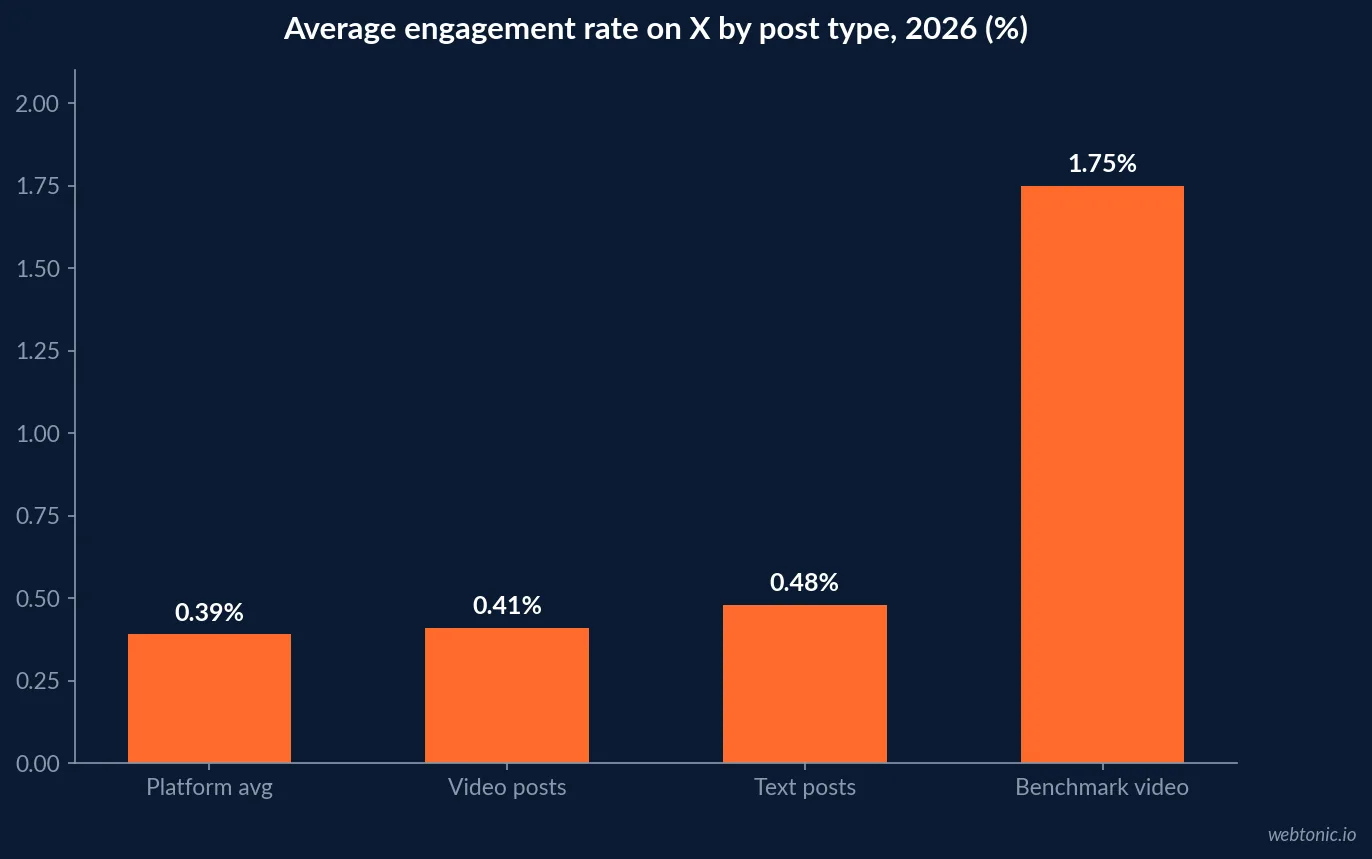
- Average engagement is 0.39% per post; video content benchmarks reach 1-2.5%.
- 60.9% of users are men and 37.5% are aged 25-34 - a professional-referral skew, not a patient skew.
- Pixel plus Conversions API recovers an estimated 15-25% of lost attribution; B2B CPL runs $10-$30.
X ad benchmarks at a glance
Reported X costs vary more than any other platform because audience size, objective and season move them sharply. The ranges below are the ones that recur across 2026 sources.
| Metric | 2026 benchmark | Note |
|---|---|---|
| Average CPC | $0.74 | Industry-dependent range of $0.18-$0.74 |
| Tight B2B audience CPC | $0.80-$2.50 | Small audiences bid up quickly |
| Awareness CPM | $4-$8 | Meta comparison: $8-$18 |
| B2B campaign CPM | $8-$15 | Outliers at $6 niche, $18-$25 competitive |
| Video-view CPM | $3-$6 | Cheapest reach unit on the platform |
| Cost per engagement | $0.03-$0.50 | Engagement is not a lead |
| Average engagement rate | 0.39% | Video 0.41%, text 0.48% |
| Video content engagement | 1%-2.5% | Well above static posts |
| B2B cost per lead | $10-$30 | Landing-page dependent |
| Conversion lift from AI targeting | +16% | Platform-reported |
Read those against the sector baseline. Addiction treatment search converts at 4.10% with a $285 cost per lead, and paid social on Meta runs a $1.85 CPC at a 1.25% conversion rate. X does not beat either on intent; it beats both on the price of a conversation.
The audience contraction that sets the ceiling
Every media decision about X in 2026 starts with the direction of the user base, because it determines how much of a plan the channel can carry.
| Audience metric | 2026 figure | Direction |
|---|---|---|
| Monthly active users | 557 million | -4.9% YoY from 586 million |
| Daily active users | 245-251 million | ~44% of MAU |
| Mobile daily active users | 132 million | -15.2% YoY |
| EU user base | 64.8 million | -15% in H2 2025 (from 76 million) |
| Daily login rate | 52% of users | 84% weekly, 96% monthly |
| Gender split | 60.9% men / 39.1% women | Strong male skew |
| Largest age band | 25-34 at 37.5% | Professional, not adolescent |

The demographic tilt is the useful part. A platform that is 60.9% male and concentrated in the 25-34 band is a poor match for the family member who typically initiates a treatment search, and a reasonable match for clinicians, HR and EAP buyers, union benefit administrators and journalists covering policy. That is a business-development audience, which is why we plan X inside growth marketing rather than inside admissions media.
Where X earns budget in a treatment marketing plan
Ranked by how defensible the spend is when the quarter is reviewed.
| Use case | Why X fits | Realistic budget |
|---|---|---|
| Professional referral development | Clinicians, therapists and case managers are still active here | $500-$2,000/month |
| EAP, HR and payer awareness | 25-34 professional skew, cheap reach | $1,000-$3,000/month |
| Policy and advocacy visibility | Journalists and policy accounts concentrate on X | $300-$1,000/month |
| Alumni and community reactivation | Cheap engagement on an existing follower base | $200-$800/month |
| Crisis-window responsiveness | Real-time surface during news events | Flexible, event-driven |
| Direct consumer admissions | Weak intent, thin conversion data | Not recommended as primary |
Two of those jobs do not require conversion volume at all, which suits a platform where cost per engagement can run as low as a few cents. If the goal is admissions this quarter, the money belongs in search and in the channels covered in our rehab Snapchat Ads statistics and rehab Reddit Ads statistics breakdowns.
Brand safety is the real cost of a cheap CPM
Behavioral health sells trust, so adjacency risk is not a theoretical concern. Senior-marketer trust in X advertising fell from 22% to 12%, and roughly 40% of the advertiser base left between late 2022 and early 2024. Regulated advertisers also get less automation: brand-safety controls in healthcare and finance need more manual configuration on X than on Meta.
The practical mitigation list is short and non-negotiable: keyword and phrase exclusions applied at account level, no reliance on automated adjacency controls, placement reporting reviewed weekly, and a named person who can pause the account inside an hour. On a $1,500-a-month test, that governance costs more than the media - which is itself an argument for keeping the test small.
Policy limits for addiction treatment advertising
X publishes prohibited-content and deceptive-practice rules that bite hardest on exactly the claims treatment marketing is tempted to make. Three patterns to design around.
| Rule area | What it blocks | Compliant alternative |
|---|---|---|
| Deceptive or unsubstantiated claims | Success-rate and cure language | Level-of-care descriptions and accreditation facts |
| Health-status inference | Targeting that implies a condition | Broad professional audiences, creative-led qualification |
| Sensitive-data handling | Ordinary conversion payloads containing PHI | Server-side events with PHI-safe parameters |
| Disclosure requirements | Undisclosed paid or affiliate placement | Explicit disclosure in creator and partner posts |
| Post-approval enforcement | Live ads can be reviewed again | Keep a reserve of approved creative |
Two federal rules sit above the platform policy. 42 CFR Part 2 is stricter than HIPAA for federally-assisted SUD programs, and the Eliminating Kickbacks in Recovery Act constrains how referral and creator arrangements can be paid. Platform-level restrictions for rehab advertisers generally require age-gating and pre-verification on top of that.
Creative rules that move X numbers
The engagement data on X points in one direction: video with text on screen.
| Creative choice | Measured effect | Implication for treatment brands |
|---|---|---|
| Image to video | Cost per engagement down 40-50% | Default to short video, even at low production value |
| Short-form video | 37% of users prefer it from brands | Under 30 seconds, one message |
| Sound off | 70-80% browse muted | Burned-in captions are mandatory |
| Card-style units | CTR up to 20% higher than static | Whole post becomes a tap target |
| Text posts | 0.48% engagement | Best for advocacy and policy commentary |
Because the audience is professional, the creative that works is not the admissions creative. Clinical staff explaining a level of care, outcome-data summaries for referrers, and accreditation or payer news outperform emotive patient-journey edits here - the reverse of the pattern in our rehab ad creative statistics analysis.
Measurement: assume you are under-crediting X
X is small enough that last-click reporting will usually show zero. Two fixes matter. First, pair the pixel with the Conversions API: server-side event integration recovers an estimated 15-25% of attribution lost to browser restrictions. Second, define the conversion as a referral conversation, a booked call with a referrer or an EAP enquiry, not an admission.
With 72.4% of this sector's traffic arriving on mobile and click-to-call converting at 18.5% versus 2.8% for forms, the destination still decides the outcome even for a professional audience. Reporting-side hygiene is covered in our data intelligence work.
What rehab X campaigns must never do
- Never treat X as an admissions channel and judge it on the $1,500-$6,000 cost per admit benchmark set by search.
- Never scale on cheap CPMs alone - a $5 CPM producing $2.50 conversions loses to a $10 CPM producing $0.80 conversions.
- Never run without account-level keyword and placement exclusions.
- Never publish success-rate or cure claims; that is the most common rejection trigger.
- Never pass ordinary conversion payloads that could contain protected health information.
- Never post silent video - 70-80% of users browse muted.
- Never budget X above roughly 5-10% of paid media until it has produced traceable referral conversations.
A 60-day X test for a treatment center
Small, governed and explicitly non-admissions.
| Window | Work | Decision point |
|---|---|---|
| Week 1 | Brand-safety exclusions, age-gating, policy review of claims | Account is safe to run |
| Week 2 | Pixel plus Conversions API, referral-conversation conversion defined | Events land server-side |
| Week 2-3 | Three captioned video concepts for referrers, EAP and advocacy | CTR read against a $0.74 CPC |
| Week 4-6 | Follower and lookalike layer on clinician and HR audiences | CPL read against the $10-$30 band |
| Week 6-8 | Weekly placement review; pause anything with adjacency risk | Keep, halve or cut the test |
If the eight weeks produce referral conversations at $10-$30 apiece, X is a cheap business-development line. If it produces engagement and nothing else, that is a legitimate result at this scale - the honest move is to close the test rather than defend the CPM. To have that call made on data, get in touch.
Metrics to report every month
- Cost per qualified referral conversation, not cost per engagement.
- CPC against the $0.74 benchmark and CPM against the $4-$8 awareness band.
- Engagement rate by format against the 0.39% platform average and 1-2.5% video band.
- Share of spend on captioned video creative.
- Placement and adjacency exceptions found in the weekly review.
- Server-side event match rate after Conversions API deployment.
- Assisted admissions where X appears anywhere in the path, reported separately from last click.
Frequently Asked Questions
Should addiction treatment centers advertise on X in 2026?
Only for narrow jobs. X carries roughly 557 million monthly active users, down 4.9% year over year, with ad revenue near $2.26 billion against $4.73 billion in 2022 - so reach and inventory quality have both thinned. Where it still works is professional and referral audiences: clinicians, EAP and HR decision-makers, unions, recovery advocates and policy press. As a direct consumer-admissions channel it cannot compete with search, which converts at 4.10% in this sector.
What do X ads cost for a treatment center?
Cheaper than everything except Reddit. Average CPC benchmarks cluster around $0.74, with reported ranges of $0.18-$0.74 by industry and $0.80-$2.50 on tighter B2B audiences. Awareness CPMs run $4-$8 against $8-$18 on Meta, and cost per engagement runs $0.03-$0.50. Against a $94.50 average Google Ads click in addiction treatment, X clicks are close to free - the constraint is whether the audience contains anyone who refers patients.
Is X brand-safe enough for a behavioral health brand?
It requires manual work. Senior-marketer trust in X as an ad platform fell from 22% in 2022 to 12%, roughly 40% of the advertiser base left between late 2022 and early 2024, and brand-safety controls in regulated categories need more manual configuration than Meta's. For a treatment brand whose entire proposition is trust, that means keyword and placement exclusions, no automated content adjacency, and a weekly review of where ads appeared.
What kind of creative works on X for behavioral health?
Short video with burned-in captions. Cost per engagement drops 40-50% when creative moves from image to video, 37% of users say short-form video is the brand format they are most likely to interact with, and 70-80% of users browse with sound off. Conversation-led formats also lift clicks: card-style units that turn the whole post into a tap target improve CTR by up to 20% against static images.
How should X be measured in a rehab media plan?
As an assist channel with server-side tracking. Pairing the X pixel with the Conversions API recovers an estimated 15-25% of attribution lost to browser limits, and B2B cost per lead on X typically lands at $10-$30. Report X against qualified referral conversations and assisted admissions rather than last-click admits, because the sector's cost per admit benchmark of $1,500-$6,000 is set by search and Meta, not by a 0.39% engagement platform.
Sources
AutoFaceless - X (Twitter) Statistics 2026: users, revenue, competition
AdLibrary - X Ads vs Meta Ads 2026 cost comparison
Pryani - X (Twitter) as a 2026 growth lever: CPM and CPL data
HeyOz - Are X (Twitter) Ads Worth It in 2026?
Enrich Labs - X cost per engagement benchmarks
Improvado - Twitter/X Ads measurement and Conversions API recovery
AuditSocials - X Ads prohibited and deceptive content policy 2026
True Interactive - Where Does X Stand With Advertisers in 2026?
Benchmarketing - 2026 Addiction Treatment Marketing Benchmarks
Online Optimism - Advertising Restrictions for Rehab and Addiction Centers
Blue Trust Health - HIPAA and 42 CFR Part 2 for Behavioral Health