Table of contents
Real estate agents are not short on social platforms - 87% run Facebook and 62% run Instagram - the open question is which one turns into leads. NAR's own surveys and Zillow's buyer research answer that with a consistent, if unglamorous, ranking: social media wins on volume of leads named, referrals and agent websites win on how buyers actually say they found their agent.
Key Takeaways
- 87% of REALTORS use Facebook for their business, the most of any platform.
- 62% use Instagram and 48% use LinkedIn.
- Only 15% used TikTok in NAR's last platform-by-platform survey.
- 16% of REALTORS report using TikTok in the 2026 Member Profile.
- 39% of agents say social media gives them their highest number of quality leads.
- That is more than double CRM at 23% and the local MLS at 17%.
- A brokerage website was named by only 13% of agents.
- A digital ad campaign was named by 12%.
- 32% of agents use dedicated social media scheduling or content tools.
- 56% of REALTORS use AI to draft social media posts.
- That trails only writing listing descriptions at 75% as an AI use case.
- 48% use drone photography or video in their marketing.
- Buyers found their agent via a real estate website or app 23% of the time.
- 22% came from a friend or family referral, almost tied with the website share.
- A social networking app accounted for 7% of how buyers found their agent.
- Search engines matched social apps at 7% as a discovery channel.
- 73% of REALTORS have a business website, per NAR's Member Profile.
- About 40% of US adults use TikTok, rising to six in ten under 30.
The platform mix agents actually run
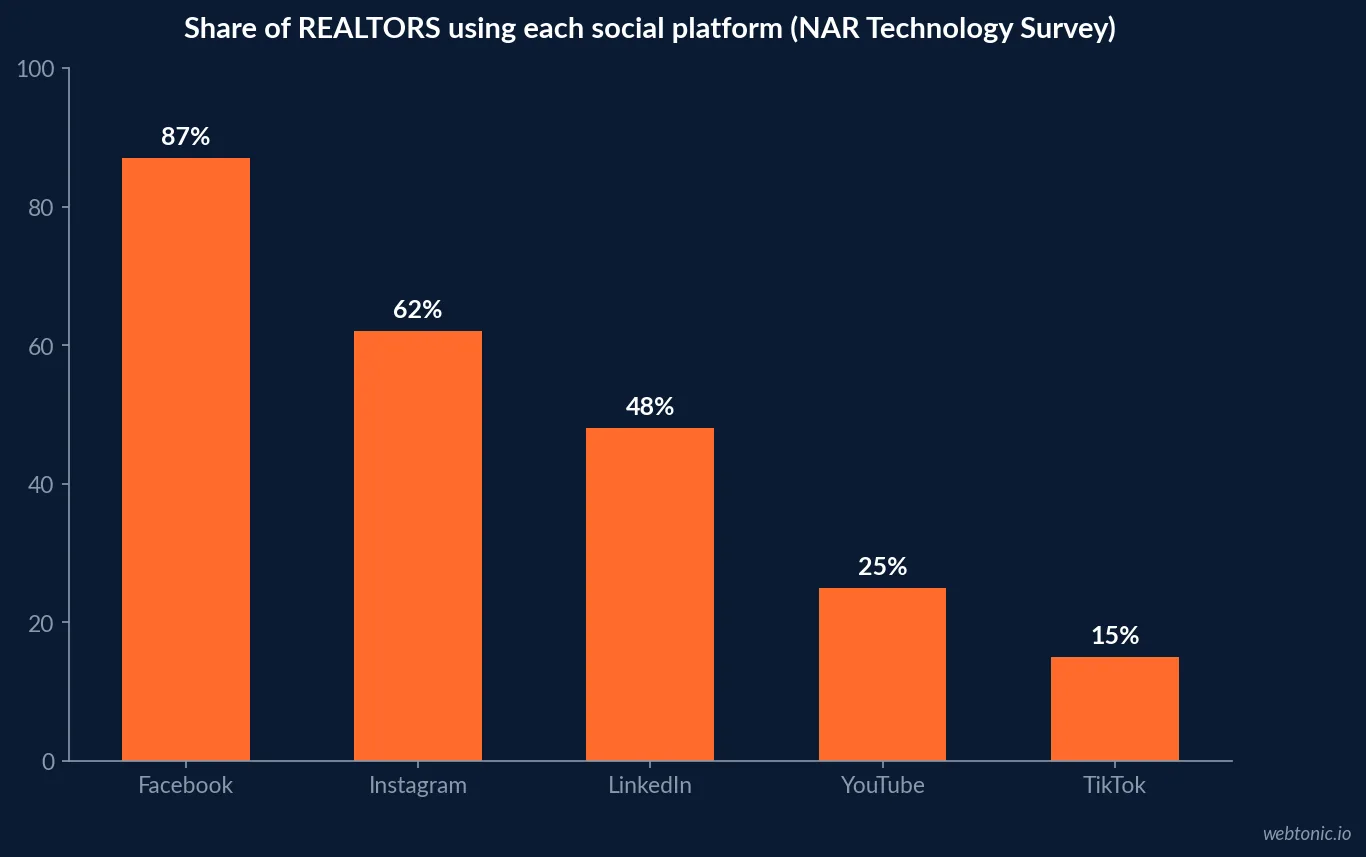
The clearest picture of agent platform adoption still comes from the National Association of REALTORS Technology Survey, which asks members which networks they personally use in their business rather than which ones they merely have an account on. Facebook leads every year measured, and the gap to second place is structural, not seasonal.
What changes year to year is the tail of the distribution - LinkedIn and YouTube usage have crept up while X (formerly Twitter) usage has stayed a rounding error. TikTok is the platform to watch precisely because it moved from a rounding error toward a real minority share.
| Platform | Share of REALTORS using it | Trend | Source year |
|---|---|---|---|
| 87% | Stable, always first | NAR Technology Survey | |
| 62% | Growing slowly | NAR Technology Survey | |
| 48% | Growing slowly | NAR Technology Survey | |
| YouTube | 25% | Flat | NAR Technology Survey |
| TikTok | 15% (survey) / 16% (member profile) | Growing fastest off a small base | NAR |
| X (formerly Twitter) | 10% | Declining | NAR Technology Survey |
Which tool actually produces quality leads
Adoption and results are two different questions, and NAR asks both. NAR's high-tech-edge report found social media named as the highest-quality-lead source by 39% of agents, roughly triple the share naming a digital ad campaign. That ranking has been stable across survey cycles even as the exact percentage moves - an earlier technology survey put the same question at 52% naming social media the top lead source of that year, still comfortably ahead of CRM and MLS.
The practical read: an agent choosing where to spend an afternoon of marketing effort should default to the channel with 87% adoption and the top lead-source ranking, not the newest app.
| Lead-generating tool | Share naming it top source | Rank |
|---|---|---|
| Social media | 39% | 1st |
| Customer relationship management (CRM) | 23% | 2nd |
| Local MLS | 17% | 3rd |
| Brokerage website | 13% | 4th |
| Digital ad campaign (Google, Meta, display) | 12% | 5th |
| Personal business website | 12% | 5th (tie) |
| Email marketing tools | 11% | 7th |
Where buyers actually meet their agent
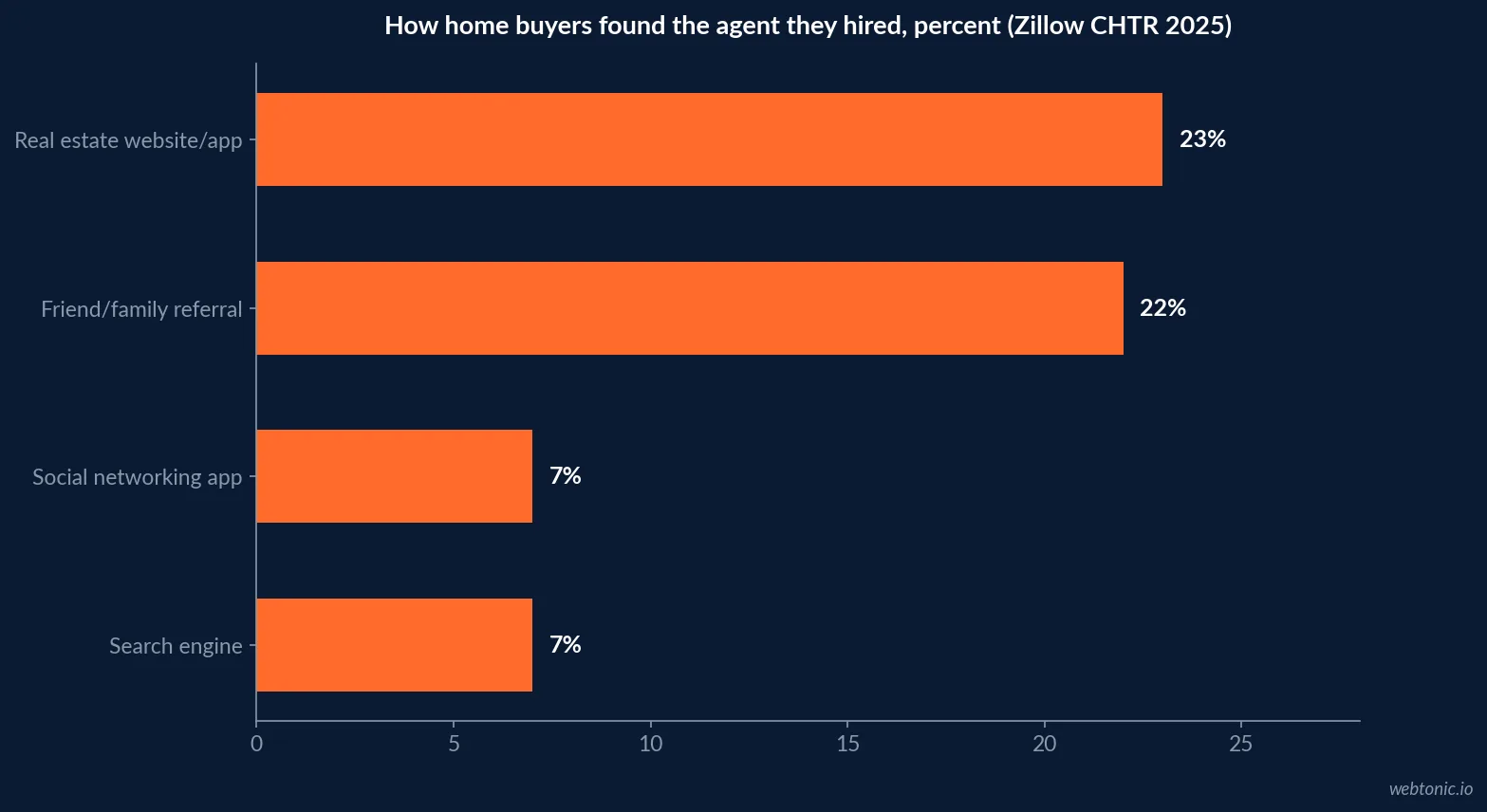
Agent-side survey data measures effort; buyer-side data measures outcome, and Zillow's Consumer Housing Trends Report asks buyers directly how they found the agent they hired. A real estate website or app topped the list at 23%, essentially tied with a friend or family referral at 22%. Social networking apps - the category that includes Facebook, NextDoor and Instagram - accounted for 7%, level with search engines.
This is the honest counterweight to the lead-source table above: agents report social media as their top lead generator, but buyers report finding the agent itself through a listing platform or a referral more often than through a social feed. Both can be true - social media nurtures a relationship that closes later through a direct message or a phone call, which the buyer then attributes to the website or the referral, not the post that started it.
| How buyers found their agent | Share of buyers | Category |
|---|---|---|
| Real estate website or app | 23% | Owned/portal |
| Referral from friend or family | 22% | Word of mouth |
| Social networking app (Facebook, NextDoor, Instagram) | 7% | Social |
| Search engine | 7% | Organic/paid search |
| Referral from another agent | 5% | Word of mouth |
| Referral from a home builder | 4% | Word of mouth |
What AI has changed about the posting itself
The platforms have not shifted as fast as the production behind them. NAR's 2026 REALTORS Technology Report found 56% of REALTORS use AI to create social media posts, the second most common AI use case after writing listing descriptions at 75%. 32% of agents separately use dedicated social media scheduling or content tools, and 48% use drone photography or video as part of their listing marketing, feeding the same channels.
Practically, this means a competitor's Facebook feed in 2026 is more likely to be AI-drafted and drone-shot than it was two years ago - the bar for what counts as a normal listing post has risen even where the platform choice has not changed.
| AI use case among REALTORS who use AI | Share reporting use |
|---|---|
| Writing listing descriptions | 75% |
| Social media posting | 56% |
| Creating emails or follow-ups | 52% |
| Market summaries | 30% |
| Drafting marketing content in a personal tone | 30% |
| Document review or summarizing | 27% |
How fast AI is reshaping the content behind the posts
HousingWire's coverage of NAR's 2026 report adds the adoption curve behind the 56% social-posting figure above: 23% of agents now use AI daily and 25% use it weekly, while the share who avoid AI entirely fell to 21%, down from 32% a year earlier. Among agents who use AI tools at all, ChatGPT usage climbed to 91%, up from 58% the year before. That is a faster shift than the platform-adoption numbers above show for any single social network, which is the real story behind a 2026 real estate social feed - the app is the same Facebook page as 2024, but more of what lands on it now starts as an AI draft.
| AI usage cadence among REALTORS | Share (2026) | Prior year |
|---|---|---|
| Use AI daily | 23% | Lower, exact prior-year daily figure not broken out |
| Use AI weekly | 25% | - |
| Experiment occasionally | 31% | - |
| Do not use AI at all | 21% | 32% in 2025 |
Matching the platform to the buyer, not the trend
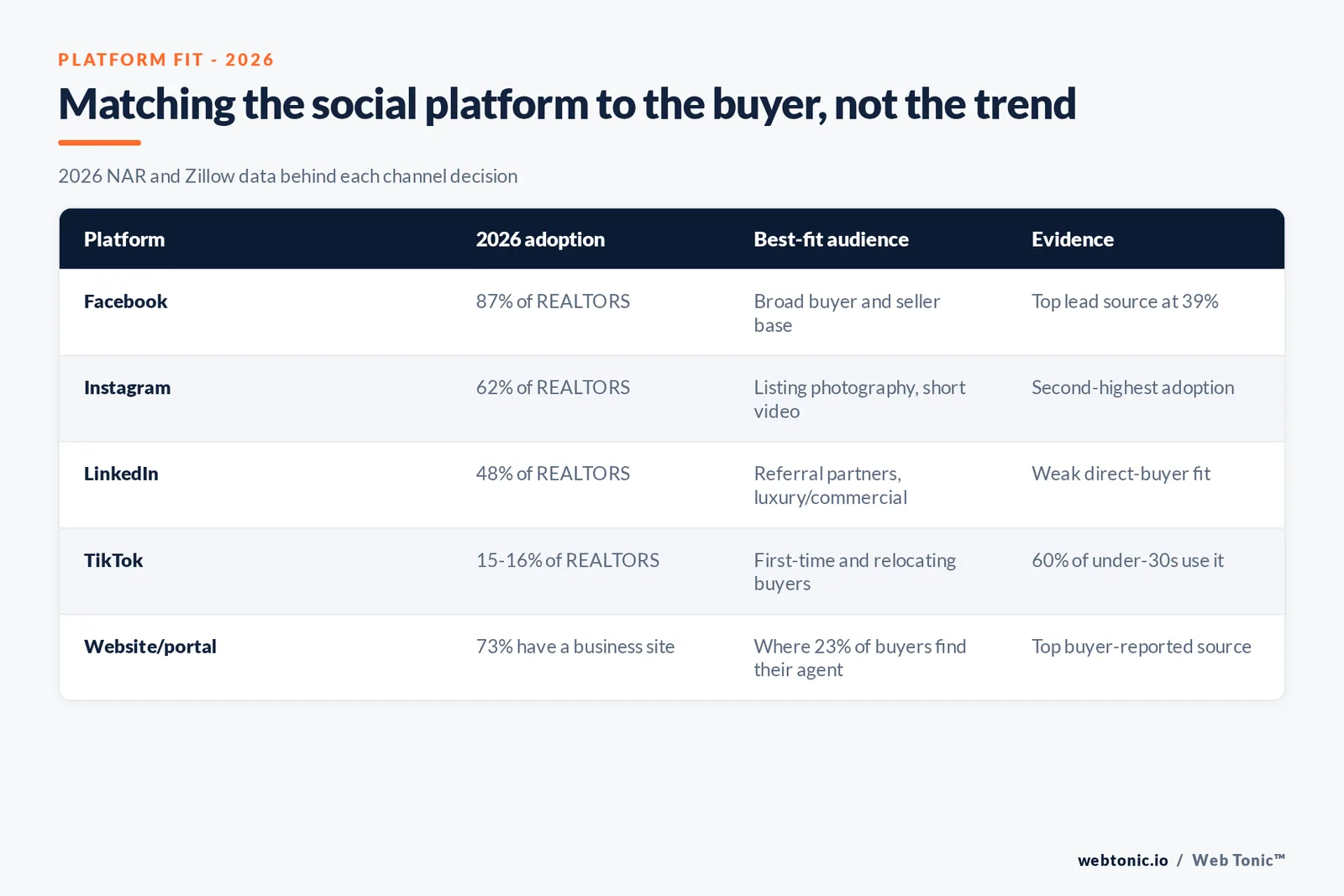
Facebook's 87% adoption and top-ranked lead generation make it the default budget line for any agent building a channel plan from scratch. Instagram at 62% is the natural second channel for listing photography and short video. LinkedIn's 48% adoption is worth noting mainly for referral-partner and luxury/commercial segments rather than direct-to-buyer marketing. TikTok's 15-16% professional adoption against a much larger under-30 consumer audience makes it a targeted bet on relocation and first-time buyers rather than a general channel worth a default budget line the way Facebook is.
The website and referral shares in the buyer-side data are also a reminder that a social strategy without a landing page behind it is leaving the actual conversion on the table - our conversion rate statistics research covers the other half of that funnel in more depth.
Building the content calendar around what converts
A calendar built from this data leans on listing video and drone content (48% of agents already use drone/video, and it is a leading input to Facebook and Instagram posts), AI-assisted captions and descriptions (56% and 75% respectively), and a consistent posting cadence backed by a scheduling tool (32% adoption, still a minority - room to differentiate). None of that replaces a referral network or a fast, mobile-first website, which the buyer-side data shows still carry more of the actual "how I found my agent" answer than any single platform.
If your team is deciding where paid budget should sit alongside organic social, our growth marketing practice can model that channel mix against your own lead data, and talk to us if you want a second read on your current platform spend.
Benchmarking against the wrong survey year
One caution worth stating plainly: NAR's platform-by-platform breakdown (Facebook 87%, Instagram 62%, LinkedIn 48%, YouTube 25%, TikTok 15%) comes from its 2024 Technology Survey, the most recent cycle to publish a full per-network table. Its 2026 Member Profile and 2026 REALTORS Technology Report update specific figures - TikTok professional use at 16%, AI usage at 56% for social posting - without re-publishing the full platform table. A CSM comparing year-over-year platform share should note which report a competitor's cited number actually comes from before treating a small move as a trend.
Frequently Asked Questions
Which social platform do the most real estate agents use?
Facebook, by a wide margin. NAR's Technology Survey put Facebook use at 87% of members, with Instagram second at 62%, LinkedIn at 48%, YouTube at 25% and TikTok at 15%. The gap between Facebook and everything else has held for three straight survey years, which is why an agent with only one channel almost always defaults to Facebook first.
Does social media actually produce quality leads for agents?
It is the single largest source agents name. NAR's high-tech-edge report found 39% of agents say social media gives them their highest number of quality leads, ahead of CRM at 23%, the local MLS at 17% and a brokerage website at 13%. An older technology survey put the same question at 52% naming social media the highest-lead tool of the year measured, so the ranking is consistent even where the exact share moves.
Do buyers actually find agents through social media?
Rarely as the first touch, but it shows up. Zillow's Consumer Housing Trends Report for buyers found a real estate website or app (23%) and a referral from friends or family (22%) lead the list of how buyers found the agent they hired, with a social network app such as Facebook, NextDoor or Instagram at a smaller but real 7%, tied with search engines. Social is a discovery channel, not the main one, and the data does not support treating it as such.
Is TikTok worth an agent's time in 2026?
It is still a minority channel professionally: 16% of REALTORS report using TikTok for their business in NAR's 2026 Member Profile, well behind Facebook, Instagram and LinkedIn. NAR's own reporting notes roughly 40% of US adults use TikTok and about six in ten adults under 30 do, per Pew Research, so the platform's audience skews toward first-time and relocating buyers rather than the broader client base most agents are already reaching on Facebook.
What is AI changing about how agents use social media?
It is compressing production time on the content agents were already posting. NAR's 2026 REALTORS Technology Report found 56% of REALTORS use AI to create social media posts, and among agents who use AI at all, 56% apply it to social posting specifically, second only to writing listing descriptions at 75%. The platforms agents use have not changed as fast as how the posts on them get made.
Sources
National Association of REALTORS - Technology Survey
NAR - The Top Tech Tools Giving Real Estate Agents a High-Tech Edge
NAR - The Tech Real Estate Agents Rely on Most in 2026
NAR - Why Real Estate Pros May Not Want to Overlook TikTok
NAR - The Feature Sheet: 2026 Member Profile
Zillow - Consumer Housing Trends Report, Buyers 2025
Pew Research Center - Social Media Fact Sheet
Sprout Social - Social Media ROI Statistics 2026
HousingWire - Realtors use AI more often, NAR 2026 tech report finds