Table of contents

Real estate agents are not guessing at technology spend anymore - NAR's 2026 REALTORS Technology Report puts a number on it, and the CRM and automation vendors publish their own price lists. This page prices the tooling from those two sources side by side: what agents report spending, and what the platforms that spend buys actually charge.
Key Takeaways
- 36% of agents spend USD 50 to 250 a month on technology overall (NAR 2026).
- 22% of agents spend more than USD 500 a month on technology.
- 81% of agents cite saving time as their top reason to adopt technology, up from 66% in 2025.
- 54% cite less manual work specifically as a reason to adopt new tools.
- 46% of agents already run a CRM, and 41% use AI-generated content tools.
- 52% use AI for follow-up email creation among agents who use AI at all.
- Follow Up Boss Grow starts at USD 69 a user a month, USD 58 billed annually.
- Follow Up Boss Pro is a flat USD 499 a month for 10 users ($416 annual).
- HubSpot Marketing Hub Starter begins at USD 20 per core seat a month for 1,000 contacts.
- HubSpot Professional runs USD 890 a month for 3 seats plus a USD 3,000 one-time onboarding fee.
- HubSpot Enterprise runs USD 3,800 a month for 5 seats plus a USD 7,000 onboarding fee.
- 63% of agents call the learning curve their biggest barrier to new technology.
- 59% cite cost itself as a barrier to adopting new tools.
- Odds of contacting a web lead drop 100 times when response comes at 30 minutes versus 5 (MIT/InsideSales.com).
- Odds of qualifying that lead drop 21 times over the same window.
- 96% of agents still rely on the MLS as their top technology, ahead of any CRM or automation tool.
- 88% of buyers and 91% of sellers used an agent for their last transaction (NAR 2025 Profile).
- Additional Follow Up Boss users cost USD 49 a month on the Grow plan, USD 41 annual.
What agents actually say they spend
NAR's 2026 REALTORS Technology Report asked members directly about monthly technology spend. Eighteen percent spend under USD 50, the largest single band at 36% sits between USD 50 and USD 250, 19% spend USD 251 to 500, and 22% spend more than USD 500 a month across their full stack, not automation alone. That spread matters: a solo agent on a single CRM plan lands in the lowest two bands, while a team layering a CRM, an email tool and paid lead sources lands in the top one.
The same report frames why agents spend at all: 81% say saving time is their primary motivation, up sharply from 66% a year earlier, and 54% cite less manual work by name. Technology is being bought to remove hours, not to add a dashboard.
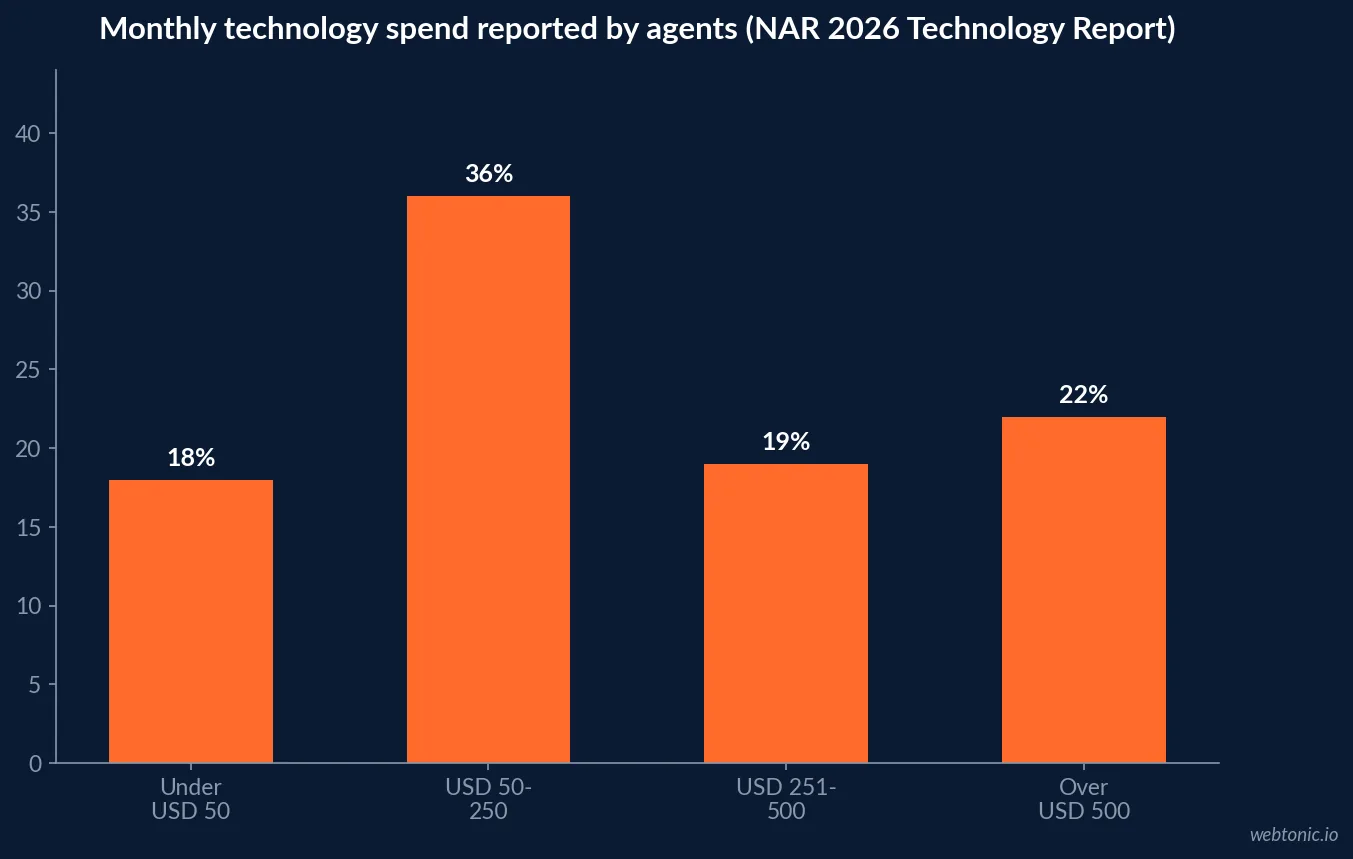
| Monthly tech spend band | Share of agents | What it typically covers | Source |
|---|---|---|---|
| Under USD 50 | 18% | A single lightweight CRM or a scheduling tool | NAR 2026 |
| USD 50-250 | 36% | One CRM plan plus a lead source or two | NAR 2026 |
| USD 251-500 | 19% | CRM plus an email/automation add-on | NAR 2026 |
| Over USD 500 | 22% | Full stack: CRM, automation, paid leads, team seats | NAR 2026 |
What the CRM built for agents actually costs
Real estate has its own CRM category built around lead routing and behavioral alerts, and the published price list is a public one. Follow Up Boss's own pricing page lists Grow at USD 69 a user a month (USD 58 billed annually), with additional users at USD 49 a month. Pro is a flat USD 499 a month for 10 users (USD 416 annual) and adds unlimited calling and texting for the whole team. Platform runs USD 1,000 a month for 30 users (USD 833 annual). None of these figures are quotes; they are the published rate card.
kvCORE, the other major agent-facing CRM, does not publish a rate card - Inside Real Estate's own pricing page routes every visitor to a sales call, so no independent price can be quoted here without guessing. That gap is itself a data point: not every category leader in this niche prices in public.
| Plan (published) | Monthly price | Annual price | Users included | Source |
|---|---|---|---|---|
| Follow Up Boss Grow | USD 69/user | USD 58/user | 1 (add USD 49/mo each) | followupboss.com |
| Follow Up Boss Pro | USD 499 flat | USD 416 flat | 10 included | followupboss.com |
| Follow Up Boss Platform | USD 1,000 flat | USD 833 flat | 30 included | followupboss.com |
| HubSpot Marketing Hub Starter | from USD 20/seat | n/a published | 5 core seats cap | hubspot.com |
| HubSpot Marketing Hub Professional | USD 890 flat | USD 800 flat | 3 core seats | hubspot.com |
The generic alternative and its onboarding tax
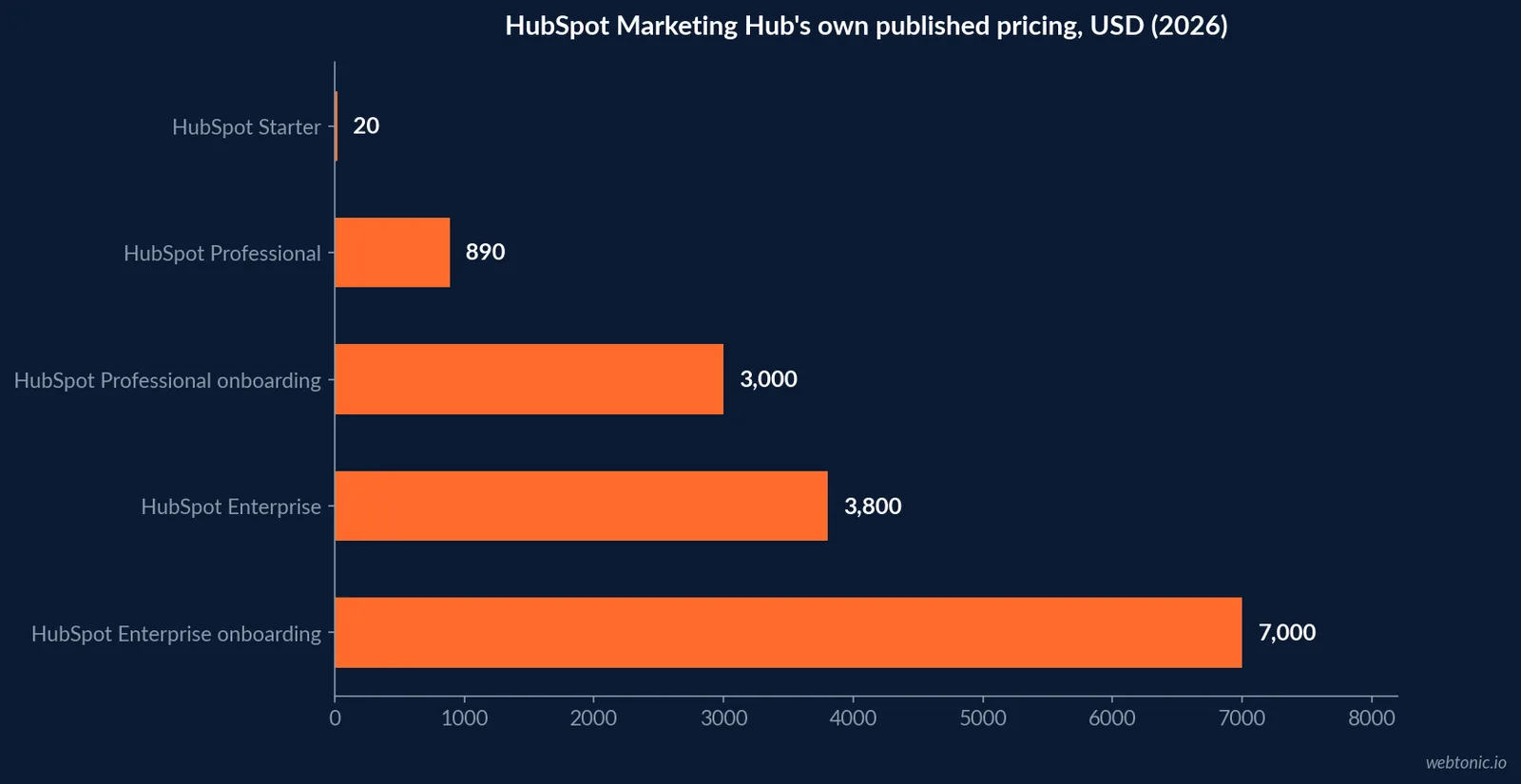
Teams that outgrow a niche CRM, or that want marketing automation broader than lead routing, look at general marketing platforms. HubSpot's own pricing page lists Marketing Hub Starter from USD 20 per core seat a month for 1,000 marketing contacts, Professional at USD 890 a month for three seats (USD 800 billed annually) with a mandatory USD 3,000 one-time onboarding fee, and Enterprise at USD 3,800 a month for five seats with a USD 7,000 onboarding fee. Exceeding the included contact tier - 2,000 on Professional, 10,000 on Enterprise - triggers the next pricing band automatically, adding roughly USD 250 a month per HubSpot's own worked example.
That onboarding fee is easy to miss when comparing headline monthly prices. A five-agent team moving from a niche CRM to HubSpot Professional is paying USD 10,680 in year one before any contact-tier overage, not USD 10,680 minus USD 3,000 - the fee is on top.
Why the money is spent on speed, not volume
The oldest and still most cited justification for buying lead-routing automation is a lead response study, not a real estate one. The MIT/InsideSales.com Lead Response Management study - the same research later summarized by Harvard Business Review's 2011 article "The Short Life of Online Sales Leads" - examined over 100,000 call attempts across fifteen thousand web leads. It found that the odds of making contact drop 100 times when the callback happens at 30 minutes instead of 5, and the odds of qualifying that lead drop 21 times over the same window.
Automation cannot make an agent answer a call at midnight, but a routing rule that pages the right agent inside minutes of a web form submission is the direct product this research funds. Our growth marketing practice treats that routing rule as the highest-leverage piece of any real estate automation stack, ahead of any content feature.
| Callback window | Relative odds of contact | Relative odds of qualifying | Source |
|---|---|---|---|
| 5 minutes (baseline) | 1x | 1x | MIT/InsideSales.com LRM study |
| 30 minutes | 100x worse | 21x worse | MIT/InsideSales.com LRM study |
| First hour | 10x worse (contact) | 6x worse (qualify) | MIT/InsideSales.com LRM study |
| After 20 hours | Further dials hurt qualification | Further dials hurt qualification | MIT/InsideSales.com LRM study |
What agents automate first, per NAR's own ranking
NAR's 2026 report ranks the technologies agents actually run: 96% still use the MLS, 79% use e-signature, 68% use showing-scheduling tools, 59% use CMA/pricing tools, and 46% run a CRM. Automation shows up further down the list as a byproduct of AI adoption: 41% use AI-generated content tools, and among agents who use AI at all, 52% use it for creating emails and follow-up, ahead of market summaries at 30%.
That ordering is useful for budgeting. An agent choosing between a CRM upgrade and an AI email-drafting tool is choosing between the fourth-most and seventh-most adopted category, not between a mainstream tool and a novelty.
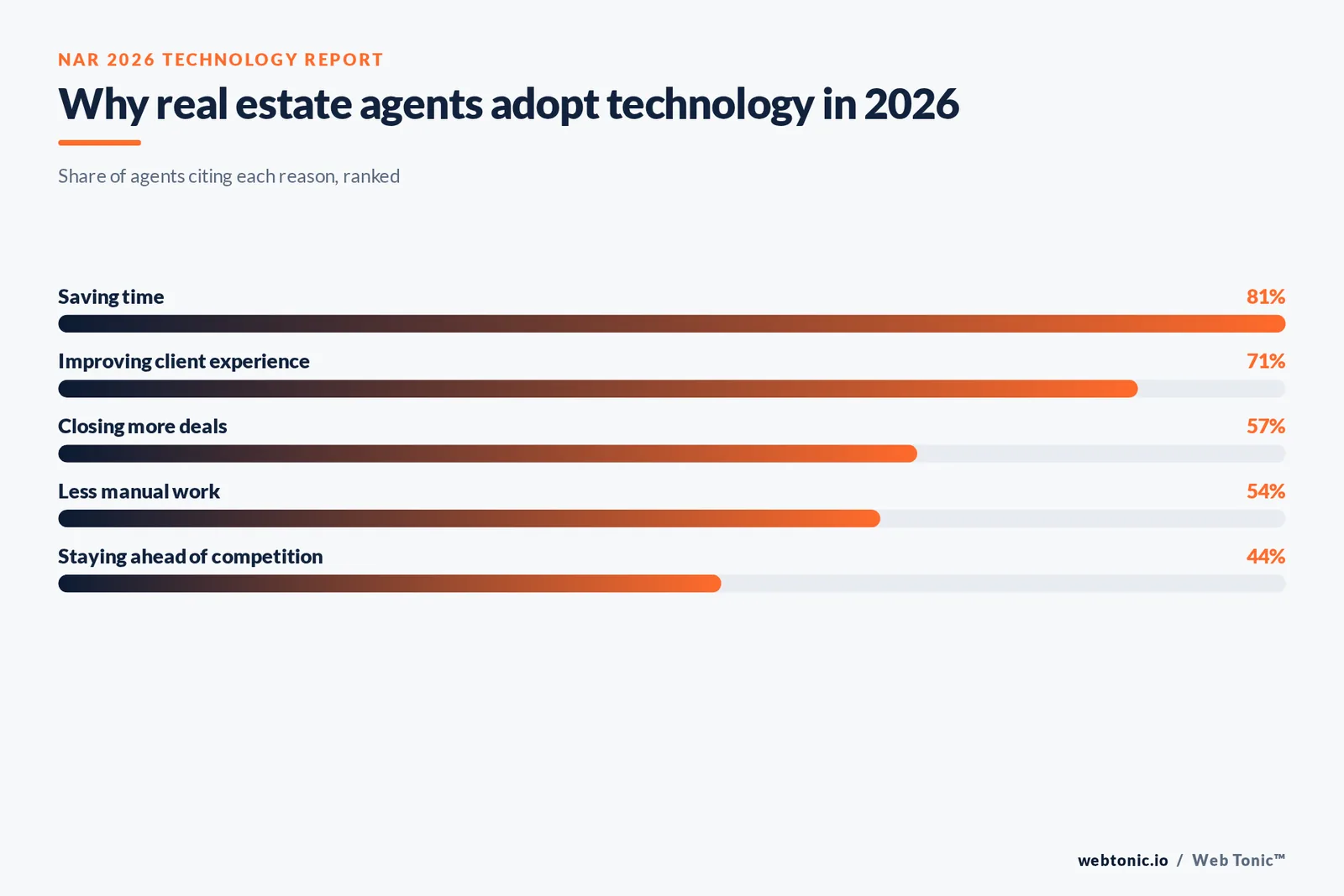
| Reason agents adopt technology | Share citing it | 2025 comparison | Source |
|---|---|---|---|
| Saving time | 81% | 66% | NAR 2026 Technology Report |
| Improving client experience | 71% | 64% | NAR 2026 Technology Report |
| Closing more deals | 57% | not stated | NAR 2026 Technology Report |
| Less manual work | 54% | not stated | NAR 2026 Technology Report |
| Staying ahead of competition | 44% | not stated | NAR 2026 Technology Report |
Where the barrier sits: cost is real, but it is not the biggest one
Budgeting for automation is not only a price question. NAR's own data shows 63% of agents name the learning curve as their biggest adoption challenge, ahead of 59% who name cost. That ordering argues for choosing the cheaper, simpler platform an agent will actually configure over the more capable one that sits unused after the onboarding fee is paid.
It also argues for sequencing: 40% of agents say clients responded very positively to new technology in their transactions and another 37% say clients found it helpful with some reservations - a strong enough signal that the return on a well-used tool outpaces a poorly used expensive one.
| Adoption barrier | Share citing it | What it implies for tool choice | Source |
|---|---|---|---|
| Learning curve | 63% | Favor tools with fast onboarding over feature depth | NAR 2026 |
| Cost | 59% | Price against the USD 50-250 band most agents already spend | NAR 2026 |
| Client reaction, very positive | 40% | Automation that touches the client experience pays back fastest | NAR 2026 |
| Client reaction, helpful with reservations | 37% | Plan for a short client-facing rollout, not a silent one | NAR 2026 |
How to size the budget against the transaction itself
NAR's 2025 Profile of Home Buyers and Sellers reports that 88% of buyers and 91% of sellers completed their last transaction with an agent's help, and that buyers searched a median of 10 weeks before finding a home. That search window is exactly where automated nurture and lead routing earn their keep - the tool has ten weeks to keep a buyer warm, not ten minutes.
Sizing a CRM budget against that window rather than against a monthly average produces a cleaner number: a Follow Up Boss Grow seat at USD 69 a month costs roughly USD 16 per week of a typical buyer search, which is a more defensible way to justify the line item to a broker than a flat monthly figure. Our data and analytics team builds that kind of unit-cost model before recommending a tool swap.
Frequently Asked Questions
How much should a real estate agent budget for marketing automation?
NAR's 2026 REALTORS Technology Report puts 36% of agents at USD 50 to 250 a month in total technology spend and 22% above USD 500. A CRM built for the industry sits inside that band: Follow Up Boss publishes USD 69 a user a month on its Grow plan, falling to USD 58 a user billed annually. Add an email tool if the CRM's own sending is thin and the combined bill still lands under USD 150 a month for a single agent.
Is a real estate CRM worth it over a generic email tool?
It depends on what slows the agent down. NAR reports 54% of agents adopt technology specifically for less manual work and 46% already run a CRM. A real estate CRM adds lead routing and behavioral alerts that a generic sender does not; a generic tool like HubSpot Starter is cheaper per seat but leaves routing and pipeline stages to be rebuilt by hand.
What does HubSpot or ActiveCampaign cost for a small brokerage?
HubSpot's own pricing page lists Marketing Hub Starter from USD 20 per core seat a month for 1,000 contacts, with Professional at USD 890 a month for three seats plus a one-time USD 3,000 onboarding fee. A five-to-ten-agent team fits inside Starter or Professional depending on contact volume; the jump to Professional is driven by seat count and automation depth, not agent headcount alone.
What is the real lead-routing payoff of automation?
The MIT/InsideSales.com Lead Response Management study, later summarized in Harvard Business Review's 2011 'The Short Life of Online Sales Leads,' found the odds of making contact with a web lead fall 100 times when the callback comes at 30 minutes instead of 5, and the odds of qualifying that lead fall 21 times over the same window. Automated routing exists to close that window, not to replace the agent's call.
Does more automation spend mean fewer manual tasks for agents?
Directionally yes, but NAR's own numbers show the gap is closing slowly: 81% of agents say saving time is their top reason for adopting technology in 2026, up from 66% a year earlier, and 54% cite less manual work specifically. Tool spend is necessary for that outcome, not sufficient by itself - 63% of agents still call the learning curve their biggest adoption barrier.
Sources
NAR 2026 REALTORS Technology Report (newsroom summary)
NAR 2025 Profile of Home Buyers and Sellers
Follow Up Boss pricing (vendor page)
HubSpot Marketing Hub pricing (vendor page)
kvCORE / Inside Real Estate pricing page
MIT/InsideSales.com Lead Response Management study (2007, archived original)
Harvard Business Review, 'The Short Life of Online Sales Leads' (2011)
Web Tonic growth marketing services
Web Tonic data and analytics services
Web Tonic: marketing automation statistics hub