Table of contents

Real estate on LinkedIn is really two different platforms wearing one name. Commercial real estate fits the platform's structure - every counterparty is a reachable business title - and residential real estate mostly does not, which shows up clearly across both outreach and paid-media data through 2026. The state of the channel in 2026, in short: a solid-but-unremarkable front door, an above-average conversation once the door opens, and a cost premium that is easier to justify for a commercial deal cycle than for a single-family listing.
Key Takeaways
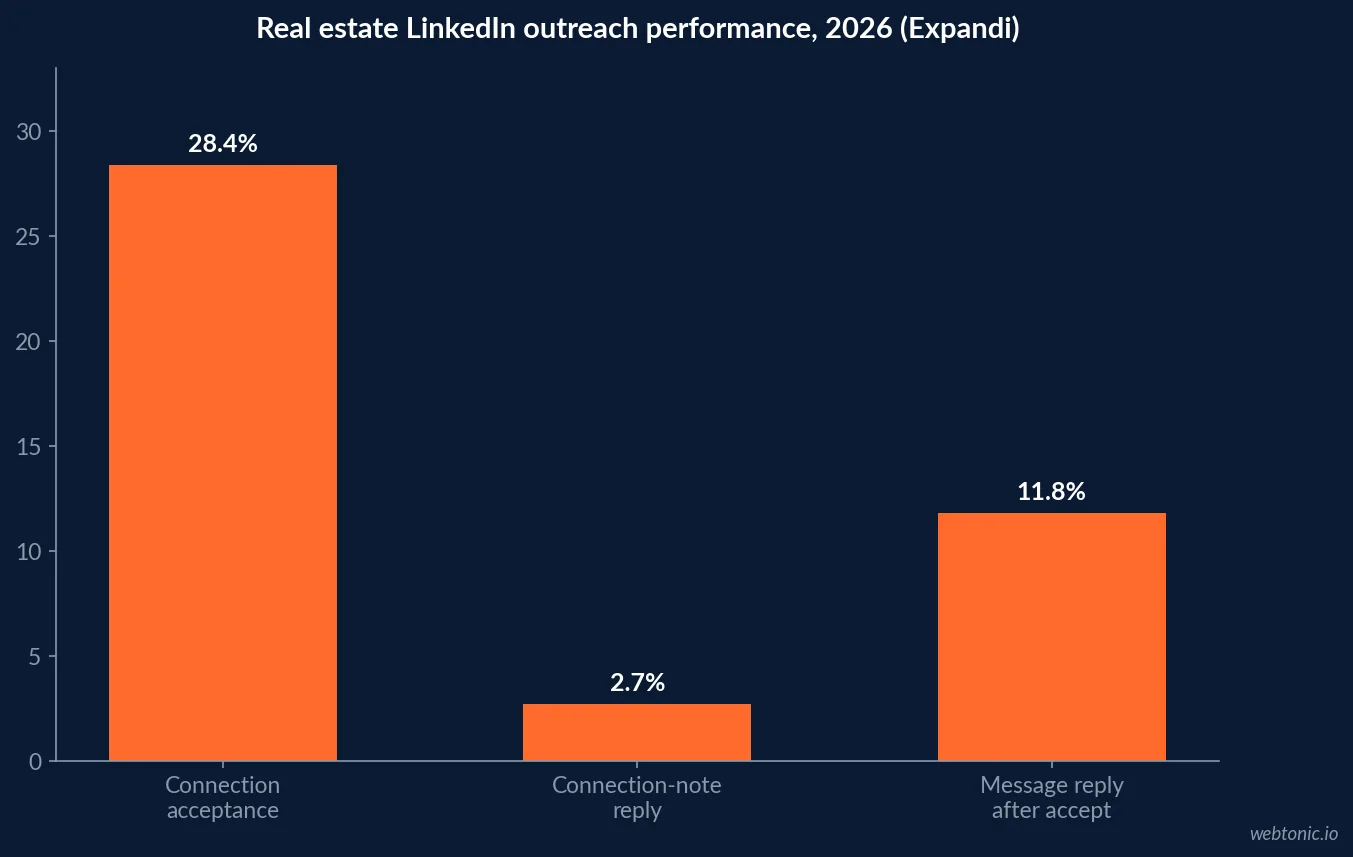
- Real estate LinkedIn connection acceptance runs at 28.4%.
- That is just 0.1 points under the 38-industry average of 28.5%.
- Real estate message reply rate after acceptance is 11.8%.
- That beats the cross-industry average of 10.4% by 1.4 points.
- Real estate ranks 9th of 38 industries on message reply rate.
- Connection-note reply rate is 2.7%, versus 3.0% cross-industry.
- The data covers 277,414 connection requests from 253 real estate accounts.
- Cross-industry, LinkedIn's average CPC is $11.90 in 2026 B2B data.
- That is 3.1 times Facebook's $3.80 CPC in the same dataset.
- LinkedIn's click-to-lead rate is 5.9%, versus 2.6% on Facebook.
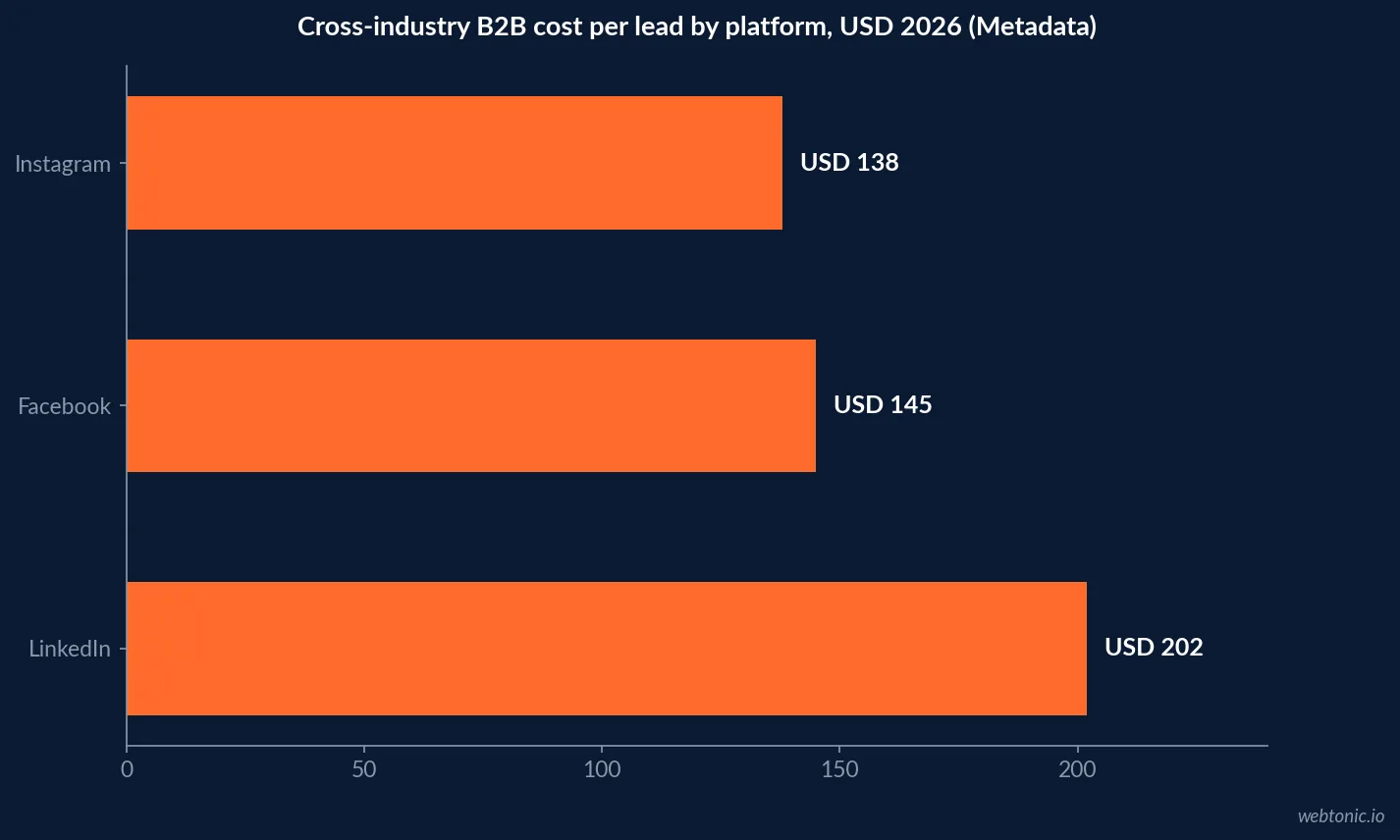
- LinkedIn's resulting cost per lead is $202, against Facebook's $145.
- Only 48% of REALTORS use LinkedIn professionally at all.
- That trails Facebook's 87% and Instagram's 62% by a wide margin.
- Document-format LinkedIn ads produced the cheapest lead in one 2026 dataset, at $142.
- That format was 29% below image ads and 46% below video ads on cost per lead.
Real estate's outreach numbers, industry-ranked
Expandi's 2026 LinkedIn outreach benchmarks for real estate, built from 277,414 connection requests sent by 253 real estate accounts between May 2025 and April 2026, found an ordinary front door and an above-average conversation. Connection acceptance sits at 28.4%, a tenth of a point under the 38-industry average and ranking 17th. Message replies after acceptance run at 11.8%, 1.4 points above the cross-industry figure and ranking 9th of 38 - the reverse pattern from most sectors, where strong acceptance and strong conversation usually move together.
| Metric | Real estate (2026) | Cross-industry average | Real estate rank (of 38) |
|---|---|---|---|
| Connection acceptance rate | 28.4% | 28.5% | 17th |
| Connection-note reply rate | 2.7% | 3.0% | 18th |
| Message reply rate after acceptance | 11.8% | 10.4% | 9th |
| End-to-end conversion per 100 sent | ~3.4 | ~3.0 | Above average |
Why commercial fits the platform structurally
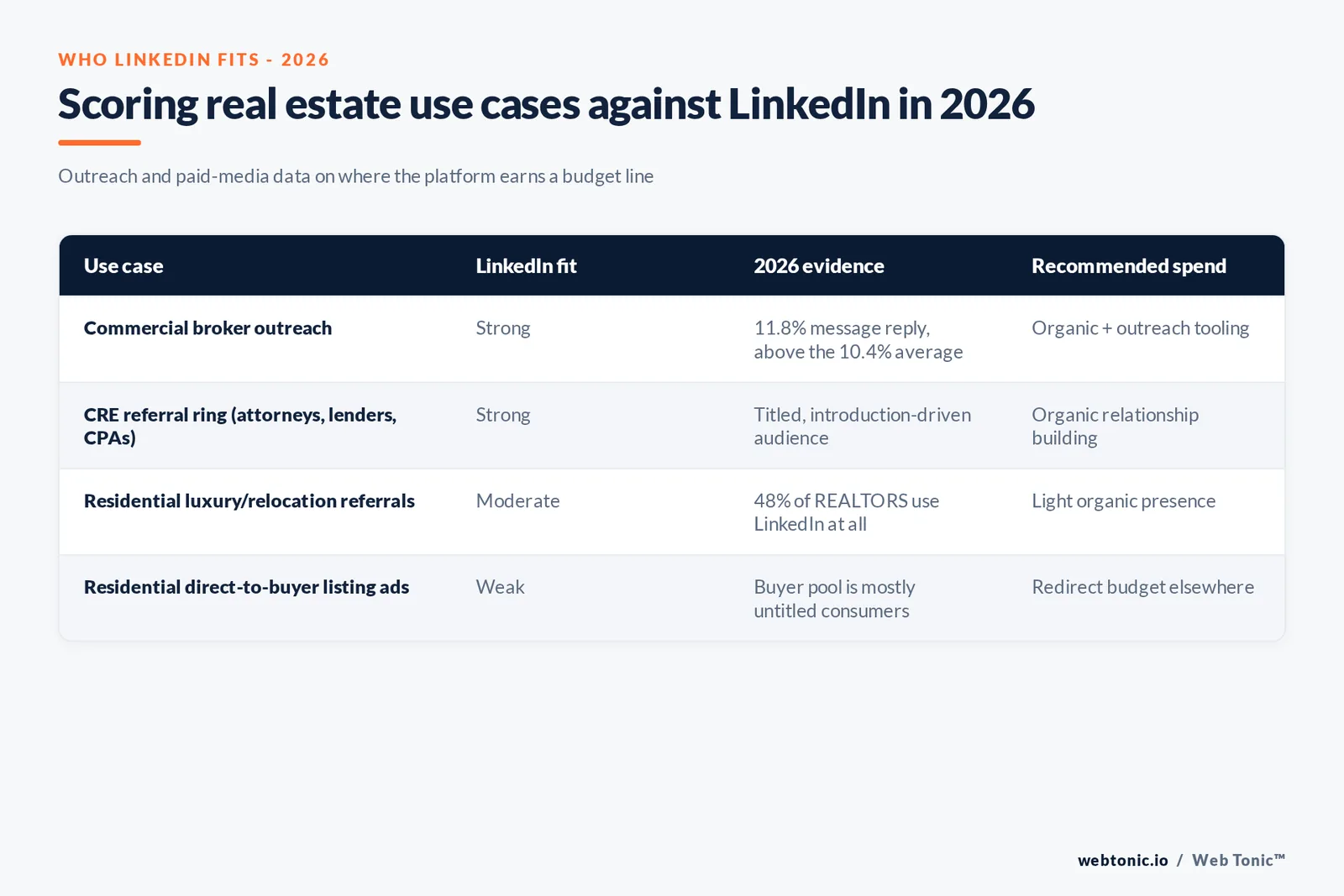
The outreach data does not separate commercial from residential accounts, but the underlying mechanism explains whichever side is driving that above-average message-reply figure: every commercial counterparty - owners, tenants, capital partners, and the attorney, lender and CPA referral ring around a deal - is a reachable business decision-maker with a title and a company on LinkedIn. Residential real estate's buyer pool is mostly private consumers without a professional title to target against, which is the structural reason LinkedIn shows up as a minority channel in NAR's agent-adoption surveys (48% adoption) even while outreach performance for the industry overall looks solid.
The Real Deal's reporting on commercial brokers using LinkedIn adds a content note: brokers interviewed found recurring market commentary and building video outperformed transaction-announcement posts, because thought-leadership framing keeps an audience engaged across the months a commercial deal cycle typically runs.
| Real estate segment | LinkedIn fit | Why |
|---|---|---|
| Commercial real estate (brokers, asset managers) | Strong | Every counterparty has a reachable business title |
| Referral partners (CRE attorneys, lenders, CPAs) | Strong | Titled professionals, introduction-driven |
| Residential brokerages, luxury/relocation referrals | Moderate | Agent-to-agent networking, not direct buyer reach |
| Residential, direct-to-consumer listing marketing | Weak | Buyer pool is mostly untitled consumers |
What the paid-media premium looks like, cross-industry
No named 2026 study prices LinkedIn ad campaigns specifically for real estate the way Expandi prices outreach for the industry. The best available cost context is Metadata's 2026 B2B Paid Media Benchmark Report, built from $57.6M of calendar-2025 B2B ad spend across LinkedIn, Google, Facebook and Instagram. LinkedIn's cost per click came in at $11.90 against Facebook's $3.80 and Instagram's $2.82 - a 3.1x premium over Facebook. LinkedIn's click-to-lead rate of 5.9%, versus Facebook's 2.6%, absorbed most of that premium, landing LinkedIn's cost per lead at $202 against Facebook's $145 and Instagram's $138. Treat these as cross-industry B2B figures a real estate media buyer can budget against directionally, not a real estate-specific benchmark.
| Platform (2026 B2B data) | CPC | CPM | Cost per lead |
|---|---|---|---|
| $11.90 | $63.19 | $202 | |
| $3.80 | $15.50 | $145 | |
| $2.82 | $18.25 | $138 |
The format detail that changes the economics
Within the same Metadata dataset, ad format moved cost per lead more than platform choice alone. Document-format LinkedIn ads bought the cheapest lead of any format tracked, at $142, 29% below image ads and 46% below video ads on cost per lead, while converting 11.9% of clicks to leads - the highest click-to-lead rate in the report. It was also the least-adopted format, with 51 advertisers running documents against 127 running image ads, which suggests real estate teams testing LinkedIn have room to try an underused format before assuming the platform's $202 average cost per lead is fixed.
| Ad format (2026 B2B data) | Cost per lead vs. image ads | Click-to-lead rate | Adopters in dataset |
|---|---|---|---|
| Document ads | 29% cheaper | 11.9%, highest in the report | 51 advertisers |
| Image ads | Baseline | Not the highest, not reported as lowest | 127 advertisers |
| Video ads | 17% more expensive than image (46% above documents) | Lower than documents | Fewer than image, exact count not published |
Where the 48% adoption ceiling comes from
The paid-media premium above only matters for the roughly half of the industry already on the platform. NAR's Technology Survey puts LinkedIn adoption among REALTORS at 48%, the third most-used network behind Facebook's 87% and Instagram's 62%. That places LinkedIn ahead of YouTube (25%) and far ahead of TikTok (15%), but still a minority-adjacent channel rather than a default one, which lines up with the structural argument above - the professionals adopting it skew toward commercial and referral work where a titled counterparty exists to reach.
| Platform | Share of REALTORS using it | How it compares to LinkedIn's 48% |
|---|---|---|
| 87% | 39 points ahead | |
| 62% | 14 points ahead | |
| 48% | Reference point | |
| YouTube | 25% | 23 points behind |
| TikTok | 15-16% | 32-33 points behind |
What to test before committing budget
A commercial real estate team weighing a first LinkedIn spend has three testable variables supported by the data above, in order of expected impact: format (documents over image or video), audience precision (titled decision-makers and the attorney/lender/CPA referral ring, not a broad "real estate" job-function filter), and message framing (recurring market commentary and building video, per The Real Deal's reporting on which posts hold a commercial audience, over transaction-announcement posts). None of these require the full $202 cross-industry cost-per-lead figure to be treated as fixed - it is a B2B average across every vertical in Metadata's dataset, not a real estate number, and a real estate advertiser testing the document format alone has a plausible path toward the $142 figure the format achieved broadly.
The outreach side is cheaper to test first. Expandi's data shows real estate's message-reply advantage shows up after a connection is accepted, not in the acceptance rate itself, which argues for spending effort on the follow-up message sequence - the point where real estate already outperforms - rather than on tactics aimed only at raising the acceptance rate, where the industry is already at the cross-industry average.
Where LinkedIn budget belongs on a real estate team
The data supports a narrow but real allocation: commercial brokers, asset managers and the referral ring around them are worth a LinkedIn organic and outreach program given the above-average message-reply performance, and a document-led LinkedIn ad test given the format's cost advantage in the broader B2B dataset. Residential, direct-to-consumer budget is better spent where NAR's adoption and lead-source data already point - our Facebook ads agency research and cost-per-lead benchmarks by industry cover the channels most residential teams should prioritize instead of a LinkedIn line item built for a buyer pool that mostly does not carry a professional title to target against.
Our growth marketing team can help scope a commercial-side LinkedIn test against your own referral network, from audience list-building through the first document-format creative brief - talk to us to walk through the numbers against your own deal pipeline.
Frequently Asked Questions
Is LinkedIn worth advertising on for real estate?
It depends heavily on whether the business is commercial or residential. Commercial real estate fits the platform structurally because every counterparty - owners, tenants, capital partners, and the attorney/lender/CPA referral ring - is a reachable business decision-maker with a title and a company, a point LinkedIn-focused CRE commentators make repeatedly. Residential real estate's buyer pool is mostly consumers, not titled professionals, which is why LinkedIn shows up as a minority channel (48% adoption) behind Facebook and Instagram in NAR's data.
How does real estate perform on LinkedIn compared with other industries?
Roughly average on the door, better than average in the conversation. Expandi's 2026 outreach benchmarks, built from 277,414 connection requests across 253 real estate accounts, found a 28.4% connection acceptance rate versus a 28.5% cross-industry average, and a message reply rate after acceptance of 11.8% versus 10.4% cross-industry - a ranking of 9th out of 38 industries measured on that metric.
What does LinkedIn advertising cost compared with Meta, broadly?
LinkedIn carries a premium across B2B advertising generally. Metadata's 2026 B2B Paid Media Benchmark Report, based on $57.6M of tracked ad spend, found LinkedIn's cost per click at $11.90 against Facebook's $3.80 and Instagram's $2.82 - a 3.1x premium over Facebook. LinkedIn's higher click-to-lead conversion rate, 5.9% versus Facebook's 2.6%, absorbs most but not all of that premium, leaving LinkedIn's cost per lead at $202 against Facebook's $145. These are cross-industry B2B figures, not a real estate-specific study.
Should a residential agent bother with LinkedIn?
Mostly as a referral-network and personal-brand channel rather than a paid lead-generation one. NAR's technology survey puts LinkedIn adoption among REALTORS at 48%, well behind Facebook's 87% and Instagram's 62%, and the platform's own use case strength - reaching titled decision-makers at named companies - has little to do with a residential buyer search. It fits luxury and relocation referral partners more than direct-to-consumer listing marketing.
What does a strong commercial real estate LinkedIn presence look like?
Reporting from The Real Deal on commercial brokers using LinkedIn describes a strategy built on recurring market commentary and video from inside buildings rather than transaction announcements - brokers interviewed said posts framed as "proud to share we closed X" get less traction than posts positioned as thought leadership, which keeps an audience engaged over the months a commercial deal cycle actually takes.
Does LinkedIn advertising actually generate a positive return for B2B accounts?
Yes, and the commercial side of real estate is exactly the B2B buying pattern this shows up in. Dreamdata's 2026 LinkedIn Ads Benchmarks Report, built from more than 66 million sessions and 3.5 million customer journeys across its customer base, found LinkedIn Ads delivering a 121% return on ad spend in 2026, up from 113% the year before, with 81% of the B2B buying journey now happening before a deal ever reaches a sales pipeline. For a commercial broker's LinkedIn spend, that lines up with the referral-ring mechanism above: the ad and the outreach are both playing a long, pre-pipeline game, not chasing a same-week close.
Sources
Dreamdata - 2026 LinkedIn Ads Benchmarks Report
Expandi - LinkedIn Outreach Benchmarks for Real Estate, 2026
The Real Deal - Up-and-Coming Commercial Brokers Love LinkedIn
Metadata - 2026 B2B Paid Media Benchmark Report
National Association of REALTORS - Technology Survey