Table of contents
The highest-weighted local search ranking factor in 2026 is not a review count - it is the category field. Whitespark's 2026 Local Search Ranking Factors survey scores Primary GBP Category at 227 points, ahead of proximity at 225 and reviews further down the list. For real estate, where Google's own guidelines add a practitioner-versus-brokerage structure on top of the ranking factors, getting the profile's basic structure right does more for rank than most of the review-chasing tactics agents spend their time on.
Key Takeaways
- Primary GBP Category scores 227 points, the top local ranking factor in Whitespark's 2026 survey.
- Proximity to the point of search scores 225 points, essentially tied for first.
- Keywords in the GBP business title score 223 points, third overall.
- Google names real estate agents directly as an individual practitioner type alongside doctors and lawyers.
- A solo agent at a branded brokerage should share one profile, named "Brokerage: Agent Name."
- High numerical Google ratings score 181 points in the same 2026 factor survey.
- Quantity of native Google reviews with text scores 170 points.
- Completeness of GBP scores 147 points.
- Verified GBP scores 123 points - suspension resets part of that signal.
- 88% of home buyers purchased through an agent or broker in the 2025 NAR Profile of Home Buyers and Sellers.
- 91% of home sellers sold with an agent's help, an all-time low of only 5% FSBO.
- 92% of previously-owned-home buyers used an agent, versus 63% of new-home buyers.
- 89% of buyers were satisfied with their agent's responsiveness and honesty.
- 91% of buyers would use their agent again or recommend them to others.
- Dedicated Page for Each Service scores 132 points, relevant to per-neighborhood landing pages linked from a profile.
Practitioner rules most brokerages get wrong
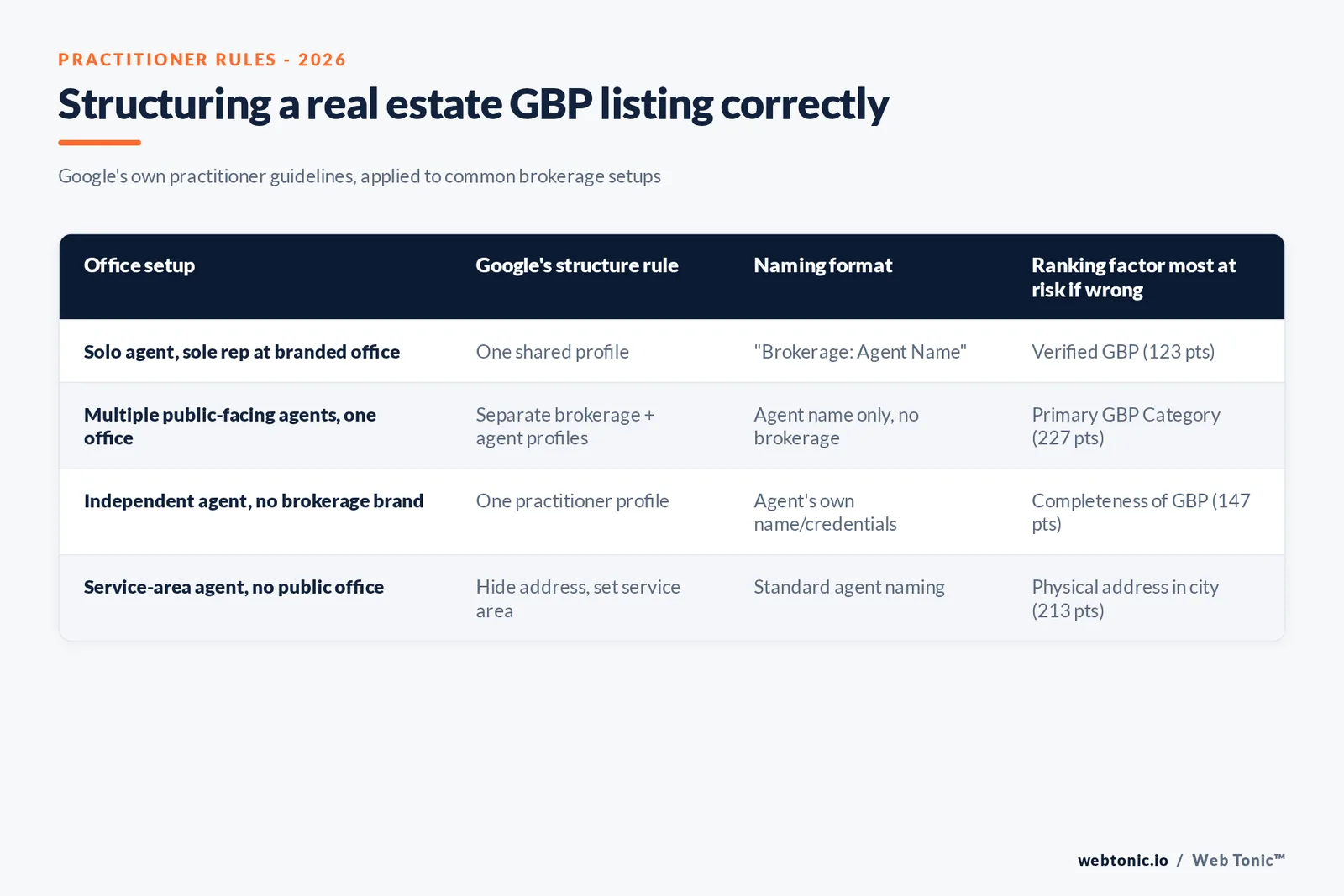
Google's guidelines for representing your business on Google define an individual practitioner as "a public-facing professional, typically with their own customer base," and list real estate agents directly alongside doctors, dentists, lawyers, and financial planners as an eligible practitioner category. The structural rule that follows matters more than most agents realize: if an agent is the only public-facing practitioner at a location and represents a branded organization, Google recommends a single shared profile, formatted as "[Brokerage]: [Agent Name]" - not two competing listings for the same address.
If multiple agents work public-facing roles from the same office, the rule flips: the brokerage gets its own profile, separate from any individual agent's, and each agent's profile title should include only their own name - never the brokerage's name appended to it. Getting this backwards is one of the more common causes of duplicate-listing suspensions in real estate.
| Office setup | Google's recommended structure | Profile naming |
|---|---|---|
| Solo agent, branded brokerage, sole public-facing rep | One shared profile | "Brokerage: Agent Name" |
| Multiple public-facing agents, one office | Separate brokerage profile + separate agent profiles | Agent profile carries only the agent's own name |
| Independent agent, no brokerage brand | One practitioner profile | Agent's own name and credentials |
| Team operating under one name at a brokerage | Brokerage profile; team is not a separate practitioner | No standalone "Team Name" profile per Google's rules |
The 2026 ranking factors, in the order they actually score
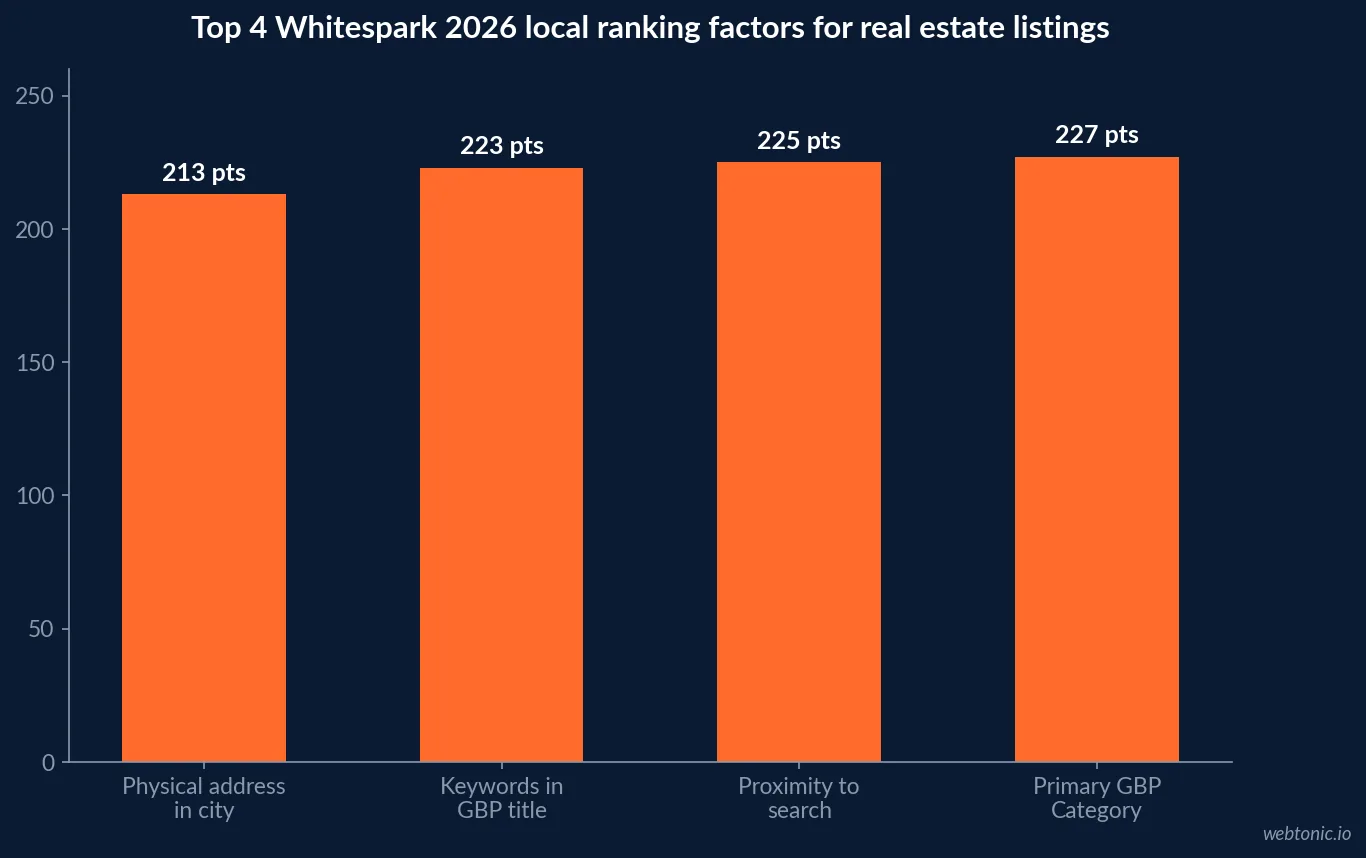
Whitespark's 2026 Local Search Ranking Factors survey scores Primary GBP Category at 227 points and Proximity of address to the point of search at 225 as the two highest-weighted local pack factors it tracks, followed by Keywords in the GBP business title at 223 and Physical address in the city of search at 213. Reviews enter the list lower: High numerical Google ratings at 181, Additional GBP categories at 173, and Quantity of native Google reviews with text at 170.
For a real estate profile, that ordering has a practical reading: category selection and title accuracy are worth fixing before any review-generation campaign, because they outscore review volume on the same survey. An agent obsessing over review count while running the wrong secondary category is optimizing the smaller lever first.
| Ranking factor (Whitespark 2026) | Score | Real estate-specific note |
|---|---|---|
| Primary GBP Category | 227 | Choose "Real estate agent" vs "agency" vs "consultant" deliberately |
| Proximity to point of search | 225 | Office location fixes this; largely outside listing owner's control |
| Keywords in GBP business title | 223 | Do not append neighborhood or "best" keywords to the name |
| Physical address in city of search | 213 | Service-area agents without a public office lose this signal |
| High numerical Google ratings (4-5) | 181 | The rating itself, separate from review volume |
| Quantity of native Google reviews (w/ text) | 170 | Text reviews outweigh star-only ratings on this factor |
| Completeness of GBP | 147 | Hours, categories, photos, services fields all in scope |
| Dedicated page for each service | 132 | Relevant if the profile links neighborhood-level pages |
What the transaction data says about how much rides on the listing
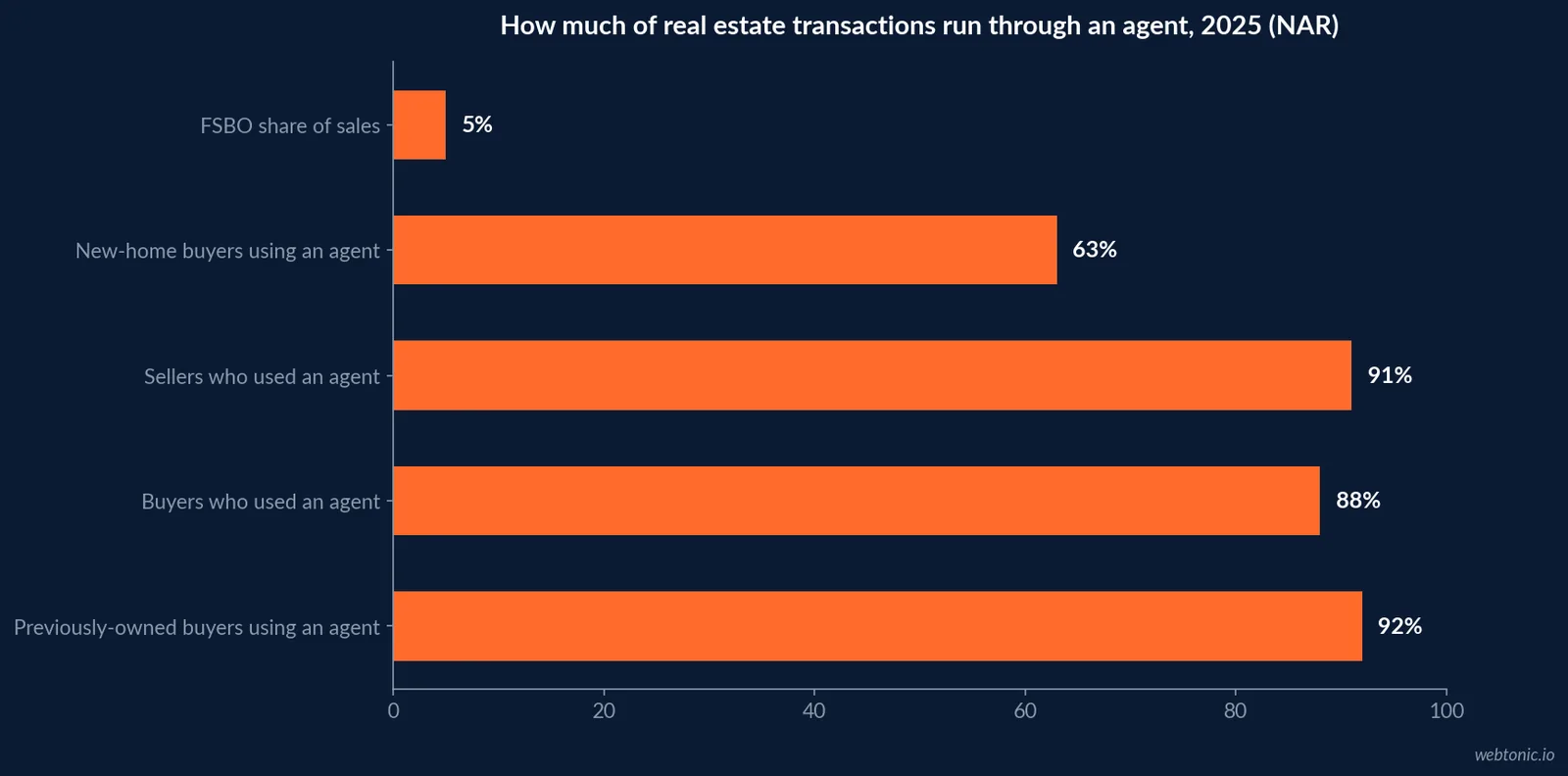
The National Association of Realtors' 2025 Profile of Home Buyers and Sellers reports 88% of home buyers purchased through a real estate agent or broker, and 91% of sellers sold with an agent's help - an all-time low of just 5% FSBO sales. The agent's role splits further by property type: 92% of buyers of previously-owned homes used an agent, against 63% of new-home buyers, who more often work directly with a builder's own sales office.
Satisfaction is high once an agent is engaged - 89% of buyers were satisfied with their agent's responsiveness, knowledge of the process, and honesty and integrity, and 91% said they would use that agent again or recommend them. That satisfaction level is exactly why the practitioner-profile structure matters: a well-run, correctly-categorized listing is what carries that reputation into the next search, rather than starting a new agent's brand equity from zero.
| NAR 2025 Profile of Home Buyers and Sellers metric | Figure |
|---|---|
| Buyers who purchased through an agent/broker | 88% |
| Sellers who sold with an agent's help | 91% |
| FSBO share of sales (all-time low) | 5% |
| Previously-owned-home buyers who used an agent | 92% |
| New-home buyers who used an agent | 63% |
| Buyers satisfied with agent responsiveness/honesty | 89% |
| Buyers who would use their agent again or recommend | 91% |
Verification and suspension risk specific to agents
Because Verified GBP scores 123 points in Whitespark's own factor list, a suspension is not just a listing going dark - it is a measurable ranking-signal reset on reinstatement. Real estate listings suspend disproportionately often for two avoidable reasons under Google's guidelines: a practitioner profile named with the brokerage first instead of the agent's own name (or vice versa, depending on the office setup above), and multiple agents at one address each trying to claim a profile that should belong to the brokerage.
Google's verification guidance recommends live video verification where available, which for a brokerage office is generally straightforward - showing signage, the reception area, and proof of the agent's or brokerage's access to the space.
| Common real estate GBP suspension trigger | Google guideline it violates | Fix |
|---|---|---|
| Agent profile named with brokerage first | Practitioner naming format ("Brokerage: Agent") | Rename to the correct order |
| Multiple agents claiming one office's profile | Multi-practitioner location rule | One brokerage profile + separate agent profiles |
| Service-area agent showing a residential address | Service-area business address rules | Hide the address, set a service area instead |
| Duplicate profile after a brokerage change | One profile per practitioner rule | Merge or request ownership transfer, not a new listing |
The cloud-brokerage eligibility problem
Sterling Sky, a local SEO firm that tracks Google Business Profile policy changes closely, documented a wave of suspensions hitting agents at cloud-based brokerage models, after Google told at least one affected agent that its "guidelines currently restrict us from working with cloud-based brokerage models." The distinction Sterling Sky draws matches Google's own service-area rules above: an agent who consistently works from a real, staffed office and sees clients face-to-face there qualifies for a profile regardless of the brokerage's cloud-based back office; an agent who works primarily from home can still qualify as a service-area business as long as they meet clients in person somewhere; a fully virtual arrangement with no in-person contact does not qualify at all.
The lesson for any brokerage model, cloud-based or traditional, is the same one that runs through this entire page: the profile has to describe a real, staffed, visitable arrangement, and the brand name attached to the brokerage does not override that eligibility test.
| Agent work pattern | Eligibility under Google's rules | Profile type |
|---|---|---|
| Works from a real, staffed brokerage office | Eligible | Standard practitioner profile at that address |
| Works from home, meets clients in person elsewhere | Eligible as a service-area business | Address hidden, service area set |
| Fully virtual, no in-person client contact | Not eligible | No profile - does not meet Google's in-person test |
Where review trust thresholds apply to a real estate listing
Given how much of a real estate transaction rides on trust in a single agent, BrightLocal's 2026 Local Consumer Review Survey figures apply with extra weight: 47% of consumers will not consider a business with fewer than 20 reviews, 68% expect at least a 4-star average, and 89% expect the business to reply to reviews. For an agent whose profile may show only a handful of transactions a year, hitting a 20-review floor takes deliberate, sustained requesting - not a one-time push after a single good closing.
| BrightLocal 2026 LCRS threshold | Figure | Real estate-specific note |
|---|---|---|
| Won't use a business with fewer than 20 reviews | 47% | A slow target for an agent closing 10 deals/year |
| Expect at least a 4-star average | 68% | One bad review disproportionately hurts a small base |
| Only trust reviews from the last 3 months | 74% | Argues for requesting a review at every closing |
| Expect a business to reply to reviews | 89% | Applies even to a solo-practitioner profile |
How this should change what an agent optimizes first
Fix the practitioner-versus-brokerage structure and category selection before running any review campaign - both outrank raw review volume on Whitespark's own 2026 scoring. Then build review volume and text-review quality, since 170 points for review quantity and 181 for rating are still large enough to matter once the structural basics are correct. Track Performance report calls and direction requests as a leading indicator, understanding they measure listing engagement, not the 88-to-91% of transactions that ultimately close through an agent relationship regardless of how the search happened.
For the reputation layer that sits alongside this ranking data, see our existing real estate reputation and review management research, and for paid-channel budget context, our growth marketing practice page. If a suspended profile needs a hands-on review, talk to our team before filing a reinstatement appeal.
Frequently Asked Questions
Should an individual agent or the brokerage own the Google Business Profile?
Both can, but not the same one. Google's guidelines define an individual practitioner as a public-facing professional with their own customer base, and name real estate agents directly alongside doctors and lawyers as an eligible practitioner type. If an agent is the only public-facing practitioner at a branded brokerage location, Google recommends one shared profile named "[Brokerage]: [Agent Name]." If several agents work public-facing roles from the same office, the brokerage gets its own profile separate from each agent's, and each agent's listing should carry only their own name, not the brokerage's.
What is the single highest-weighted local ranking factor for real estate in 2026?
Primary GBP Category, scoring 227 points in Whitespark's 2026 Local Search Ranking Factors survey - the highest of any factor it tracks. For a real estate profile that usually means choosing between categories like "Real estate agent," "Real estate agency," or "Real estate consultant" and picking the one that matches how the listing is actually staffed and verified, not the one with the highest search volume.
Does proximity or reviews matter more for ranking in a local market?
Whitespark's 2026 data ranks proximity of address to the point of search at 225 points, just below category, with high numerical Google ratings at 181 and quantity of native Google reviews with text at 170. Proximity is largely outside an agent's control once an office location is set; review volume and rating are the two factors a listing owner can actually move month over month.
How reliable is Google Business Profile data for measuring lead volume?
GBP's own Performance reporting - calls, direction requests, and website clicks - is the closest thing to a first-party local lead-volume number a listing owner has, but it measures interactions with the listing, not closed transactions. The National Association of Realtors' 2025 Profile of Home Buyers and Sellers reports that 88% of buyers purchased through an agent or broker, which sets the floor for how much of the transaction volume ever touches a search-driven listing versus a personal referral network.
What happens if a real estate agent's profile gets suspended?
The listing loses its Performance data, its map-pack position, and its review history's visible display while under review - and reinstatement runs through Google's standard support process, which can take days to weeks. Because Verified GBP scores 123 points in Whitespark's own ranking-factor data, a suspended-then-reinstated profile effectively restarts part of its ranking signal, which is the practical cost of letting an agent's listing lapse into a policy violation over something as avoidable as a mismatched name field.
Sources
Whitespark - 2026 Local Search Ranking Factors Report
Google Business Profile Help - Guidelines for representing your business on Google
Google Business Profile Help - Business eligibility and ownership guidelines
Google Business Profile Help - Verify your business on Google
National Association of Realtors - 2025 Profile of Home Buyers and Sellers
Sterling Sky - Google is suspending eXp Realty agents
BrightLocal - Local Consumer Review Survey 2026