Table of contents

NAR's own 2025 Member Profile puts referrals, not paid media, at the center of how a typical real estate agent gets business - 20% from past clients and another 32% from other referral sources, against a typical agent who spent nothing on lead generation in 2024. That does not mean paid lead generation is worthless; it means the honest starting budget is built from an agent's own volume goals and referral gap, not from an industry average that describes a profession where most of the income already flows through relationships.
Key Takeaways
- The typical REALTOR earns 20% of business from past clients (2025 NAR Member Profile).
- Another 32% comes from non-personal referral sources like community and school networks.
- 26% of agents received no non-personal referrals at all in 2024.
- 30% of agents received at least some business through paid third-party lead sources.
- The typical (median) agent reported spending USD 0 on lead generation in 2024.
- Median REALTOR gross income is USD 58,100, up from USD 55,800 the prior year.
- The typical agent closes 10 transaction sides a year on USD 2.5 million in volume.
- Median years of experience is 12 years, and 74% plan to stay two more years.
- 88% of buyers and 91% of sellers used an agent in the 2025 NAR Profile of Home Buyers and Sellers.
- A buyer's home search runs a typical 10 weeks, essentially flat year over year.
- 92% of buyers report satisfaction with the overall buying process.
- Over 30% of buy-side deals can come from paid third-party referral leads at brokerages that track the source, per industry reporting on the same NAR data.
- GBP visibility tooling starts at USD 49 a month (GBPcentral), a small line next to referral-driven income.
- Review management software runs USD 99 a month for a single office (GatherUp).
- A cross-industry B2B buying cycle of 10.1 months (6sense, 2025) does not describe a residential buyer's 10-week search - the two should never be conflated in a lead-nurture plan.
Where the typical agent's business actually comes from
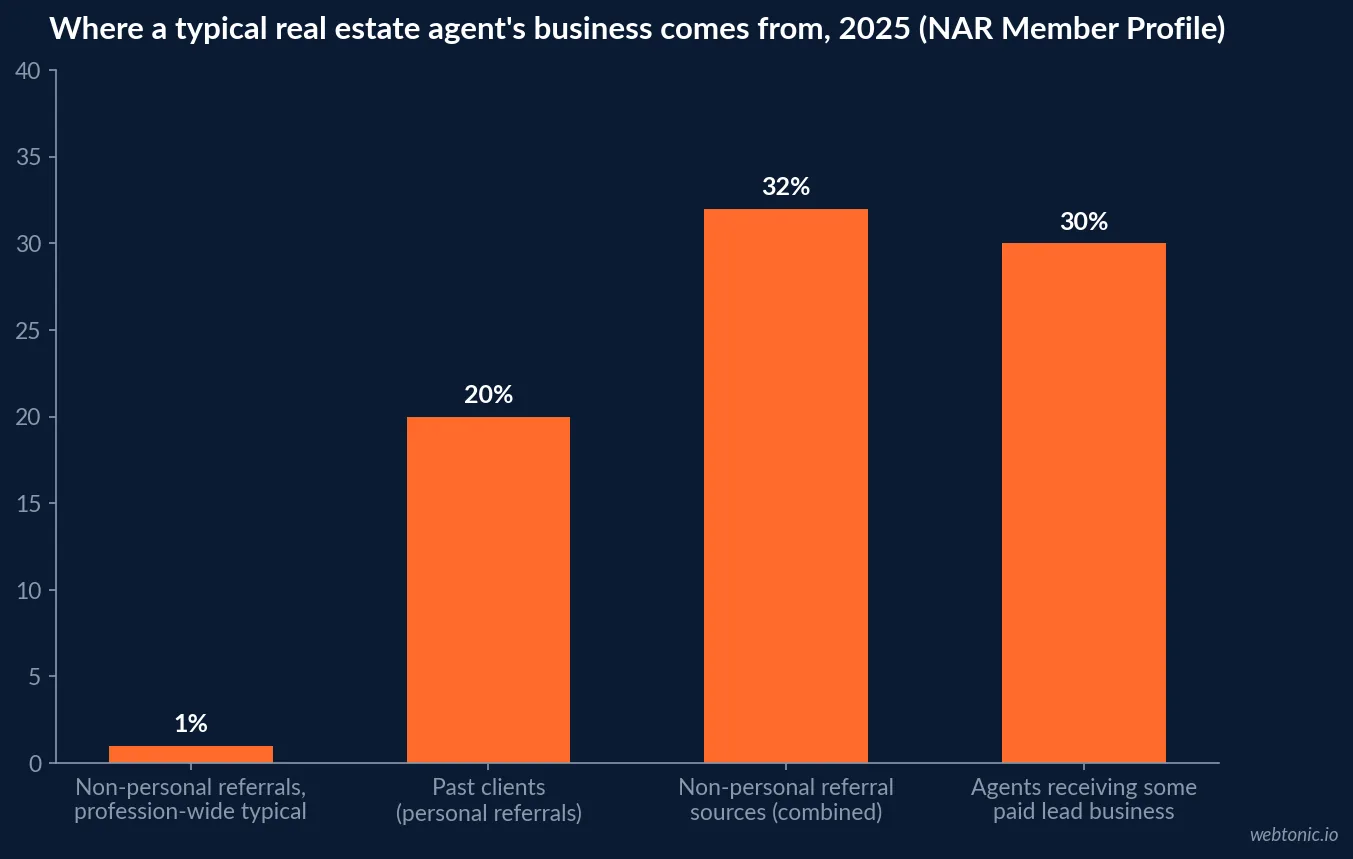
The 2025 NAR Member Profile reports that a typical REALTOR earns 20% of business from past clients, with that share rising for more experienced agents, and gains another 32% from non-personal referral sources - community social media groups and boards contribute 20% of that non-personal share, church and school groups 14%, and non-profit community work 10%. A little over a quarter of agents, 26%, received no non-personal referrals at all in 2024, and across the profession, non-personal referrals contributed just 1% of the typical agent's total business - the 32% figure is concentrated among agents actively working those networks, not spread evenly.
On the paid side, 30% of agents reported receiving at least some business through paid third-party lead sources such as listing portals, but the typical (median) agent reported spending USD 0 on lead generation in 2024. That split matters for budgeting: a small share of agents buy paid leads heavily, while the median agent's business runs almost entirely on referral and repeat relationships.
| Lead source (2025 NAR Member Profile) | Share of typical agent's business |
|---|---|
| Past clients (personal referrals) | 20% |
| Non-personal referral sources (combined) | 32% |
| - of which, community social media groups/boards | 20% of non-personal share |
| - of which, church and school groups | 14% of non-personal share |
| - of which, non-profit community work | 10% of non-personal share |
| Non-personal referrals, profession-wide typical share | 1% |
| Paid third-party lead sources (any business received) | 30% of agents |
| Lead generation spend, typical (median) agent | USD 0 |
What that referral flywheel is worth to income
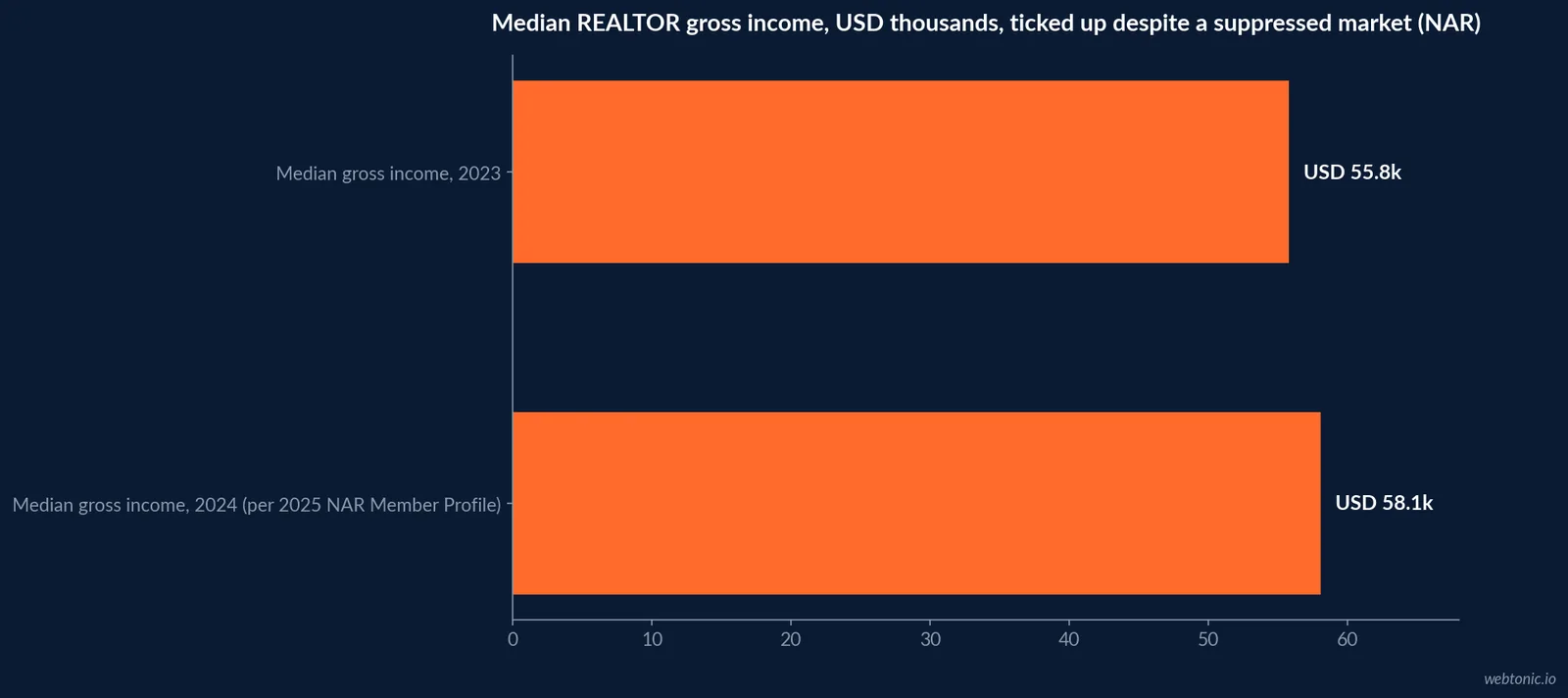
The same 2025 NAR Member Profile puts median REALTOR gross income at USD 58,100, up from USD 55,800 the prior year, on a typical 10 transaction sides and USD 2.5 million in sales volume - both flat from 2023. Median years of experience rose slightly to 12 years, and 74% of members said they were very certain they would remain in the business for two more years, even amid a housing market NAR itself describes as suppressed by low sales volume.
That tenure number explains the referral economics: a 12-year-median agent has had over a decade to build the past-client base that supplies 20% of business, which a first- or second-year agent simply does not have yet. For newer agents, the practical reading is that paid lead sources and a well-run digital presence are not optional extras - they are the only lever available before the referral base exists.
| 2025 NAR Member Profile metric | Figure |
|---|---|
| Median REALTOR gross income | USD 58,100 (up from USD 55,800) |
| Typical transaction sides per year | 10 |
| Typical sales volume | USD 2.5 million |
| Median years of experience | 12 years |
| Members very certain to stay 2+ more years | 74% |
| Members with 16+ years of experience | 46% (up from 42%) |
The buyer's side of the funnel: how long, and how satisfied
The 2025 NAR Profile of Home Buyers and Sellers reports a typical buyer's home search runs 10 weeks, steady year over year, and that 88% of buyers ultimately purchased through an agent or broker, with 91% of sellers selling with agent assistance. Overall, 92% of buyers reported satisfaction with the buying process. That 10-week window is the real lead-nurture horizon for residential real estate - a fraction of the multi-month B2B buying cycles reported in cross-industry research such as 6sense's 2025 B2B Buyer Experience report, which describes an average 10.1-month cycle for a very different category of purchase and should not be imported into a home-buyer nurture sequence.
Housing industry reporting built on the same NAR data has also noted that at some brokerages, over 30% of buy-side deals trace back to leads agents paid for through third-party referral companies - a reminder that "referral" in real estate covers both free personal networks and paid referral arrangements, and the two should be tracked separately in any lead-source dashboard.
| Metric | Real estate (residential) | Cross-industry B2B (for contrast only) |
|---|---|---|
| Typical buying cycle / search length | 10 weeks (NAR 2025) | 10.1 months (6sense 2025, B2B SaaS) |
| Share using a professional intermediary | 88% buyers use an agent | N/A - not a comparable metric |
| Overall process satisfaction | 92% of buyers satisfied | Not measured the same way |
| Decision-makers typically involved | 1-2 (household) | 6-10 (B2B buying committee) |
Where a lead-gen budget line actually fits
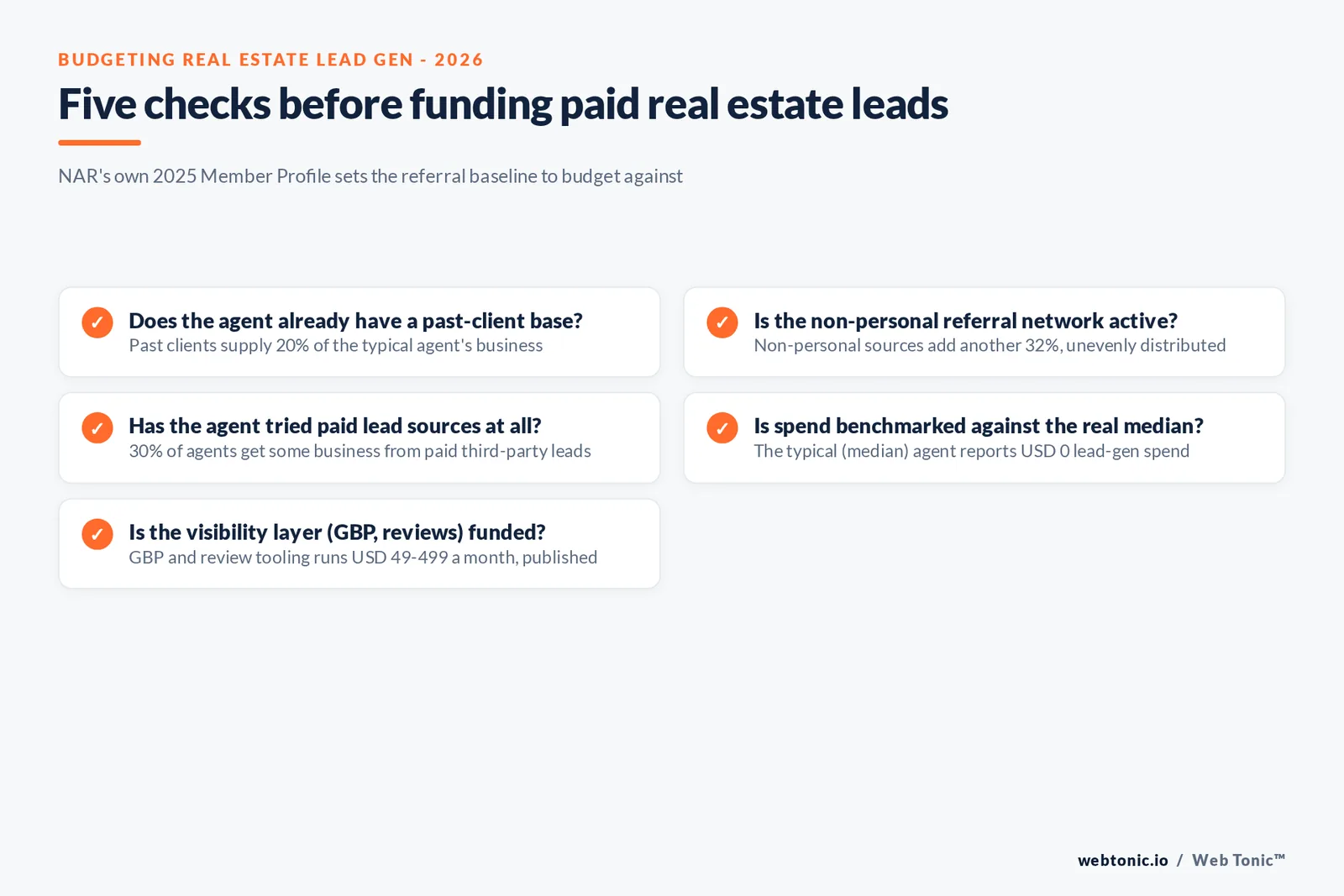
Because the median agent's reported lead-gen spend is USD 0, there is no industry-average dollar figure to benchmark against - the honest approach is to size the budget against the referral gap a specific agent or team actually has. An agent under five years in the business, still building the past-client base that eventually supplies 20% of income, has a stronger case for paid lead spend than a 12-year-median agent whose 32% non-personal referral share is already established.
On the visibility side that supports both referral and paid leads, published vendor pricing includes GBPcentral's Business Profile management software from USD 49 a month, Vendasta's Professional tier at a USD 499-a-month wholesale minimum, and GatherUp's single-location review management at USD 99 a month. None of these generate leads directly - they protect the reputation signal that both referral prospects and portal leads check before calling.
| Budget line | Who needs it most | Published 2026 cost reference |
|---|---|---|
| Paid third-party lead sources (portals, referral networks) | Newer agents without a referral base yet | Varies by portal, not publicly listed |
| GBP visibility and management tooling | Any agent competing in a local pack | USD 49-499/mo (GBPcentral, Vendasta) |
| Review management software | Agents relying on reputation-driven referrals | USD 99/mo (GatherUp, single location) |
| Referral-network cultivation (events, sponsorships) | Established agents defending existing share | Not a fixed software cost |
Tenure changes the math
The 2025 NAR Member Profile's tenure data explains why a flat industry-wide lead-gen budget makes no sense: 46% of members now have 16 or more years of experience, up from 42% the year before, while the share with two years or less fell from 18% to 15%. A 16-year agent's 20% past-client referral share represents a much larger absolute volume of past clients than the same percentage would for a two-year agent - which means the same "20% from referrals" statistic describes a comfortable cushion for one agent and a still-empty pipeline for another.
Brokerages setting a shared marketing budget policy across agents at different tenure levels should size paid lead spend as a declining share of an agent's total marketing budget as tenure increases, rather than applying one flat per-agent number regardless of how established that agent's referral base already is.
| Agent tenure (2025 NAR Member Profile) | Share of members | Realistic budget implication |
|---|---|---|
| 2 years or less | 15% (down from 18%) | Referral base does not exist yet - paid share should be highest |
| 16 years or more | 46% (up from 42%) | Referral base is established - paid share can be lowest |
| Median years of experience | 12 years | The typical agent sits between the two extremes |
Reputation still matters inside a referral-driven business
A referral does not eliminate the need for online reputation - it usually gets checked before it converts. BrightLocal's 2025 Local Consumer Review Survey found 96% of consumers are open to writing a review when asked, and that the typical consumer now uses 2 or more review sites before trusting a business, referral or not. A referred prospect who then finds a thin or stale profile is a warmer version of the same trust problem a cold paid lead faces - the referral gets the introduction, but the profile still closes or loses the credibility check.
| BrightLocal 2025 LCRS metric | Figure | Why it matters even for referral leads |
|---|---|---|
| Consumers open to writing a review when asked | 96% | Referral-driven agents still need to ask |
| Consumers using 2+ review sites before trusting a business | 40% | A referral gets checked online anyway |
| Consumers who never read reviews at all | 4% | The overwhelming majority still check first |
The honest bottom line for a budget conversation
Real estate demand generation is not a channel-mix optimization problem the way B2B SaaS or paid e-commerce budgets are - it is a referral-versus-paid allocation problem, and NAR's own data says the referral side already carries the majority of the typical agent's business. Budget conversations should start by asking how much of that 52% combined referral share (20% past-client plus 32% non-personal) a specific agent or team can actually claim today, then size paid spend to cover the gap, not to replace a system that is already working for tenured agents.
For the ranking-factor side of visibility that supports both referral and paid discovery, see our companion research on real estate reputation and review management, and for broader budget planning, our growth marketing practice page. To size a lead-gen budget against a specific team's referral gap, talk to our team.
Frequently Asked Questions
How much of a typical agent's business comes from referrals versus paid leads?
The 2025 NAR Member Profile reports the typical REALTOR earns 20% of business from past clients and another 32% from non-personal referral sources such as community groups, church and school networks, and non-profit involvement. On the paid side, 30% of agents received at least some business through paid third-party lead sources such as portals, though the typical (median) agent reported spending nothing on lead generation in 2024 - the paid channel is concentrated among a minority of agents who buy it heavily, not evenly spread across the profession.
What does the typical agent earn, and how does that set a lead-gen budget?
NAR's 2025 Member Profile puts the median gross income of REALTORS at USD 58,100, up from USD 55,800 the year before, on a typical 10 transaction sides and USD 2.5 million in sales volume. Because the median agent reports spending USD 0 on lead generation, any specific dollar lead-gen budget has to be built from an individual agent's or team's own volume goals, not from an industry median that reflects mostly referral-driven, low-cash-spend agents.
How long does it take a buyer to find a home, and what does that mean for lead nurture?
The 2025 NAR Profile of Home Buyers and Sellers reports a buyer's typical home search runs 10 weeks, essentially flat year over year, with 92% of buyers reporting satisfaction with the overall buying process. That is a short window compared to the multi-month B2B buying cycles reported elsewhere - cross-industry B2B buyer-journey research (6sense, 2025) describing 10-plus-month cycles does not describe a homebuyer's timeline, and should not be applied to residential real estate lead nurture planning.
Is referral-heavy lead generation sustainable, or does it hide a gap?
It is sustainable for agents with enough transaction volume and tenure to keep the referral flywheel turning - median years of experience among REALTORS was 12 years in the 2025 Member Profile, and 74% of members said they were very certain they would remain in the field for two more years. The gap it hides is for newer agents: referral supply scales with a client base that does not exist yet, which is exactly the situation paid lead sources and a well-run Business Profile are positioned to fill in the first few years.
What third-party costs exist for the paid side of the budget, if referrals fall short?
Vendor-published pricing for the reputation and visibility tools that support paid lead flow includes GBPcentral's Business Profile management software starting at USD 49 a month, Vendasta's Professional tier at a USD 499-a-month wholesale minimum, and GatherUp's review management at USD 99 a month for a single location. None of these are lead-gen portals themselves - they support the visibility and reputation layer that referral and portal leads both depend on.
Sources
National Association of Realtors - 2025 Member Profile (state association mirror)
HousingWire - From Zillow to sphere: real estate referral lead generation, citing the 2025 NAR Member Profile
National Association of Realtors - 2025 Profile of Home Buyers and Sellers
6sense - The B2B Buyer Experience Report for 2025
GBPcentral - GBP management software pricing
Vendasta - Pricing plans
GatherUp - Review software pricing
BrightLocal - Local Consumer Review Survey 2025