Table of contents
Real estate agents close most of their business on referrals and repeat clients, not cold outreach - so the honest way to read "real estate cold email statistics" is as B2B prospecting to investors, wholesalers and commercial brokerages, run alongside cold calling, which carries its own Do Not Call exposure. This page separates the two channels and prices each against 2025-2026 vendor data.
Key Takeaways
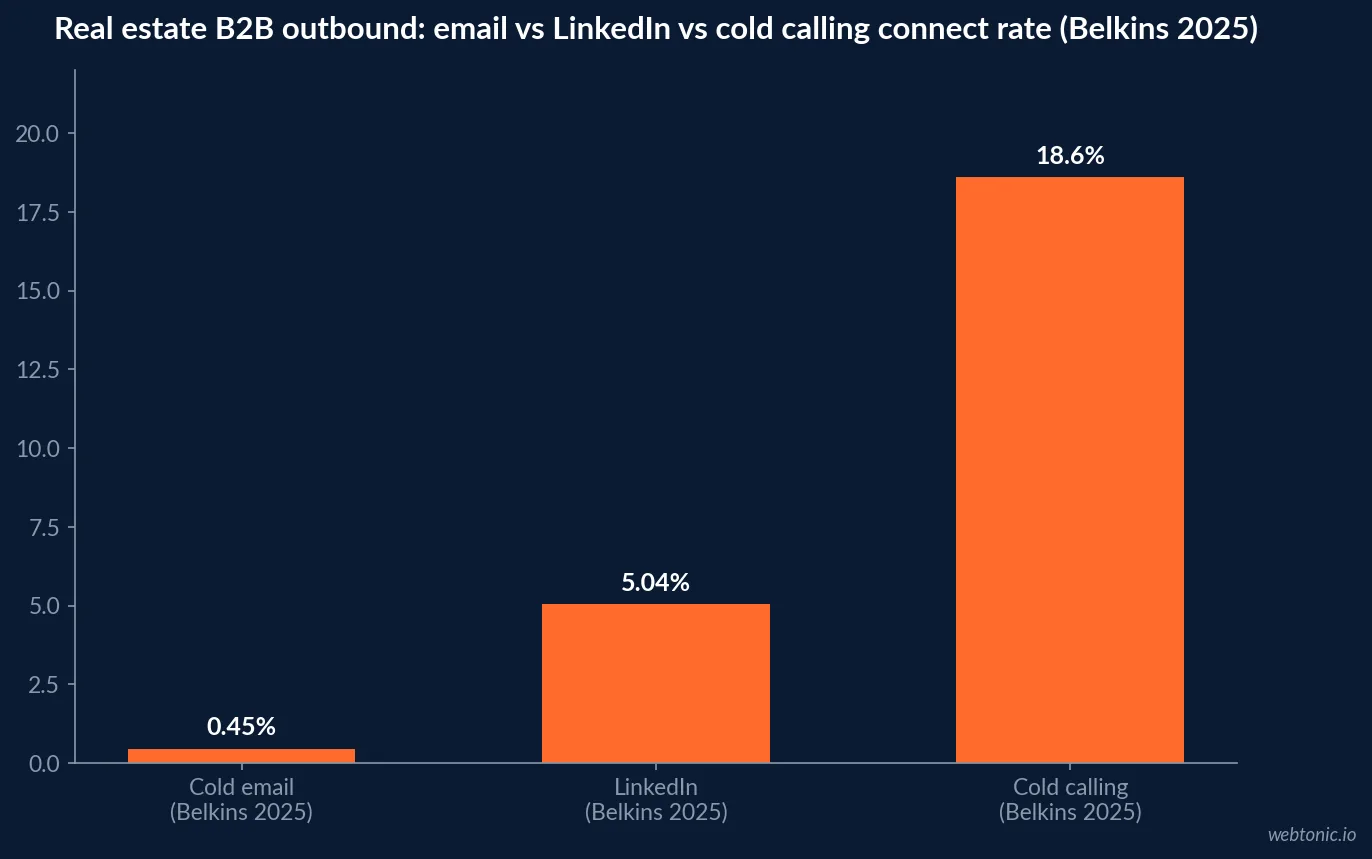
- 0.45% average cold email reply rate across 7.5 million emails (Belkins, 2025).
- 18.6% cold-call connect rate across 46,000-plus outbound calls (Belkins).
- 5.04% LinkedIn connect rate in the same Belkins dataset.
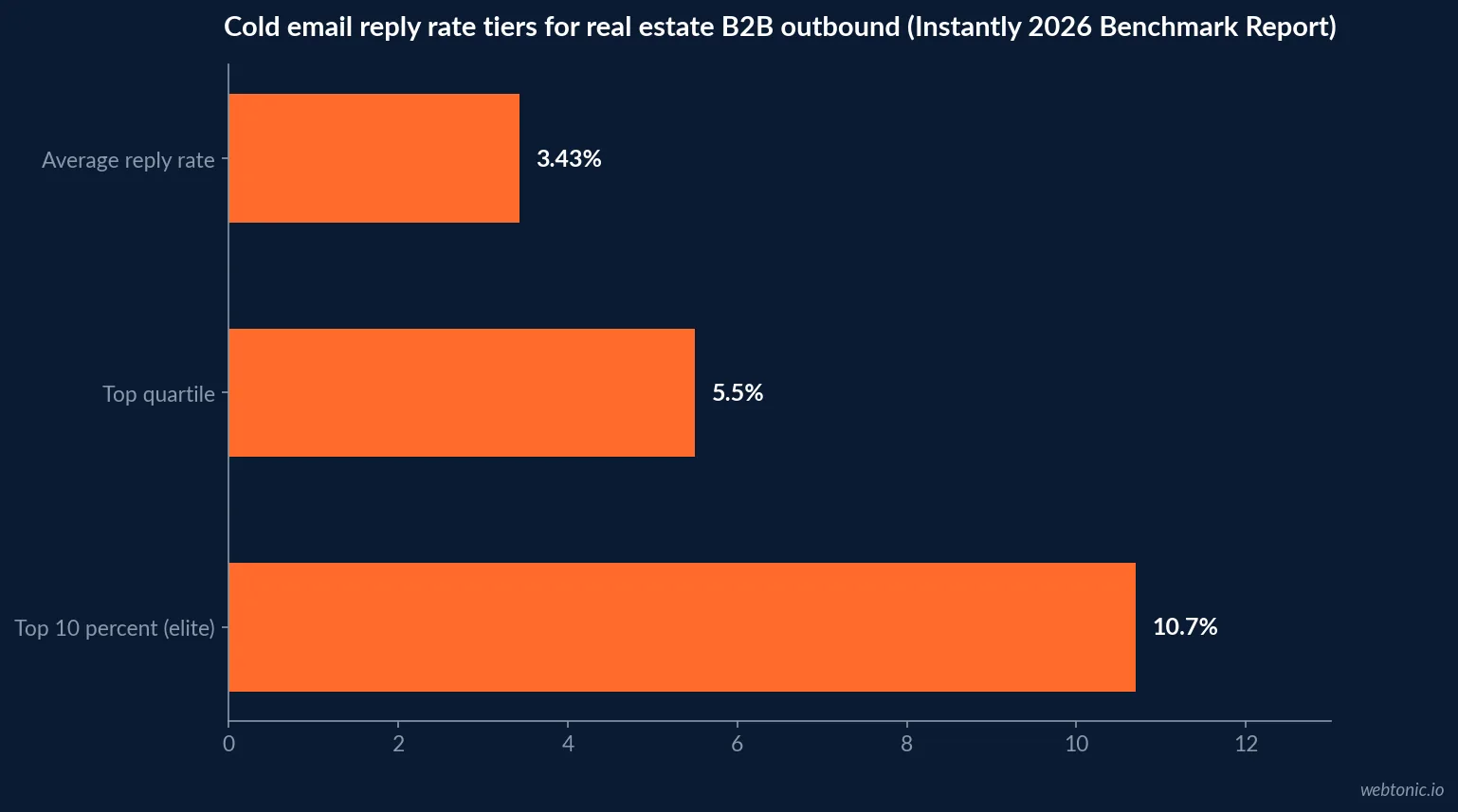
- 3.43% average cold email reply rate platform-wide (Instantly, 2026).
- 1.5% median reply rate across 56,614 campaigns (Woodpecker).
- 28.5% LinkedIn connection acceptance across 13.2 million data points (Expandi 2026).
- 10.4% LinkedIn message reply rate, same Expandi dataset.
- 851,000 franchise-adjacent comparison point is not this page's frame - see the franchise outbound page for that industry instead.
- NAR's 2025 Member Profile puts typical agent experience at 12 years, with repeat and referral business rising sharply after 16-plus years in the field.
- 0.3% is the spam-complaint ceiling Google and Yahoo enforce for bulk senders (2024 rules, still active in 2026).
- Roughly 5,000 messages a day is the threshold that triggers Google/Yahoo's bulk-sender authentication rules.
- 10 business days is the CAN-SPAM deadline to honor an opt-out request.
- 31 days is how often NAR tells members to re-check the Do Not Call Registry.
- 33.6% of 2025 appointments booked by Belkins' clients came from cold-call follow-up after email sequences went quiet.
- 7%-plus LinkedIn reply rates when email sequences run dry, stable across all 12 months of 2025 (Belkins).
- 58.6% of all replies in Belkins' data come from follow-up emails, not the first touch.
- Step 3 is the single most productive email in a sequence for booking meetings (Belkins).
| Channel | Headline metric | Source | Real estate read |
|---|---|---|---|
| Cold email, all industries | 3.43% average reply rate | Instantly 2026 Benchmark Report | Ceiling for a generic real estate B2B list |
| Cold email, median campaign | 1.5% median reply rate (56,614 campaigns) | Woodpecker | Typical outcome without list refinement |
| Cold email, large dataset | 0.45% average reply rate (7.5M emails) | Belkins 2025 | Floor for an unrefined broker/investor list |
| Cold calling, connect rate | 18.6% of prospects reached | Belkins 2025 (46,000+ calls) | Best per-contact channel, highest compliance exposure |
| LinkedIn, connect rate | 5.04% (Belkins) / 28.5% acceptance (Expandi) | Belkins; Expandi 2026 | Middle ground - no DNC exposure, slower volume |
What "real estate cold email" honestly means
Search demand groups "real estate" with "cold email," but the two halves of the industry behave differently. NAR's 2025 Member Trends report notes that agents with 16-plus years of experience get more than 40% of business from repeat clients, with referrals accounting for another 28% - business that arrives without a cold outbound program. The part of real estate that genuinely runs on cold outreach is B2B: agents prospecting investors and wholesalers, commercial brokerages chasing tenants and capital partners, and property managers pitching portfolio owners.
That reframing matters for compliance as much as for expectations. A consumer homeowner list is governed by Do Not Call and TCPA exposure that a business list, contacted in a business capacity, mostly is not.
The vendor reply-rate baseline this page is built on
Instantly's 2026 Cold Email Benchmark Report (vendor data, billions of interactions) puts the average reply rate at 3.43%, top-quartile senders at 5.5% and the top 10% above 10.7%. Woodpecker's benchmark tool (vendor data) reports a 26% open rate across 37,000 campaigns and a 1.5% median reply rate across 56,614 campaigns. Belkins (vendor data, its own client campaigns) measured 0.45% across 7.5 million emails sent in 2025.
None of the three studies segments by "real estate." Treat the spread between 0.45% and 3.43% as the range a real estate B2B list should land inside, with list quality - investor intent signals, off-market seller data, verified commercial contacts - deciding where in that range a given campaign sits.
| Vendor benchmark | Metric | Sample | Year |
|---|---|---|---|
| Instantly | 3.43% average reply rate | Billions of interactions, platform-wide | 2026 |
| Instantly | 10.7%+ top-10% reply rate | Same dataset | 2026 |
| Woodpecker | 1.5% median reply rate | 56,614 campaigns | 2026 tracker |
| Woodpecker | 26% open rate | 37,000 campaigns | 2026 tracker |
| Belkins | 0.45% average reply rate | 7.5 million emails | 2025 |
Why cold calling still wins the per-contact race - and what it costs to run
Belkins' comparison across 46,000-plus outbound calls found cold calling connecting with 18.6% of prospects actually reached, against 5.04% for LinkedIn and 0.45% for email - calling forces an immediate decision that a message sitting in an inbox does not. For real estate specifically, that per-contact advantage runs straight into the Do Not Call Registry, which NAR tells members to check at least every 31 days before calling any consumer, on top of any state registry.
A wholesaler or investor buying distressed properties, calling other businesses rather than homeowners, faces a materially lighter compliance load - which is the honest reason cold calling shows up more often on the investor side of real estate outbound than on the consumer-facing agent side.
| Rule | What it requires | Applies to | Source |
|---|---|---|---|
| National Do Not Call Registry | Check every 31 days before calling | Calls to consumers | NAR guidance to members |
| State Do Not Call lists | Additional registry, varies by state | Calls to consumers in that state | NAR guidance |
| TCPA enforcement | FCC has increased telemarketing suits against agents | Calls and texts to consumers | NAR (2024 report) |
| Established business relationship | Narrower exemption than most agents assume | Existing clients only | NAR guidance |
| B2B calls (investor/broker to business) | Materially lighter DNC exposure | Business-to-business contact | General TCPA framework |
The deliverability rules that decide if the email even arrives
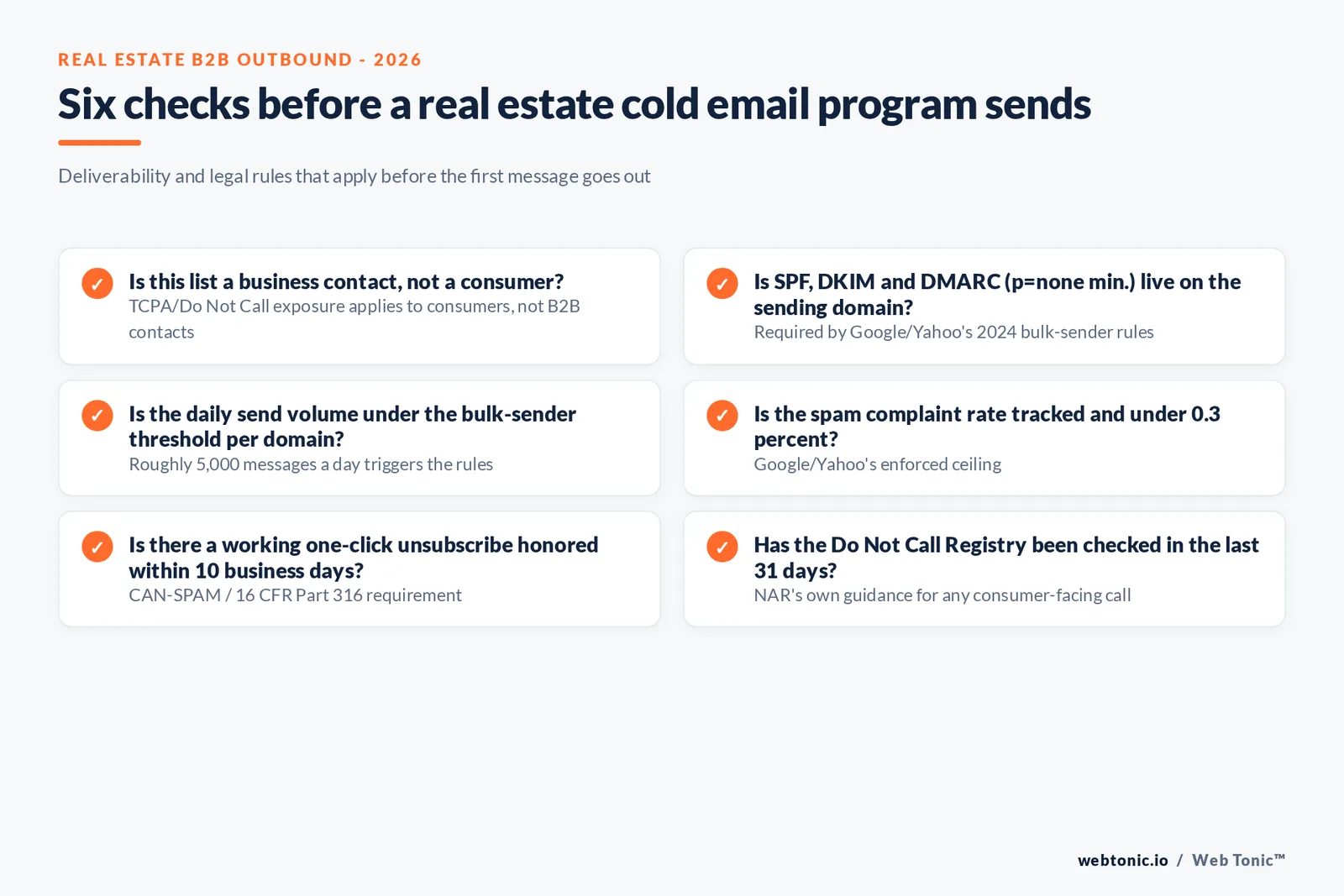
Since Google's 2024 bulk-sender requirements and Yahoo's parallel rules took effect, any sender pushing roughly 5,000-plus messages a day to Gmail or Yahoo addresses needs SPF, DKIM and a DMARC record at minimum p=none, spam complaints held under 0.3%, and a one-click List-Unsubscribe header. A real estate investor list run through a personal Gmail account, common in smaller shops, is exactly the profile these rules were written to catch.
Layered on top, the CAN-SPAM Act compliance guide and its implementing rule, 16 CFR Part 316, require a working opt-out honored within 10 business days, an accurate header and no deceptive subject line - all of it enforceable against a brokerage's outbound program regardless of list size.
| Requirement (2026) | Threshold | Governing rule | Consequence of missing it |
|---|---|---|---|
| Authentication | SPF + DKIM + DMARC (p=none minimum) | Google/Yahoo bulk-sender rules | Bulk mail routed to spam or rejected |
| Spam complaint rate | Under 0.3%, target under 0.1% | Google/Yahoo bulk-sender rules | Sending domain flagged, deliverability drops |
| Unsubscribe mechanism | One-click List-Unsubscribe header | Google/Yahoo bulk-sender rules | Blocked from bulk inboxes |
| Opt-out honored | Within 10 business days | CAN-SPAM / 16 CFR Part 316 | FTC penalty exposure |
| Subject line accuracy | No deceptive or misleading subject | CAN-SPAM / 16 CFR Part 316 | FTC penalty exposure |
List sourcing and volume per inbox for real estate outbound
Real estate B2B lists are typically built from public MLS records, county recorder filings for off-market and distressed properties, LinkedIn Sales Navigator for commercial brokers and property managers, and licensed data providers - never scraped consumer contact data, which both fails CAN-SPAM's spirit and burns domain reputation fast. Spreading volume across multiple authenticated sending domains and inboxes, rather than one address pushed past the roughly 5,000-message threshold, is standard practice for keeping under the Google/Yahoo spam-complaint ceiling.
Belkins' data on follow-up sequencing is directly useful here: 58.6% of all replies in its dataset come from follow-up emails rather than the first touch, and step 3 is the single most productive email for booking a meeting - reinforcing that volume without a sequence wastes most of the reply potential a list can produce.
| Sourcing method | Best fit | Compliance note | Volume guidance |
|---|---|---|---|
| Public MLS + county recorder data | Off-market/distressed investor outreach | Business-purpose data, lower DNC exposure | Segment by deal type before sending |
| LinkedIn Sales Navigator export | Commercial brokers, property managers | Verify opt-in expectations under CAN-SPAM | Enrich before first send |
| Licensed B2B data providers | Institutional investors, capital partners | Contractual compliance terms apply | Validate deliverability before scaling |
| Scraped consumer contact lists | Not recommended | High CAN-SPAM/TCPA exposure | Avoid entirely |
| Existing client CRM (referral mining) | Repeat/referral business, not cold outreach | Established business relationship applies | Not a cold channel |
What the follow-up channel mix looks like once email goes quiet
Belkins reports that when an email sequence runs dry, LinkedIn delivers 7%-plus reply rates, stable across all 12 months of 2025 with no seasonal dip, and cold calling connects with 18.6% of prospects reached while producing 33.6% of all appointments booked in its 2025 dataset. For a real estate investor-outbound program, that argues for a three-channel sequence - email first for reach and cost, LinkedIn second for warmer re-engagement, a call as the escalation once a contact has already seen the name twice.
Expandi's larger, LinkedIn-only dataset (13.2 million data points, 2026) puts platform-wide connection acceptance at 28.5% and message reply at 10.4% - both ahead of average cold email, which is the case for treating LinkedIn as the middle step rather than skipping straight from email to phone.
| Sequence step | Channel | Reported outcome | Source |
|---|---|---|---|
| Touch 1-2 | Cold email | 0.45%-3.43% average reply rate | Belkins / Instantly |
| Touch 3 (best-performing) | Cold email | Highest per-email meeting-booking rate | Belkins |
| Re-engagement | 7%+ reply rate, no seasonal dip (2025) | Belkins | |
| Re-engagement (platform-wide) | 28.5% connection acceptance, 10.4% reply | Expandi 2026 | |
| Escalation | Cold call | 18.6% connect rate, 33.6% of appointments booked | Belkins |
Building a compliant outbound program for real estate B2B
- Separate consumer contacts (Do Not Call/TCPA exposure) from business contacts (investors, wholesalers, brokerages, property managers) before building any list.
- Authenticate every sending domain with SPF, DKIM and DMARC before the first campaign, not after a deliverability problem appears.
- Budget for a 0.45%-3.43% reply rate range, not a single number, and treat anything under 0.45% as a list-quality problem to fix before scaling volume.
- Sequence email, then LinkedIn, then a call - Belkins' data shows most of the value sits in the follow-up steps, not the first message.
- Re-check the Do Not Call Registry every 31 days for any contact that could plausibly be reached as a consumer, per NAR's own guidance to members.
For the channel's wider benchmark set across industries, see our cold email outbound statistics hub. Our growth marketing practice builds and monitors deliverability for outbound programs like this one, and you can talk to us about a real estate outbound build.
Frequently Asked Questions
Do real estate agents cold email homebuyers and sellers?
Rarely, and it is legally risky to try. The Do Not Call rules that NAR tells members to follow apply to cold-calling and texting consumers, and unsolicited commercial email to a private individual reads as spam even where CAN-SPAM technically allows it with an opt-out. The outbound channel that actually works in real estate is B2B: emailing investors, wholesalers, property managers, commercial brokerages and capital partners who expect deal flow in their inbox.
What reply rate should a real estate B2B outbound campaign expect?
Vendor datasets that are not real-estate-specific still set the honest ceiling. Instantly's 2026 benchmark report, drawn from billions of cold email interactions, puts the average reply rate at 3.43% with elite senders over 10%. Woodpecker's tracker shows a 1.5% median across 56,614 campaigns. Belkins measured 0.45% across 7.5 million emails in 2025. A real estate investor-outreach list with a sharper niche (distressed properties, off-market sellers) should sit above the all-industry median, not below it.
Is cold calling still legal for real estate prospecting?
For consumers, only within limits. NAR tells members that real estate cold-calling activity must comply with the National Do Not Call Registry, checked at least every 31 days, plus any state list, with an established-business-relationship exemption that is narrower than most agents assume. For B2B calls to investors, brokerages and property managers acting in a business capacity, the restrictions are lighter, which is why serious real estate outbound programs increasingly route through B2B contacts, not consumer lead lists.
How does cold email compare with cold calling and LinkedIn for real estate outbound?
Belkins' 2025 dataset of 46,000-plus outbound calls found cold calling connecting with 18.6% of prospects reached, against 5.04% for LinkedIn and 0.45% for email - calling wins on a per-contact basis because it forces an immediate answer/don't-answer decision. Email wins on cost per contact and compliance simplicity for large B2B lists. Expandi's 13.2-million-datapoint 2026 report puts LinkedIn's platform-wide connection acceptance at 28.5% and message reply at 10.4%, ahead of average cold email but behind a live phone call.
What deliverability rules apply to real estate outbound email in 2026?
The same ones every B2B sender follows since Google and Yahoo's 2024 bulk-sender rules: SPF, DKIM and a DMARC record at minimum p=none for anyone sending roughly 5,000-plus messages a day to Gmail or Yahoo addresses, spam complaints held under 0.3%, and a one-click List-Unsubscribe header. CAN-SPAM (16 CFR Part 316) additionally requires a working opt-out, honored within 10 business days, and no misleading subject lines - non-negotiable for any list built from public MLS, LinkedIn or scraped broker data.
Sources
Instantly - Cold Email Benchmark Report 2026 (vendor data)
Woodpecker - Cold email benchmarks tool (vendor data)
Belkins - Sales follow-up statistics, 2025 dataset (vendor data)
Expandi - State of LinkedIn Outreach H2 2026
National Association of Realtors - 2025 Member Trends
National Association of Realtors - Telemarketing and cold-calling guidance
Google - Email sender guidelines (bulk-sender requirements)
Yahoo - Sender best practices
Federal Trade Commission - CAN-SPAM Act compliance guide
eCFR - 16 CFR Part 316, CAN-SPAM Rule