Table of contents

Fees, and specifically retainers, are what a CMO should budget for in 2026 - not commissions, and increasingly not pure value-based pricing either. A 99-organization client-side survey and an 87-founder rate study land on the same conclusion from opposite sides of the negotiating table.
Key Takeaways
- Fees, particularly labor-based fees, are the most dominant compensation method (ANA, 2025).
- Fees are growing in share over value-based and commission-based methods.
- Marketing agencies favor retainers at a 45% preference rate (Promethean Research).
- Design agencies favor project-based pricing at 41%.
- Value-based pricing fell to just 18% of agencies in the 2025 survey wave.
- Agencies using value-based pricing underperformed standard-model agencies.
- Median agency hourly rate is USD 185 across an 87-founder survey (Striveloom).
- The range runs from USD 75 to USD 650 an hour depending on specialization.
- Niched agencies charge 2.3 times more per hour than generalists with equal output.
- Niched agencies also report 40% shorter sales cycles.
- 61% of surveyed agencies now default to project-based pricing, up from 44% in 2023.
- Companies outsource roughly a third of digital marketing activity on average (The CMO Survey).
- B2C product companies outsource the most, at 48% currently.
- B2B services companies outsource the least, at 25% currently.
- Retail/wholesale outsources 57% of digital marketing work, the heaviest industry.
- Education outsources just 3%, the lightest industry.
What the client side actually reports paying
For more than 50 years the Association of National Advertisers has fielded its Trends in Agency Compensation survey among client-side marketers, and the 19th edition, based on 99 ANA member organizations, delivers the clearest client-side signal available: fees, particularly labor-based fees, are the most dominant compensation method today, and that dominance is increasing against both newer value-based approaches and older sales commission-based methodologies. The ANA and co-author JLB + Partners break this down further in Agency Compensation Methods, by the Numbers, which tracks the fee-versus-commission split over time and by marketing discipline.
For a CMO building a budget line, that trend line matters more than any single quoted number: the market has been moving away from commission and toward negotiated, labor-based fees for years, which means the negotiating leverage sits in scoping the labor hours accurately, not in arguing over a percentage-of-spend commission structure that is disappearing anyway.
| ANA 19th Edition findings (99 member orgs, Nov 2025) | Direction |
|---|---|
| Fee-based compensation (esp. labor-based) | Most dominant method, still rising |
| Value-based compensation | Growing more slowly than fees |
| Sales commission-based compensation | Losing share to fees |
| Survey scope | Client-side marketer members only |
What the agency side is quoting, model by model
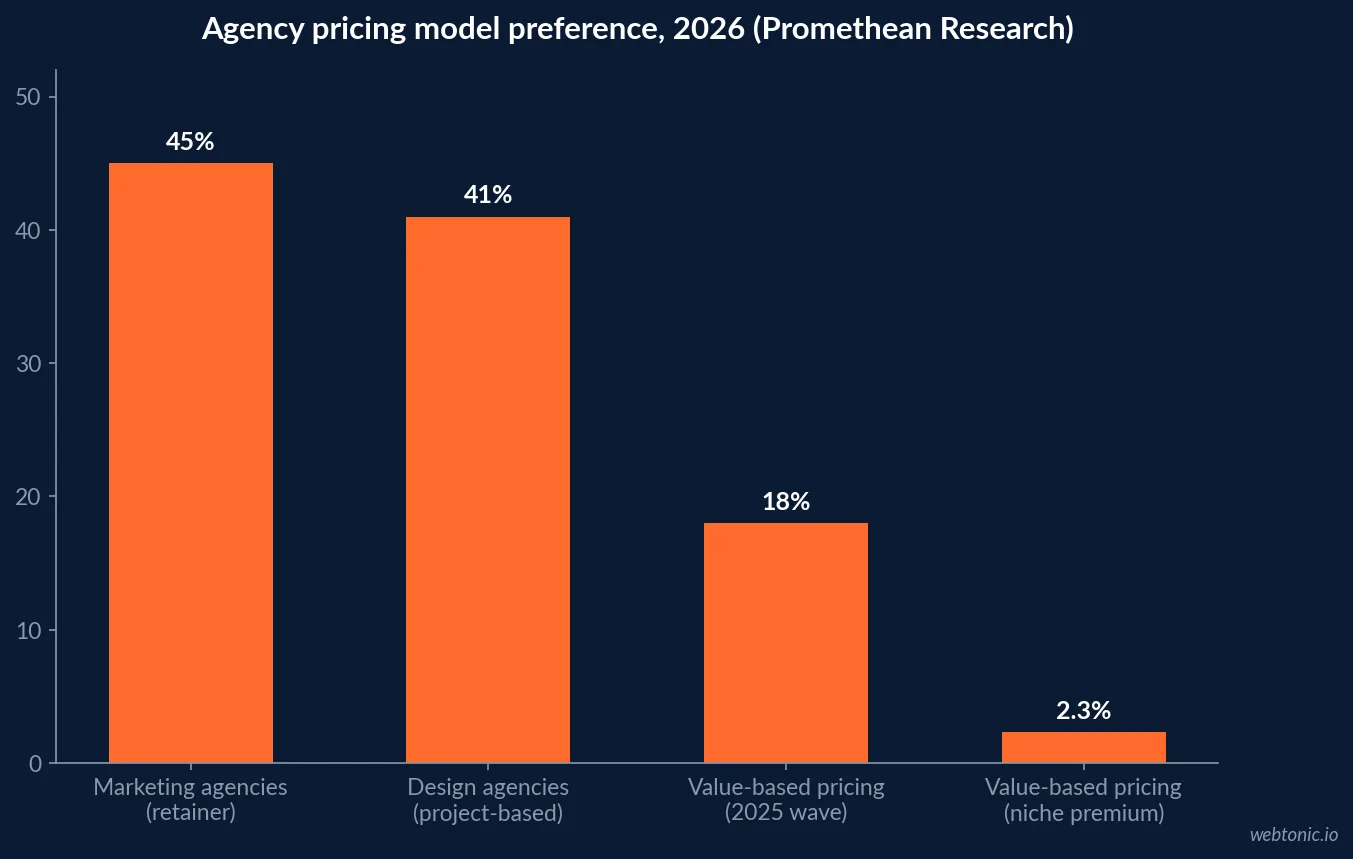
Promethean Research's 2026 State of Digital Services Report confirms the pattern breaks down by agency type rather than resolving to one universal model. Marketing agencies lean hard toward retainers, at a 45% preference, because recurring execution and optimization work fits a recurring payment structure. Design agencies favor project-based pricing at 41%, matching how design work delivers as a discrete, finished transformation rather than an ongoing service. Development agencies split nearly evenly across time-and-materials, project work and retainers, reflecting the mixed nature of scoped builds plus ongoing support.
The same research flags a structural warning for CMOs being pitched value-based pricing: it fell to just 18% of agencies in the 2025 survey wave, and the agencies using it underperformed those running more standard pricing models. Value-based pricing sounds like the sophisticated choice, but it requires an outcome-attribution clarity that most client-agency relationships simply do not have in practice.
| Agency archetype | Dominant pricing model | Preference share |
|---|---|---|
| Marketing agencies | Monthly retainer | 45% |
| Design agencies | Project-based | 41% |
| Development agencies | Split (T&M / project / retainer) | Roughly even |
| Blended agencies | Most fragmented mix | Highest (still minority) value-based use |
What that translates to in actual hourly dollars
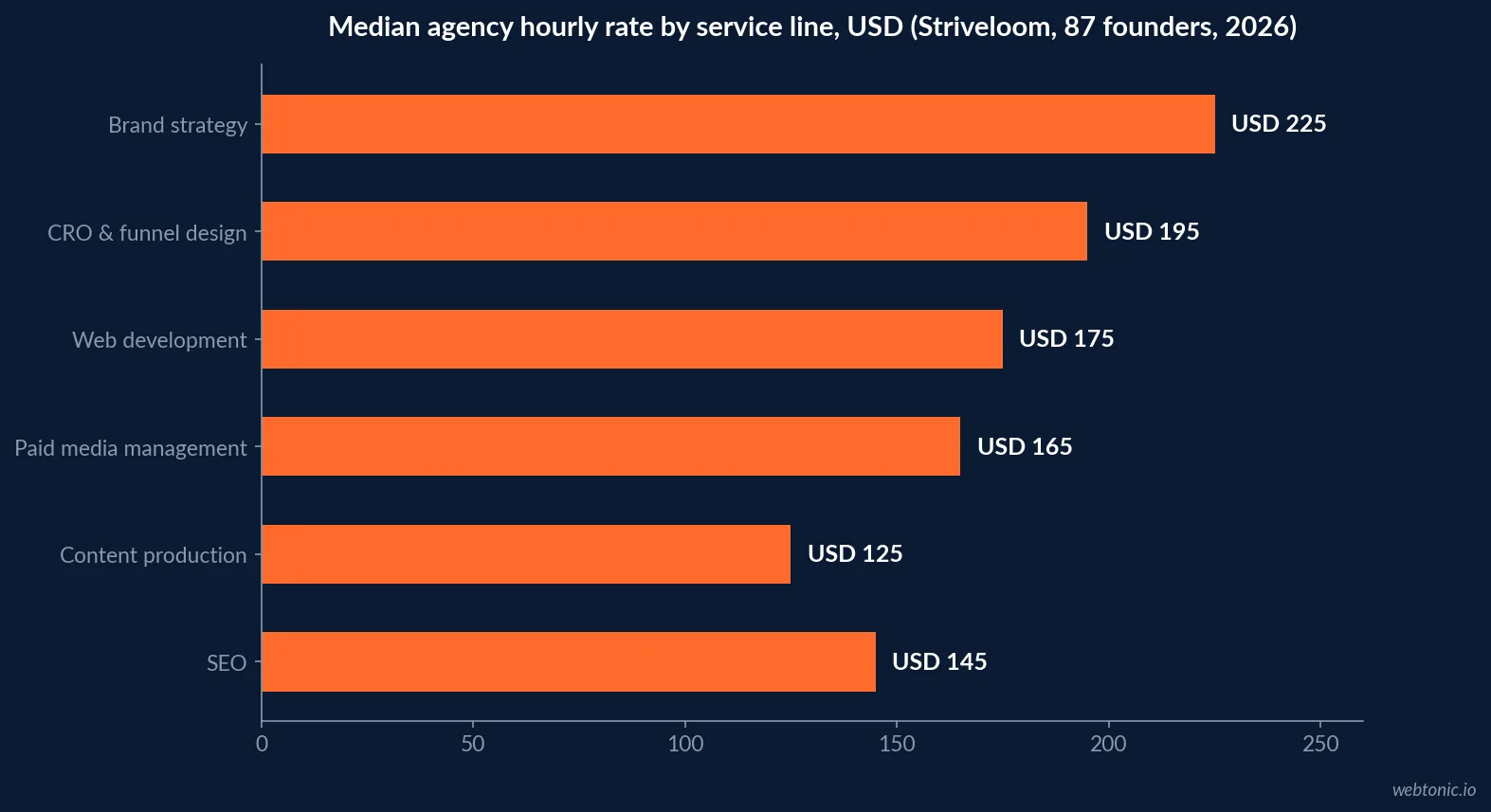
The rate-card evidence comes from Striveloom's 2026 survey of 87 agency founders across digital marketing, web development, brand strategy, SEO and paid media. The median hourly rate is USD 185, spanning a floor of USD 75 for offshore generalist work to a ceiling of USD 650 for specialized US boutiques. The single biggest predictor of where an agency landed in that range was not years in business or portfolio quality - it was having a defined niche: niched agencies charged 2.3 times more per hour than generalists with comparable output, and reported 40% shorter average sales cycles on top of the higher rate.
Consulting Success's broader survey of roughly 1,000 consultants shows a similar model mix outside marketing specifically - fixed-price at 30% of engagements, hourly at 29%, monthly retainers at 16% - which suggests the fee-over-commission, retainer-heavy shift the ANA reports is not unique to advertising; it is happening across professional services generally.
| Service line (Striveloom, 87 founders, 2026) | Low | Median | High |
|---|---|---|---|
| Web development | USD 95 | USD 175 | USD 425 |
| Paid media management | USD 85 | USD 165 | USD 350 |
| SEO | USD 75 | USD 145 | USD 300 |
| Brand strategy | USD 150 | USD 225 | USD 650 |
| Content production | USD 65 | USD 125 | USD 275 |
| CRO and funnel design | USD 120 | USD 195 | USD 480 |
The pricing-model shift already underway
Striveloom's founders also show the billing structure itself moving: 61% now default to quoting a fixed-scope project rather than an open hourly arrangement, up from 44% in 2023. That is a meaningful three-year swing, and it lines up with what CMOs should expect in a pitch: fewer open-ended hourly estimates, more fixed packages with change-request terms buried in the fine print. Ask for the change-request rate in writing before signing a "fixed" quote - it is the clause that decides whether a fixed price stays fixed.
How much of the marketing function actually leaves the building
Budget conversations do not happen in a vacuum; they happen against how much work a company has already decided to send outside. The CMO Survey's spring 2026 wave, run out of Duke's Fuqua School of Business, reports companies outsourcing roughly a third of digital marketing activity on average, but the split by business model is wide: B2C product companies outsource 48% currently (projected to ease slightly to 44% in two years), while B2B services companies outsource just 25%. By industry, retail/wholesale (57%) and consumer packaged goods (55%) are the heaviest outside spenders, while education (3%) and communications/media (10%) keep almost everything in-house. See the full breakout in the CMO Survey 2026 Highlights and Insights Report.
| Segment (The CMO Survey, spring 2026) | Share outsourced today | Projected in 2 years |
|---|---|---|
| B2C product companies | 48% | 44% |
| B2C services companies | 44% | 45% |
| B2B product companies | 28% | 31% |
| B2B services companies | 25% | 26% |
| Retail / wholesale (industry) | 57% | - |
| Consumer packaged goods (industry) | 55% | - |
| Education (industry) | 3% | - |
What a 2026 agency budget line should actually contain
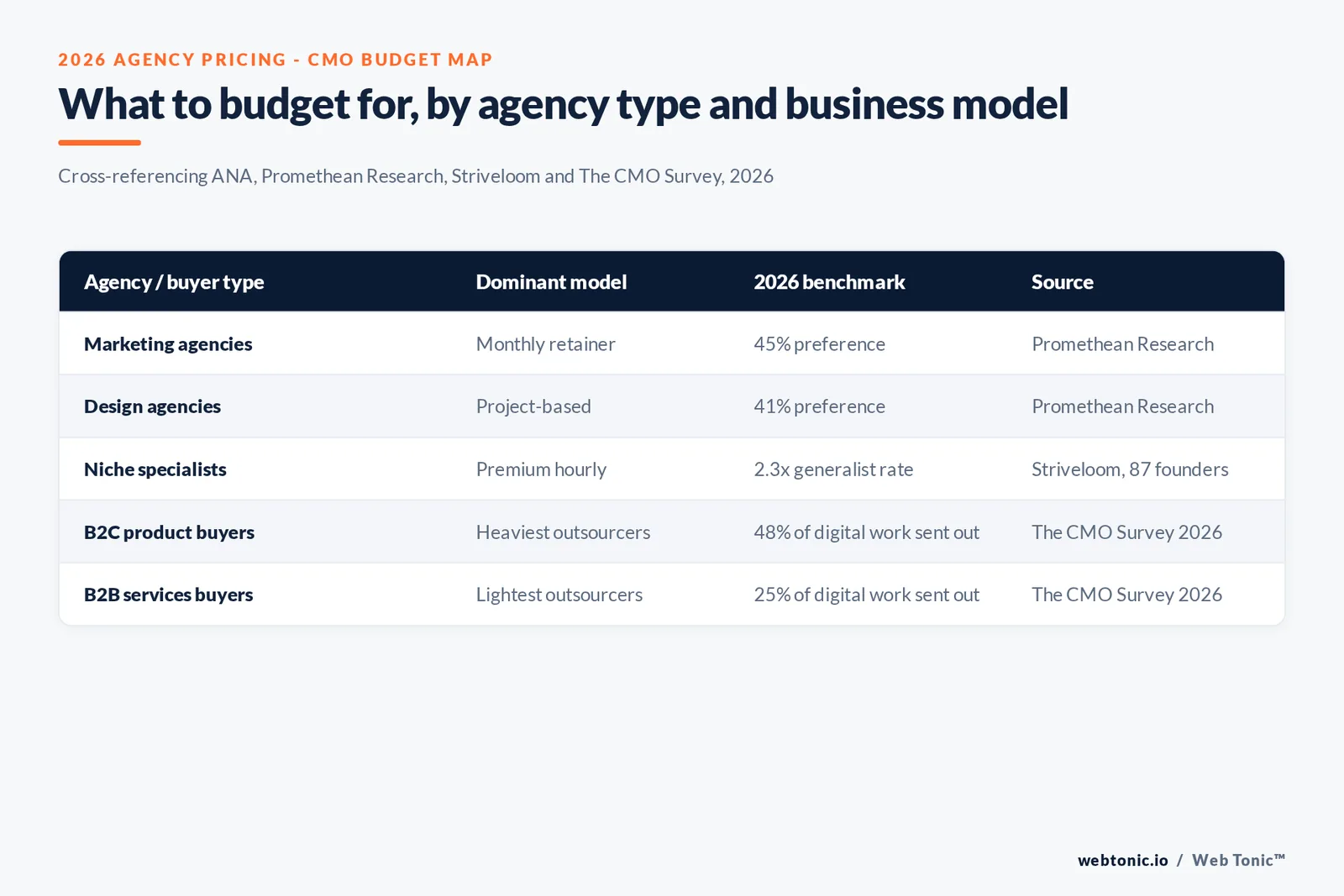
Budget for a retainer if the work is ongoing execution and optimization - that is what 45% of marketing agencies default to and what a labor-based fee structure is built to price fairly. Budget for a fixed-scope project quote if the deliverable is discrete, and get the change-request rate in writing regardless of which structure you sign, since that clause decides the real total more than the headline rate does. And weight the hourly range toward the niche-specialist end of the Striveloom data if the work requires expertise a generalist agency cannot credibly claim - the 2.3x rate premium buys faster sales cycles too, which is its own budget argument.
Our growth marketing practice scopes exactly this kind of retainer-versus-project decision before a contract gets signed, our data and analytics team validates whether a proposed retainer's implied hourly rate matches the deliverables on paper, and if you want a second read on a quote you have already received, talk to us.
What CMOs get wrong when comparing quotes
The most common budgeting mistake is comparing an hourly quote from one agency against a retainer quote from another without normalizing for scope. A USD 145 median SEO hourly rate and a USD 4,500 monthly retainer are not comparable numbers until you know how many hours the retainer actually buys - and per Striveloom's data, agencies are increasingly vague about that hour count precisely because 61% now default to fixed-scope framing that hides the underlying rate. Ask for the implied hourly rate inside any retainer quote before comparing it to a competing bid.
The second mistake is assuming commission-based pricing is dead everywhere. The ANA's own data shows it losing share to fees on average, but specific disciplines - particularly media buying at scale - still run meaningful commission structures. Ask which model a specific proposal is actually using rather than assuming the industry-wide trend applies to your specific line item.
| Comparison trap | Why it misleads | What to ask instead |
|---|---|---|
| Hourly rate vs. retainer sticker price | Retainers hide the implied hourly rate | How many hours does this retainer include? |
| Generalist quote vs. niche specialist quote | Niche agencies charge 2.3x for a reason | What outcome is the premium buying? |
| "Fixed price" vs. true total cost | Change-request rates are rarely disclosed upfront | What is the change-request rate in writing? |
| Industry-wide trend vs. this specific proposal | Commission still exists in some disciplines | Which model does this specific SOW use? |
The takeaway for the budget conversation
Both sides of the negotiating table now agree on the direction: fees over commissions, retainers over ad hoc hourly billing for ongoing work, and specialization commanding a real, measurable premium. A CMO who walks into a 2026 agency negotiation expecting a commission structure or a flat generalist hourly rate is negotiating against data that no longer describes the market.
Frequently Asked Questions
What is the dominant agency pricing model in 2026?
Fees, specifically labor-based fees, not commissions or pure value-based pricing. The ANA's 19th edition Trends in Agency Compensation report, based on 99 member organizations, finds fees are the most dominant compensation method and still growing in share against both value-based and commission-based alternatives. On the agency side, Promethean Research's 2026 survey shows marketing agencies specifically lean toward retainers at 45% preference, well ahead of project-based work.
Why did value-based pricing fall out of favor?
It underperformed. Promethean Research's 2026 State of Digital Services survey found value-based pricing dropped to just 18% of agencies in 2025, and the agencies using it underperformed those running more standard hourly, project or retainer models. Value-based pricing sounds appealing in theory but requires an outcome-attribution clarity most client-agency relationships do not actually have.
What hourly rate should a CMO expect to see quoted in 2026?
A wide range depending on specialization. Striveloom's survey of 87 agency founders found a median hourly rate of USD 185, spanning USD 75 for offshore generalist work up to USD 650 for specialized US boutiques. The single biggest driver of where an agency lands in that range was having a defined niche, not years in business or portfolio size - niched agencies charged 2.3 times more for comparable output.
How much of digital marketing work do companies actually send outside?
Roughly a third on average, but it varies sharply by business model. The CMO Survey's 2026 data shows B2C product companies sending out the most work (48% currently, projected 44% in two years), while B2B services companies send out the least (25% currently). Retail/wholesale (57%) and consumer packaged goods (55%) are the heaviest outsourcers by industry; education (3%) is the lightest.
Is project-based pricing replacing hourly billing?
Among the agencies actually shifting their model, yes. Striveloom's 2026 survey found 61% of surveyed agencies now quote fixed-scope projects as their default, up from 44% in 2023, as hourly billing slides toward a minority practice among founders who can command premium, niche-driven rates.
Sources
ANA - 2025 Trends in Agency Compensation Report, 19th Edition
ANA / JLB + Partners - Agency Compensation Methods, by the Numbers
Promethean Research - Pricing Models Follow Agency Archetypes, 2026
Striveloom - Agency pricing survey of 87 founders, 2026
Consulting Success - Consulting fees study
The CMO Survey - Spring 2026 results
The CMO Survey - Highlights and Insights Report 2026