



Table of contents
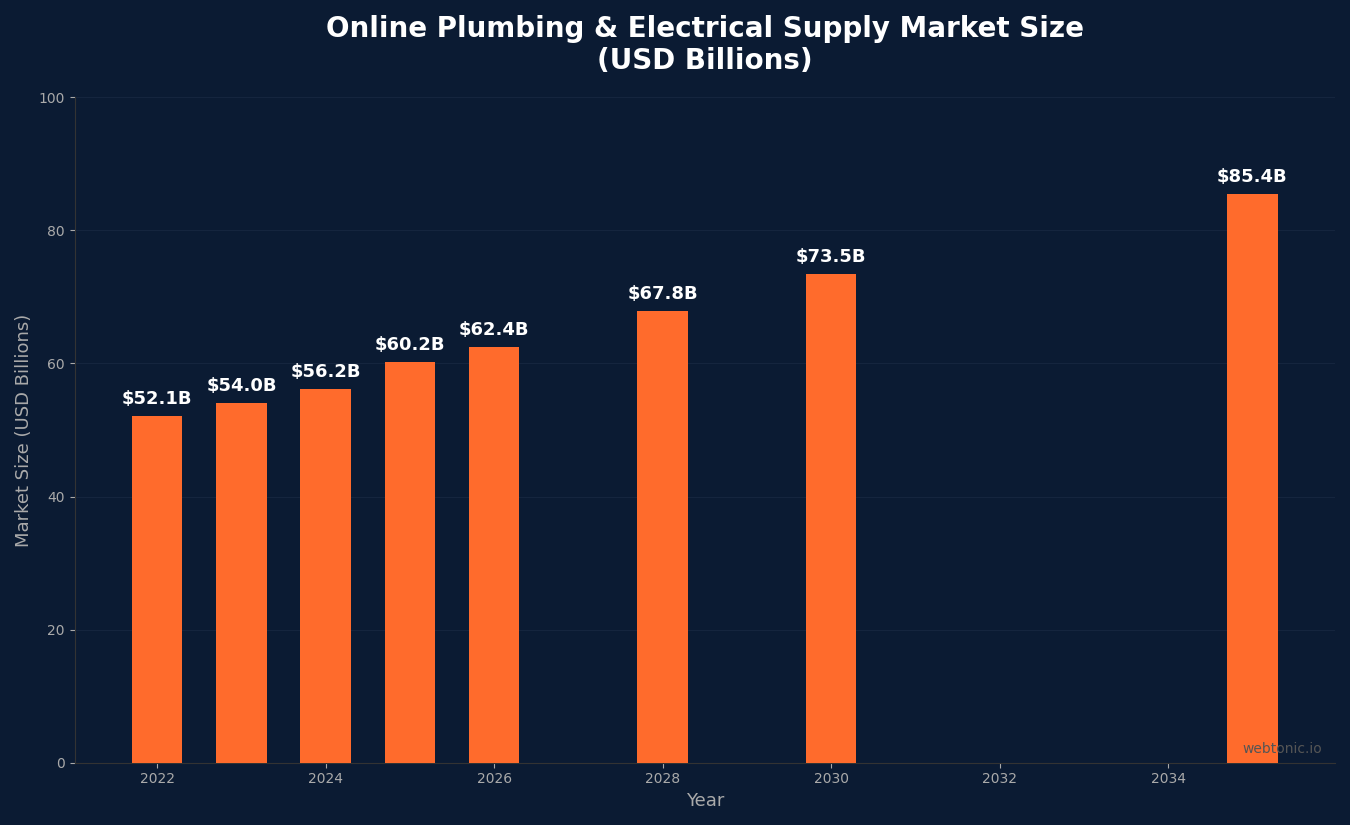
The online plumbing and electrical supply market hit $60.2 billion in 2025 and is projected to reach $85.4 billion by 2035, and Shopify-powered stores are capturing a growing share of that market as plumbing wholesalers and retailers accelerate their shift to digital storefronts.
Key Takeaways
- The online plumbing and electrical supply market was valued at $60.2 billion in 2025 and is forecast to grow to $85.4 billion by 2035 at a 3.6% CAGR (WiseGuyReports, 2026).
- Aggregate online plumbing supply sales across tracked retailers totaled $1.93 billion in 2025, with a projected 20–50% rebound in 2026 after a 5–10% decline the prior year (Grips Intelligence).
- Shopify B2B gross merchandise volume surged 140% year-over-year to $9.4 billion in H1 2026, with an average B2B order value of $1,840 compared to $130 for direct-to-consumer orders (Ecommerce Times, 2026).
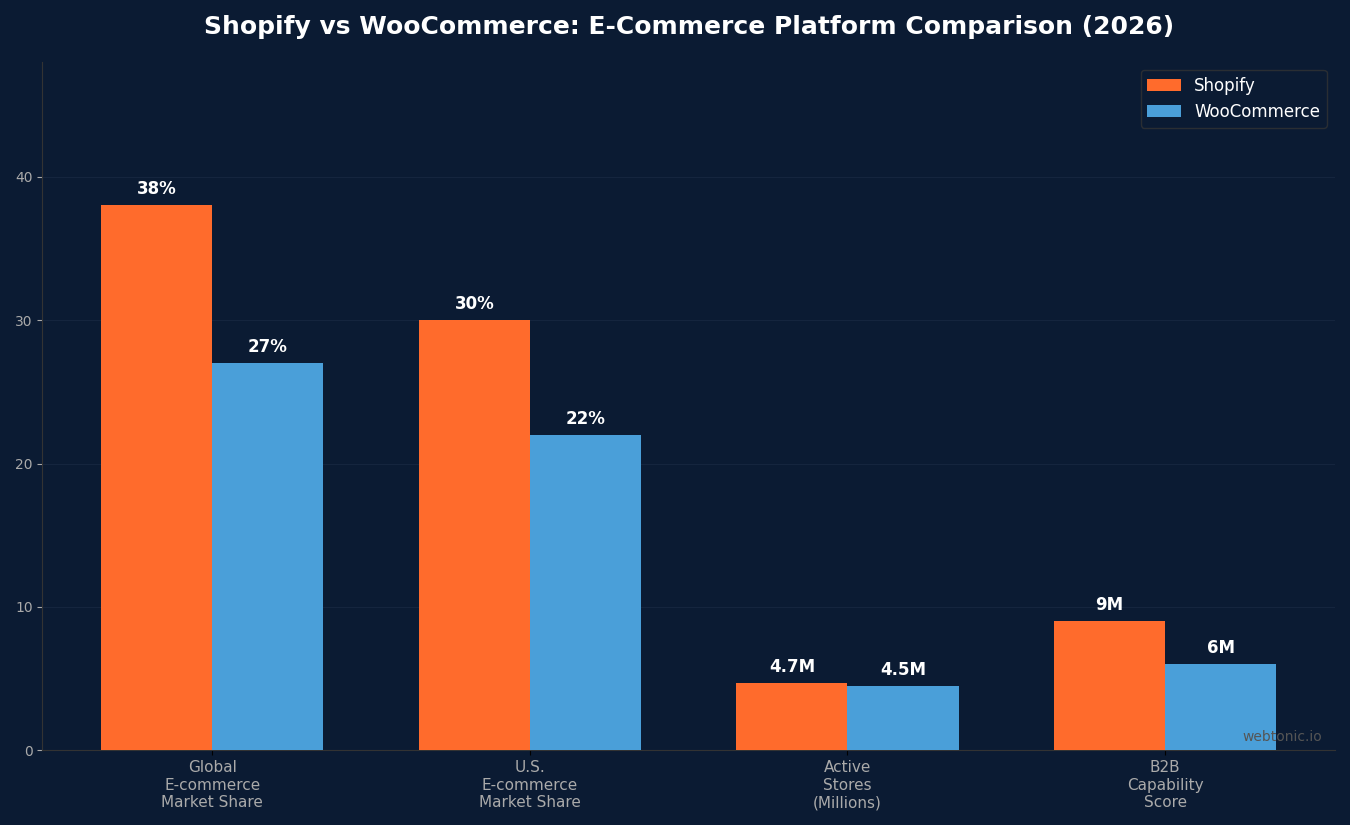
- Shopify holds approximately 38% global e-commerce market share in 2026, making it the leading platform for plumbing supply stores migrating from legacy systems (Tech Insider, 2026).
- The global plumbing fixtures market grew from $114.31 billion in 2025 to $123.37 billion in 2026 at a 7.9% CAGR, with online channels capturing an increasing share of that growth (GII Research).
- Victorian Plumbing, a Shopify-powered U.K. plumbing retailer, reports an average order value of £287 with mixed baskets ranging from under £50 replacement parts to project orders exceeding £1,000 (LSE Annual Report).
Plumbing E-Commerce Market Data at a Glance
| Metric | Value | Source |
|---|---|---|
| Online plumbing & electrical supply market (2025) | $60.2B | WiseGuyReports |
| Projected market size (2035) | $85.4B | WiseGuyReports |
| Market CAGR (2026–2035) | 3.6% | WiseGuyReports |
| Tracked plumbing retailer online sales (2025) | $1.93B | Grips Intelligence |
| 2026 growth forecast (tracked retailers) | 20–50% | Grips Intelligence |
| Shopify global e-commerce market share | ~38% | Tech Insider |
| WooCommerce global market share | ~27% | Tech Insider |
| Shopify B2B GMV (H1 2026) | $9.4B | Ecommerce Times |
| Avg. B2B order value (Shopify) | $1,840 | Ecommerce Times |
| Plumbing fixtures market (2026) | $123.37B | GII Research |
Online Plumbing Supply Market Size and Growth
WiseGuyReports valued the online plumbing and electrical supply market at $60.2 billion in 2025, projecting it to reach $85.4 billion by 2035 at a compound annual growth rate of 3.6% (WiseGuyReports, 2026). Key growth drivers include increasing DIY culture, aging housing stock requiring replacement parts, and the convenience of next-day delivery for professional plumbers managing multiple job sites.
At the retail tracking level, Grips Intelligence reports that aggregate online plumbing supply sales across tracked retailers totaled $1.93 billion in 2025 — a 5–10% decline from the prior year. However, the 2026 outlook calls for a 20–50% revenue rebound, suggesting the dip was a temporary correction rather than a structural shift. The broader plumbing fixtures market reached $123.37 billion in 2026, growing at a 7.9% CAGR from $114.31 billion in 2025 (GII Research).
Shopify Platform Performance for Plumbing Retailers
Shopify's B2B gross merchandise volume surged 140% year-over-year to $9.4 billion in the first half of 2026, as wholesale operations — including plumbing supply distributors — adopted the platform's custom catalog, volume pricing, and draft order automation features (Ecommerce Times, 2026). The average B2B order on Shopify now stands at $1,840, roughly 14× the $130 average for DTC orders — a ratio that reflects the bulk purchasing patterns of plumbing contractors stocking jobsite materials.
For plumbing supply retailers specifically, Shopify offers distinct advantages over general-purpose platforms. The growth marketing capabilities built into Shopify's ecosystem — abandoned cart recovery, multi-channel selling, and integrated analytics — are particularly valuable for parts catalogs with thousands of SKUs where conversion rate optimization directly impacts revenue per visitor.
E-Commerce Platform Comparison for Plumbing Stores
| Platform | Global Market Share | U.S. Market Share | Active Stores | B2B Strength |
|---|---|---|---|---|
| Shopify | ~38% | ~30% | 4.7M+ | Strong — native B2B catalogs, volume pricing |
| WooCommerce | ~27% | ~22% | 4.5M+ | Moderate — plugin-dependent |
| Wix | ~6% | ~5% | 800K+ | Limited — basic invoicing only |
| BigCommerce | ~3% | ~4% | 60K+ | Strong — built-in B2B edition |
| Squarespace | ~4% | ~3% | 3.8M | Minimal — no wholesale features |
Shopify's dominance is particularly notable in the U.S. market, where it holds approximately 30% of the e-commerce software market — the clear domestic leader according to Mobiloud's 2026 analysis. For plumbing supply stores, the choice between Shopify and WooCommerce often comes down to whether the business prioritizes ease of management (Shopify) or full customization through WordPress plugins (WooCommerce). Both platforms support the catalog size and variant complexity typical of plumbing inventory.
B2B and Wholesale Plumbing E-Commerce Trends
The wholesale plumbing supply chain is undergoing a digital transformation that mirrors what happened in B2C e-commerce a decade ago. Shopify's 140% B2B GMV growth signals that legacy ordering systems — phone, fax, and email-based purchase orders — are rapidly giving way to self-service digital storefronts where contractors can browse catalogs, check real-time inventory, and place orders 24/7.
Plumbing distributors using Shopify B2B report average order values of $1,840, reflecting the typical contractor purchase pattern: bulk fittings, pipe lengths, and fixture packages for upcoming projects. The platform's draft order automation and PO matching features reduce the manual processing overhead that traditionally required dedicated inside sales teams. For businesses considering this shift, data intelligence services can help model the transition impact on revenue and customer retention.
Plumbing E-Commerce Conversion Rates and Order Values
| Metric | Plumbing Avg. | E-Commerce Avg. | Gap |
|---|---|---|---|
| Conversion rate (all traffic) | 1.0–2.5% | 2.5–3.0% | Plumbing runs 0.5–2× below average |
| Avg. order value (B2C) | £287 / ~$360 | $130 | 2.8× higher — project-driven |
| Avg. order value (B2B wholesale) | $1,840 | $540 | 3.4× higher — bulk contractor purchases |
| Cart abandonment rate | 72–78% | 70% | Comparable to industry average |
| Mobile traffic share | 55–65% | 73% | Lower — contractors use desktop for specs |
| Repeat purchase rate | 35–45% | 27% | Higher — recurring supply needs |
The Victorian Plumbing annual report reveals that the U.K.-based Shopify retailer maintains an average order value of £287 (approximately $360) — nearly 3× the general e-commerce average. This premium AOV is driven by project-based purchasing: a bathroom remodel typically generates baskets exceeding £1,000, while individual replacement parts average under £50. The wide AOV range creates unique Google Ads bidding challenges, where cost-per-click targets must account for dramatically different revenue-per-conversion scenarios.
Shopify Apps and Integrations for Plumbing Stores
The Shopify App Store hosts specialized tools that address the unique inventory and customer management challenges of plumbing supply operations. Key integration categories include:
- Inventory management with variant mapping — plumbing SKUs often include 20+ size/material variants per product. Apps like Stocky and custom ERP connectors handle this complexity at scale.
- B2B pricing tiers and customer-specific catalogs — Shopify's native B2B features now support volume discounts, net payment terms, and contractor-only pricing without third-party apps.
- Real-time shipping calculators for heavy/bulky items — pipe, fittings, and fixtures have dimensional weight surcharges that standard flat-rate shipping cannot accommodate.
- Customer relationship management integration — connecting purchase history to analytics dashboards enables predictive reordering for contractors with recurring supply needs.
- Multi-location inventory visibility — plumbing distributors with multiple warehouses benefit from Shopify's native multi-location tracking to show real-time stock levels by region.
Best Practices for Plumbing E-Commerce on Shopify
- Structure product data for search intent — plumbing buyers search by spec (½" copper elbow, PEX crimp ring, 3" ABS fitting), not brand. Optimize product titles, descriptions, and filter facets for technical search terms.
- Implement B2B checkout for wholesale accounts — Shopify's native B2B features support net-30 terms, PO numbers, and volume pricing. The $1,840 average B2B order value justifies the enterprise-tier investment.
- Build product bundles for common projects — a "bathroom rough-in kit" with all required fittings, valves, and connectors converts better than individual part listings because contractors prefer one-click project kits.
- Optimize for long-term customer value over acquisition cost — plumbing stores see 35–45% repeat purchase rates. Invest in post-purchase email sequences and Meta retargeting to maximize lifetime value.
- Address dimensional shipping cost transparency — hidden shipping costs on heavy/oversized items like water heaters and bathtubs drive 72–78% cart abandonment. Show estimated freight before checkout.
- Use performance creative for product photography — professional plumbing product images showing installation context (in-wall, under-sink) outperform white-background photos for conversion.
Digital Marketing Performance for Plumbing E-Commerce
Plumbing supply stores running Google Ads face unique cost-per-click dynamics compared to service-based plumbing companies. Shopping campaign CPCs for plumbing parts average $0.45–$1.20, significantly below the $10.49 average CPC for plumbing service keywords (The Snow Media, 2026). This gap creates an arbitrage opportunity: parts retailers can acquire customers at a fraction of the cost that service plumbers pay for lead generation.
Email marketing delivers particularly strong returns for plumbing e-commerce, with open rates of 18–22% and click-through rates of 2.5–4% for product restock reminders and project-based recommendations. Contractors who purchase fittings typically need the same SKUs on a recurring 30–60 day cycle, making automated reorder campaigns one of the highest-ROI digital channels for plumbing stores. For stores looking to maximize their marketing performance, combining search advertising with email-based retention creates a compounding growth engine.
| Channel | Avg. CPC / Cost | Conversion Rate | Best Use Case |
|---|---|---|---|
| Google Shopping Ads | $0.45–$1.20 | 2.0–3.5% | Product discovery by part number or spec |
| Google Search Ads | $1.80–$4.50 | 3.0–5.0% | Brand and category searches |
| Meta Ads (Facebook/IG) | $0.60–$1.40 | 1.2–2.8% | Retargeting and project bundles |
| Email Marketing | $0.01–$0.05/send | 3.5–6.0% | Restock reminders and seasonal promotions |
| SEO / Organic | $0 (content cost only) | 2.0–4.0% | Long-tail product and how-to searches |
Plumbing E-Commerce Technology Stack Considerations
Inventory management remains the single biggest technology challenge for plumbing e-commerce stores. A typical plumbing distributor carries 15,000–40,000 SKUs with 5–25 variants per product (size, material, connection type, pressure rating). This complexity requires either Shopify Plus with custom metafield configurations or enterprise-grade plugins that map product hierarchies properly.
Payment processing also differs from standard retail. Net-30 and net-60 payment terms are the norm for contractor accounts, requiring B2B-specific checkout workflows that standard Shopify plans do not natively support. Shopify Plus and BigCommerce B2B Edition both handle these requirements, while WooCommerce stores typically rely on plugins like B2B for WooCommerce or WholeSale Suite to replicate the same functionality.
Mobile optimization matters less for plumbing B2B than for consumer retail — only 55–65% of plumbing supply site traffic comes from mobile devices, compared to 73% for general e-commerce. Contractors often use desktop workstations to cross-reference specifications, compare product dimensions, and place large orders with specific part numbers. Stores should optimize their desktop experience proportionally rather than defaulting to mobile-first design assumptions.
Related reading
- 38+ Statistics Shaping Shopify in the Mold Removal Industry (2026)
- Mortgage Shopify & E-Commerce Statistics: Platform Data, Conversion Rates & Market Trends for 2026
- Painting Shopify Statistics: 2026 Data & Benchmarks
- Custom Web Development services at Web Tonic
Frequently Asked Questions
How big is the online plumbing supply market?
The online plumbing and electrical supply market was valued at $60.2 billion in 2025 and is projected to reach $85.4 billion by 2035, growing at a 3.6% CAGR. Tracked plumbing retailers generated $1.93 billion in online sales in 2025, with a 20–50% rebound expected in 2026.
Is Shopify a good platform for plumbing supply stores?
Shopify is a strong choice for plumbing supply stores, particularly those with B2B wholesale operations. Shopify's B2B GMV grew 140% in H1 2026 to $9.4 billion, and its native wholesale features — volume pricing, custom catalogs, and PO matching — eliminate the need for third-party plugins that WooCommerce stores require.
What is the average order value for plumbing e-commerce?
Plumbing e-commerce order values vary significantly by customer type. B2C orders average $287–$360 (approximately 2.8× the general e-commerce average), while B2B wholesale orders average $1,840 on Shopify — reflecting bulk contractor purchases of fittings, pipe, and fixtures.
How does Shopify compare to WooCommerce for plumbing stores?
Shopify holds ~38% global e-commerce market share versus WooCommerce's ~27%. Shopify offers superior B2B features natively, while WooCommerce provides deeper customization through WordPress plugins. Plumbing stores prioritizing ease of management tend to choose Shopify; those needing full custom integrations often prefer WooCommerce.
What are the biggest challenges for plumbing e-commerce?
The three most significant challenges are: SKU complexity (thousands of variants per product line), dimensional shipping costs (heavy/oversized items inflate fulfillment costs), and B2B pricing complexity (contractor accounts require custom terms, volume discounts, and net payment terms that standard DTC platforms do not support natively).
Sources
WiseGuyReports — Online Plumbing & Electrical Supply Market
Grips Intelligence — Plumbing Supplies Market Analytics
Ecommerce Times — Shopify B2B GMV Surges 140%
GII Research — Plumbing Fixtures and Fittings Global Market Report 2026
Mobiloud — WooCommerce vs Shopify Market Share 2026
Tech Insider — Shopify vs WooCommerce 2026
Victorian Plumbing — LSE Annual Report
Dataintelo — Plumbing Fixtures Market Report


