



Table of contents
Key Takeaways
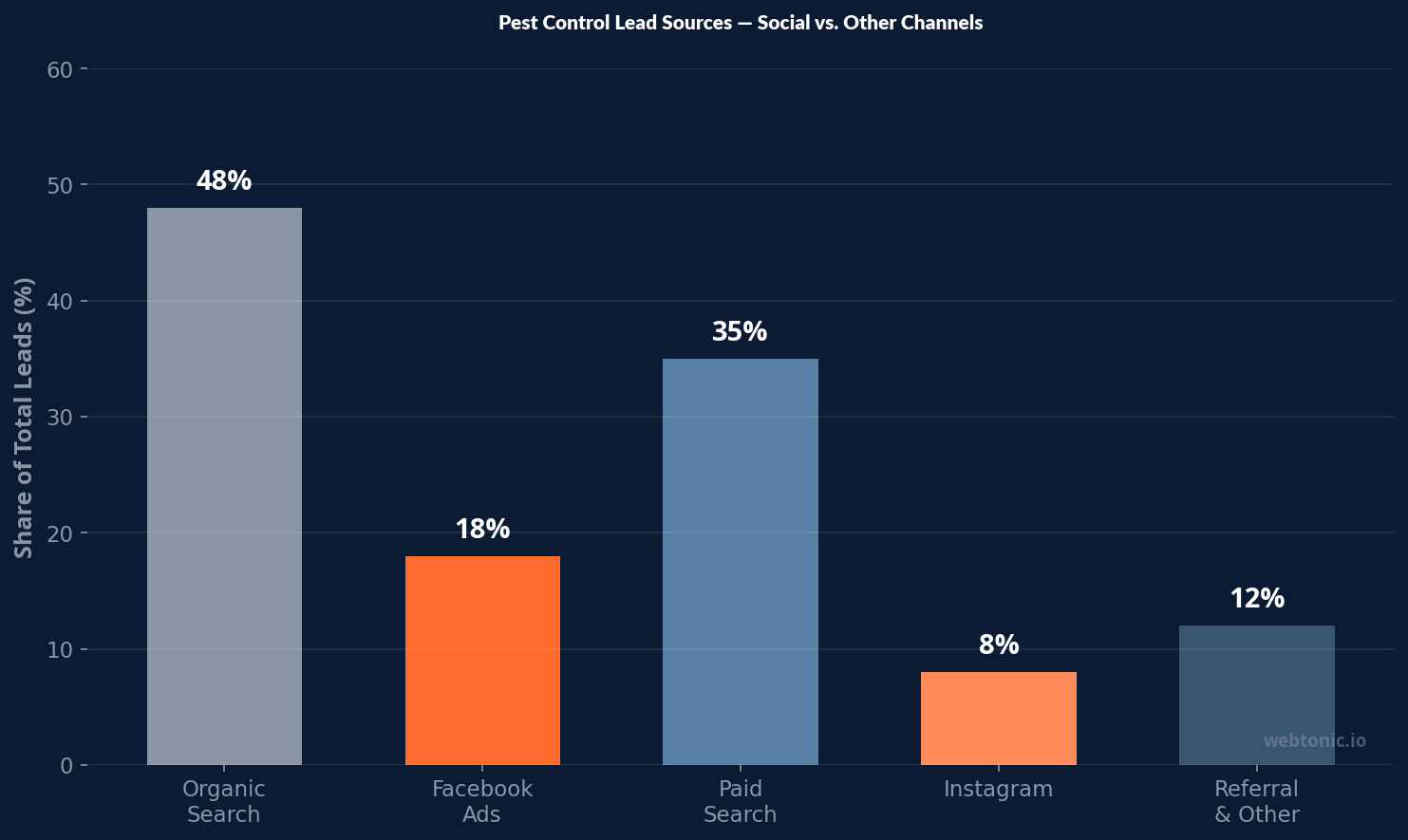
- Facebook ads generate 18% of all pest control leads, making it the largest social channel for direct lead acquisition in the industry (MarketingLTB, 2026).
- 86% of pest control operators underuse paid social ads — 53% barely use them and 33% skip them entirely, creating a wide competitive gap for active advertisers (PCT Magazine/ResultCalls, 2025).
- Facebook ads cost $0.83 per click compared to $4.22 on Google Ads, delivering 5× lower acquisition costs for top-of-funnel brand awareness campaigns (ResultCalls, 2026).
- Pest Badger generates 4.5 million views every 28 days across TikTok, YouTube, and Instagram with organic content, proving the scale achievable through consistent pest-focused video publishing (PestControlMillionaires, 2026).
- Instagram delivers an 18% conversion rate for combined paid and organic content in home services, driven by before/after treatment visuals and time-lapse formats (ResultCalls, 2026).
- Companies using strategic social approaches see website traffic increase 78% and lead generation improve 30%–50% compared with operators without a social presence (ResultCalls, 2026).
Platform Performance Benchmarks
Not all platforms deliver equally for pest control businesses. Facebook remains the dominant social channel, reaching 78% of homeowners and driving the largest share of social-originated leads. Instagram, TikTok, and YouTube each serve distinct roles in the customer acquisition funnel. The table below compares performance benchmarks across the major platforms.
| Platform | Key Benchmark | Best Use Case |
|---|---|---|
| 18% of leads; $0.83 CPC; 78% of homeowners | Local targeting, lead forms, community trust | |
| 18% conv. rate; 30% lower engagement vs. FB | Before/after visuals, time-lapses, Stories | |
| TikTok | Fastest follower growth; 10M+ view potential | Viral pest footage, educational clips |
| YouTube | Long-form authority; subscriber loyalty | Tutorials, identification guides, brand building |
| Google Business Profile | 68% of leads from local search | Reviews, photos, weekly posts (bridge channel) |
Sources: MarketingLTB, 2026; ResultCalls, 2026.
Instagram engagement runs 30% lower than Facebook for pest control specifically, though its visual format excels for showcasing treatment results. Before/after photos and treatment time-lapses generate the highest engagement rates across both platforms, significantly outperforming stock imagery or generic promotional posts (ContentWorks, 2025).
The 86% Competitive Gap in Paid Social
One of the most striking findings in pest control social data is the massive gap in paid ad adoption. A May 2025 PCT Magazine poll found that 53% of pest control operators barely use paid social ads and another 33% do not use them at all. That means 86% of competitors are missing a significant lead generation channel — creating an outsized advantage for the 14% who invest in it strategically (ResultCalls, 2026).
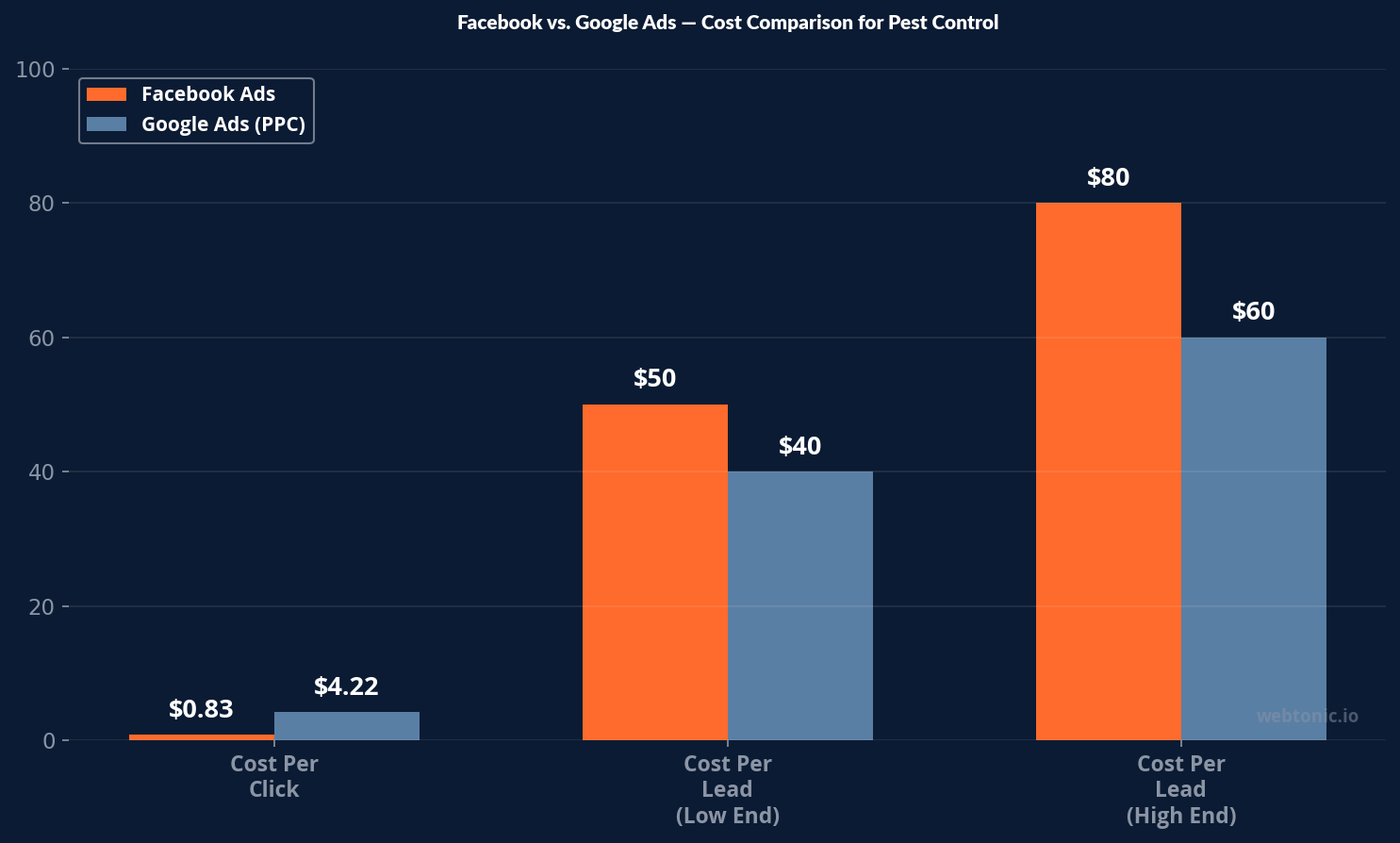
For operators entering this space, the cost advantage is substantial. Facebook ads average $0.83 per click compared to Google Ads at $4.22 per click — a 5× cost difference for initial engagement. While search ads capture higher-intent prospects, social ads build brand awareness and top-of-funnel consideration at a fraction of the cost, particularly during the months preceding seasonal pest surges when awareness-stage investment compounds into peak-season conversions.
Meta advertising for pest control carries average cost-per-lead benchmarks of $50–$80+, higher than search channels but serving primarily brand-building and retargeting functions. Lead form ads on Facebook achieve 3× the conversion rate compared with landing page redirects for pest control campaigns, reducing friction for mobile users who discover services through their news feed (Cube Creative, 2026).
Organic Content That Drives Results
Paid ads drive immediate leads, but organic content builds the trust foundation that makes paid campaigns more effective over time. 75% of consumers always or regularly read online reviews and social feeds before hiring a local tradesperson (ContentWorks/BrightLocal, 2025). A well-maintained social presence with recent job photos tells the same story as a strong review average — it shows the company is active, local, and performing real work.
| Content Type | Engagement Level | Lead Impact |
|---|---|---|
| Before/after treatment photos | Highest | Builds trust, drives shares to neighbors |
| Seasonal pest warnings/tips | High | Positions brand before emergencies happen |
| Real job footage (video) | High | Proves expertise, goes viral locally |
| Pest identification guides | Medium-High | Educational authority, long shelf life |
| Customer review spotlights | Medium | Social proof reinforcement |
| Price transparency posts | Medium | Reduces friction, attracts budget-conscious leads |
| Promotional offers | Low-Medium | Short-term spikes, minimal brand building |
A consistent three-post-per-week rhythm is recommended for small pest control businesses: one seasonal tip (Monday), one job footage post (Wednesday), and one review spotlight or pricing post (Friday). This cadence balances visibility with sustainability for operators without dedicated content teams (ContentWorks, 2025).
Case Study — Pest Badger: From Zero to 4.5 Million Monthly Views
Jonas Olson, CEO of Pest Badger (a $10 million pest control company), built his brand to 140,000 YouTube subscribers, 60,000 Instagram followers, and millions of TikTok views through organic content alone. In a recent 28-day period, Pest Badger's content generated 4.5 million views across all platforms — without paid advertising spend (PestControlMillionaires, 2026).
Key lessons from the Pest Badger content approach:
- Volume and consistency matter most — the company posts 5+ times per week with short-form content and 2–3 times weekly with long-form video.
- Start with Facebook for geographically targeted local reach — its older homeowner demographic matches the pest control buyer profile better than any other platform.
- TikTok offers the fastest growth trajectory — the algorithm rewards new creators who post consistently, enabling a path from zero to thousands of followers in weeks.
- Real pest footage outperforms polished production — authentic field work resonates with audiences and builds credibility that scripted ads cannot replicate.
Orkin's TikTok strategy reinforces these patterns at enterprise scale. By featuring relatable Orkin Pros in educational TikTok videos, the company gained 15,000 followers and 7.5 million total video views, achieving a 20% lift in brand awareness with their core demographic. Orkin's #BugWeek campaign placed the brand in the top 5% of TikTok creators during its activation period (Acadia/Orkin, 2023).
Industry Adoption and Tool Usage
Social and content management tool adoption continues to grow across home service businesses. According to Scorpion's 2026 survey, 67% of home services companies use social and content management tools, 57% use email platforms, and 47% use AI tools for content creation, chat, and analytics (Click-Vision, 2026).
Direct messaging is emerging as a key conversion channel: 32% of home services businesses say direct messages are their top-performing CTA, rising to 43% for plumbing businesses. For pest control companies, enabling and monitoring DMs across Facebook, Instagram, and Google Business Profile creates a low-friction entry point for prospects who discover the brand through content but prefer messaging over phone calls.
The broader industry context supports continued investment. The pest control market reached $24.6 billion in 2022 and is projected to hit $42.5 billion by 2032. With 97% of consumers searching online for local services and 45% finding home service providers through social channels, the intersection of a growing market and expanding digital discovery makes social investment increasingly essential (ResultCalls, 2026). Operators ready to invest can explore our growth-oriented strategies that integrate paid and organic approaches.
Social Advertising Cost Benchmarks
| Metric | Facebook/Instagram | Google Ads (Comparison) |
|---|---|---|
| Cost per click | $0.83 | $4.22 |
| Cost per lead | $50–$80+ | $40–$60 (PPC); $15–$55 (LSA) |
| Lead form conversion rate | 3× higher than landing page | 7.33% (search) |
| Homeowner reach | 78% of homeowners on Facebook | Intent-based only |
| Best for | Brand awareness, retargeting | High-intent capture |
Sources: ResultCalls, 2026; Cube Creative, 2026; BaaDigi, 2026.
For companies benchmarking their ad costs against the industry, our Facebook Ads pricing guide provides additional context on budgeting and bid optimization strategies that apply directly to pest control campaigns. Understanding whether Facebook ads deliver ROI for service businesses is a critical first step.
Seasonal Timing and Content Calendar Optimization
Social performance for pest control businesses follows predictable seasonal patterns that smart operators use to maximize reach and engagement. Spring campaigns (March–May) targeting termite swarms, ant invasions, and mosquito emergence capture the highest-intent audience windows. Summer (June–August) drives peak social engagement as homeowners deal with active infestations, while fall content around rodent prevention and winter-proofing generates strong engagement as temperatures drop.
The most effective pest control companies plan their social content calendars 4–6 weeks ahead of seasonal demand peaks. This lead time ensures posts gain algorithmic momentum before search volume spikes, creating a compounding effect where organic reach accelerates precisely when consumer intent is highest. A company posting mosquito prevention tips in late February will have established authority and follower trust by the time peak mosquito season hits in May, positioning their paid campaigns for lower costs and higher conversions.
Video content timed to seasonal events consistently outperforms static posts. 86% of marketers report that video generates strong ROI, and pest control brands leveraging short-form video (15–60 seconds) for seasonal pest alerts and treatment demonstrations see 2–3× higher engagement rates than image-only posts. Platforms like TikTok and Instagram Reels reward this format with amplified algorithmic distribution, creating organic reach that supplements paid advertising budgets.
Measuring Social ROI for Pest Control
Attributing revenue to social channels remains a challenge for many pest control operators. Without proper tracking, ROI determination is impossible — and many operators lack the analytics tools needed to connect social engagement to booked jobs. Companies that implement UTM parameters, call tracking numbers, and dedicated landing pages for social campaigns gain clear visibility into which platforms and content types drive actual revenue.
The recommended approach combines leading indicators (reach, engagement rate, click-through rate) with lagging indicators (leads, booked jobs, revenue). Social campaigns often influence customers across multiple touchpoints before a booking — a homeowner might see a pest prevention tip in March, follow the company in April, see a retargeting ad in May, and call during a June ant problem. Single-touch attribution dramatically undervalues social contribution. Multi-touch models that credit the first awareness touchpoint typically show social channels contributing 2–3× more value than last-click attribution suggests. Brands using data intelligence tools to track the full customer journey gain the clearest picture of social channel contribution.
Frequently Asked Questions
What is the best social platform for pest control businesses?
Facebook is the most effective platform for most pest control companies, delivering 18% of total leads and reaching 78% of homeowners. Its geographic targeting capabilities make it uniquely suited for local service businesses. TikTok offers the fastest organic growth for companies willing to produce regular video content, while Instagram excels for visual before/after content.
How much do social ads cost for pest control companies?
Facebook ads average $0.83 per click, roughly 5× cheaper than Google Ads at $4.22 per click. Cost per lead through Meta platforms (Facebook and Instagram) typically ranges from $50 to $80+, higher than Local Services Ads ($15–$55) but serving brand awareness and retargeting functions that search ads cannot replicate.
Do pest control companies actually get leads from social channels?
Yes. Facebook ads alone generate 18% of pest control leads, and companies with strategic social presence see 78% higher website traffic and 30%–50% more leads. However, 86% of operators underuse or skip paid social entirely, meaning the companies that do invest face significantly less competition than on search platforms.
How often should a pest control company post on social channels?
Three posts per week is a sustainable cadence for small operators: one seasonal tip, one real job footage post, and one review or pricing transparency post. High-growth operators like Pest Badger post 5+ times weekly with short-form content and 2–3 times with long-form video, generating 4.5 million monthly views across platforms.
What type of content performs best for pest control on social platforms?
Before/after treatment photos and real job footage videos generate the highest engagement and sharing rates. Seasonal pest prevention tips build awareness before emergencies, while pest identification guides establish educational authority. Stock photos and generic promotional content consistently underperform compared with authentic field work documentation. Content featuring professional creative combined with authentic footage delivers the strongest results.
Sources
MarketingLTB — Pest Control Stats 2026
ResultCalls — Pest Control Social Lead Generation
Cube Creative — Pest Control CPL 2026
PestControlMillionaires — Pest Control Social Guide
ContentWorks — Social Posts for Pest Control
Acadia — Orkin TikTok Case Study
Click-Vision — Home Services Stats 2026
BaaDigi — Pest Control Benchmarks 2026
ResidenceRenew — Social Guide 2026


