Table of contents
Pest control service plans cannot be listed in Google Shopping, but registered DIY baits, traps and sprays can, and Google publishes exact image rules for them. This page separates what Google and federal pesticide law require from what no study has yet measured.
Key Takeaways
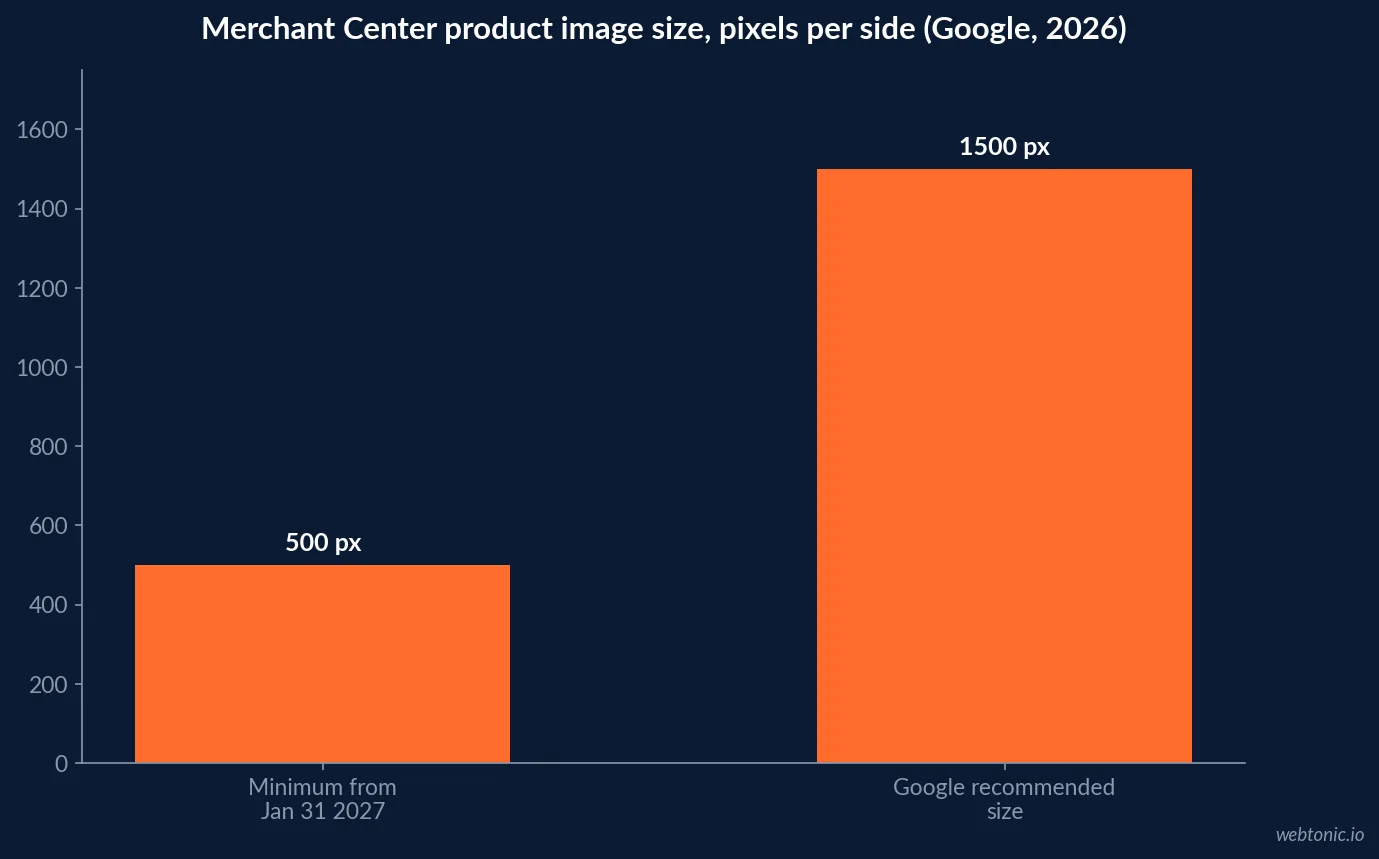
- Google requires product images of at least 500 x 500 pixels from January 31, 2027.
- It recommends around 1500 x 1500 pixels for best performance in all formats.
- Image files are capped at 64 megapixels and 16MB.
- Products with more than 10% sodium nitrite are not allowed; Google lists pesticides as an example.
- US pest control service revenue reached USD 13.416 billion in 2025, up 6% (NPMA).
- 81.4% of the 16,565 firms run one or two locations.
- Recurring work was 85.4% of residential service revenue.
- 51.6% of operators named ants as the top callback pest; cockroaches 42.6%.
- Performance Max held 62% of retailer Google shopping spend in Q4 2025 (Tinuiti).
What the headline can and cannot mean
The title of this page talks about visual overhauls and visibility, so it is worth being precise. No public dataset measures a Shopping visibility gain for pest control listings after an image upgrade. What exists is Google's own statement that larger images are recommended "to ensure best performance in all listing formats," and a hard minimum coming in 2027. Everything below is either a published rule or a named industry figure.
The eligibility line comes first. Google's Unsupported Shopping content policy excludes "labor, time, effort, expertise, or actions, which do not result in ownership of a tangible product," including "any services sold bundled with physical goods." A quarterly treatment plan that ships a bait station is still a service.
| Pest offer | Shopping status | Governing rule | Google route |
|---|---|---|---|
| Recurring residential plan | Not eligible | Service, unsupported content | Local Services, Search |
| Termite inspection | Not eligible | Service, unsupported content | Local Services, Search |
| Plan bundled with bait stations | Not eligible | Services bundled with goods | Search |
| Registered ant bait | Eligible if compliant | FIFRA registration and label | Shopping, free listings |
| Snap traps and glue boards | Eligible | Physical product | Shopping, local inventory |
The service business behind the product shelf
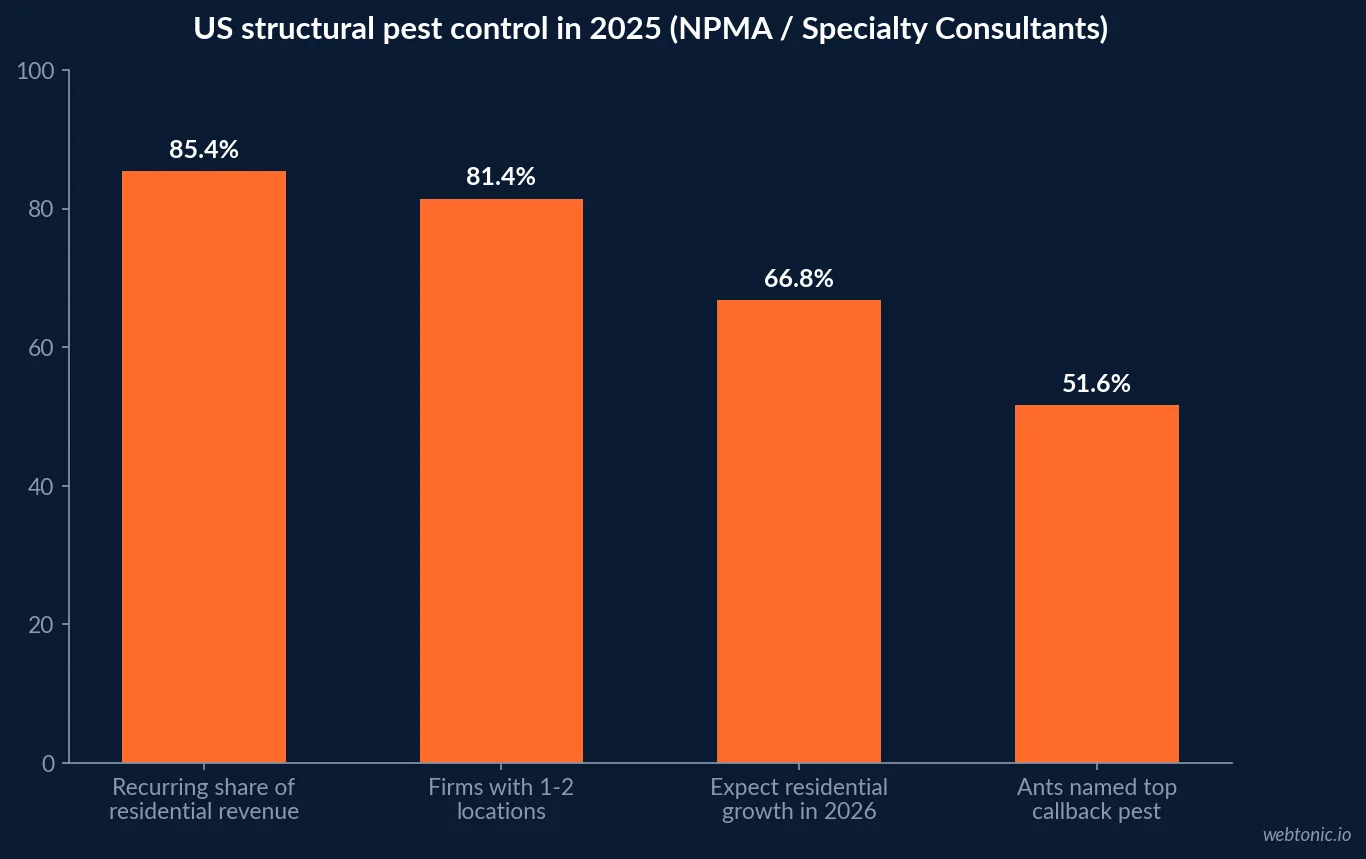
The National Pest Management Association, citing Specialty Consultants' 26th annual analysis, reports 2025 US structural pest control service revenue of USD 13.416 billion, up 6% from USD 12.654 billion. There were 16,565 firms, with 81.4% running one or two locations, an estimated 109,384 service technicians, and 13.29 million residential customers.
Recurring revenue was 85.4% of residential service revenue, 36.8% of respondents said technician shortages constrained growth, and 66.8% expected residential revenue to grow in 2026. Commercial service revenue rose nearly 7.0%. None of it is product revenue a feed could carry, which is why most operators will meet Shopping only through a retail side line or a manufacturer partner.
| NPMA 2025 figure | Value | What it tells a Shopping planner |
|---|---|---|
| Service revenue | USD 13.416 billion, +6% | The market is services, not SKUs |
| Firms | 16,565 | Few have a retail catalog |
| Firms with 1-2 locations | 81.4% | Local inventory needs a walk-in store |
| Residential customers | 13.29 million | DIY buyers overlap with this base |
| Top callback pests | Ants 51.6%, cockroaches 42.6% | Product lines DIY searchers look for |
Federal pesticide law comes before any feed
The EPA explains that FIFRA "requires all pesticides sold or distributed in the United States (including imported pesticides) to be registered by EPA," and that "label directions control how products are used." The statute itself, 7 USC 136j, makes it unlawful to distribute or sell an unregistered pesticide, or a registered one "if any claims made for it as a part of its distribution or sale substantially differ" from its registration.
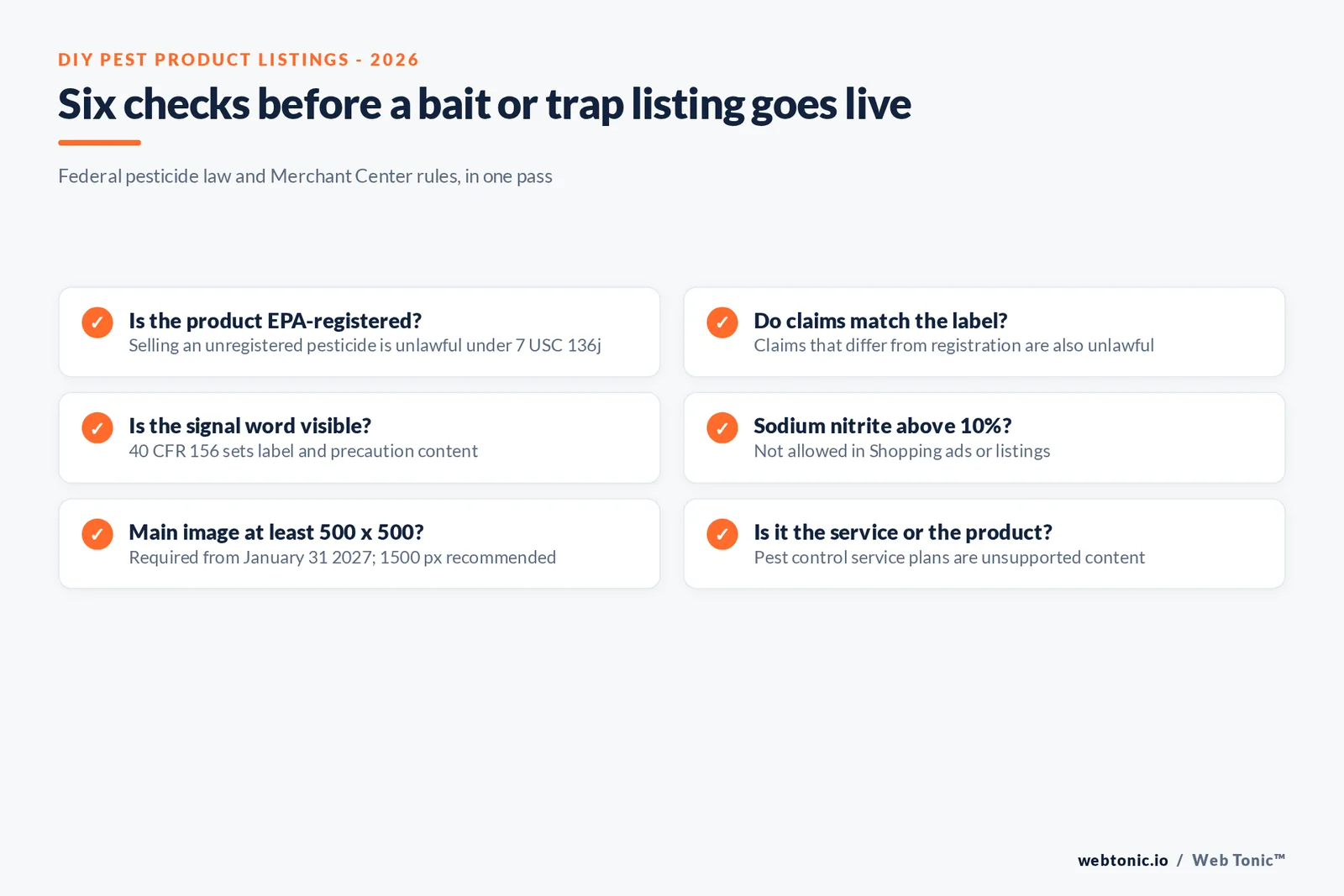
That second clause reaches the feed. A product title or description is a claim made as part of sale, so "kills every termite" on a listing whose label says otherwise is a legal problem, not just a disapproval risk. Label content is set by 40 CFR Part 156, which covers the signal word, child hazard warning, first aid and precautionary statements.
EPA also notes that certification and training are required for applicators of restricted use pesticides, and that states can authorise products for special local needs. Both points argue for a state-by-state check before a listing is targeted nationally: a product a licensed technician may apply in one state is not automatically a product a consumer can buy online everywhere. Building that check into the feed as an exclusion rule, rather than a manual review, keeps new SKUs from going live before someone has looked at the label and the registration record.
| Requirement | Source | Rule | Where it shows in a listing |
|---|---|---|---|
| Registration | FIFRA via EPA | All pesticides sold in the US must be registered | Only registered SKUs enter the feed |
| Claims | 7 USC 136j | Sale claims may not substantially differ from registration | Titles and descriptions |
| Label content | 40 CFR 156 | Signal word, precautionary statements, first aid | Label image and description |
| Sodium nitrite | Google dangerous products | More than 10% not allowed | Rodenticide SKUs |
| Hazardous materials | Google local legal requirements | Safety restrictions may apply | Shipping and listing checks |
Google's own product restrictions for pest SKUs
Google's dangerous products policy says products "with a concentration of more than 10% sodium nitrite are not allowed," and its examples include "sodium nitrite for industrial use, chemical laboratory reagents, heat transfer salts, pesticides, lubricants." Its local legal requirements and safety standards page adds that Google has "safety restrictions around the sale of hazardous materials" and may disapprove items that violate health and safety standards.
The practical step is a SKU-level screen before upload: registration status, active ingredient and concentration, and any state restrictions on sale. That screen is also where restricted-use products, which require certified applicators, are removed from consumer listings.
The visual rules Google actually publishes
Google's image link specification announces "new image size requirements of at least 500 x 500 pixels for all products beginning January 31, 2027," recommends images "1500x1500 pixels or above," and caps files at 64 megapixels and 16MB. It also supports a separate lifestyle image attribute for in-use shots, which suits a trap photographed in place under a sink while the main image stays a clean product shot.
For the organic side, Google Search Central's image best practices advise descriptive filenames, titles and alt text, and placing images near relevant text; its example prefers "my-new-black-kitten.jpg" to "IMG00023.JPG". A bait photographed with its label panel legible serves both the buyer and the policy reviewer.
| Image rule | Figure | Status | Pest listing application |
|---|---|---|---|
| Minimum size, all products | 500 x 500 px | From January 31, 2027 | Re-shoot small legacy packshots |
| Recommended size | 1500 x 1500 px or above | Recommendation | Label text legible on zoom |
| Maximum resolution | 64 megapixels | Requirement | Export, do not upload raw files |
| Maximum file size | 16MB | Requirement | Compress before upload |
| Lifestyle image | Separate attribute | Optional | Trap or station shown in place |
Local inventory: the route for operators with a counter
Some pest operators and farm-and-garden stores sell DIY products over a counter. Google's local inventory ads policy covers retailers with physical stores in 47 countries, requires a location where customers can "physically visit, view, and purchase the desired item," and waives the online checkout and shipping requirements because the sale happens in store. It excludes stores that restrict purchases to members.
That fits the NPMA profile only partly. With 81.4% of firms running one or two locations, most operators are service depots rather than shops, and a depot customers cannot walk into does not meet the brick-and-mortar test. For those firms the realistic product route is a manufacturer or retailer partner, while the firm's own Google budget stays on Local Services and Search. Our Google Ads team sets up that split when an operator does have a retail line.
| Local inventory rule | Google wording or figure | Pest operator reality |
|---|---|---|
| Countries covered | 47 listed markets | US and Canada included |
| Physical location | Customers can visit, view and purchase | Service depots usually do not qualify |
| Online checkout | Not required | Counter sales are enough |
| Shipping details | Not required | Pick-up in store |
| Membership-only buying | Ineligible | Contract-customer-only pricing needs a public price |
Retail context: who DIY listings compete with
Tinuiti's Q4 2025 benchmark, based on its retail client base, reports Google shopping ad spending up 16% year over year, CPC down 1%, and Performance Max at 62% of retailer shopping spend, with Amazon absent from nearly all US Google shopping auctions since July 2025. The Census Bureau estimates Q2 2026 e-commerce at USD 340.2 billion, or 17.1% of retail. These are cross-retail numbers; no source publishes a pest-product Shopping click-through or conversion rate.
Where the service side goes instead
Google's Local Services category list includes Pest control services, and the format is billed when "a customer gets in touch from your ad." Search and Performance Max without a feed cover the rest. For channel budgets, see our Google Ads cost guide; for awareness formats, the pest control CTV report; and for product photography and ad assets, our performance creative team.
A listing overhaul checklist that stays within the evidence
- Remove services: no plans, inspections or bundles in the feed.
- Confirm registration: every pesticide SKU registered, claims matching the label.
- Screen ingredients: nothing above 10% sodium nitrite; restricted-use products out.
- Re-shoot images: at least 500 x 500, ideally around 1500 x 1500, label legible.
- Add lifestyle shots: use the separate attribute rather than replacing the main image.
- Measure yourself: compare impressions and clicks before and after in your own account, since no public benchmark exists.
Frequently Asked Questions
Can a pest control company advertise its service in Google Shopping?
No. Recurring treatments, inspections and exclusion work are services, and Google's Unsupported Shopping content policy excludes labour, time, effort, expertise or actions that do not result in ownership of a tangible product. Google's Local Services category list includes Pest control services, which is the format built for that side.
Can DIY pest products be sold through Google Shopping?
Physical products such as baits, traps and sprays can be listed if they meet Shopping policies and the law. Under FIFRA, 7 USC 136j makes it unlawful to distribute or sell a pesticide that is not registered, or a registered one whose sale claims substantially differ from its registration. Google's dangerous products policy also bars products with more than 10% sodium nitrite, and names pesticides among its examples.
Do better product images increase Shopping visibility?
No public study measures that for pest products, and this page does not claim a lift. What Google states is a requirement and a recommendation: at least 500 x 500 pixels for all products from January 31, 2027, and around 1500 x 1500 pixels to ensure best performance in all listing formats.
What should a pest product image show?
The product itself, clearly, as the main image. Google's image attribute supports a separate lifestyle image link for in-use shots, and Google Search Central advises descriptive filenames, titles and alt text placed near relevant text. The label panel with the signal word and EPA registration number is part of what buyers and reviewers look for.
How big is the US pest control market?
NPMA reports 2025 structural pest control service revenue of USD 13.416 billion, up 6% from USD 12.654 billion, across 16,565 firms, with 13.29 million residential customers served. That is service revenue; no public figure splits out DIY product sales through Google.
Sources
Google Merchant Center Help - Unsupported Shopping content
Google Merchant Center Help - Dangerous products
Google Merchant Center Help - Local legal requirements and safety standards
Google Merchant Center Help - Image link
Google Merchant Center Help - Local inventory ads policies
Google Local Services Help - Supported categories
Google Search Central - Image SEO best practices
NPMA - US pest control industry grows 6% in 2025
US EPA - About pesticide registration
Cornell LII - 7 USC 136j Unlawful acts
eCFR - 40 CFR Part 156 pesticide labeling
Tinuiti - Digital Ads Benchmark Report Q4 2025
US Census Bureau - Quarterly Retail E-Commerce Sales, Q2 2026