



Table of contents
Key Takeaways
- Facebook ads for home services average $2.45 CPC and $45 CPL in 2026, with pest control operators often achieving lower CPLs through lead form ads (Cube Creative).
- BugShield Defense achieved a $29 cost per lead and 8.4× ROAS from Facebook ads, scaling to 342 monthly leads on a $5,000/month budget (AQuality Pest).
- 139 pest control advertisers ran 623 live ads on Meta platforms in Q2 2026 across the United States (PipelineOn).
- Lead ads with pre-filled forms convert 3× better than traditional landing page ads for pest control campaigns (Cube Creative).
- 96% of home service Facebook advertisers ran no Conversions API (CAPI) alongside their Meta Pixel in Q2 2026 (PipelineOn).
- Seasonal campaigns generate 2× ROI compared to evergreen ads for pest control on social media (MarketingLTB).
- Commercial pest control Meta ads benchmark ROAS sits at 2.5× according to Benchmarketing's Q1 2023–Q4 2024 cohort (Benchmarketing).
Pest Control Facebook Ads Benchmarks at a Glance
| Metric | Industry Benchmark | Source |
|---|---|---|
| CPC (Home Services) | $2.45 | Cube Creative 2026 |
| CPL (Home Services) | $45 | Cube Creative 2026 |
| CPL (BugShield Case Study) | $29 | AQuality Pest |
| Meta Ads CTR (Commercial) | 1.08% | Benchmarketing 2026 |
| Meta Ads ROAS (Commercial) | 2.5× | Benchmarketing 2026 |
| ROAS (BugShield Case Study) | 8.4× | AQuality Pest |
| Active Pest Control Advertisers (Q2 2026) | 139 | PipelineOn Q2 2026 |
| Live Pest Control Ads (Q2 2026) | 623 | PipelineOn Q2 2026 |
Cost Per Lead by Advertising Channel for Pest Control
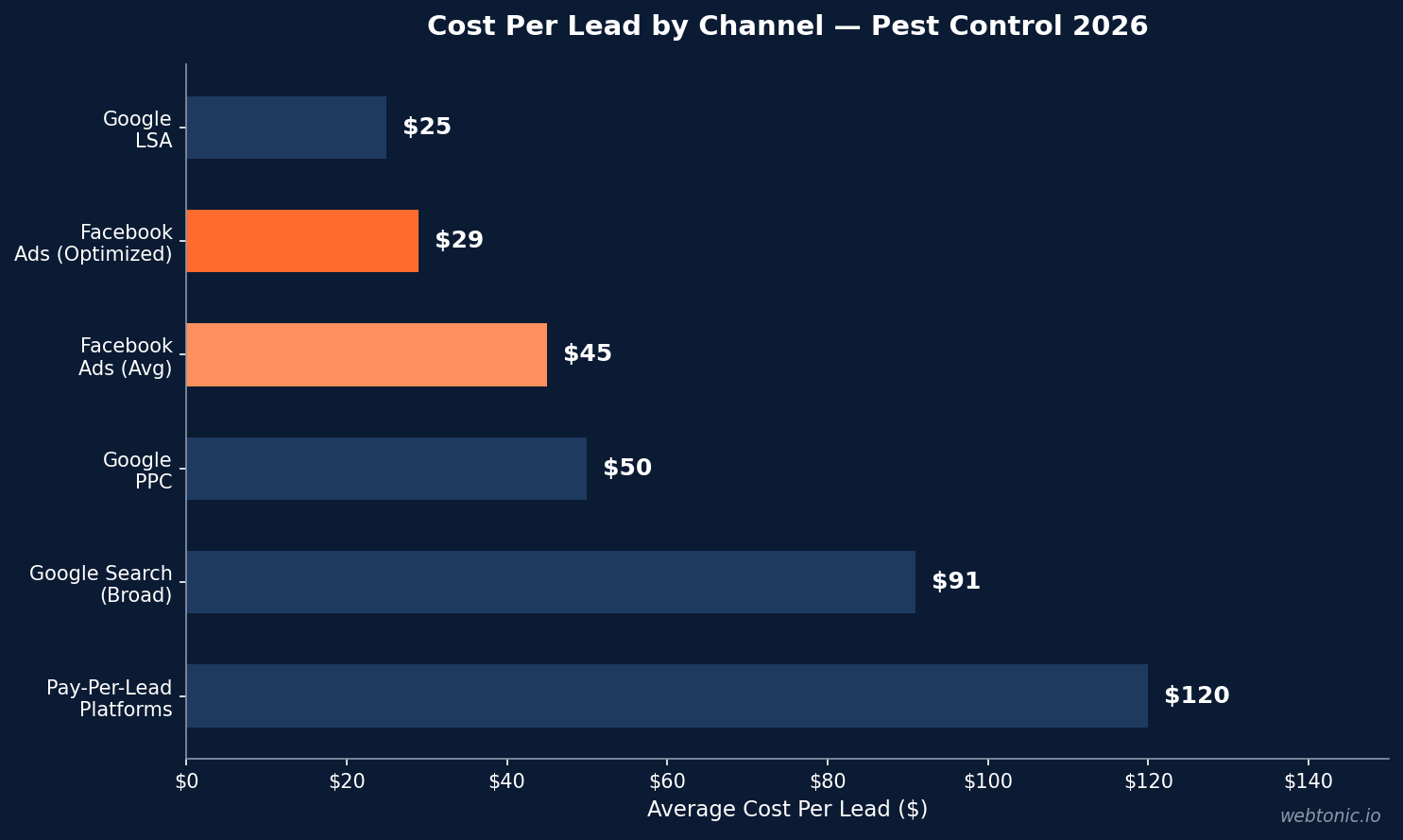
Facebook ads sit at the lower end of the CPL spectrum for pest control when campaigns are optimized with lead form ads and proper audience segmentation. The chart below compares average CPL across channels based on data from Cube Creative and Blue Grid Media.
The Measurement Gap: Most Pest Control Advertisers Fly Blind
PipelineOn's Q2 2026 dataset of 1,222 US home service advertiser-trade rows reveals a stark measurement deficit across Meta advertising. 96% of home service Facebook advertisers were running no Conversions API (CAPI) server-side events alongside their Meta Pixel, and 100% had no anonymous visitor identification or lead recovery tooling on their landing pages (PipelineOn).
For pest control specifically, 139 advertisers ran 623 live ads during Q2 2026. The majority sent traffic to their company home page rather than a dedicated service landing page — a pattern that suppresses conversion rates and inflates cost per lead. Companies with landing page conversion rates of 6–12% (MarketingLTB) outperform those sending paid traffic to generic homepages by 2–4× on CPL.
Creative Strategies That Lower CPL
AQuality Pest's BugShield Defense case study demonstrates the impact of systematic creative testing. After testing 147 ad variations, they identified a winning formula that achieved 3.7% CTR and 14.2% conversion rate on lead forms (AQuality Pest).
The top-performing ad structure follows a hook-problem-solution-proof pattern:
- Hook (0–3 seconds) — Location-specific pest problem visual.
- Problem agitation (3–8 seconds) — Dramatic footage of common infestations.
- Solution (8–12 seconds) — Quick treatment footage with happy customer reaction.
- Social proof (12–15 seconds) — Customer count and satisfaction data.
- Call to action — "Free inspection" or "$49 first treatment" offer.
Before-and-after transformation videos, customer testimonial compilations, and "pest of the month" educational content ranked as the three highest-performing creative categories across the BugShield campaign.
Audience Targeting Architecture for Pest Control
The most successful pest control companies build a three-tier audience architecture on Meta platforms (Cube Creative, AQuality Pest):
| Audience Tier | Strategy | Expected CPL Range |
|---|---|---|
| Prospecting — Broad | Homeowners 25–65, home improvement interests, 1–3% lookalikes | $35–$55 |
| Prospecting — Interest Stack | Pest-related interests layered with homeowner demographics | $30–$45 |
| Retargeting — Warm | Website visitors (180 days), video viewers (25%+), page engagers | $15–$30 |
| Retargeting — Hot | Lead form openers who didn't submit, phone call clickers | $10–$25 |
| Lookalike — Best Customers | 1% lookalike of converted customers or recurring plan holders | $25–$40 |
Facebook Ads vs. Google Ads: Budget Allocation for Pest Control
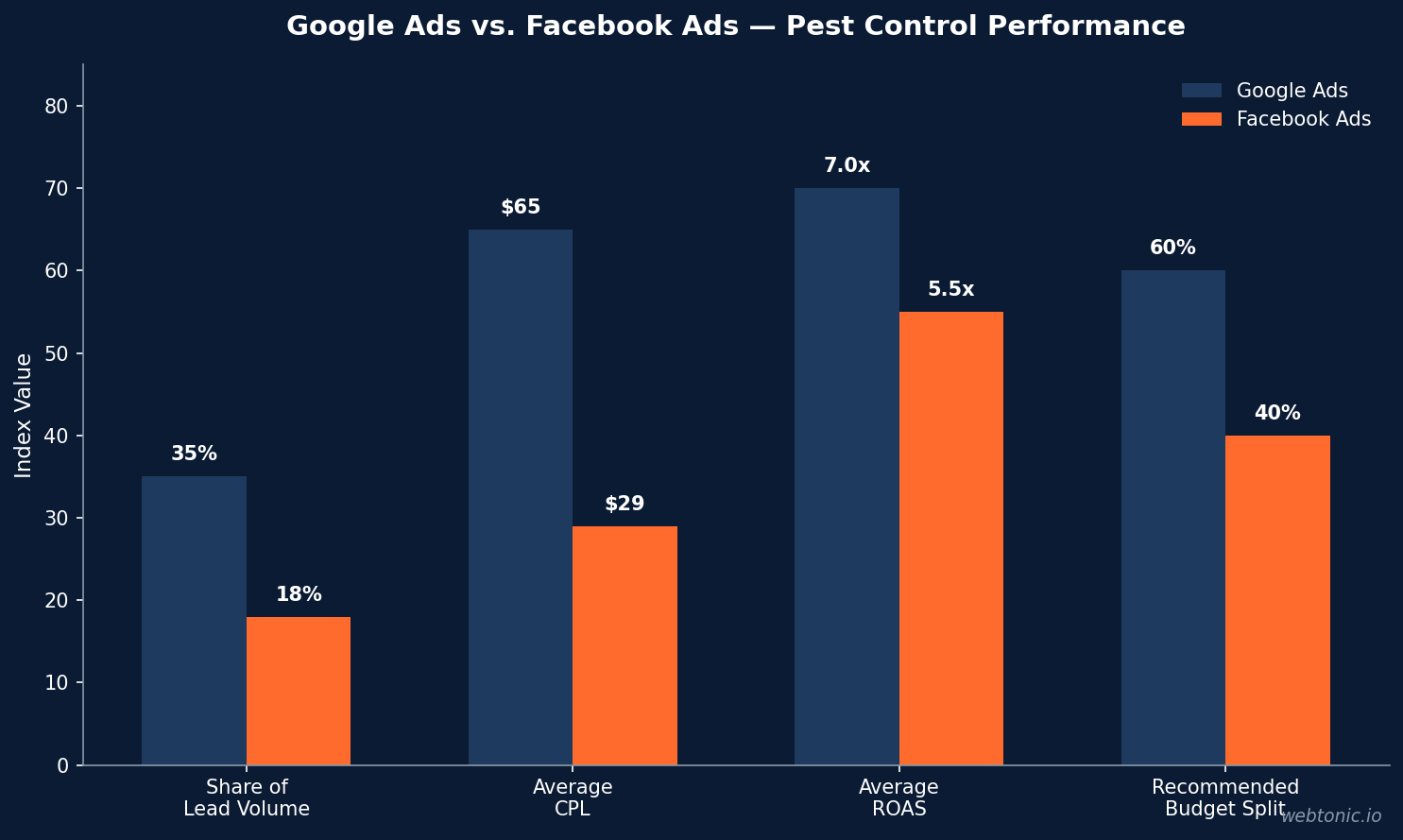
Most successful pest control companies allocate 60% of their advertising budget to Google Ads and 40% to Facebook to capture both high-intent search traffic and awareness-stage homeowners (Cube Creative). The chart below shows how lead volume and cost per lead compare between the two platforms.
Seasonal Ad Spend Patterns and Performance
Seasonal campaigns generate 2× ROI compared to evergreen ads for pest control on social media platforms (MarketingLTB). Seasonal demand spikes increase traffic by up to 40% in summer months, making budget timing a critical lever.
Pest control operators should increase Facebook ad spend 30–60 days before peak pest seasons in their region — termite swarms in March–May, mosquito and tick surges in June–August, rodent migration in October–November. Campaigns launched during peak awareness windows benefit from higher engagement rates and lower CPMs as homeowners actively seek solutions.
Best Practices for Pest Control Facebook Advertising
- Use lead form ads over landing page ads — pre-filled forms convert 3× better and reduce friction for mobile users.
- Install both Meta Pixel and Conversions API (CAPI) — 96% of competitors lack CAPI, giving properly tracked campaigns a significant optimization advantage.
- Send paid traffic to dedicated service landing pages, not your homepage — landing page conversion rates of 6–12% are achievable versus 1–3% on homepages.
- Test at least 3–5 creative variations per ad set before scaling — the BugShield case study tested 147 variants before finding its winner.
- Follow up on leads within 5 minutes — response time is the single largest conversion rate lever after the initial click (MarketingLTB).
- Allocate 60% Google Ads / 40% Facebook for balanced intent capture and awareness building.
- Retarget video viewers at the 25%+ watch threshold — they demonstrate interest without the cost of a website visit.
- Rotate creative every 4–6 weeks to prevent audience fatigue and maintain CTR above 1%.
Common Facebook Advertising Mistakes Pest Control Companies Make
Despite the proven ROI of Facebook advertising for pest control, many operators waste budget through structural and strategic errors. The most damaging mistakes include (Cube Creative, AQuality Pest):
- Sending all traffic to the company homepage — 59% of website-bound HVAC Facebook ads (a comparable home services vertical) sent clicks to the home page rather than a service-specific landing page in Q2 2026 (PipelineOn). This pattern inflates CPL by 2–4× compared to dedicated landing pages converting at 6–12%.
- Running ads without proper Meta Pixel or CAPI implementation — 96% of home service advertisers lack Conversions API, leaving campaigns optimizing on incomplete data. Without server-side event tracking, Meta's algorithm cannot identify high-value conversions accurately.
- Using only one creative per ad set — the BugShield case study tested 147 variations to find its winning formula. Running a single static image without testing video, carousel, or testimonial formats leaves conversion rate improvements undiscovered.
- Neglecting lead response time — 58% of leads are lost due to slow response time (MarketingLTB). Facebook lead form leads go cold within minutes. Companies without automated CRM intake and instant follow-up workflows waste a significant portion of their ad spend.
- Ignoring retargeting entirely — cold prospecting generates leads at $35–$55 CPL, while retargeting warm audiences (website visitors, video viewers, page engagers) drops CPL to $10–$30. Allocating zero budget to retargeting is the most common structural waste.
- Running identical ads year-round — seasonal campaigns generate 2× ROI versus evergreen ads. Pest control operators should align creative and offers with local pest pressure cycles (termite swarms, mosquito surges, rodent migration) rather than running the same ad continuously.
Facebook vs. Instagram Performance for Pest Control
While both platforms run under Meta's advertising system, performance varies meaningfully for pest control. Instagram engagement is 30% lower than Facebook for pest control (MarketingLTB), though Instagram Stories and Reels can deliver lower CPMs for awareness-stage campaigns.
Facebook remains the primary lead generation platform for pest control due to its older demographic (homeowners 35–65 skew heavily toward Facebook), lead form ad infrastructure, and Marketplace integration. Instagram serves best as a complementary branding and retargeting channel, particularly for before-and-after treatment content and community engagement.
The optimal allocation within the Meta ecosystem for most pest control operators: 70–80% of Meta budget on Facebook placements and 20–30% on Instagram, with automatic placement optimization enabled for campaigns that have passed the learning phase.
Scaling Facebook Ads Without Breaking Unit Economics
The BugShield Defense case study illustrates the path from $5,000/month to 342 leads at $29 CPL, but scaling requires discipline. Key scaling principles for pest control Facebook campaigns:
- Increase daily budget by no more than 20% every 3–5 days to avoid resetting the learning phase. Rapid budget increases (50%+ overnight) typically spike CPL by 30–60% during the re-learning period.
- Expand service area radius by 5-mile increments before broadening audience interests. Geographic expansion maintains targeting quality while increasing addressable audience size.
- Add new ad sets rather than inflating budgets on existing ones — duplicate winning ad sets with slight audience variations (different lookalike percentages, new interest layers) to maintain delivery efficiency.
- Monitor frequency metrics closely — when frequency exceeds 2.5–3.0 on a prospecting campaign, creative fatigue sets in and CPL climbs. This is the signal to refresh creative, not increase budget.
- Maintain the 60/40 Google/Facebook split as you scale. Companies that over-index on Facebook beyond 40–50% of total digital spend often see diminishing returns as they exhaust the local homeowner audience.
Lead Quality and Conversion Tracking on Meta Platforms
Generating leads is only half the equation — lead quality determines whether Facebook advertising is profitable for pest control. Key conversion tracking benchmarks and quality indicators include:
- Booked call-to-customer conversion rate sits at 40–50% for pest control leads from Facebook (Cube Creative), meaning roughly half of booked leads become paying customers.
- New customers per month from Facebook — well-optimized campaigns generating 5–7 new customers monthly from a $3,000–$5,000 monthly budget is a realistic benchmark for single-location operators.
- Lead-to-appointment show rate — companies with automated appointment confirmations via SMS and email achieve 75–85% show rates, while those relying on manual follow-up see 50–65%.
- Revenue per lead by source — track whether Facebook leads convert to recurring plans at the same rate as Google Ads leads. Typically, Facebook leads have a 15–25% lower initial plan conversion rate but cost significantly less per lead, making blended ROAS comparable.
The PipelineOn Q2 2026 dataset revealed that 100% of home service Facebook advertisers lacked anonymous visitor identification tooling, meaning the vast majority cannot track the full journey from ad click to booked job to recurring customer. Companies that close this tracking gap gain a substantial competitive advantage in campaign optimization.
Frequently Asked Questions
How much do Facebook ads cost for pest control companies?
Home services Facebook ads averaged $2.45 CPC and $45 CPL in 2026 (Cube Creative). Optimized pest control campaigns using lead form ads and retargeting can achieve CPLs as low as $29, as demonstrated by the BugShield Defense case study that generated 342 leads monthly on a $5,000 budget.
Are Facebook ads worth it for pest control businesses?
Yes — Facebook ads generate approximately 18% of pest control leads (MarketingLTB) and serve as the primary awareness and retargeting channel. The BugShield case study demonstrated 8.4× ROAS, while commercial pest control campaigns average 2.5× ROAS (Benchmarketing). Facebook excels at reaching homeowners before they search on Google.
What types of Facebook ads work best for pest control?
Lead form ads with pre-filled fields outperform landing page ads by 3× for pest control. Video creatives — especially before-and-after treatment footage, customer testimonials, and seasonal pest alerts — generate the highest engagement. The winning creative formula uses a hook-problem-solution-proof sequence of 12–15 seconds.
How should pest control companies target their Facebook ads?
Build a three-tier audience architecture: prospecting campaigns targeting homeowners with interest stacking and 1–3% lookalikes, retargeting campaigns for website visitors and video viewers, and conversion campaigns for lead form openers. Geographic targeting should match your actual service radius with a 10–15 mile buffer for suburbs.
What conversion rate should pest control companies expect from Facebook ads?
Lead form conversion rates of 10–15% are achievable with optimized creative and offers. Landing page conversion rates typically range from 6–12% for pest control (MarketingLTB), though this drops to 1–3% when ads point to generic homepages. Booked-call-to-customer conversion rates sit at 40–50% for pest control (Cube Creative).
Sources
Cube Creative — Facebook Ads for Pest Control Strategy Guide
AQuality Pest — BugShield Defense $29 Facebook Leads Case Study
PipelineOn — Quarterly Home Service Meta Ads Review Q2 2026
Benchmarketing — Commercial Pest Control Marketing Benchmarks 2026
MarketingLTB — Pest Control Marketing Statistics 2026
FieldPie — Pest Control Facebook Ads in 2026
Web Tonic — Meta Ads Services
Web Tonic — Performance Creative
Web Tonic — Are Facebook Ads Worth It?
Web Tonic — How Much Do Facebook Ads Cost?
Web Tonic — Contact


