Table of contents
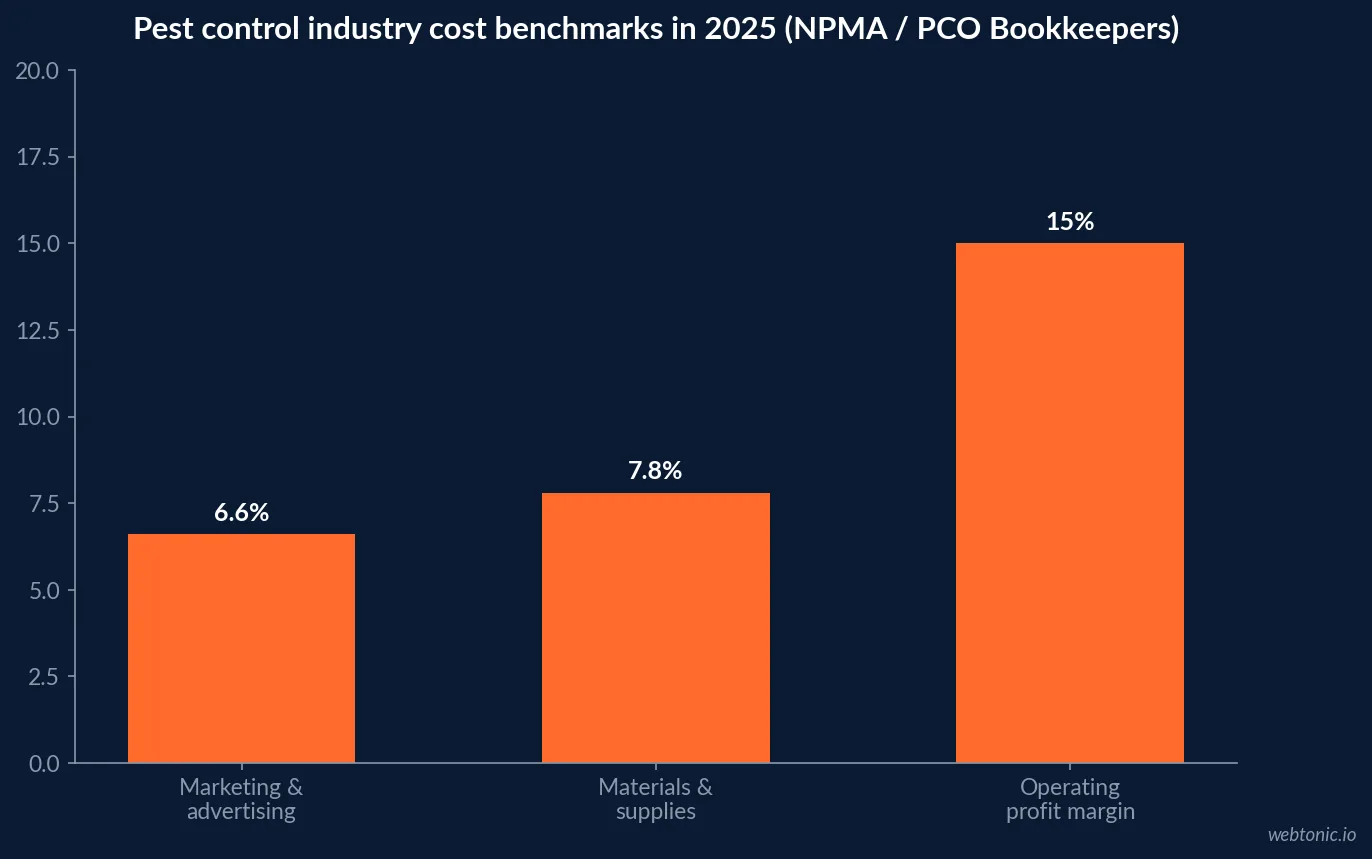
Pest control has no consumer affiliate network to speak of - it has referral-partner programs and paid lead marketplaces doing the same economic job. NPMA's own 2025 cost study puts marketing and advertising investment at 6.6% of revenue industry-wide; this page prices the two channels that actually deliver a job in this trade against that backdrop, using programs' own published terms rather than a borrowed e-commerce affiliate number.
Key Takeaways
- Pest control firms spend 6.6% of revenue on marketing, per NPMA's 2025 cost study.
- Materials and supplies cost 7.8% of revenue, the next-largest line item.
- Average operating profit margin runs 15% industry-wide.
- Industry revenue grew 9.5% year over year in the same 2025 study.
- 74% of total income is now recurring revenue, the base referrals compound against.
- One realtor referral program pays USD 250 per referral after a partner's tenth referral.
- Another referral-partner structure pays 10% of net revenue from the referred client's first year.
- Some pest control brands pay no cash for referrals at all, relying on service quality instead.
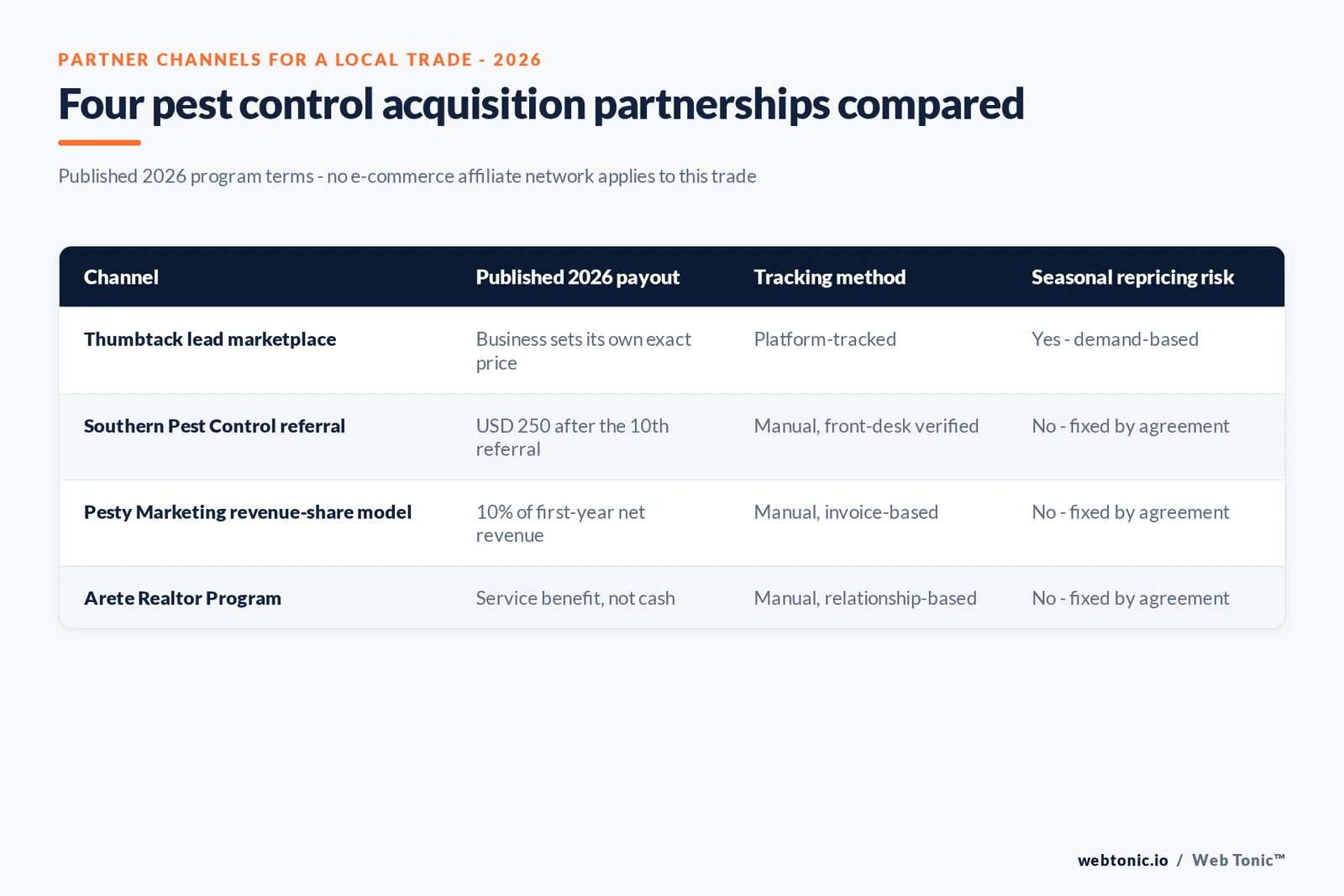
- Thumbtack lets each business set its own exact lead price per service, with no single national rate card.
- 43% of advertisers, cross-vertical, increased affiliate/partner spend in the past year (IAB Australia 2025).
- 59% plan to increase that spend further next year.
- 51% of advertisers manage partner programs in-house, ahead of agency (26%) and network (19%) management.
- CPA is the dominant advertiser payment model at 74%, ahead of tenancy fees.
Why "affiliate marketing" means something different here
Affiliate marketing, as networks like Awin and Impact.com run it, prices a tracked click-to-purchase for a product. Pest control sells a scheduled, appointment-based, often-recurring local service with no cart to click into. The channel doing affiliate marketing's economic job in this trade is a referral-partner program - realtors, property managers, other trades - plus paid lead marketplaces that charge per delivered contact. Framing it honestly here means pricing those two, not forcing an e-commerce commission model onto a doorbell-and-truck business.
The industry cost backdrop a partner program has to fit inside
| Metric (2025 data) | Figure | Source |
|---|---|---|
| Marketing and advertising spend | 6.6% of revenue | NPMA / PCO Bookkeepers Cost Study 2025 |
| Materials and supplies cost | 7.8% of revenue | NPMA / PCO Bookkeepers Cost Study 2025 |
| Average operating profit margin | 15% | NPMA / PCO Bookkeepers Cost Study 2025 |
| Year-over-year revenue growth | 9.5% | NPMA / PCO Bookkeepers Cost Study 2025 |
| Share of income that is recurring | 74% | NPMA / PCO Bookkeepers Cost Study 2025 |
What realtor and referral-partner programs actually pay
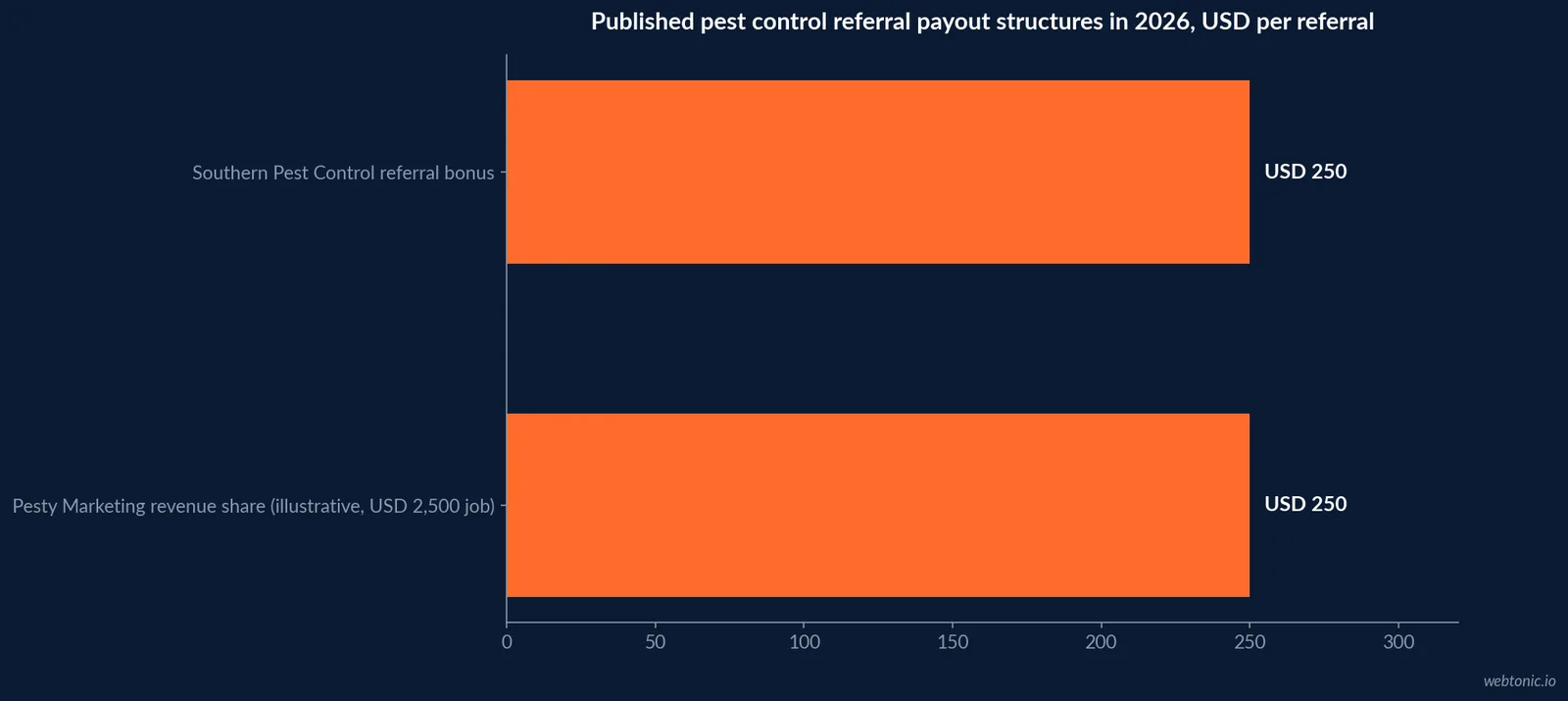
Terms are set by the individual operator, not a network, and they vary widely. One regional operator's own referral program pays USD 250 per referral once a partner passes their tenth referral that converts to a client. A referral-partner program example built for pest control operators structures the payout as 10% of net revenue from the referred client during their first year. Other operators, such as Firehouse Pest Control's own referral page, state explicitly that they do not pay referral fees at all, relying instead on service quality and reputation to earn the next referral. Realtor-specific programs, like Arete Pest Control's Realtor Program, position the payoff as smoother WDI inspections and closings rather than a cash commission at all.
| Program (own page, 2026) | Payout structure | Partner type |
|---|---|---|
| Southern Pest Control | USD 250 per referral after the 10th | Existing residential clients |
| Pesty Marketing referral-partner model | 10% of net revenue, year one | Referral partners generally |
| Firehouse Pest Control | No cash referral fee | Any referral source |
| Arete Pest Control Realtor Program | Service benefit, not commission | Realtors and property managers |
| Terminix Partnership Referral Program | Service discounts for referrers | Existing clients |
What a lead marketplace charges instead
Where a realtor referral is a relationship, a lead marketplace is a transaction. Thumbtack's own help documentation confirms its model is pro-set: a business chooses the exact price it wants to pay for a lead or opportunity in each service category it lists, and that is the exact amount charged - Thumbtack does not publish one fixed national rate per trade. That structure means two pest control companies in the same metro can be paying entirely different lead prices for the identical search, based only on what each set their own price to.
Cross-vertical partnership spend, for context
No pest-control-specific affiliate spend survey exists, so the honest comparison point is IAB Australia's 2025 Affiliate & Partnership Marketing Industry Review: 43% of advertisers increased partner spend over the past year and 59% plan further increases, with CPA the dominant payment model at 74% of advertisers. Pest control's referral programs above are closer to a flat bonus or a revenue-share model than a CPA click-to-purchase, which is the structural mismatch that makes borrowing an e-commerce affiliate benchmark misleading for this trade. Only 19% of advertisers in that same survey route their partnership programs through a network at all - the model closest to a classic affiliate relationship.
| Cross-vertical benchmark (2025, IAB Australia) | Figure |
|---|---|
| Advertisers who increased partner spend last year | 43% |
| Advertisers planning further increases | 59% |
| Advertisers using CPA payment model | 74% |
| Advertisers managing programs in-house | 51% |
| Advertisers managing programs via agency | 26% |
| Advertisers managing programs via network | 19% |
Manufacturer and franchise dealer programs: a smaller lever here
Unlike roofing or HVAC, pest control has no equivalent to a GAF or Carrier certified-dealer network driving consumer-facing leads, because most pest control chemistries are commodity-registered rather than brand-marketed to homeowners. The nearest equivalent is franchise-level co-op marketing inside national brands like Orkin and Terminix, which is a franchise-agreement structure, not an open affiliate program a third party can join - worth naming so operators do not go looking for a dealer program that does not exist in this category.
Building the budget line correctly
With marketing already running at 6.6% of revenue and materials costs close behind at 7.8%, a pest control operator has little room to run an undifferentiated "partnerships" budget. The workable split is three lines: paid lead marketplaces priced per Thumbtack-style set pricing, a referral-partner program priced either as a flat per-referral bonus or a capped first-year revenue share, and organic realtor/property-manager relationships that may carry no cash cost at all. Our growth marketing practice builds that three-line budget rather than one blended spend number, and see our affiliate marketing statistics hub for how CPA-based programs price in categories that do have a click-to-purchase product. Talk to us about structuring the referral side of a pest control acquisition budget.
FTC disclosure still applies to a paid realtor or influencer post
A cash-per-referral realtor program, like Southern Pest Control's USD 250 structure, is a paid endorsement the moment a realtor promotes the company to their own clients or on social media in exchange for that payment - which means the FTC's 16 CFR Part 255 Endorsement Guides apply the same way they would to a beauty influencer's promo code. A local Facebook post from a paid referral partner that does not disclose the payment is exposed to the same enforcement risk as an undisclosed affiliate link, regardless of how small or local the audience is.
| Referral relationship | Cash changes hands? | FTC disclosure required? |
|---|---|---|
| Southern Pest Control's USD 250 client referral | Yes, after 10th referral | Yes, if promoted publicly for pay |
| Pesty Marketing 10% revenue-share partner | Yes, ongoing | Yes, if promoted publicly for pay |
| Arete Realtor Program | No cash, service benefit | Lower risk, still disclose material connection |
| Firehouse Pest Control (no referral fee) | No | Not applicable |
Seasonal demand changes what a lead is worth
Pest pressure is seasonal in most US markets - spring and summer termite swarms, fall rodent intrusion - which means a Thumbtack-style set lead price that looked competitive in February can be underpriced by June, when more operators are bidding for the same volume of urgent calls. A referral partner relationship does not have that same seasonal repricing problem, because the payout is fixed by agreement rather than by real-time marketplace demand - one more reason the two channels need separate budget logic rather than a shared "lead cost" assumption. With 74% of income already recurring per NPMA's own figures, a well-run referral partner base compounds through the off-season in a way a marketplace lead spend spike cannot.
Frequently Asked Questions
Does pest control have a real affiliate marketing channel?
Not in the consumer-affiliate-network sense. Pest control is a local, appointment-based service with no product to click-and-buy, so the channel that does the same job is a referral-partner program - realtors, property managers and other trades sending a lead - plus paid lead marketplaces like Thumbtack that charge per delivered job rather than per commission. Both function like affiliate marketing economically: a third party is paid for delivering a customer.
How much do pest control companies actually spend on marketing?
NPMA and PCO Bookkeepers' 2025 Pest Control Industry Cost Study puts marketing and advertising investment at 6.6% of revenue industry-wide, against 7.8% for materials costs and a 15% average operating profit margin. The same study found 9.5% year-over-year revenue growth and 74% of total income now recurring, which is the base a referral-partner program is trying to compound.
What does a realtor or property manager referral program actually pay?
Terms vary by operator and are rarely a percentage commission. Some firms pay a flat referral bonus per converted client - one regional operator's own program pays USD 250 per referral after the tenth referral from a partner. Others, like one marketing-agency-run program example, structure it as 10% of net revenue from the referred client during their first year. A number of pest control brands explicitly do not pay cash for referrals at all, instead relying on service quality to earn the next referral for free.
How does a lead marketplace like Thumbtack price a pest control lead?
Thumbtack's own pricing model is pro-set, not fixed: the business chooses the exact price it is willing to pay per lead or opportunity for each service it lists, and that set price is the amount charged - Thumbtack does not publish a single national rate card by trade. That make-your-own-price model is structurally different from a manufacturer's percentage commission, so a pest control marketing budget has to treat marketplace lead spend and referral-partner payouts as two separate line items.
Should pest control 'affiliate' spend come out of the same budget as paid ads?
Given marketing runs at 6.6% of revenue industry-wide, the more useful split is by acquisition source, not channel label: paid digital, lead marketplaces, and referral/partner relationships each earn their own line so a firm can see which one is actually compounding against its 74% recurring-revenue base rather than one blended 'marketing' number that hides which channel is doing the work.
Sources
National Pest Management Association - 2025 Pest Control Industry Cost Study
Southern Pest Control - Client Referral Program terms
Pesty Marketing - Referral Partner Program structure example
Firehouse Pest Control - Referral Partners page
Arete Pest Control - Realtor Program
Terminix - Partnership Referral Program
Thumbtack Help - How lead pricing works
IAB Australia - Affiliate & Partnership Marketing Industry Review 2025