Table of contents

There is no consumer version of account-based marketing, and a pest control company that claims one is misusing the term. ABM only applies where there is a named commercial account with its own buying group: a property management company, an HOA board, a hospital facilities department, or a GC building a new commercial site. This page prices that strategy honestly against cross-industry B2B benchmarks, not against residential pest leads.
Key Takeaways
- 13 to 17 stakeholders sit in a typical B2B buying group (Demandbase, 1,452 companies).
- 13 people on average are involved in a B2B buying decision (Forrester).
- 30% of marketing budget goes to ABM at companies running a program (Momentum ITSMA / ABM Leadership Alliance).
- 66% plan to increase ABM spend the following year (Momentum ITSMA).
- 85% report improved engagement with selected accounts from ABM (Momentum ITSMA).
- 78% report pipeline growth attributable to ABM (Momentum ITSMA).
- Only 14% report significant win-rate improvement (>10%); 54% report some improvement (Momentum ITSMA).
- Buying-group-aligned teams win 2 to 3 times more often than lead-centric teams (Demandbase).
- 58.7% win rate for accounts run with four advertising products, a 71% lift over zero (Demandbase).
- 2 to 3 buying groups per product is where win rates peak before diminishing returns (Demandbase).
- 22.33% MQA-to-pipeline conversion for mature, integrated programs vs. 14.19% for the rest (Demandbase).
- $13.416 billion total US structural pest control service revenue in 2025 (NPMA).
- 6% year-over-year growth in that industry total (NPMA/Specialty Consultants).
- Terminix and Orkin both run standing national-accounts programs aimed at multi-site commercial buyers.
Where ABM fits a trade that mostly sells to homeowners
Most pest control revenue is residential and does not need account-based marketing at all - it needs local ads, reviews and a fast callback. ABM has a real job on the commercial side, where Terminix's National Accounts team and Orkin's National Accounts Program both exist specifically to sell standardized pest coverage across many locations to one buyer, evidence that the largest national operators already treat multi-site commercial accounts as a distinct, named-account sales motion rather than a generic lead.
The cross-industry benchmarks, stated honestly
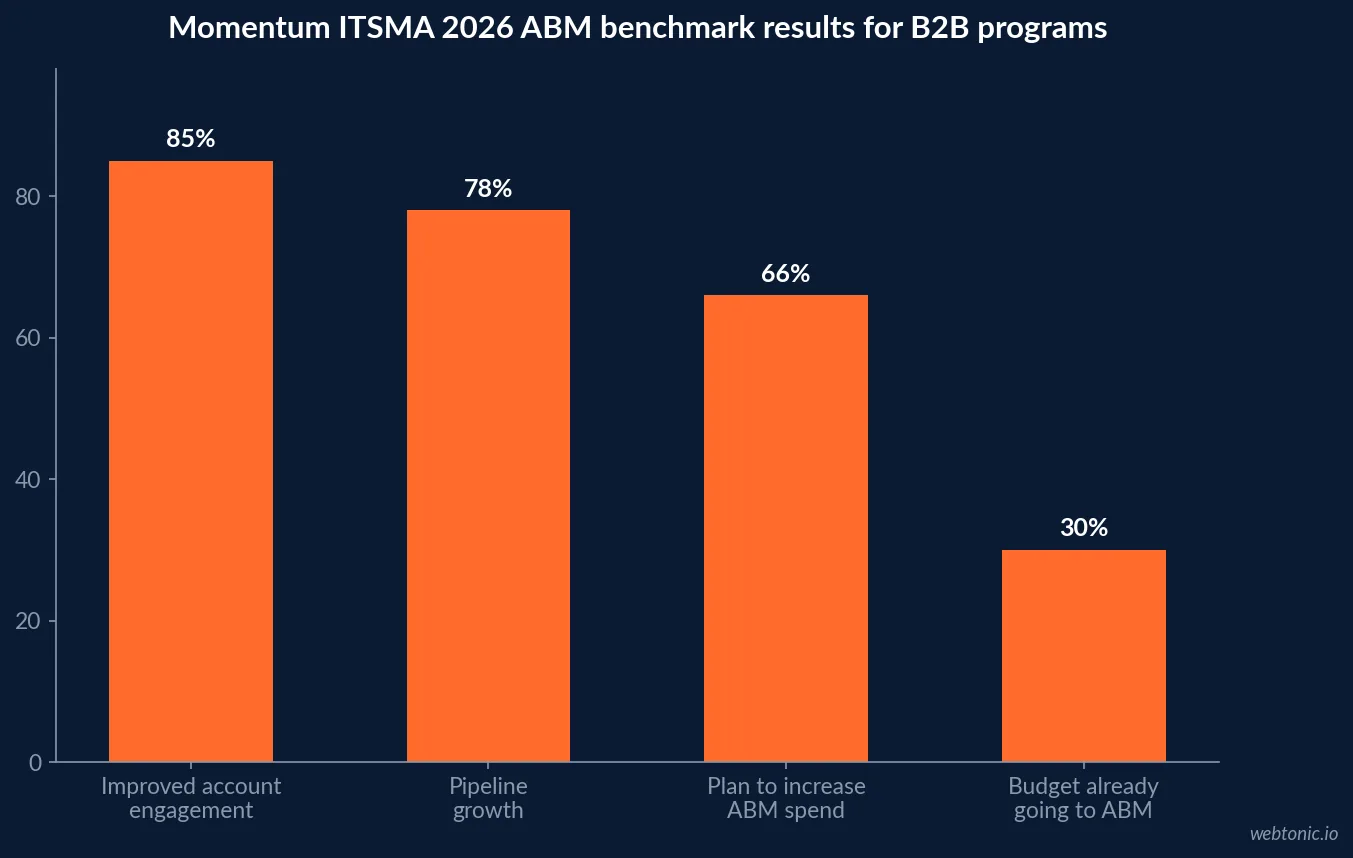
The most-cited ABM benchmark study is the Momentum ITSMA and ABM Leadership Alliance's annual research, drawing on 111 to 208 B2B marketing respondents depending on the question. It reports 30% of the marketing budget going to ABM at companies with a program, 66% planning to increase that spend, and improvement rates of 85% for account engagement, 78% for pipeline growth, 77% for sales team satisfaction and 74% for revenue growth. On the metric that matters most commercially - deals closed and win rate - only 14% report significant improvement above 10%, with a further 54% reporting some improvement below that threshold. Nobody in this data set is reporting an ABM miracle on win rate; the honest read is broad, moderate gains.
| Metric (Momentum ITSMA / ABM Leadership Alliance) | Figure | Sample | What it measures |
|---|---|---|---|
| Marketing budget share going to ABM | 30% | N=208 | Companies already running an ABM program |
| Plan to increase ABM spend next year | 66% | N=208 | Budget trajectory |
| Report improved account engagement | 85% | N=111 | Companies with an ABM program |
| Report pipeline growth from ABM | 78% | N=111 | Companies with an ABM program |
| Significant win-rate improvement (>10%) | 14% | N=111 | The revenue metric that matters most |
| Some win-rate improvement (up to 10%) | 54% | N=111 | The revenue metric that matters most |
Who actually sits in a commercial pest contract's buying group
Demandbase's 2026 State of ABM report, analysing 1,452 company tenants, 429,634 advertising campaigns, 38 million marketing activities and 9.7 million sales interactions, reports a typical B2B buying group at 13 to 17 stakeholders. Forrester independently reports an average of 13 people involved in a B2B buying decision. For a property management portfolio, that group plausibly includes a regional property manager, on-site facilities leads at flagged buildings, a procurement or compliance contact, and the ownership group or board that signs the contract. Engaging one contact and calling the account covered is the exact failure mode both studies describe.
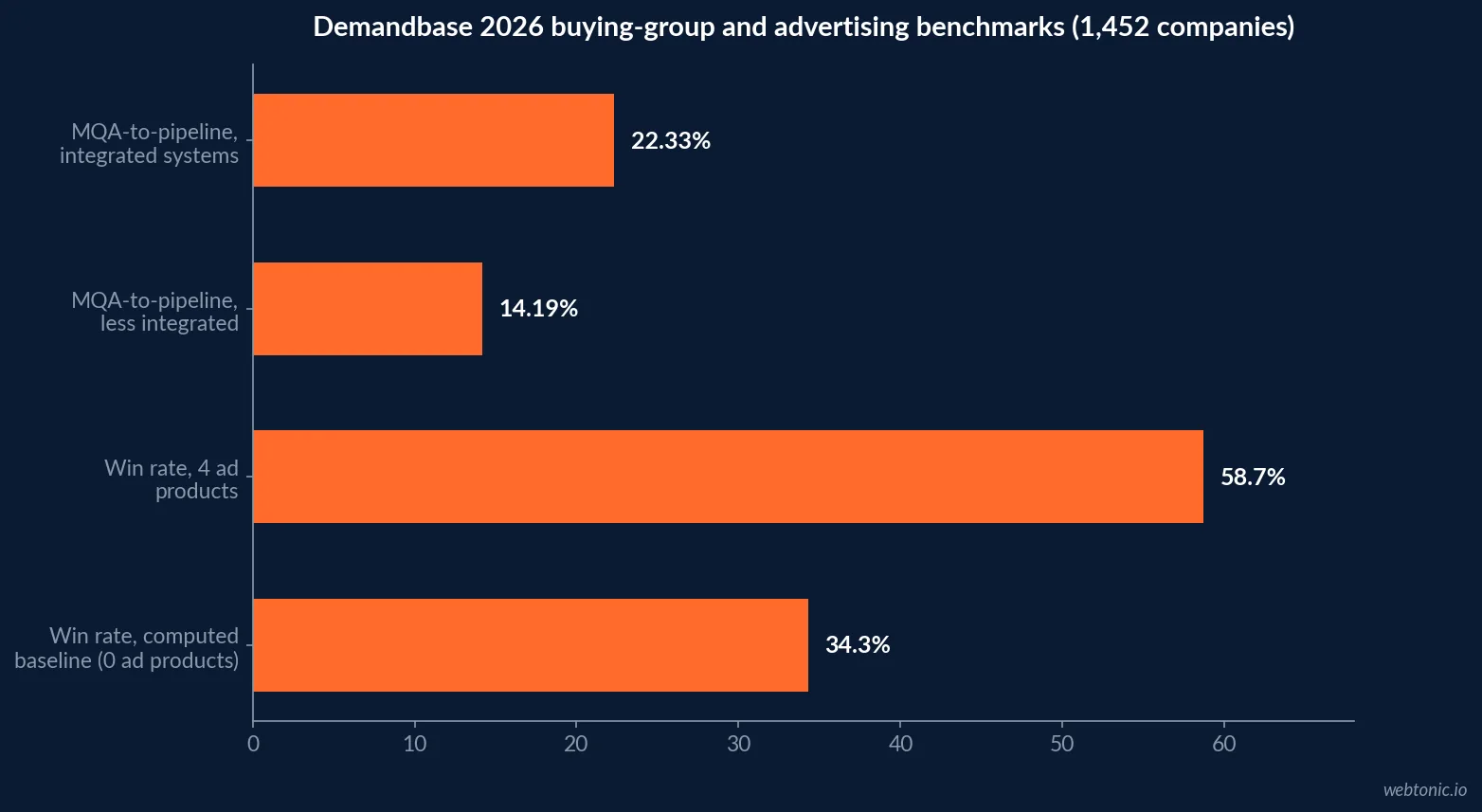
What coordinated engagement is worth, per Demandbase's 2026 data
Organizations that align marketing and sales around the full buying group, rather than a single lead, achieve 2 to 3 times higher win rates in the Demandbase dataset. Win rates peak when a team focuses on 2 to 3 buying groups per product, with diminishing returns past that range - a useful cap for a commercial pest team deciding how many property-management companies to run a dedicated plan against at once. Companies connecting their CRM, marketing platform and predictive model achieve a 22.33% MQA-to-pipeline conversion rate against a 14.19% baseline for less integrated teams, and companies running four advertising products against target accounts post a 58.7% win rate, a 71% lift over a computed baseline of roughly 34% for accounts run with none.
| Demandbase 2026 finding | Figure | What it implies for a commercial pest program |
|---|---|---|
| Typical B2B buying group size | 13-17 stakeholders | Map every flagged property's decision-makers, not one contact |
| Buying-group-aligned vs. lead-centric win rate | 2-3x higher | Build one plan per named property portfolio |
| Optimal buying groups tracked per product | 2-3 | Cap active named-account plans to avoid diminishing returns |
| MQA-to-pipeline conversion, integrated systems | 22.33% vs 14.19% | Connect CRM and marketing data before scaling accounts |
| Win rate, 4 ad products vs. zero | 58.7% vs. baseline, +71% lift | Layer paid, email and direct outreach on the same account |
The market this budget case is being made against
The National Pest Management Association, citing Specialty Consultants' annual analysis directly, puts 2025 US structural pest control service revenue at $13.416 billion, up 6% from 2024's $12.654 billion. A dedicated ABM plan for a handful of large commercial accounts - a regional property manager with dozens of buildings, or a hospital system's facilities department - is a rounding error against that market size but can represent a meaningful share of a single operator's commercial book if it lands one multi-site contract.
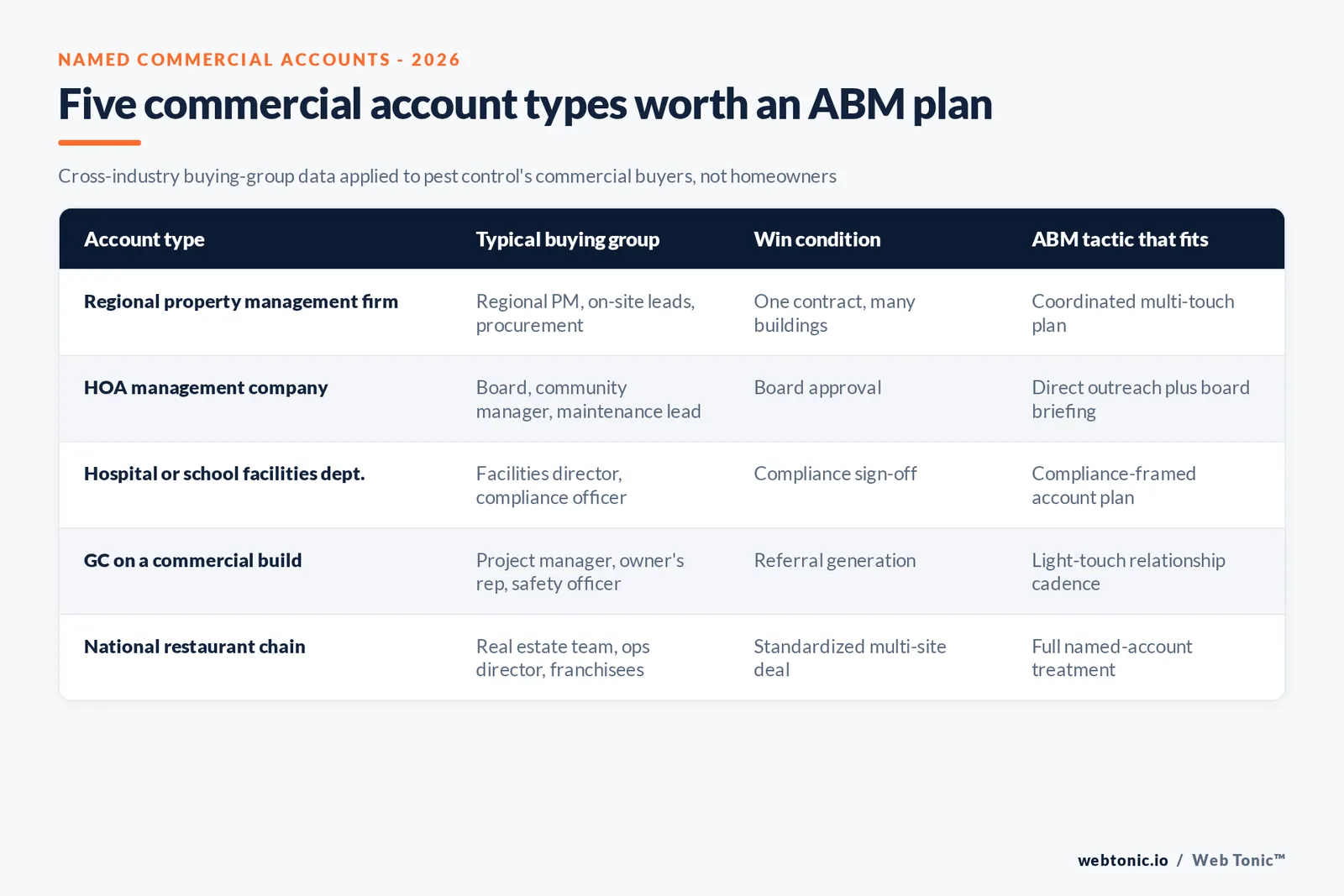
Building the account list without pretending it is consumer marketing
The named-account list for a commercial pest ABM program should come from the same commercial buyer categories the national operators already chase: regional and national property management firms, HOA management companies, hospital and school facilities departments, and GCs active on commercial builds in the service area. None of that overlaps with a residential lead list, and treating the two as one audience is the fastest way to waste both the ABM budget and the review-and-referral budget that residential marketing actually needs.
| Commercial account type | Typical buying-group roles | Why it fits ABM, not mass marketing |
|---|---|---|
| Regional property management firm | Regional PM, on-site facilities leads, procurement | One contract covers many buildings |
| HOA management company | HOA board, community manager, maintenance lead | Board approval gates the whole portfolio |
| Hospital or school facilities dept. | Facilities director, compliance officer, budget owner | Compliance-driven, multi-stakeholder sign-off |
| GC on a commercial build | Project manager, owner's rep, safety officer | One-time but high-value, referral-generating |
| National or regional restaurant chain | Real estate team, ops director, franchise owners | Standardized service across many locations |
How to size the ABM budget against the residential budget
Momentum ITSMA's 30% ABM budget-share figure comes from B2B companies where ABM is close to the whole marketing motion; a pest control operator whose revenue is mostly residential should not mirror that ratio. The more useful read is the win-rate ceiling: even in mature B2B programs, only 14% see a significant win-rate lift, so an ABM budget sized to a handful of named accounts with real multi-site upside, layered on top of - not instead of - local review and referral spend, matches what the data actually supports. Our growth marketing practice builds that split rather than porting a B2B ABM template wholesale onto a trade business.
How this fits next to a cold email program
ABM decides which accounts get a dedicated plan; the channel that carries the outreach itself - email, a call, a direct visit - is a separate question. Our companion piece on cold email outbound benchmarks covers the reply-rate mechanics for the property managers and facility contacts named inside an ABM plan; this page is about which accounts deserve that dedicated plan in the first place and what budget follows.
Measuring an account plan instead of a lead funnel
A named-account plan needs account-level metrics, not lead-level ones: engagement across every stakeholder on the account, not just the first reply, and pipeline tied to the account rather than to whichever contact happened to fill out a form. Our data and analytics practice builds that account-level view before a pest operator commits budget to more than a handful of named commercial targets, and our team can walk through what that dashboard looks like for a specific portfolio.
| Account-level metric | Why it beats a lead-level metric | Demandbase 2026 benchmark it maps to |
|---|---|---|
| Stakeholders engaged per account | Catches a stalled deal with only one contact reached | 13-17 stakeholder buying group |
| Active buying groups per product | Flags when a team has spread too thin | 2-3 is the win-rate peak |
| Account-level win rate | The number the budget case actually rests on | 58.7% at 4 ad products vs. baseline |
| MQA-to-pipeline conversion | Shows whether systems, not just accounts, are aligned | 22.33% integrated vs. 14.19% baseline |
Frequently Asked Questions
What does account-based marketing mean for a pest control company?
It does not mean targeting individual households more precisely - there is no ABM version of residential pest marketing. It means treating a named commercial account, such as a property management company with 40 buildings, a hospital facilities department, or a national restaurant chain's real estate team, as a single target with its own plan, rather than running the same generic ad set at every business in a metro area. The accounts worth naming are property managers, HOA boards, facility managers, GCs on new commercial builds, and national or regional chains buying recurring service across many locations.
Are the published ABM benchmarks specific to pest control?
No, and this page says so directly. The ITSMA/ABM Leadership Alliance and Demandbase figures below come from cross-industry B2B benchmark studies - mostly software, technology and professional services respondents - not from pest control companies. They are the best available evidence on how ABM performs in principle, and a commercial pest operator selling multi-site contracts is closer to that B2B buying pattern than a residential lead is, but nobody should read these numbers as a pest-industry-specific guarantee.
How many people decide a portfolio-wide pest control contract?
Demandbase's 2026 analysis of 1,452 company tenants, 429,634 ad campaigns and 9.7 million sales interactions puts a typical B2B buying group at 13 to 17 stakeholders. For a property management portfolio, that maps to a regional property manager, an on-site facilities lead at each flagged building, a procurement or compliance contact, and the board or ownership group that signs off on the contract value. Emailing or advertising to one contact and calling the deal covered is the single most common mistake the Demandbase data flags.
What is the budget case for treating a handful of accounts differently?
Momentum ITSMA and the ABM Leadership Alliance's benchmark study, based on 111 to 208 B2B marketing respondents, found companies running ABM programs devote an average of 30% of their marketing budget to the practice and 66% planned to increase that spend the following year, with 85% reporting improved engagement with selected accounts and 78% reporting pipeline growth. Those are aggregate B2B results, but they argue for the same principle at a smaller scale: a handful of large, named property or facility accounts justify a dedicated plan rather than the same ad set as every other lead.
Does more advertising to a target account actually close more deals?
Demandbase's 2026 data reports companies running four advertising products against target accounts see a 58.7% win rate, a 71% lift over companies running none, and that accounts engaged with buying-group-level advertising convert to opportunities at 2 to 3 times the rate of accounts without it. Correlational, not causal - larger, better-resourced accounts may also be easier wins - but it is consistent evidence that coordinated, multi-contact engagement on a named account outperforms a single generic touch.
Sources
Demandbase - State of ABM 2026: Pipeline Benchmarks from 1,452 Companies
Forrester - Your Buyer Is A Group, Not A Person
Momentum ITSMA & ABM Leadership Alliance - Rethinking ABM Benchmark Study
ABM Leadership Alliance - Rethinking ABM: Outperforming the Market in the World of AI
National Pest Management Association - US pest control industry, 2025
Terminix - National Accounts Program
Orkin - National Accounts Program