Table of contents
67% of law firms did not respond to a secret-shopper email in Clio's 2024 study, and firms were unreachable by phone 48% of the time. This page prices what an automation budget should target - intake speed - against vendor pricing pages for the general tooling involved, and against the TCPA, 10DLC and solicitation rules that bound how a personal injury firm can automate outreach to an injured prospect.
Key Takeaways
- 67% of law firms did not respond to a secret-shopper email in 2024 (Clio).
- That is up from 60% in the same test run in 2019.
- Firms were unreachable by phone 48% of the time in 2024.
- Only 52% of firms picked up or called back, down from 73% in 2019.
- Of firms that did respond to email, 84% did so within 8 business hours.
- Only 20% of firms responded to a voicemail in 2024, down from 43% in 2019.
- A cross-industry 2011 Harvard Business Review study found odds of qualifying a lead fall sharply after the first hour.
- That study is 15 years old and not personal-injury-specific - label it as dated.
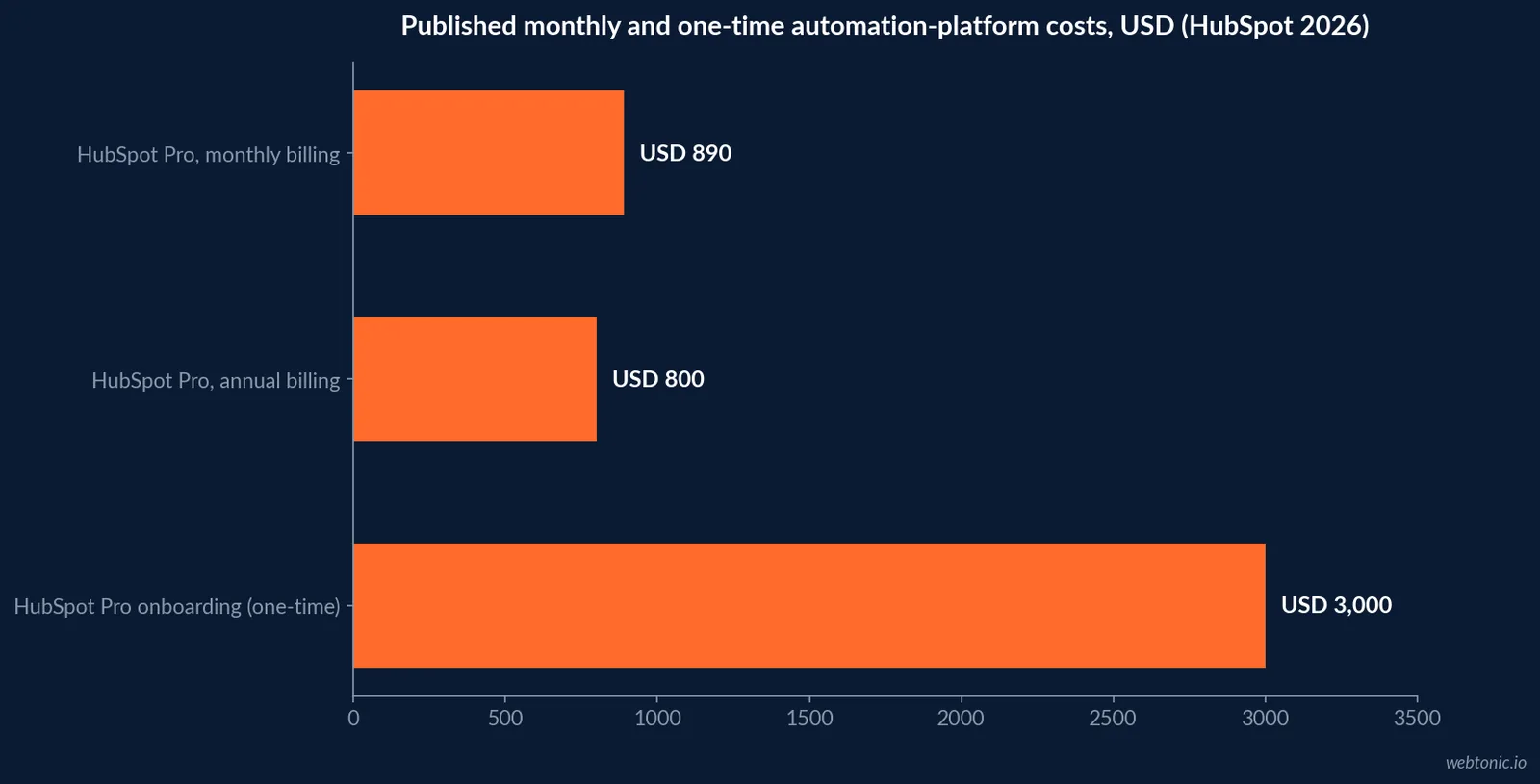
- HubSpot Marketing Hub Professional runs USD 890 a month billed monthly.
- Or USD 800 a month billed annually, a USD 1,080 yearly saving.
- Professional-tier onboarding is a one-time USD 3,000 fee.
- Klaviyo's free tier is capped at 250 profiles and 500 emails a month.
- Personal injury billed USD 335 an hour for lawyers in Clio's 2025 report.
- Every business texting U.S. leads at scale needs A2P 10DLC registration.
- Attorney solicitation of a specific injured prospect is restricted under state bar rules modeled on ABA guidance.
The problem the budget exists to fix
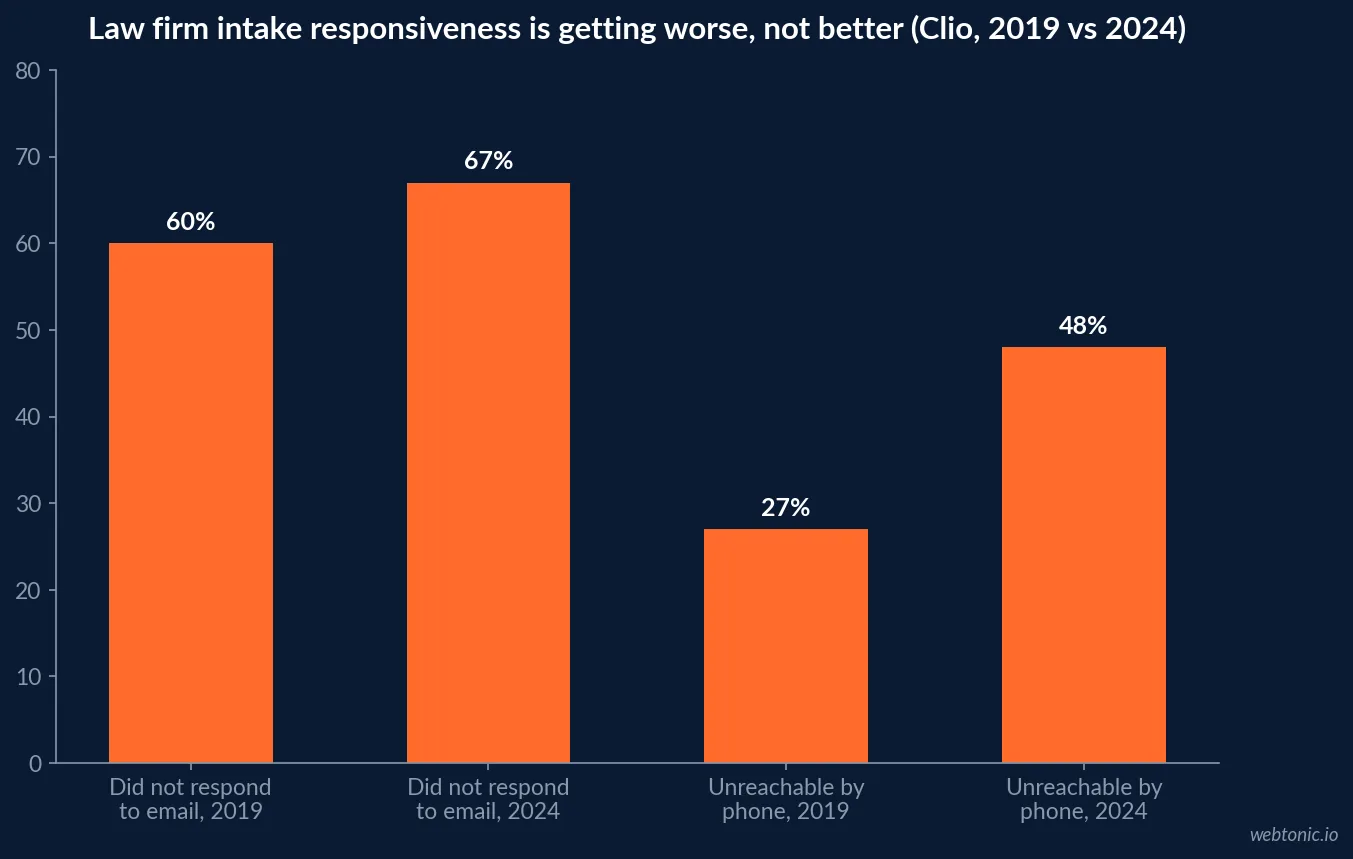
Clio's 2024 Legal Trends Report ran a secret-shopper study against 1,000 U.S. law firms by email and 500 by phone. 67% did not respond to the email at all, worse than 60% in the same test in 2019. By phone, firms were unreachable 48% of the time; only 52% either picked up or called back, down from 73% in 2019. Voicemail follow-up fell even further, from 43% of firms responding in 2019 to 20% in 2024. This is the trade's own benchmark for how much a competent intake-automation process is worth relative to doing nothing, and it is worsening year over year rather than improving on its own.
| Intake responsiveness metric | 2019 | 2024 | Direction |
|---|---|---|---|
| Firms that did not respond to email | 60% | 67% | Worse |
| Firms unreachable by phone | 27% | 48% | Worse |
| Firms that picked up or called back | 73% | 52% | Worse |
| Firms that responded to a voicemail | 43% | 20% | Worse |
| Email responders replying within 8 hours | N/A | 84% | Fast, for the minority who reply |
What slow response is reported to cost, across the legal market
CallRail's own 2022 Marketing Outlook for Law Firms, based on a survey of nearly 600 U.S. law firm marketers, is law-firm-wide rather than personal-injury-specific, and it is now several years old, but it is the clearest first-party figure available on the dollar cost of slow response. Firms reported an average 5-hour response time to a new lead, and estimated they lose an average of 46 clients and USD 200,000 in revenue a year as a result. The same survey found 97% of firms admit they "often" or "sometimes" prioritize existing clients over following up on new leads, and that 46% of clients prefer first contact by phone against 27% by email - yet only 43% of those calls reach a live receptionist, with 20% going straight to voicemail.
| Law-firm intake fact (CallRail, 2022 survey, ~600 firms) | Figure |
|---|---|
| Average response time to a new lead | 5 hours |
| Average clients lost per year to slow response | 46 |
| Average annual revenue lost to slow response | USD 200,000 |
| Firms that prioritize existing clients over new leads at least sometimes | 97% |
| Clients preferring first contact by phone | 46% |
| Calls answered live by a receptionist | 43% |
| Calls sent straight to voicemail | 20% |
The speed-to-lead study everyone cites, dated correctly
The figure behind most "leads go cold fast" claims traces to a single, cross-industry study: Harvard Business Review's 2011 article, "The Short Life of Online Sales Leads." It found the odds of successfully qualifying a lead fall sharply once the first hour after contact passes. That study is now fifteen years old, was not conducted on legal intake specifically, and no dated, personal-injury-specific replacement exists. CallRail's 2022 average of a 5-hour firm response time, cited above, gives a law-firm-specific (if dated) point of comparison against that older, cross-industry benchmark; cite the HBR figure as directional evidence for why speed matters, not as a current legal-industry finding.
What the general automation tooling costs
A firm still needs volume tooling on top of a case-management system, and vendor pricing pages set the floor. HubSpot's own pricing guide puts Marketing Hub Professional at USD 890 a month billed monthly or USD 800 a month billed annually - a USD 1,080 annual saving - plus a one-time USD 3,000 onboarding fee for that tier. Klaviyo's own pricing page caps its free tier at 250 profiles and 500 emails a month, with mobile messaging metered separately at USD 5 a month included on the free plan.
| General automation platform (own pricing page) | Published price point | Billing basis |
|---|---|---|
| HubSpot Marketing Hub Professional | USD 890/mo | Monthly billing |
| HubSpot Marketing Hub Professional | USD 800/mo | Annual billing |
| HubSpot Professional onboarding | USD 3,000 one-time | Required at signup |
| Klaviyo free tier | USD 0 | Capped at 250 profiles / 500 emails |
| Klaviyo free tier mobile messaging | USD 5/mo included | Metered beyond that |
What a referred or paid case is worth once it converts
The budget math needs a case value to compare against. Clio's 2025 Legal Trends Report puts personal injury billing at USD 335 an hour for lawyers and USD 284 blended at the firm level - both up from USD 309 and USD 271 in the 2024 report. Against that rate, the cost of an automation platform amortizes quickly if it converts even one additional case a quarter that would otherwise have gone unreached in the 48%-unreachable-by-phone or 67%-unanswered-email gap above.
| Personal injury billing rate (Clio Legal Trends) | 2024 | 2025 |
|---|---|---|
| Lawyer hourly rate | USD 309 | USD 335 |
| Blended firm-level rate | USD 271 | USD 284 |
The compliance ceiling on how automation can run
Three rule sets bound this budget before it is spent. The Telephone Consumer Protection Act, which the FCC continues to actively amend, governs consent for automated calls and texts to a prospect's mobile number. Twilio's own compliance documentation confirms any business texting U.S. numbers at scale must register under the carrier-run A2P 10DLC framework. And per Cornell Law School's Legal Information Institute, most state bars restrict direct, live solicitation of a specific injured prospect under rules modeled on the American Bar Association's Model Rules of Professional Conduct - a limit that shapes what an "automated outreach" sequence is legally allowed to say and to whom it can be sent.
| Compliance layer | What it restricts | Enforcement body |
|---|---|---|
| TCPA consent rules | Automated calls/texts to a mobile number | FCC |
| A2P 10DLC registration | Bulk application-to-person SMS delivery | Wireless carriers via Twilio |
| State bar solicitation rules (ABA-modeled) | Direct, live solicitation of an injured prospect | State bar associations |
Why firms keep chasing existing clients instead of new leads
CallRail's 2022 survey also found that firms report an average of 5 conversations with a lead before accepting a client or case, which helps explain the 97% figure above - a firm mid-conversation with an existing prospect genuinely has less capacity for a new inbound call, not just a process failure. 96% of firms in the same survey say they are much more likely to follow up on leads that arrive with a clear ask and detailed background, which argues for automation that qualifies and summarizes a lead before it reaches an attorney, rather than automation that only speeds up the initial contact.
Put together with the phone-answering data above - 43% reaching a live receptionist and 20% going straight to voicemail - the budget case for automation in personal injury intake is less about replacing a human and more about catching the calls a stretched front desk cannot get to during a conversation with an existing client. The 3% of firms that route overflow to an after-hours number in CallRail's data are effectively running a manual version of what automated intake routing is meant to do at scale.
Building the budget line
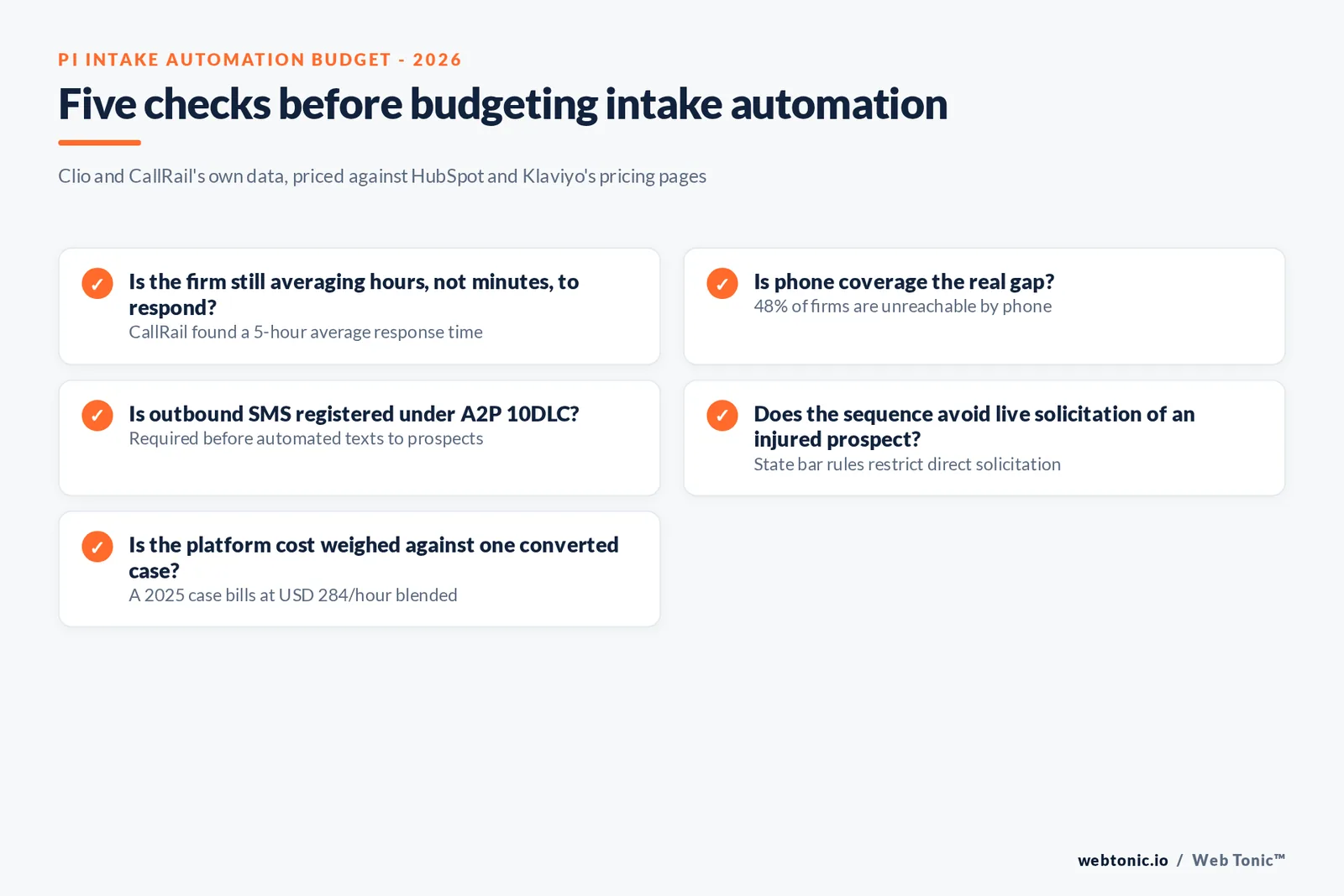
The sequence the data supports: fix the intake-responsiveness gap first, since it costs more than any automation platform (a firm unreachable 48% of the time by phone is losing cases the marketing budget already paid to generate); confirm the compliance ceiling on outbound texting and solicitation before buying volume tooling; then price the general platform (HubSpot, Klaviyo) against the value of one additional converted case at the 2025 blended rate of USD 284 an hour, not against a vendor's feature list. Our growth marketing practice and data and analytics practice build that comparison against a firm's own case data; see our marketing automation statistics page for the cross-industry adoption figures behind the same platforms. A firm still averaging CallRail's reported 5-hour response time in 2022 has more to gain from fixing that single number than from any feature comparison between HubSpot and Klaviyo.
Frequently Asked Questions
How bad is the intake-responsiveness problem this budget is solving?
Severe, by the injury bar's own trade data. Clio's 2024 secret-shopper study emailed 1,000 U.S. law firms and phoned 500 more: 67% did not respond to email at all, and firms were unreachable by phone 48% of the time, meaning only 52% either picked up or called back. That is worse than the same study in 2019, when 60% ignored email and 73% picked up or called back.
Is it true that online leads go cold in minutes?
The specific number widely quoted traces to a 2011 Harvard Business Review study, 'The Short Life of Online Sales Leads,' which is cross-industry, not personal-injury-specific, and is now 15 years old. It should be cited as a dated, cross-industry benchmark for why speed-to-lead matters directionally, not as a personal-injury-specific figure - no dated, injury-specific response-time study exists to replace it.
What does intake-automation software cost?
Vendor pricing pages, not round-ups, give the honest floor. HubSpot's own pricing guide lists Marketing Hub Professional at USD 890 a month billed monthly, or USD 800 annually, plus a one-time USD 3,000 onboarding fee. Klaviyo's own pricing page caps its free tier at 250 profiles and 500 emails a month before usage-based pricing kicks in. Neither of these figures is legal-specific pricing; a firm still needs a case-management or intake layer (such as Clio Grow) on top.
What compliance rules apply to automated intake texts and emails?
The Telephone Consumer Protection Act, enforced by the FCC, governs consent for automated calls and texts to a prospective client's mobile number. Separately, sending application-to-person SMS at scale in the U.S. requires A2P 10DLC registration per Twilio's own compliance documentation. On top of both, state bar solicitation rules - modeled on the American Bar Association's Model Rules, per Cornell Law's Legal Information Institute - restrict direct, live solicitation of a specific injured prospect, which limits how an automated outbound sequence can be worded and targeted.
Should a firm build its own automation or buy a legal-specific platform?
The comparison is not the buyer's choice alone - it is compliance capability. A general marketing platform like HubSpot or ActiveCampaign handles volume and sequencing but is not purpose-built for attorney-solicitation rules or case-conflict screening the way a legal intake product is. Budgeting for automation in this category means pricing the general platform's monthly cost and then pricing the compliance and intake layer separately, rather than assuming one subscription covers both.
Sources
CallRail - 2022 Marketing Outlook for Law Firms
Clio - 2024 Legal Trends Report, full publication
Clio - 2025 Legal Trends Report
Harvard Business Review - The Short Life of Online Sales Leads, 2011
HubSpot - Marketing Hub pricing guide
Klaviyo - Pricing page
Twilio - A2P 10DLC compliance documentation
Federal Communications Commission - TCPA rulemaking docket
Cornell Law School, Legal Information Institute - Legal advertising