Table of contents

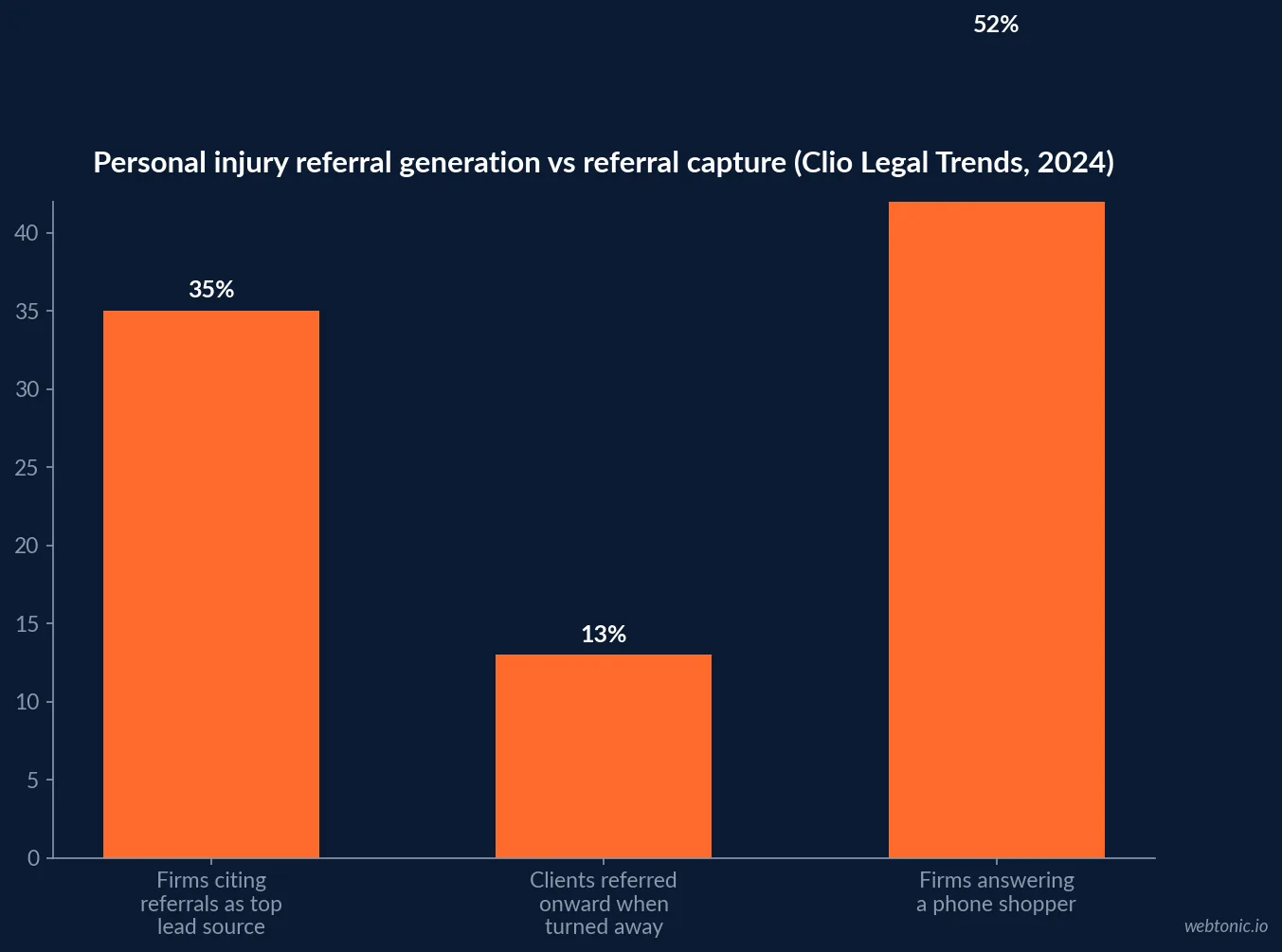
35% of law firms say legal-professional referrals generate their most potential client leads, but only 13% of clients a firm cannot help get referred onward. A personal injury client is close to a one-time transaction, so this page treats lifecycle value as referral generation and referral capture, sourced from Clio's own Legal Trends data, not a SaaS-style repeat-purchase model.
Key Takeaways
- 35% of law firms say referrals from other legal professionals drive their most leads (Clio, 2024).
- Only 13% of clients a firm turns away get referred to another attorney.
- Referrals rank as the single greatest source of new clients industry-wide, ahead of websites and search.
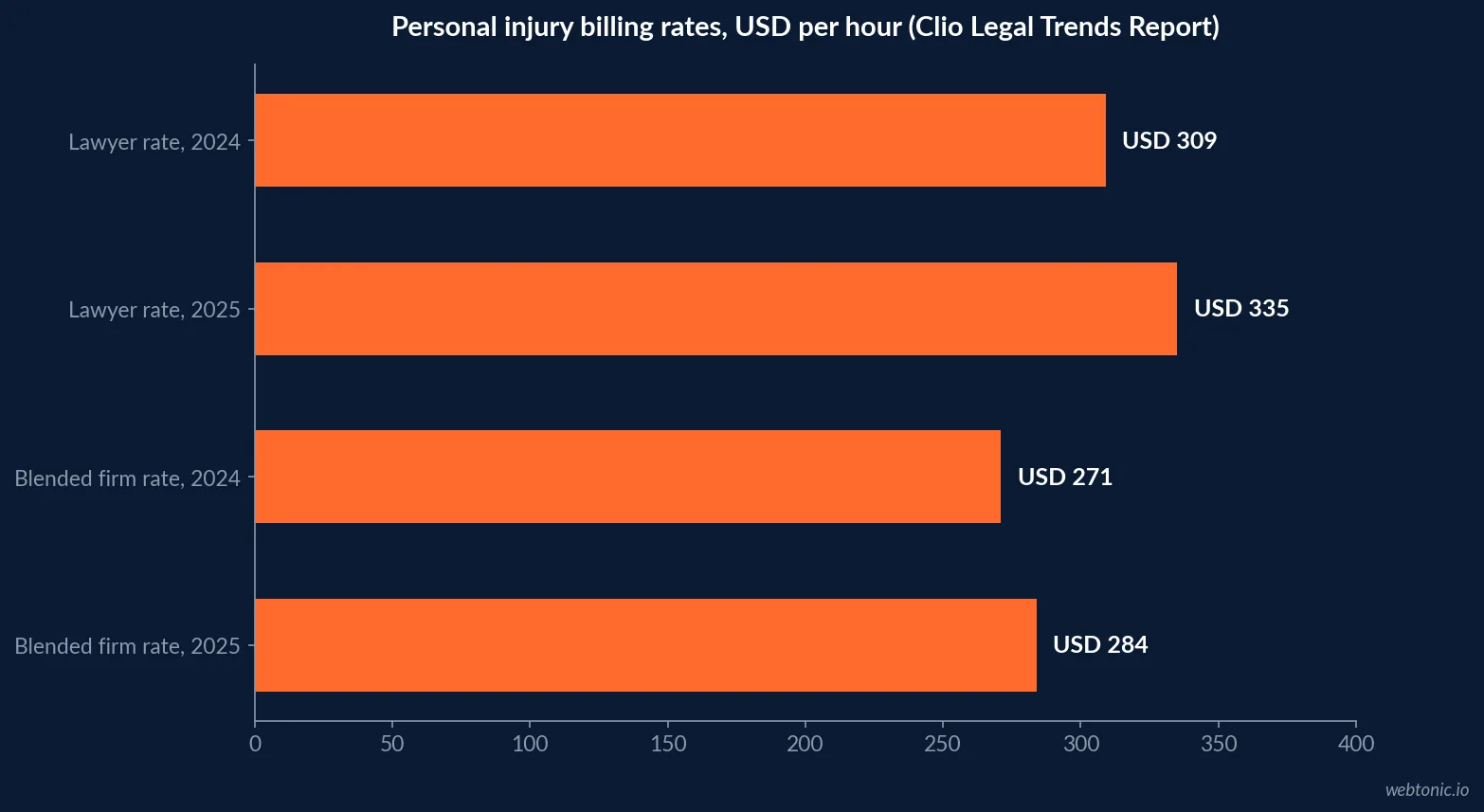
- Personal injury billed USD 335 an hour for lawyers in the 2025 Legal Trends Report.
- That is up from USD 309 an hour in the 2024 report, a year-over-year increase.
- Blended firm-level personal injury rates hit USD 284 in 2025, up from USD 271.
- 67% of law firms did not respond to a secret-shopper email in 2024, up from 60% in 2019.
- Firms that did respond answered within 8 hours 84% of the time.
- Only 52% of firms picked up the phone or called back a secret shopper in 2024, down from 73% in 2019.
- A 5-point retention gain can lift profit up to 95% in Bain's long-standing (2006) finding, a cross-industry floor, not PI-specific.
- New-customer acquisition runs 5 to 25 times the cost of retention (Harvard Business Review, 2014).
- PILMMA's referral heuristic splits clients into roughly 20% automatic referrers, 20% non-referrers, and 60% persuadable.
- Attorney advertising has carried First Amendment protection since a 1977 U.S. Supreme Court ruling, per Cornell's Legal Information Institute.
- States still restrict misleading claims and direct in-person solicitation of accident victims.
Why referrals are the lifecycle metric here
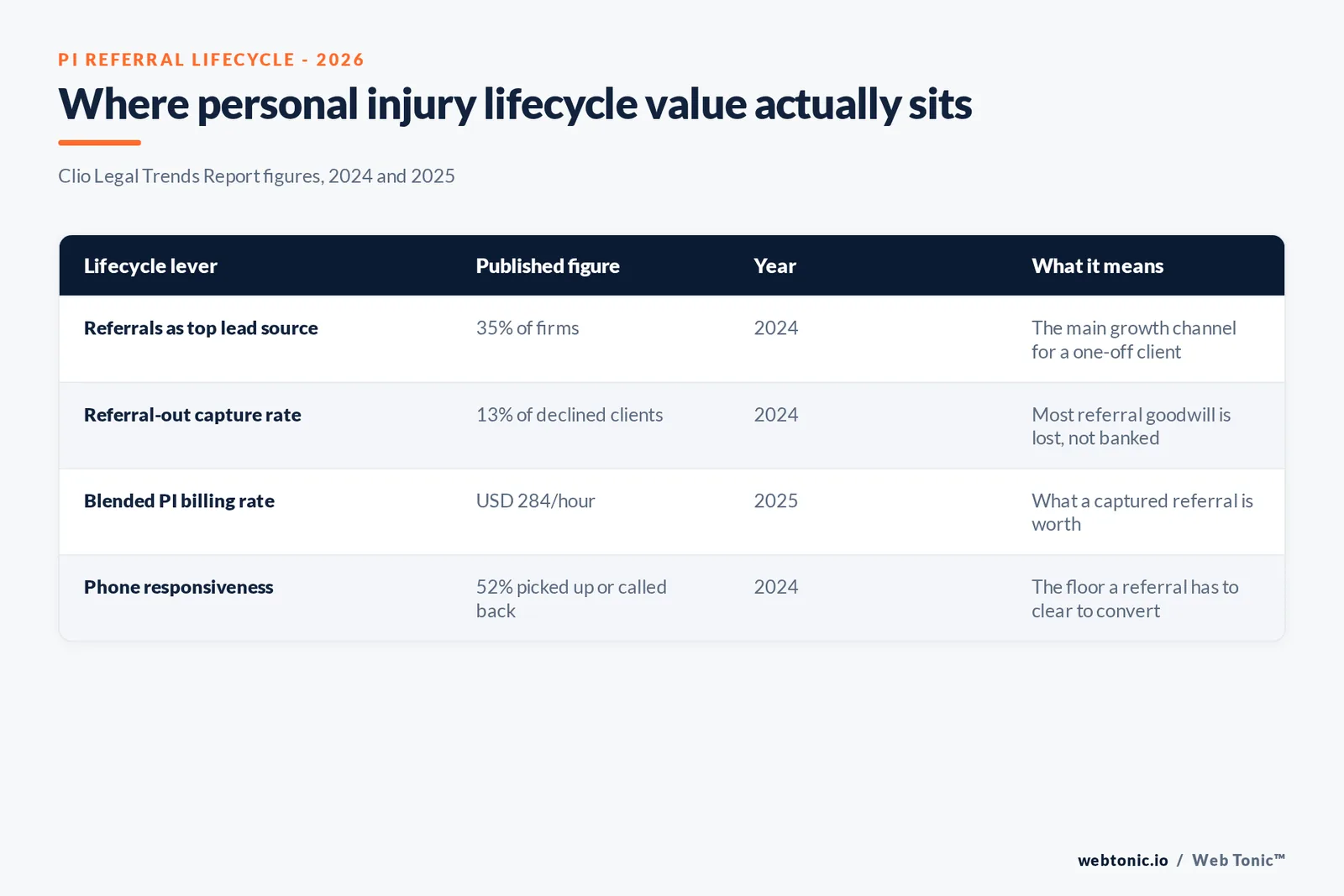
Most personal injury clients hire a firm once. Clio's 2024 Legal Trends Report found that 35% of law firms report referrals from other legal professionals as their top source of potential leads, and its companion 2025 solo and small-firm report confirms referrals as the greatest single source of new business across firm sizes - ahead of firm websites, online reviews and paid search. For a practice area with almost no repeat purchase, referral generation and referral capture are the closest equivalents to a SaaS retention curve.
| Referral fact (Clio Legal Trends) | Figure | Year | What it measures |
|---|---|---|---|
| Firms citing referrals as top lead source | 35% | 2024 | Where the next client comes from |
| Clients referred to another attorney when turned away | 13% | 2024 | Referral capture rate on rejected leads |
| Firms that answered a secret-shopper email | 33% | 2024 | Responsiveness to inbound referral leads |
| Firms that picked up or called back a phone shopper | 52% | 2024 | Responsiveness by phone |
The referral capture gap
Generating a referral lead and converting it are two different failure points. Clio's report notes that firms are not good at passing referrals on when they cannot take a case: only 13% of potential clients received a referral to a different law firm or another attorney within the same firm. Every uncaptured referral is lost goodwill with the referring party as well as a lost case, which compounds against a firm's reputation with the professionals sending it business in the first place. A firm that formalizes a referral-out process - a named contact list of adjacent practice areas, a standard handoff script, a tracked follow-up on whether the referred client was actually taken on - has a direct lever on that 13% figure that costs closer to nothing than any paid acquisition channel would.
PILMMA, a personal injury lawyer marketing association, frames the client-side version of this as a rough industry heuristic: about 20% of a firm's past clients will refer new business regardless of effort, another 20% will not refer no matter what, and the remaining 60% are persuadable with deliberate follow-up. This is a working framework the association publishes, not a peer-reviewed statistic, and should be labelled as such.
| PILMMA client-referral framework | Share of past clients | Marketing implication |
|---|---|---|
| Automatic referrers | ~20% | Referral rate here is a floor, not a marketing win |
| Non-referrers | ~20% | Follow-up spend here has the lowest expected return |
| Persuadable middle | ~60% | Where a deliberate case-closure follow-up program pays off |
What a personal injury case is actually worth
Referral value scales with what a case bills at. Clio's Legal Trends Report publishes average billing rates by practice area every year. Personal injury billed at USD 335 an hour for lawyers, USD 163 for non-lawyer staff, and USD 284 blended at the firm level in the 2025 report - all up from USD 309, USD 161 and USD 271 respectively in the 2024 report. A firm generating one referred case a month at the 2025 blended rate is protecting materially more revenue per referral than it was a year earlier.
| Personal injury billing rate | 2024 report | 2025 report | Change |
|---|---|---|---|
| Lawyer hourly rate | USD 309 | USD 335 | +USD 26 |
| Non-lawyer hourly rate | USD 161 | USD 163 | +USD 2 |
| Blended firm-level rate | USD 271 | USD 284 | +USD 13 |
The responsiveness problem sitting on top of the referral pipeline
A referral is only worth what a firm does with it. Clio's 2024 secret-shopper study emailed 1,000 U.S. law firms and phoned 500 more: 67% did not respond to the email at all, worse than 60% in the same 2019 study, though the minority who did respond answered fast - 84% within eight business hours. By phone, only 52% of firms picked up or called back, down from 73% in 2019, meaning roughly half of firms tested were unreachable by phone at all. A referred lead that hits a non-responsive intake process is a wasted referral regardless of how it was generated.
| Responsiveness metric | 2019 | 2024 | Direction |
|---|---|---|---|
| Firms that did not respond to email | 60% | 67% | Worse |
| Firms that picked up or called back | 73% | 52% | Worse |
| Email responders replying within 8 hours | N/A | 84% | Fast, for the minority who reply |
How firms already try to keep the relationship alive
CallRail's 2022 Marketing Outlook for Law Firms, a law-firm-wide survey of nearly 600 U.S. marketers, found 91% of law firms say their area of law generally sees repeat clients, and 45% use remarketing specifically to keep in touch with unconverted leads. Firms that remarket allocate 49% of their marketing budget to that part of the funnel, most often through targeted content (46%), check-in calls (46%) and special-occasion greetings (45%). This survey is not personal-injury-specific and is dated 2022, but it is the clearest first-party figure available on how much of a legal marketing budget already goes toward relationship maintenance rather than new acquisition.
| Legal-market remarketing fact (CallRail, 2022 survey) | Figure |
|---|---|
| Firms saying their area of law sees repeat clients | 91% |
| Firms using remarketing to reach unconverted leads | 45% |
| Share of marketing budget allocated to remarketing (among users) | 49% |
| Remarketing via targeted content | 46% |
| Remarketing via check-in calls | 46% |
| Remarketing via special-occasion greetings | 45% |
How the old retention math applies here, carefully labelled
Two cross-industry figures are useful context but are not personal-injury-specific. Bain & Company's long-standing finding, restated in a 2006 Bain insight, holds that a 5-percentage-point gain in retention can lift profit by up to 95%. Harvard Business Review's 2014 article puts new-customer acquisition at 5 to 25 times the cost of retention. For a practice area with almost no repeat client relationship, the practical translation is that a referral relationship functions as the "retained customer" - it costs far less to keep a referring attorney or past client sending cases than to source an equivalent case through paid channels.
What the law allows a firm to do about it
Referral marketing runs into real limits. Per Cornell Law School's Legal Information Institute, attorney advertising has carried First Amendment protection since the U.S. Supreme Court's 1977 ruling in Bates v. State Bar of Arizona, and states cannot impose a blanket ban on truthful legal advertising. Most state bars model their solicitation rules on the American Bar Association's Model Rules of Professional Conduct, which restrict direct, in-person or live solicitation of a specific prospective client, particularly one who has just been injured. A referral program has to be built around passive, opt-in follow-up rather than direct outreach to an accident victim a firm has not already been retained by.
Sequencing a referral-based lifecycle program
The order the data supports: fix intake responsiveness first (the 52%-callback and 67%-no-email- response gaps above cost more than any referral campaign can offset), build a passive, compliant referral-request sequence for the persuadable 60% of past clients, and track referral-source capture on every case the firm declines so the 13% referral-out rate has somewhere to go up from. A firm already allocating close to CallRail's reported 49% of its remarketing budget to check-ins and special-occasion outreach should audit whether that spend is reaching the persuadable middle tier specifically, rather than being spread evenly across a client list where a fifth will never refer regardless of the outreach.
Our growth marketing practice builds intake and referral workflows against a firm's own case data, our data and analytics practice tracks referral-source capture against the 13% figure above, and our customer lifetime value statistics page covers the cross-industry retention multipliers referenced above.
Frequently Asked Questions
Does a personal injury firm even have a customer lifecycle if clients rarely return?
Yes, but it runs through referrals instead of repeat purchase. Clio's 2024 Legal Trends Report found 35% of law firms say referrals from other legal professionals generate the most potential client leads, and separately reports that referrals are the greatest single source of new clients across the industry, ahead of firm websites, online reviews and paid search. The lifecycle metric that matters for a one-off practice area is referral rate and review volume, not repeat-visit frequency.
How much referral volume are firms actually losing?
A meaningful share. Clio's 2024 report found that only 13% of potential clients who could not be helped by the firm they contacted received a referral to a different law firm or another attorney within the same firm. Every client who is turned away without a referral is a lead source the firm generated but did not monetize or convert into referral goodwill.
What is the '60% rule' for personal injury referrals?
It is an industry heuristic, not a peer-reviewed study: PILMMA, a personal injury marketing association, frames it as roughly 20% of a firm's client base referring new business regardless of effort, another 20% never referring no matter what, and the remaining 60% being persuadable through deliberate follow-up. Treat it as a working framework for where a referral program should focus effort, not as a verified statistic.
What do personal injury cases actually bill at?
Clio's Legal Trends Report publishes average hourly rates by practice area. In the 2025 report, personal injury billed at USD 335 an hour for lawyers, USD 163 for non-lawyer staff, and USD 284 blended at the firm level - up from USD 309, USD 161 and USD 271 respectively in the 2024 report. Those year-over-year increases matter for lifecycle economics because they raise the value of every referred client relative to the cost of generating one through paid channels.
Are there legal limits on how a personal injury firm can solicit referred leads?
Yes. Attorney advertising and direct solicitation are regulated at the state bar level, and most states model their rules on the American Bar Association's Model Rules of Professional Conduct, particularly the sections covering lawyer communications and direct contact with prospective clients, per Cornell Law School's Legal Information Institute. States cannot ban truthful legal advertising outright under a line of U.S. Supreme Court First Amendment rulings, but they can and do restrict misleading claims and in-person solicitation of an accident victim.
Sources
CallRail - 2022 Marketing Outlook for Law Firms
Clio - 2024 Legal Trends Report, full publication
Clio - 2025 Legal Trends Report
Clio - 2025 Legal Trends Report for Solo and Small Law Firms
PILMMA - Seven strategies to get new cases out of past clients
Bain & Company - Retaining customers is the real challenge
Harvard Business Review - The Value of Keeping the Right Customers, 2014
Cornell Law School, Legal Information Institute - Legal advertising