Table of contents
A personal injury firm cannot cold-email a specific injured person under ABA Model Rule 7.3, so the cold email data that actually applies to PI firms covers their B2B outreach to referral partners, co-counsel and vendors - and that channel's reply rates moved with the rest of B2B email after the February 2024 Google and Yahoo bulk-sender rules.
Key Takeaways
- ABA Model Rule 7.3 restricts solicitation of a specific person known to need legal services.
- NY State Bar Opinion 1227 ruled targeted case-specific email counts as solicitation.
- B2B referral-partner and co-counsel outreach falls outside Rule 7.3 entirely.
- Belkins' 2026 dataset of 7.5 million emails reports a 0.45% average reply rate.
- Woodpecker's 56,614-campaign benchmark reports a 1.5% median reply rate.
- Instantly's 2026 report puts the B2B average at 3.43% and top quartile at 5.5%.
- Elite campaigns in that same Instantly dataset exceed 10.7% reply rate.
- Since Feb 2024, 5,000+/day senders to Gmail/Yahoo must run SPF, DKIM and DMARC.
- Spam complaint rates must stay under roughly 0.3% under those same rules.
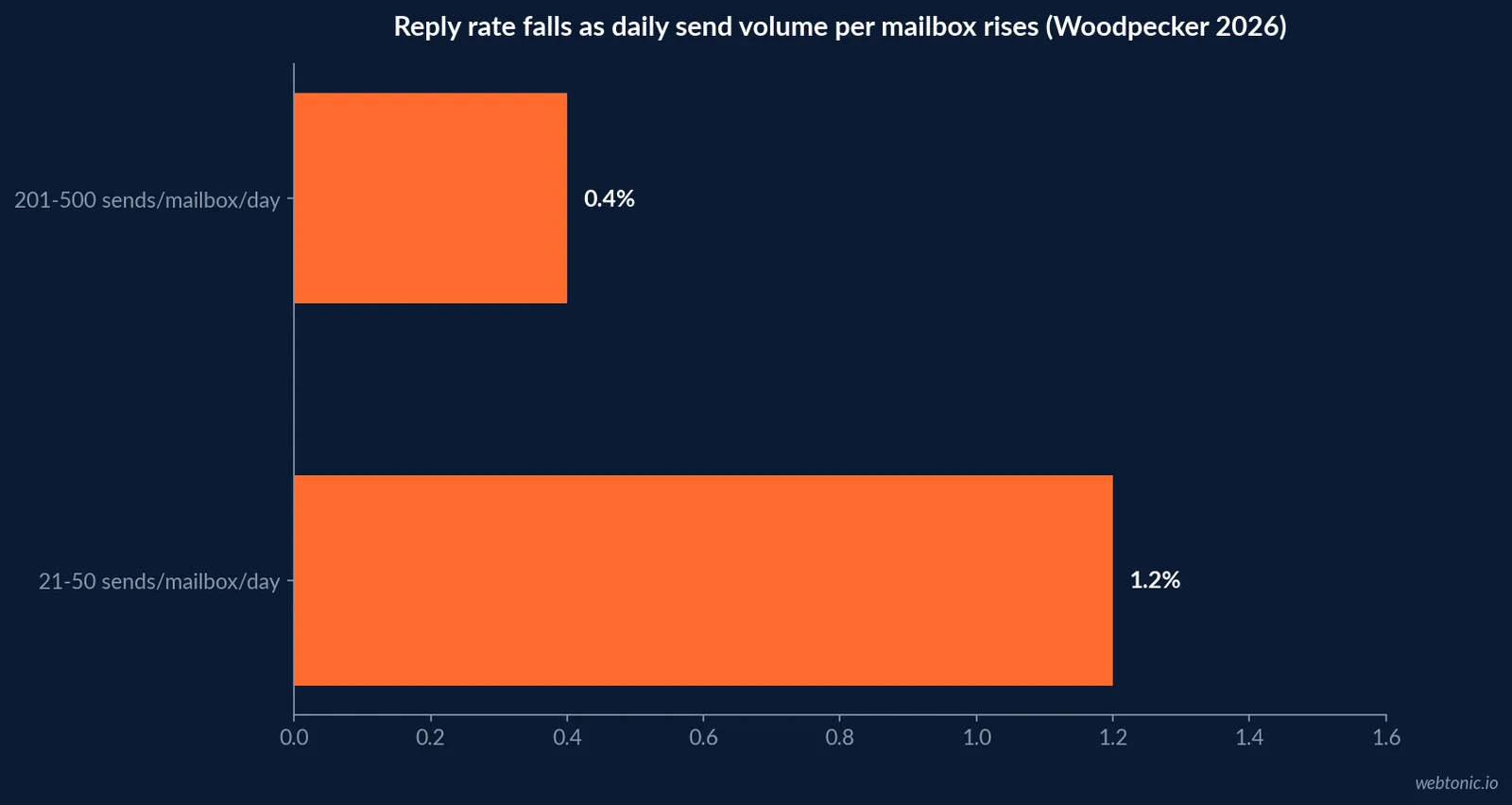
- Reply rate falls from 1.2% to 0.4% as daily volume per mailbox rises from 21-50 to 201-500.
- CAN-SPAM requires truthful header information and a working unsubscribe on every send.
- ABA Formal Opinion 501 narrowed the definition of solicitation in 2018.
- 27.1% of tracked LinkedIn connection requests were accepted in Expandi's 2026 data.
- Legal advertising spend nationally is measured in the billions annually, but that is media, not email.
- No dataset measures PI-specific cold email, because the client-facing version of it is restricted.
The rule that separates PI cold email from every other industry's
Most industries ask "what reply rate should we expect." A personal injury firm has to ask a prior question: is this email legal to send at all. ABA Model Rule 7.3 defines solicitation as a communication initiated by or for a lawyer, directed to a specific person the lawyer knows or reasonably should know needs legal services in a particular matter, where a significant motive is retention. An email to a named accident victim about their specific crash is a textbook example of exactly what the rule is written to restrict.
The case that settled whether email counts as solicitation
New York State Bar Association Formal Opinion 1227 applied a four-part test to targeted email sent to prospective class action plaintiffs: was it initiated by the lawyer, directed at a specific recipient, motivated primarily by retention, and sent absent a prior professional relationship. Answering yes to all four, the opinion concluded the email was a solicitation, closing off the idea that email is somehow exempt from the same rule that restricts phone calls and in-person contact. ABA Formal Opinion 501, issued in 2018, narrowed the definition of solicitation somewhat but did not remove targeted, case-specific outreach from its scope.
| Communication type | Directed at | Governed by | Restriction level |
|---|---|---|---|
| Email to a named accident victim | A specific person needing services in a particular matter | ABA Model Rule 7.3 | Heavily restricted / labeling required |
| Targeted email to class action prospects | A specific, identifiable recipient group | NY State Bar Op. 1227 | Ruled a solicitation |
| Referral-partner outreach (chiropractor, body shop) | A business contact, not an injured person | Ordinary CAN-SPAM rules | Standard commercial email compliance |
| Co-counsel / case-referral outreach to other firms | Another lawyer or firm | Ordinary CAN-SPAM rules | Standard commercial email compliance |
What the B2B side of PI outreach can legally run, and what it should expect
Once the target shifts from an injured individual to a business contact, PI firm outreach is ordinary B2B cold email and the general 2026 benchmarks apply directly. Belkins' 2026 study of 7.5 million of its own client emails reports a 0.45% average reply rate; Woodpecker's live benchmark tool, built from 56,614 campaigns, reports a 1.5% median; Instantly's 2026 Cold Email Benchmark Report, spanning billions of emails, puts the average at 3.43% and the top quartile at 5.5%, with elite campaigns clearing 10.7%.
| Vendor dataset (2026) | Sample size | Reported reply rate | Applies to PI firm outreach when... |
|---|---|---|---|
| Belkins 2026 study | 7,530,489 emails | 0.45% average | Cold list of referral-partner or vendor prospects |
| Woodpecker live benchmark tool | 56,614 campaigns | 1.5% median | Moderately targeted B2B referral outreach |
| Instantly Cold Email Benchmark Report | Billions of emails, 700,000+ businesses | 3.43% average | Authenticated, warmed B2B sending setup |
| Instantly Cold Email Benchmark Report | Same dataset | 5.5% top quartile / 10.7%+ elite | High-personalization co-counsel or partner outreach |
What actually changed since February 2024
The Feb 2024 Google and Yahoo bulk-sender rules made mandatory, for anyone sending 5,000 or more messages a day to their users, what used to be optional best practice: SPF, DKIM and DMARC authentication, a spam complaint rate held under roughly 0.3%, and one-click unsubscribe. Woodpecker's own volume-segmented figures show why that convergence matters in practice: mailboxes sending 21 to 50 emails a day average a 1.2% reply rate, while pushing to 201 to 500 a day drops that average to 0.4%. The rule change and the underlying reply-rate data now point in exactly the same direction: send less, to a better-qualified list, from an authenticated domain.
| Requirement or rule | Threshold | Effective since | Governing source |
|---|---|---|---|
| SPF + DKIM + DMARC authentication | 5,000+ messages/day to Gmail or Yahoo | February 2024 | Google + Yahoo bulk-sender rules |
| Spam complaint rate ceiling | ~0.3% | February 2024 | Google Postmaster Tools guidance |
| One-click unsubscribe | 5,000+ messages/day senders | February 2024 | Google + Yahoo bulk-sender rules |
| Truthful header/from info | All commercial senders | Since 2003 (CAN-SPAM) | 16 CFR 316 |
| 10-business-day opt-out honoring | All commercial senders | Since 2003 (CAN-SPAM) | 16 CFR 316 |
Where LinkedIn fits for the same referral-partner outreach
Expandi's State of LinkedIn Outreach H2 2026 report, drawn from 180,155 tracked connection requests, found 27.1% of requests accepted and 27.6% of accepted connections producing a reply. For PI firms building relationships with chiropractors, treating physicians' offices, and other co-counsel, LinkedIn's accepted-connection reply rate outperforms raw cold email, at the cost of the extra acceptance step email does not require.
How sequence structure changes when the recipient is a business, not a prospect
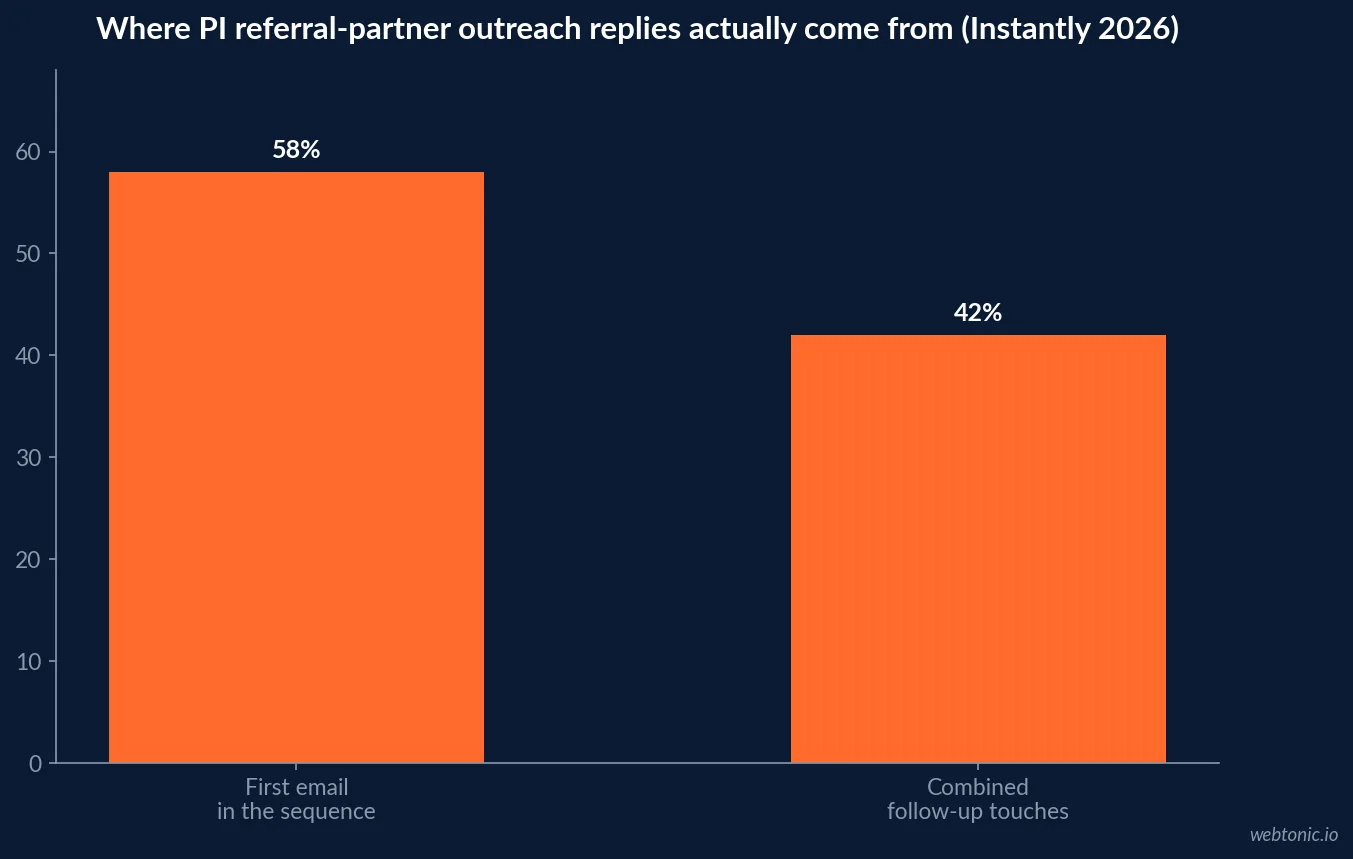
Instantly's 2026 data shows 58% of eventual replies land on the first email in a sequence, with the remaining 42% coming from follow-ups over the following one to two weeks. For a PI firm's referral-partner outreach - reaching a chiropractor's office manager or another firm's intake coordinator - that argues for a short opener with one specific ask (a warm introduction call, a mutual referral arrangement) rather than a long pitch, and one or two spaced follow-ups rather than an aggressive multi-touch cadence more common in consumer sales outreach.
The compliance benefit is a side effect of good practice here too: a short, clearly-purposed B2B email to a named business contact reads nothing like a case-specific solicitation, which keeps it further from any Rule 7.3 ambiguity.
| Sequence element | Recommended approach for PI referral outreach | Why | Source |
|---|---|---|---|
| Opener length | 50-125 words, one clear ask | Matches the segment that drives most replies | Instantly 2026 |
| Follow-up count | 1-3 spaced touches | Captures the 42% of replies follow-ups produce | Instantly 2026 |
| Cadence | 7-14 days between touches | Avoids read-as-aggressive volume | Instantly 2026 / Woodpecker |
| Recipient framing | Named business role, not case reference | Keeps outreach outside Rule 7.3's scope | ABA Model Rule 7.3 |
What a compliance-safe outbound checklist actually verifies
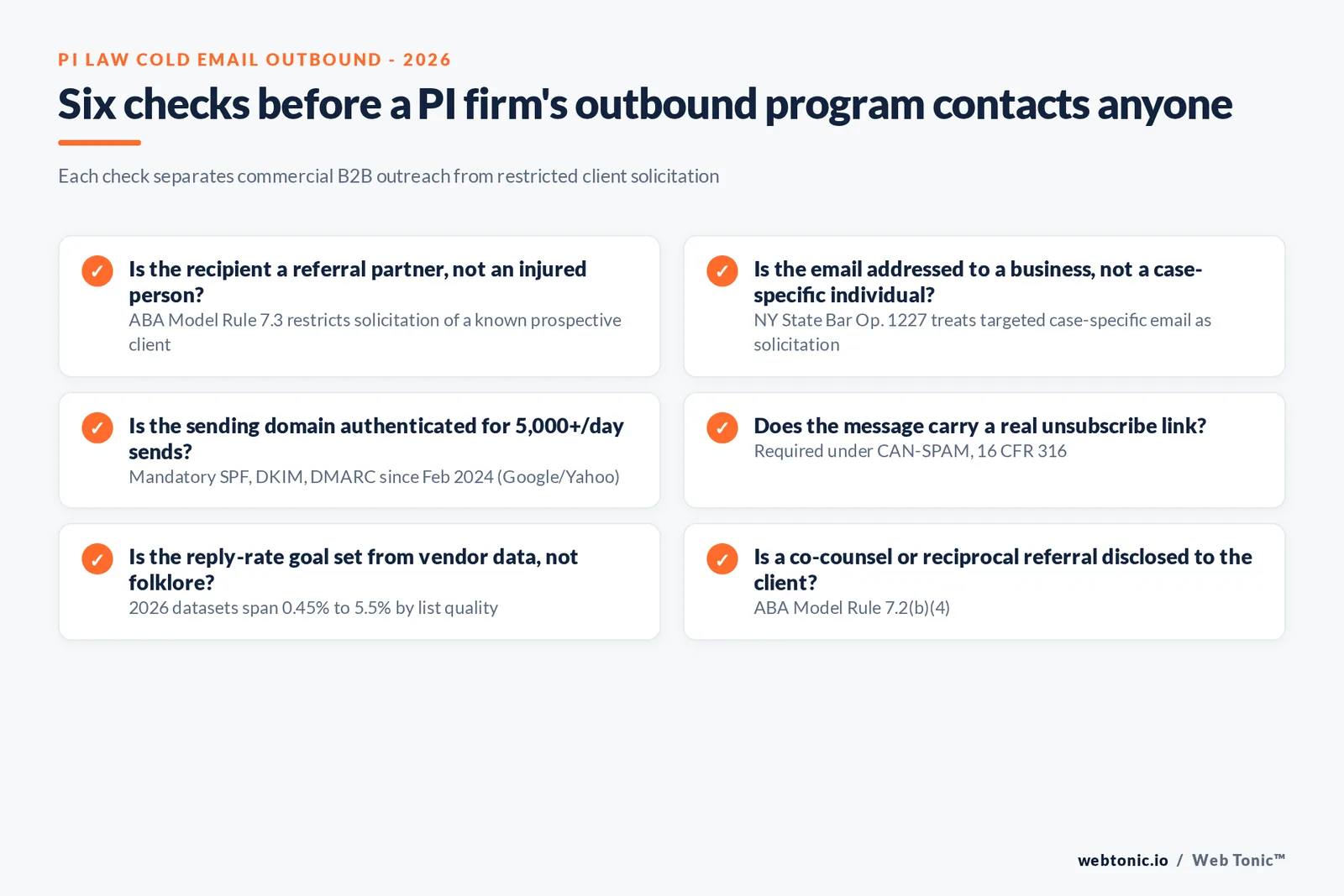
Before any send, the recipient test comes first: is this a business contact (a referral partner, a vendor, another firm) or a specific individual who might need representation for a particular incident. Only after that test passes does the deliverability and CAN-SPAM checklist apply - authenticated domain, truthful sender identity, working unsubscribe, and volume held under the 5,000-per-day threshold that triggers the stricter 2024 Google and Yahoo rules. Skipping the recipient test and going straight to deliverability mechanics is the most common way a well-run technical outbound program still creates an ethics problem.
What a firm should measure instead of a blanket reply rate
Rather than one reply-rate number for "outbound," a PI firm running referral-partner and co-counsel outreach should track reply rate separately by recipient type: chiropractors and medical providers, other law firms for case referrals, and vendors or service providers. Belkins' 2026 data notes that reply rate also varies by the seniority of the recipient and by company size, which means a firm blending all three recipient types into one average is more likely to misread which relationship type is actually working.
| Recipient type | Typical relationship goal | Benchmark to apply | Compliance note |
|---|---|---|---|
| Medical/chiropractic referral sources | Two-way patient-to-case referral relationship | General B2B average, 0.45%-3.43% | Reciprocal referral disclosure under Rule 7.2(b)(4) |
| Other law firms (co-counsel) | Case referral / fee-split partnership | General B2B average, 0.45%-3.43% | Rule 1.5(e) fee division consent |
| Vendors and service providers | Ordinary commercial relationship | General B2B average, 0.45%-3.43% | Standard CAN-SPAM compliance only |
What Gong Labs adds on executive-level recipients
Gong Labs data separately shows C-level executives are 30.2% less likely to reply to cold email than non-executives. For PI firms whose highest-value referral relationships are often with a founding partner at a smaller firm or a practice owner rather than an office manager, that gap argues for routing initial outreach to an operations or intake contact first, then looping in the decision-maker once a relationship exists, rather than opening cold at the top.
Setting the target correctly
A PI firm should never benchmark client-acquisition performance against any of these cold email figures, because client acquisition through unsolicited, case-specific email is restricted, not a volume game. The figures on this page belong to the referral-partner and co-counsel-development side of the practice, where ordinary B2B benchmarks apply, and where our growth marketing team sets outreach targets from the dataset that matches list quality, not from the most flattering number in the market. See our wider demand generation statistics for how that same targeting discipline plays out across other regulated and semi-regulated industries, and get in touch if a current campaign needs a compliance-and-deliverability review before its next send.
Frequently Asked Questions
Can a personal injury law firm cold-email potential clients directly?
Not the way most industries mean it. ABA Model Rule 7.3 defines solicitation as a communication initiated by or for a lawyer, directed to a specific person the lawyer knows or reasonably should know needs legal services in a particular matter, with retention as a significant motive. Email to a named, injured individual about their specific incident falls squarely inside that definition and is heavily restricted or requires a compliant disclosure label depending on the state.
What did the New York State Bar say about targeted email specifically?
NY State Bar Formal Opinion 1227 applied a four-part test to targeted email sent to prospective class action plaintiffs and concluded it qualified as a solicitation: initiated by the lawyer, directed at a specific recipient, with retention as the primary purpose, and no prior professional relationship. That opinion is the clearest statement that email is not exempt from solicitation rules just because it is not a phone call or in-person contact.
So what cold email is actually legal for a PI firm to send?
B2B commercial outreach to businesses and professionals, not case-specific solicitation of an injured person: co-counsel development with other firms, referral-partner outreach to chiropractors, body shops, or financial planners, vendor and service-provider communications, and firm-to-firm case referral discussions. None of these target 'a specific person...who needs legal services in a particular matter,' which keeps them outside Rule 7.3's restriction and inside ordinary CAN-SPAM commercial email rules instead.
What reply rate should that B2B side of a PI firm's outreach expect in 2026?
The same vendor datasets that apply to any B2B industry: Belkins' 2026 study of 7.5 million of its own client emails reports a 0.45% average reply rate; Woodpecker's live benchmark tool, built from 56,614 campaigns, reports a 1.5% median; Instantly's 2026 Cold Email Benchmark Report, spanning billions of emails, puts the average at 3.43% and the top quartile at 5.5%. A PI firm's referral-partner outreach should sit in that same range, since the recipients are business contacts, not consumer prospects.
What changed operationally since the February 2024 Google and Yahoo rules?
Anyone sending 5,000 or more emails a day to Gmail or Yahoo accounts now must authenticate with SPF, DKIM and DMARC, keep spam complaints under roughly 0.3%, and support one-click unsubscribe. Woodpecker's volume-segmented data shows the same shift in outcome: reply rate drops from 1.2% at 21-50 sends per mailbox per day to 0.4% at 201-500 sends per day, meaning the compliant path (smaller, authenticated, better-targeted sends) and the effective path are now the same path.
Sources
North Carolina State Bar - Rule 7.2/7.3 mirror, Model Rules of Professional Conduct
NY State Bar Association - Formal Opinion 1227, Targeted Email as Solicitation
ABA Journal - Avoiding Unlawful Client Solicitation (Formal Opinion 501)
Belkins - B2B cold email response rates, 2026 study
Woodpecker - Free cold email benchmarks tool
Instantly - Cold Email Benchmark Report 2026
Google - Email sender guidelines
Yahoo Sender Hub - FAQs
eCFR - 16 CFR Part 316, CAN-SPAM Rule
Expandi - State of LinkedIn Outreach H2 2026
Gong Labs - Do execs really reply to cold email