Table of contents
Personal injury is the most expensive keyword category in paid search, with top terms reaching $300+ per click. It is also a market where 54% of clients research only two or three firms before hiring. Branding is what decides whether you are in that set — and it is the only lever that lowers the price of every other channel.
Key Takeaways
- 54% of clients who hired a lawyer researched only two or three firms; 19% researched one.
- Fewer than 5% considered six firms or more — the shortlist is the whole competition.
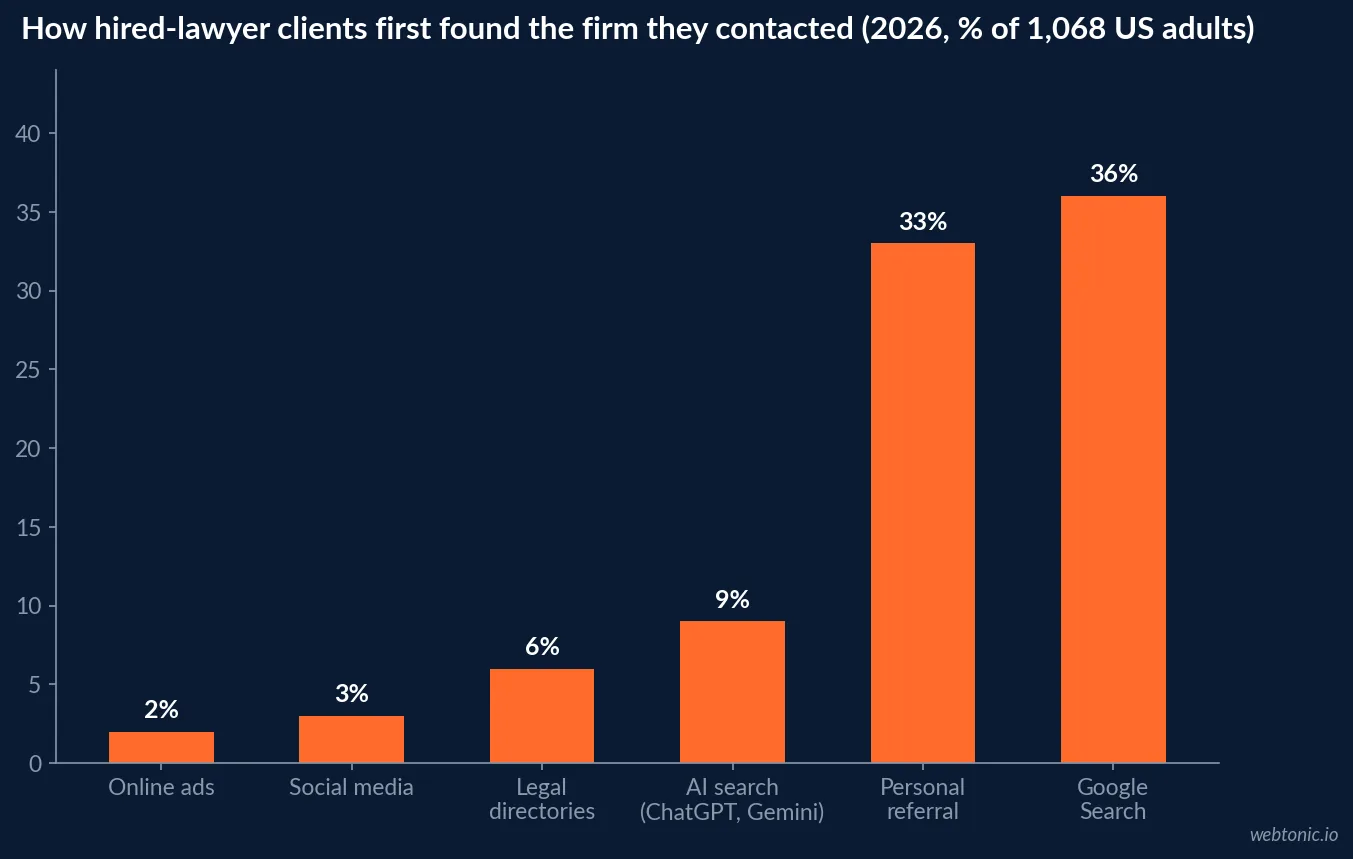
- Google Search (36%) and personal referrals (33%) are the top discovery routes.
- AI search tools already account for 9% of first-contact discovery, ahead of directories (6%) and ads (2%).
- 52% name slow or no response as a reason not to contact a firm; 52% name poor reviews.
- Nearly half hesitate to contact any firm rated below 4.0 stars; 76% read Google reviews.
- 72% of prospects expect a response the same business day; about 15% within an hour.
- 60% of first contacts are made by phone, so brand recall converts through the call, not a form.
- Over three-quarters say a thoughtful reply to a negative review increases trust.
- Trust signals — recommendation (28%), credentials (23%), reviews (19%) — drive over 70% of first calls.
- Personal injury keywords run $50–$300 per click, the highest of any paid-search category.
- Average PI cost per lead is $442 on Google Ads against $183 on SEO.
- Branded search clicks cost $2–$5 and convert at 25–40%.
- US lawyer TV advertising spend is estimated at $2.5–$3.0 billion for 2025.
- Legal-services website redesigns averaged 485% ROI and 41% conversion lift.
- Consistent brand presentation across touchpoints correlates with 23–33% revenue growth.
How Injury Clients Actually Choose a Firm
The most useful branding data in legal marketing is not about logos. A March 2026 survey of 1,068 US adults who hired a lawyer in the previous three years found the decision is faster and narrower than most firms assume: 54% researched two or three firms, 19% researched one, and fewer than 5% looked at six or more.
| Decision behaviour | Share of clients | Brand implication |
|---|---|---|
| Researched 2–3 firms | 54% | Recognition decides shortlist membership |
| Researched exactly 1 firm | 19% | Recall alone can win the case |
| Considered 6+ firms | Under 5% | Comparison shopping is rare |
| Start research on Google Search | 50% | Brand must be findable and consistent |
| First contact made by phone | 60% | Name recall converts through a call |
| Expect same-business-day reply | 72% | Intake is part of the brand |
The Two Dealbreakers That Undo Brand Spend
Elimination is faster than selection. Asked what would stop them contacting a firm, respondents named slow or no response (52%) and poor online reviews (52%) far above every other factor. Nearly half would hesitate at anything under 4.0 stars, and about a quarter treat too few reviews as its own dealbreaker.
| Signal | Client behaviour | Operational fix |
|---|---|---|
| Response speed | 72% expect same-day; ~15% within an hour | Answer within 60 seconds, call back missed calls in 5 minutes |
| Star rating | ~50% hesitate below 4.0 | Systematic review requests after settlement |
| Review volume | ~25% avoid thin profiles | Continuous generation, not campaigns |
| Review depth | 63% read 3–10 reviews | Encourage detailed experience descriptions |
| Negative review handling | 75%+ trust a thoughtful reply | Respond publicly, professionally, always |
| Where reviews are read | Google 76%, directories 28%, Yelp 28% | Prioritise Google Business Profile |
Note what ranks third rather than first: overall star rating. Clients prioritise detailed descriptions of other clients’ experiences, then recency, then the star average. Reputation content is brand content — the same logic behind our personal injury law local SEO statistics.
Why Brand Is the Only Cheap Channel in PI
Legal advertising in 2026 is, per the State of Legal Advertising report, the highest-CPC paid-media category in the US: personal injury keywords routinely cost $50–$300 per click, and top terms exceed $300. Channel benchmarks from PI cost-per-lead research show what those clicks turn into.
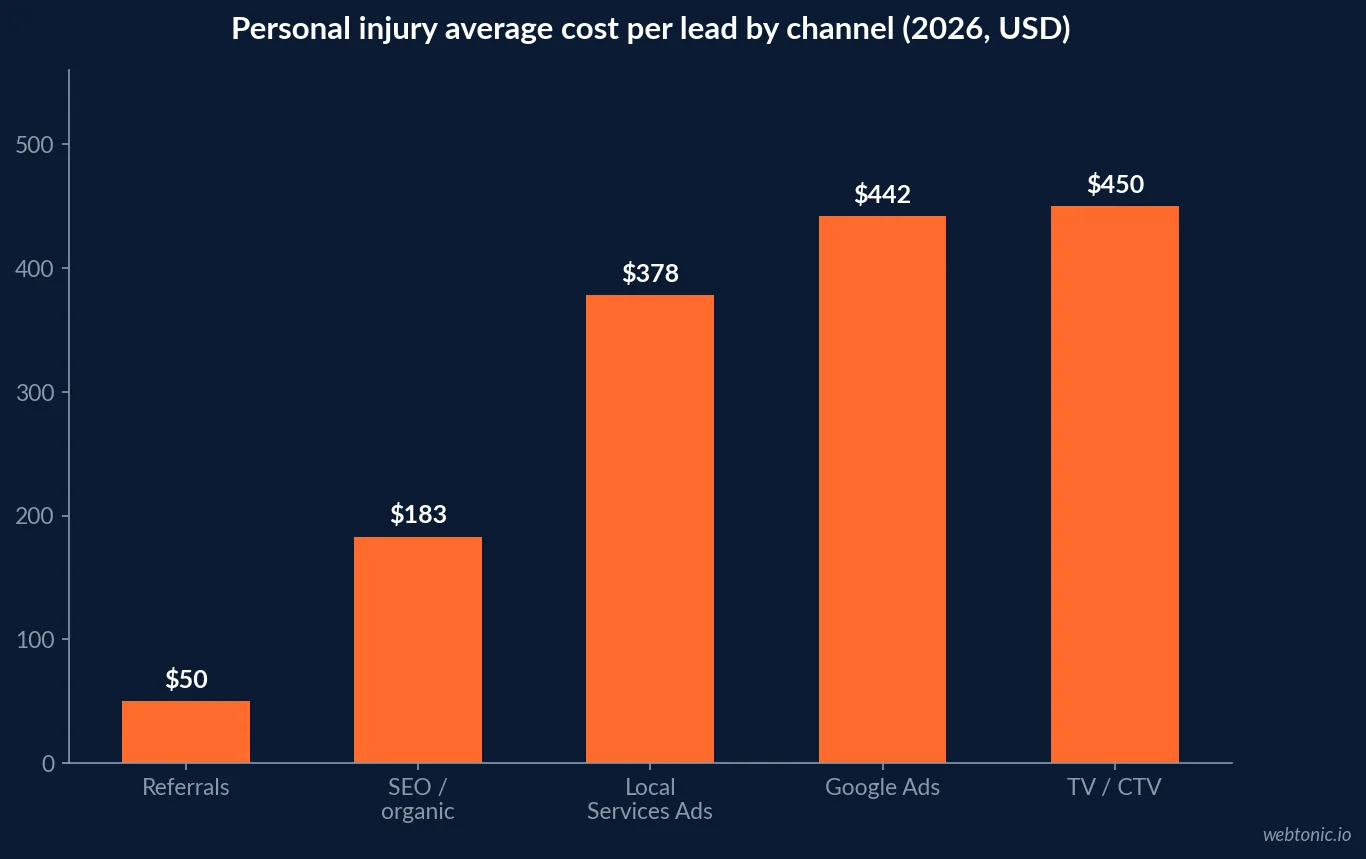
| Channel | Avg cost per lead | Lead-to-case rate | Cost per signed case |
|---|---|---|---|
| Referrals | $0–$100 | 15–20%+ | $0–$667 |
| SEO / organic | $183 | 15–20% | $915–$1,220 |
| TV / CTV | $300–$600+ | 10–15% | $2,000–$6,000 |
| Local Services Ads | $378 | 8–12% | $3,150–$4,725 |
| Google Ads | $442 | 5–15% | $2,900–$8,800 |
The branded-search line is the one that pays for brand work. When someone sees a firm on TV, a billboard or a jersey and later searches the firm by name, that click costs $2–$5 and converts at 25–40%. Nothing else in the PI media mix produces that ratio. Our personal injury law Google Ads statistics cover the auction side of the same equation.
Where the Category Puts Its Brand Money
Estimates of total PI advertising cluster around $2.5–$3.0 billion annually. One 2026 channel-level model of $2.5B in legal ad spend allocates it as follows, and the shape tells you where a smaller firm can still buy attention cheaply.
| Channel | Share of spend | Approx. annual | Primary function |
|---|---|---|---|
| Google Ads | 31% | $775M | High-intent harvest |
| Purchased leads | 26% | $650M | Volume, shared and low-converting |
| TV advertising | 18% | $450M | Brand recall, branded search |
| Google Local Services Ads | 12% | $300M | Verified local intent |
| SEO and content | 8% | $200M | Compounding, lowest CPL |
| Social, print, radio, OOH | 5% | $125M | Awareness and retargeting |
Independent legal ad tracking reports $141.6M in monthly legal ad spend across 35 markets, with legal services taking 6.11% of local broadcast impressions against only 2.72% of local CTV impressions — a gap that matters now that streaming holds roughly 47.5% of all TV viewing. Cheaper TV-equivalent inventory (CTV at $30–$55 CPM, programmatic DOOH at $8–$20) puts a recall-building presence inside reach of firms that could never fund broadcast saturation.
Brand Consistency and Rebrand Economics
Two data points anchor the investment case. First, Lucidpress and Demand Metric research correlates consistent brand presentation across touchpoints with 23–33% revenue growth. Second, a 312-company website redesign study puts legal services at the top of every column: 485% ROI, break-even at 6.2 months, 58% lead-quality improvement and 41% conversion lift — the highest of 18 industries, because case values are large enough that small percentage gains clear the cost quickly.
| Brand investment | Typical cost | Cases needed to break even | Notes |
|---|---|---|---|
| New-firm professional logo | $200–$500 | Under 1 | Freelance-level identity |
| Identity rebrand, established small firm | $2,000–$5,000 | 1–3 | Logo, palette, typography, collateral |
| Full website redesign (legal) | $15,000–$50,000 | 8–25 | 485% avg ROI, 6.2-month break-even |
| Mid-market firm full repositioning | $50,000+ | 25+ | Research, naming, messaging, rollout |
Those identity figures follow published law firm logo design guidance, which recommends $200–$500 for a new firm and $2,000–$5,000 for an established firm that has outgrown an amateur mark.
Costs assume a mid-market cost per signed case of roughly $2,000 on owned channels; firms buying shared leads at $3,000–$6,000 per signed case break even faster on brand work, not slower, because their alternative is more expensive.
What Triggers the Call — and What Does Not
Asked what made them reach out to a specific firm, clients named a recommendation from someone they trust (28%), the lawyer’s experience or credentials (23%) and strong online reviews (19%). Transparent pricing, free-consultation offers and a professional website all trailed. Together, reviews, credentials and endorsements account for over 70% of first calls.
- Lead with proof, not adjectives. Case results, verdict counts and named attorney credentials outperform “aggressive representation” language.
- Make the shortlist reachable. If 60% call first, a tracked, tappable number in the first viewport is brand infrastructure.
- Own one positioning idea. Trucking, premises liability, Spanish-language intake or trial-ready reputation — not “personal injury” generically.
- Design for recall, not taste. Broadcast, DOOH and jersey placements exist to make a later branded search feel safe.
- Audit consistency quarterly across site, GBP, directories, ads and signage — the mechanism behind the 23–33% consistency finding.
The AI-Search Shift Brand Now Has to Cover
9% of clients in the 2026 survey first found their firm through an AI assistant such as ChatGPT or Gemini — ahead of legal directories (6%), social media (3%) and online ads (2%). Directory research shows the same direction: attorney discovery research for 2026 still finds Google dominant with YouTube (16%) and Yelp (14%) reaching meaningful audiences, while write-in answers are dominated by referrals and word of mouth.
For brand teams that means the entity, not just the identity: consistent firm name, address, attorney bios, practice-area pages and review volume across the profiles AI systems lean on to validate a firm. Practitioner analysis of how people choose personal injury lawyers makes the same point without the technology: visibility without familiarity loses to familiarity with reputation.
Personal Injury vs Other Legal Verticals
| Practice area | Client acquisition cost | Cost per lead | Case value range |
|---|---|---|---|
| Personal injury | $2,500 | $183–$512 | $30,000–$100,000+ |
| Criminal defence | $2,000–$7,000 | $100–$350 | $5,000–$50,000 |
| Family law | $500–$2,000 | $75–$200 | $3,000–$20,000 |
| Business / corporate | $5,000–$15,000 | $200–$500 | Varies widely |
PI sits in a rare position: high acquisition cost and high case value, which is exactly the condition under which brand equity compounds. Median PI cost per lead also swings 33% between regions ($314 in the Midwest against $468 in the Northeast), so the value of being recalled rather than auctioned is highest in dense metros. For the creative execution side, see our personal injury law ad creative statistics, and for the full channel picture our personal injury law digital marketing statistics.
Building a Brand Measurement Loop
The reason brand budgets get cut in personal injury is that they are measured with lead-source fields designed for paid search. Four measurements survive scrutiny with partners, and all four can be read monthly.
| Measurement | How to capture it | What good looks like |
|---|---|---|
| Branded search volume | Search Console impressions on firm-name queries | Rising month over month during flights |
| Branded click cost and conversion | Paid search brand campaign segment | $2–$5 CPC, 25–40% conversion |
| Share of intake naming the firm unprompted | Intake script question, logged in the CRM | Growing share of total signed cases |
| Review velocity and average rating | Google Business Profile, monthly | Above 4.0 stars and never stalling |
| Blended cost per signed case | All marketing cost ÷ signed cases | Falling as brand share rises |
The last row is the one that settles arguments. Brand does not have its own conversion rate; it lowers everyone else’s cost. A firm running $442 Google Ads leads at a 5% signed-case rate is paying $8,840 per case, while the same lead cost at a 15% rate is $2,947. Recognition, response speed and review depth are what move that rate — which is why intake training and reputation work usually outperform another bid increase.
Frequently Asked Questions
Does branding actually matter in personal injury law?
It decides who gets shortlisted. In a 2026 survey of 1,068 US adults who had hired a lawyer, 54% researched only two or three firms and 19% researched exactly one. Brand recognition and reputation determine membership of that set before any ad, offer or fee structure is compared.
How much do personal injury firms spend on advertising?
US lawyer TV advertising alone is estimated at $2.5–$3.0 billion for 2025, and one 2026 channel model puts total PI advertising near $2.5 billion split across Google Ads (31%), purchased leads (26%), TV (18%), Local Services Ads (12%), SEO and content (8%) and everything else (5%). Personal injury is the highest-CPC category in all of paid search, with top keywords reaching $300+ per click.
What is a PI law firm brand actually worth in dollars?
Its clearest measurable value is branded search. Branded clicks driven by TV and out-of-home cost roughly $2–$5 and convert at 25–40%, against a $442 average Google Ads cost per lead converting at 5–15% to a signed case. Every case that arrives through a recalled name instead of an auction avoids a $2,900–$8,800 acquisition cost.
What kills a personal injury firm's brand fastest?
Response time and reviews, equally. Both slow or no response and poor online reviews were cited by 52% of surveyed clients as reasons not to contact a firm at all, and nearly half would hesitate to contact any firm rated below 4.0 stars. 72% expect a reply the same business day.
How much should a personal injury firm spend on a logo or rebrand?
Published guidance for law firms puts a professional freelance logo at $200–$500 for a new firm and a proper identity rebrand at $2,000–$5,000 for an established small firm, scaling into six figures for multi-office brands. Against a $2,000 cost per signed case and case fees that run five to six figures, that is one to three cases.
Sources
How Clients Choose Law Firms in 2026 (1,068-respondent survey)
PI Cost Per Lead Benchmarks 2026
Law Firm Client Acquisition Cost by practice area
State of Legal Advertising 2026
Legal advertising spend 2026 by channel
Attorney advertising data: $2.9B a year
Online sources used to find attorneys in 2026
How do people choose personal injury lawyers
Website Redesign ROI Statistics 2026
Rebranding vs renaming: brand consistency research
Personal injury lawyers marketing benchmarks 2026
Law firm logo design: what works