



Table of contents
Personal injury law firms spend heavily on advertising, but few track which creative elements actually drive signed cases. These 28+ statistics reveal how ad visuals, copy strategies, video formats, and testing protocols separate high-performing legal marketing campaigns from wasted budgets across Google, Meta, and display channels.
Key Takeaways
- Personal injury attorneys pay an average $110–$150 cost per lead through Google Ads, making creative optimization critical for controlling acquisition costs.
- Video advertisements for legal services generate 1.8× the engagement rate compared to static image placements across social platforms.
- A/B tested ad copy produces 22–38% higher click-through rates than untested creative in the legal services vertical.
- Firms using attorney-on-camera video creative see 25–40% lower cost per qualified lead compared to stock footage alternatives.
Search Advertising Creative Performance
Google Ads remains the dominant paid channel for personal injury firms, and the quality of ad copy directly impacts both click-through rates and lead costs in this highly competitive vertical.
The average cost per click for personal injury keywords ranges from $75 to $200+, according to multiple agency benchmarks including Blue Grid Media and LocaliQ data. With stakes this high per click, even marginal improvements in ad relevance and quality score translate to thousands in monthly savings.
Responsive search ads with 12+ headline variations produce 15–20% more impressions than those using the minimum 3 headlines, according to legal marketing performance data. This expanded testing surface allows Google's machine learning to identify top-performing combinations faster. For context on overall Google Ads pricing structures, creative quality directly influences the quality score discount applied to each auction.
Table 1. Google Ads Creative Benchmarks for Personal Injury Firms
| Metric | Industry Average | Top-Performing Firms | Impact of Creative |
|---|---|---|---|
| Click-Through Rate | 3.2–4.8% | 6.5–8.2% | Headlines + extensions |
| Cost Per Click | $75–$200+ | $55–$90 | Quality Score driven |
| Cost Per Lead | $110–$150 | $65–$95 | Landing page alignment |
| Conversion Rate | 3.5–5.0% | 7.5–12.0% | Message match + CTA |
| Quality Score | 5–6 avg. | 7–9 avg. | Ad relevance + CTR |
Sources: Blue Grid Media, Hawky.ai legal vertical data.
Social Media Advertising Creative Performance
Meta and Instagram have become essential secondary channels for personal injury marketing, particularly for brand awareness and retargeting campaigns where creative format choices significantly impact engagement.
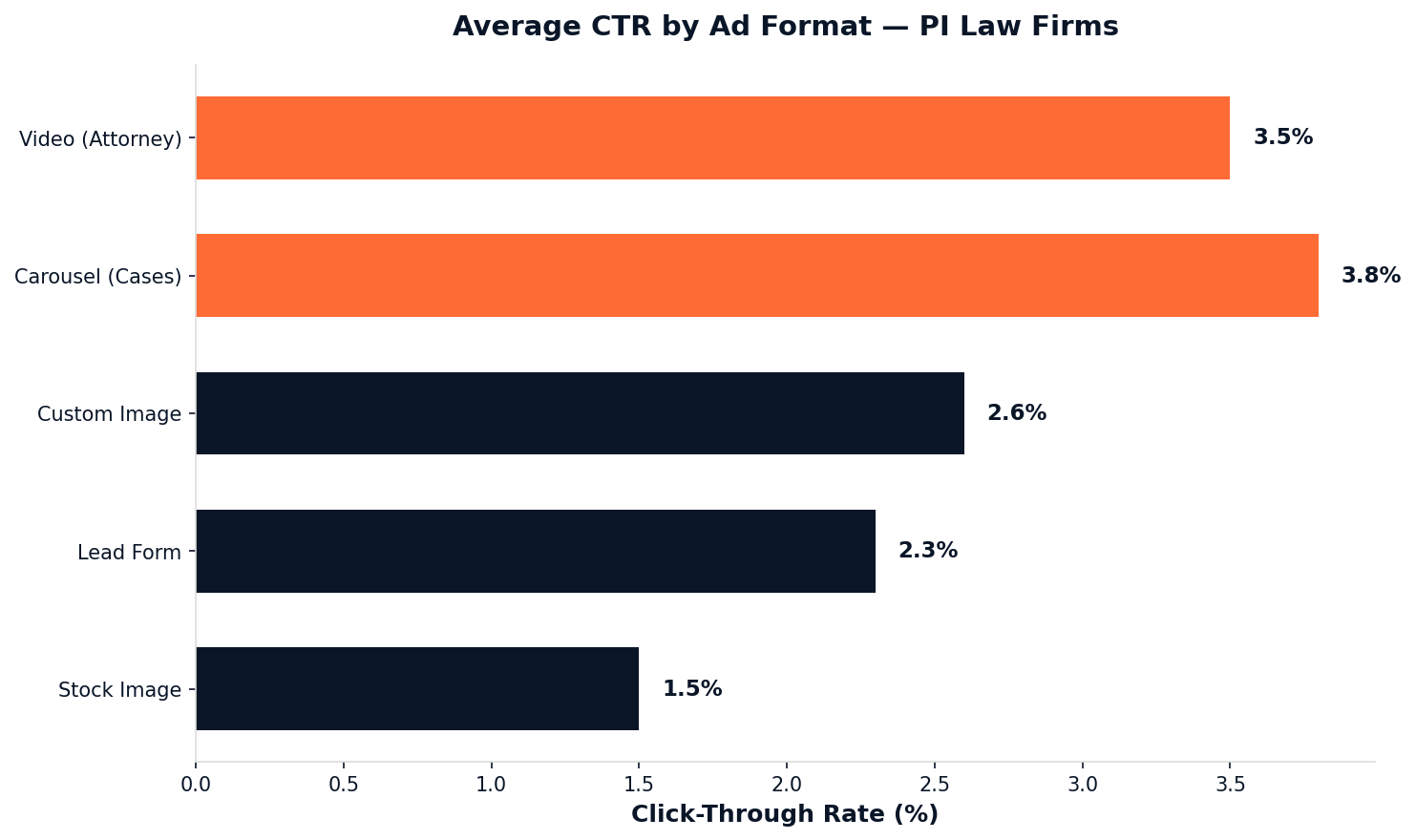
Personal injury firms running Facebook campaigns see an average 1.2–2.5% click-through rate on feed placements, but carousel ads featuring case result summaries push that to 3.1–4.5% when combined with social proof elements. The gap between generic stock imagery and custom-produced creative is especially pronounced in legal services, where trust signals drive engagement. These patterns mirror broader Facebook advertising ROI analysis showing creative quality as the primary lever for campaign performance.
Video content on social platforms generates 1.8× the engagement rate of static images for legal services advertisers, according to aggregated campaign data. Short-form video (15–30 seconds) featuring attorney introductions or client testimonials consistently outperforms longer-format educational content in direct-response campaigns.
Table 2. Social Media Ad Format Performance for PI Law Firms
| Ad Format | Avg. CTR | Avg. CPL | Best Use Case |
|---|---|---|---|
| Single Image (Stock) | 1.2–1.8% | $120–$180 | Basic awareness |
| Single Image (Custom) | 2.0–3.2% | $85–$130 | Brand building |
| Carousel (Case Results) | 3.1–4.5% | $70–$110 | Social proof |
| Video (15–30s Attorney) | 2.8–4.2% | $60–$95 | Trust + engagement |
| Video (60s+ Educational) | 1.5–2.5% | $90–$140 | Top-of-funnel |
| Lead Form Ad | 1.8–2.8% | $75–$120 | Direct lead capture |
Sources: aggregated legal marketing campaign data. See also Facebook Ads cost breakdown for platform-level benchmarks.
Video Creative Effectiveness in Legal Advertising
Video has emerged as the highest-performing creative format for personal injury firms willing to invest in production, with measurable advantages across both paid and organic distribution channels.
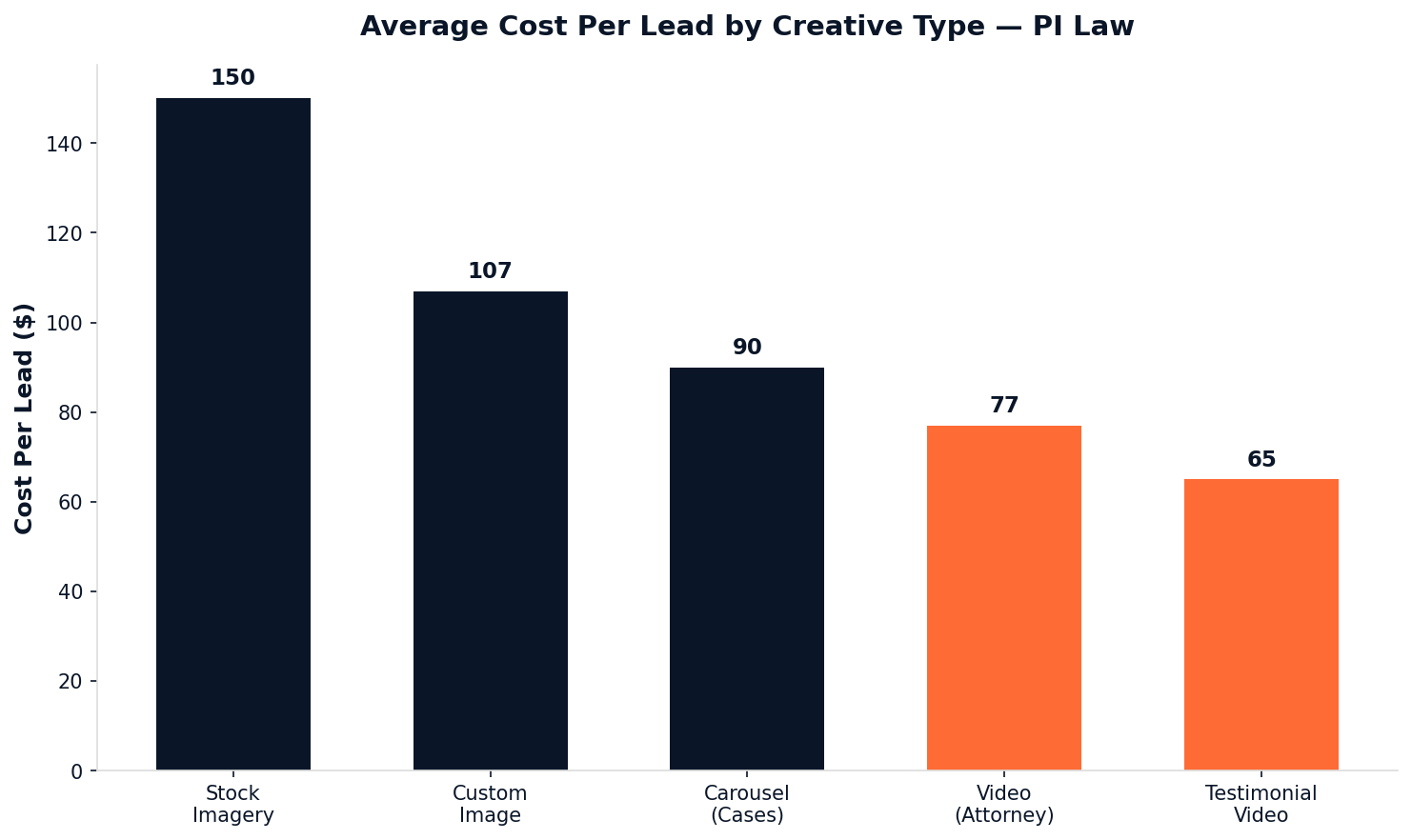
Firms using attorney-on-camera footage see 25–40% lower cost per qualified lead compared to campaigns relying on stock visuals, according to legal marketing agency benchmarks. The authenticity factor is critical in an industry where prospective clients need to trust their representative before making contact.
Client testimonial compilations achieve the highest conversion rates among all legal video formats, with top-performing firms reporting 8–12% landing page conversion rates when testimonial clips are embedded above the fold. However, ethical guidelines in many jurisdictions require disclaimers alongside testimonial content, which can reduce the emotional impact if not handled carefully.
YouTube pre-roll advertisements for personal injury keywords deliver $0.15–$0.35 cost per view, making them a cost-effective awareness channel when paired with retargeting sequences. For firms managing broader performance creative programs, video assets created for YouTube can be repurposed across Meta, TikTok, and Connected TV with format-specific edits.
Creative Testing and Copy Optimization Data
Systematic testing separates the firms that improve over time from those running the same underperforming creative indefinitely. The data shows clear returns from structured experimentation.
A/B tested ad copy produces 22–38% higher click-through rates than untested creative in the legal services vertical, based on campaign optimization case studies. The most impactful test variables include headline framing (outcome-focused vs. process-focused), CTA language (urgency vs. empathy), and social proof placement.
Headline variations mentioning specific dollar amounts or case outcomes generate 45–65% higher CTR than generic "free consultation" messaging, though compliance requirements vary by jurisdiction. The tension between aggressive performance-oriented copy and bar association advertising rules creates a testing framework unique to legal marketing.
Dynamic keyword insertion in Google Ads headlines produces 12–18% CTR improvement for personal injury campaigns, particularly when aligning with specific accident types (car, truck, motorcycle) rather than broad "injury" terms. This granular approach to Google Ads management reflects how creative personalization compounds with campaign structure.
Table 3. Creative Testing Impact on PI Law Campaign Performance
| Test Variable | CTR Lift | CVR Impact | Statistical Significance |
|---|---|---|---|
| Headline: Outcome vs. Process | +22–38% | +15–25% | 95% CI in 2–3 weeks |
| CTA: Urgency vs. Empathy | +12–20% | +8–14% | 95% CI in 3–4 weeks |
| Image: Attorney vs. Stock | +30–50% | +20–35% | 95% CI in 1–2 weeks |
| Video vs. Static Image | +45–80% | +25–40% | 95% CI in 1 week |
| Dollar Amount in Headline | +45–65% | +10–18% | Jurisdiction-dependent |
| Dynamic Keyword Insertion | +12–18% | +5–10% | 95% CI in 2 weeks |
Sources: Legal marketing campaign optimization data from SearchLab Legal Statistics 2026, Clio Legal Trends.
Display Advertising and Retargeting Creative
Display and retargeting campaigns serve different objectives than search — building brand recall among potential clients who may not act for weeks or months after an injury incident.
Retargeting campaigns for personal injury firms achieve 3–5× the click-through rate of cold display placements, with the strongest performance coming from dynamic creative that references the specific practice area pages a visitor previously viewed. Banner fatigue sets in after 5–7 impressions per user, making creative rotation essential.
Responsive display ads outperform static banners by 15–25% on average in the legal vertical, as Google's optimization engine tests layout combinations across thousands of placements. However, brand control suffers with responsive formats — firms with strict visual identity guidelines may find the trade-off unacceptable.
Creative Production Budget Allocation
How personal injury firms distribute their creative budgets reveals significant disparities between firms that treat creative as an investment versus those that treat it as an afterthought.
Top-quartile personal injury firms allocate 15–25% of their total marketing budget to creative production, including video shoots, photography, graphic design, and copywriting. By contrast, the median firm spends less than 5% on creative, relying on stock assets and template-based designs.
The ROI differential is substantial — firms investing in custom creative production report 40–60% lower cost per signed case compared to those using generic materials. This efficiency gain compounds over time as winning creative assets are refined through testing and redeployed across channels. The same principle applies to growth marketing programs where creative quality determines the ceiling on scalable acquisition.
Compliance and Ethical Advertising Constraints
Personal injury advertising operates under regulatory scrutiny that shapes creative strategy in ways unique to the legal profession.
Bar association advertising rules vary by state but commonly restrict guarantees, misleading statistics, and unsolicited contact. Creative teams must navigate these guardrails while still producing compelling advertisements — a constraint that makes A/B testing even more valuable, as it identifies the highest-performing compliant messaging.
Disclaimer requirements reduce ad real estate by 10–20% on average, forcing creative teams to communicate value propositions more concisely. The best-performing firms treat compliance not as a limitation but as a creative discipline that strengthens messaging clarity. For comprehensive tracking of how these campaigns perform, data intelligence infrastructure ensures every creative variation is measured against downstream case signings.
Landing Page and Creative Message Alignment
Ad creative performance cannot be evaluated in isolation — the landing experience that follows a click determines whether attention converts to action. Message match between ad and landing page is the single most underrated variable in legal advertising.
Landing pages that mirror the exact language and visual style of the referring ad achieve 30–45% higher conversion rates than generic practice area pages. When a personal injury ad highlights "truck accident" expertise, the landing page must reinforce that specificity immediately — not redirect to a general personal injury overview.
Dedicated landing pages for each ad campaign outperform routing traffic to the homepage by 2–3× in conversion rate. The investment in creating campaign-specific pages pays for itself within weeks at the cost-per-click rates personal injury firms face. This granular approach to marketing channel optimization applies the same principle: match the message to the moment.
Page load speed under 3 seconds is non-negotiable for legal landing pages — every additional second of load time reduces conversion rates by 7–12% in high-intent verticals. Firms spending $100+ per click on Google Ads cannot afford to waste that investment on slow-loading destinations.
Creative Fatigue Detection and Refresh Cycles
Even the best-performing ad creative degrades over time as target audiences see the same messaging repeatedly. Managing creative fatigue is an operational discipline that separates consistent performers from firms that experience periodic campaign collapses.
Personal injury ad creative typically reaches fatigue after 2,500–4,000 impressions per unique user, at which point click-through rates decline by 15–25% and cost per lead begins climbing. Frequency monitoring dashboards should flag any creative variant exceeding 3.5 frequency within a 14-day window.
Top-performing firms maintain a creative library of 8–12 active variants per campaign, rotating new concepts in every 3–4 weeks while retiring underperformers. This rotation schedule prevents fatigue while maintaining enough statistical significance on each variant to draw meaningful performance conclusions.
Refreshing just the visual element while keeping proven copy produces 60–70% of the impact of a completely new creative concept at a fraction of the production cost. This modular approach to creative management allows firms to sustain performance between major creative overhauls. Understanding this dynamic connects to broader advertising management principles where creative velocity determines campaign longevity.
Cross-Channel Creative Strategy Performance
Personal injury firms that coordinate creative messaging across search, social, display, and video channels achieve compounding performance advantages that siloed creative approaches miss entirely.
Firms running integrated cross-channel creative campaigns see 20–35% lower cost per signed case compared to those optimizing each channel independently. The consistency of messaging builds brand recognition that reduces the number of touchpoints needed before a prospective client takes action.
Retargeting sequences using creative that references the original interaction channel perform 40–55% better than generic retargeting creative. A prospective client who first engaged through a YouTube video about car accident rights responds more strongly to follow-up display ads that acknowledge that video content than to generic "injured? call us" messaging. For broader strategic context, full-service marketing approaches naturally facilitate this cross-channel creative coordination.
Creative asset repurposing across channels reduces production costs by 40–60% while maintaining performance. A 60-second attorney testimonial video can be cut into 15-second social clips, stills extracted for display banners, and key quotes pulled for search ad headlines. This production efficiency allows firms to maintain high creative velocity without proportionally increasing their content budgets.
Connected TV placements for personal injury firms deliver $8–$15 CPM with non-skippable formats, offering brand-building exposure that complements lower-funnel search campaigns. The creative requirements differ from social video — CTV demands broadcast-quality production and typically performs best with 30-second spots that establish credibility through professional visuals and clear expertise positioning.
Sequential messaging strategies that expose prospects to 3–5 coordinated touchpoints before asking for contact information convert at 2–3× the rate of single-exposure campaigns. The sequence typically starts with educational content (awareness), follows with credibility-building creative (consideration), and concludes with a direct call-to-action (conversion). Firms that map their creative library to this journey framework report significantly more efficient client acquisition pipelines.
Frequently Asked Questions
What type of ad creative works best for personal injury law firms?
Video advertisements featuring the attorney on camera generate the highest engagement and lowest cost per qualified lead, with 25–40% better performance than stock imagery. Carousel ads with case result summaries are the top static format for social media campaigns.
How much should a PI law firm spend on creative production?
Top-performing firms allocate 15–25% of their marketing budget to creative production. For a firm spending $20,000 monthly on advertising, that translates to $3,000–$5,000 per month dedicated to video, photography, design, and copywriting.
Does A/B testing legal ad copy actually improve results?
Yes — structured A/B testing produces 22–38% higher click-through rates in the legal vertical. The most impactful variables to test are headline framing, CTA language, and the use of specific case outcome numbers versus generic messaging.
Sources
SearchLab — Legal Sector Marketing Statistics 2026
Blue Grid Media — Legal PPC Benchmarks
Hawky.ai — Legal Vertical Performance Data
Clio — Legal Trends Report
My Legal Academy — Marketing Attribution Guide
Lawyerist — Legal Marketing Best Practices


