Table of contents

What personal injury firms call affiliate or partnership marketing is not a commission program: ABA Model Rule 7.2(b) blocks cash-for-referral outside four narrow exceptions, and every published bar-run referral service charges a consistent 10% remittance on the resulting fee. This page prices what is actually published, not a generic affiliate benchmark.
Key Takeaways
- ABA Model Rule 7.2(b) bars paying a non-lawyer for recommending a lawyer's services.
- Four exceptions exist: ad costs, legal service plans, practice purchase, reciprocal referrals.
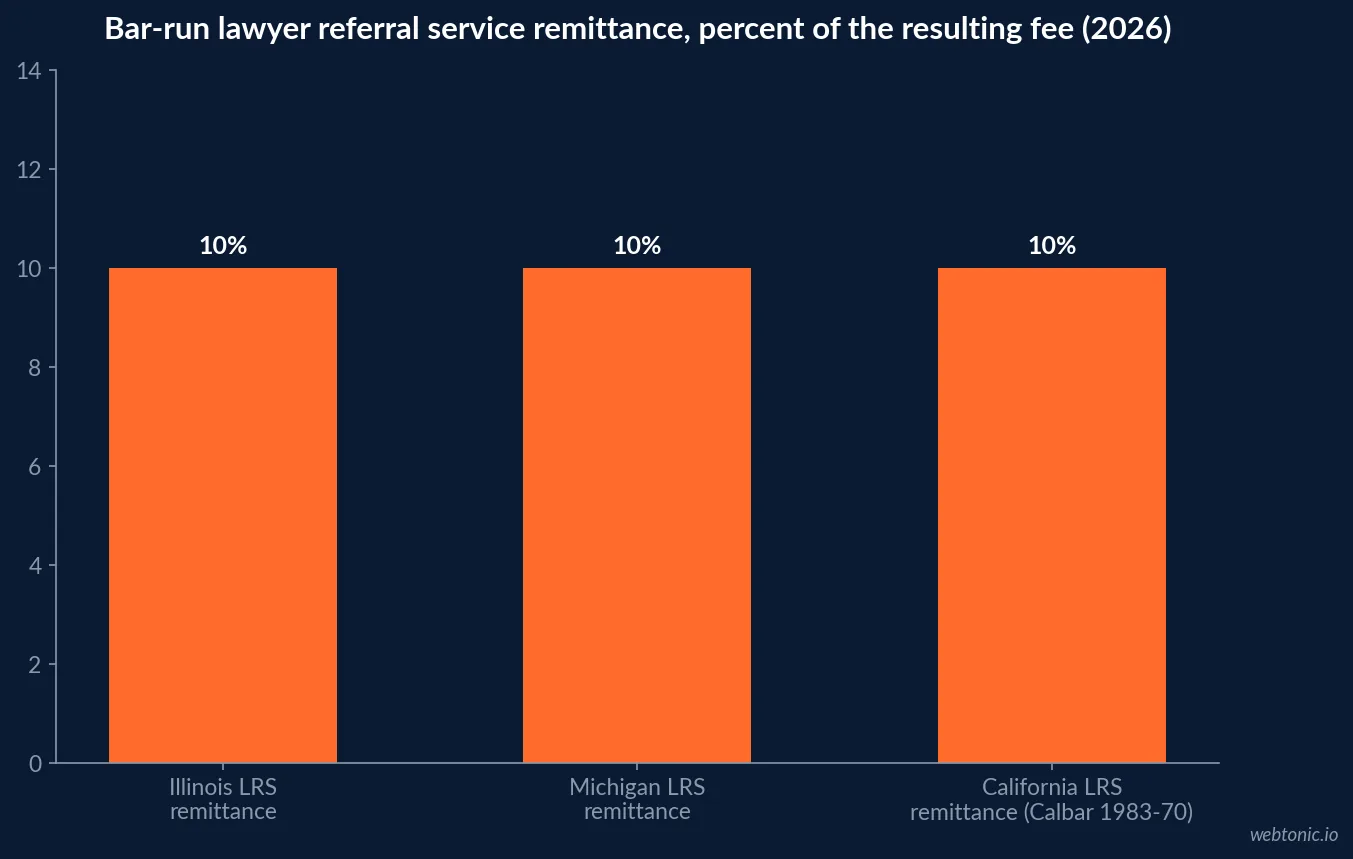
- Illinois State Bar's referral service charges 10% of fees of USD 500 or more.
- Michigan's referral service charges the same 10% on fees of USD 250 or more.
- A 1983 California State Bar opinion describes a 10% remittance with a USD 300 minimum.
- ABA Model Rule 1.5(e) governs fee division between lawyers not in the same firm.
- Florida wrongful death referrals cap the referring attorney's share at 25%.
- The primary attorney must keep at least 75% in that same Florida case type.
- Reciprocal referral agreements must be non-exclusive and disclosed to the client.
- LegalMatch's attorney lead generation service is published starting at USD 455 a month.
- Commercial lead marketplaces are a purchase of advertising, not a fee split.
- No commission-style affiliate benchmark exists for personal injury law, unlike retail.
- FTC 16 CFR 255 still requires disclosure of any paid endorsement a firm runs online.
- New York's Formal Opinion 2017-1 permits paying a percentage to an approved referral service.
Why "affiliate marketing" means something different in personal injury law
In retail or SaaS, affiliate marketing is a commission paid to whoever sends a converting buyer. Legal ethics rules make that exact mechanism illegal for lawyers in most circumstances. ABA Model Rule 7.2(b) states a lawyer "shall not compensate, give or promise anything of value to a person...for recommending the lawyer's services" except in four narrow situations. Anyone building a PI-firm partnership program has to design inside those four exceptions, not around them.
The four exceptions that make any of this legal
Rule 7.2(b) permits paying: (1) the reasonable costs of advertisements or communications; (2) the usual charges of a legal service plan or a not-for-profit or qualified lawyer referral service; (3) the reasonable costs of buying a law practice consistent with Rule 1.17; and (4) a reciprocal referral agreement with another lawyer or nonlawyer professional, provided it is not exclusive and the client is told about it. Nearly every legitimate PI partnership structure fits inside one of these four boxes; nearly every problematic one does not.
| Exception under Rule 7.2(b) | What it actually permits | What it does not permit |
|---|---|---|
| (1) Advertising costs | Paying a publisher, platform or agency for ad placement | Paying per lead delivered as a %-of-fee kickback |
| (2) Legal service plan / referral service | Usual charges of a qualified, often not-for-profit, referral program | An informal, unregulated referral broker |
| (3) Practice purchase | Buying a retiring lawyer's practice under Rule 1.17 | Paying a non-lawyer to source new clients |
| (4) Reciprocal referral agreement | Non-exclusive, disclosed cross-referral with another professional | An exclusive arrangement or one hidden from the client |
What a bar-run referral service actually charges
Where a state bar operates its own program, the published rate clusters tightly around 10%. The Illinois State Bar Association's Lawyer Referral Service charges panelists 10% of the total fee once it reaches USD 500 or more. The State Bar of Michigan's Lawyer Referral Service sets the identical 10% remittance on fees of USD 250 or more. A 1983 California State Bar ethics opinion describes the same 10% structure with a USD 300 minimum fee threshold, and the mechanism is old enough, and stable enough, that no state has meaningfully moved off it in the decades since.
| Referral service | Published remittance | Minimum fee threshold | Governing document |
|---|---|---|---|
| Illinois State Bar Association LRS | 10% of total fee | USD 500 | ISBA Premium Referral Rules |
| State Bar of Michigan LRS | 10% of entire fee | USD 250 | Michigan LRS program rules |
| California LRS (per 1983 opinion) | 10% of fees over the minimum | USD 300 | Calbar Formal Opinion 1983-70 |
| New York bar-approved referral service | Percentage permitted per Formal Op. 2017-1 | Varies by program | NYC Bar Formal Opinion 2017-1 |
Co-counsel fee splits: where the real percentages move
Lawyer-to-lawyer referrals - the co-counsel and case-transfer relationships that function like a "partnership channel" inside the PI industry - run on Rule 1.5(e)'s fee-division framework, and individual states cap specific case types further. Florida's Formal Opinion 89-1 confirms a referring attorney can receive up to 25% of the fee under a standard referral, while wrongful death matters under Florida Rule 4-1.5(f)(4)(D) specifically require the primary attorney to keep at least 75% and cap the referring attorney at 25%, unless a court approves a different division.

Commercial lead marketplaces: a different legal category entirely
Attorney lead marketplaces sidestep the fee-splitting rules by charging for advertising, not for a share of the recovered fee. LegalMatch publishes its attorney lead generation service starting at USD 455 a month. Martindale-Avvo's LeadDirect for Personal Injury advertises a fixed cost per lead with no long-term commitment, structured so a firm can ramp spend up or down. Both models function under Rule 7.2(b)'s first exception - paying the reasonable cost of advertising - which is exactly why they can charge on volume without touching fee-splitting rules at all.
| Channel | Pricing published (2026) | Legal mechanism | Rule 7.2(b) exception used |
|---|---|---|---|
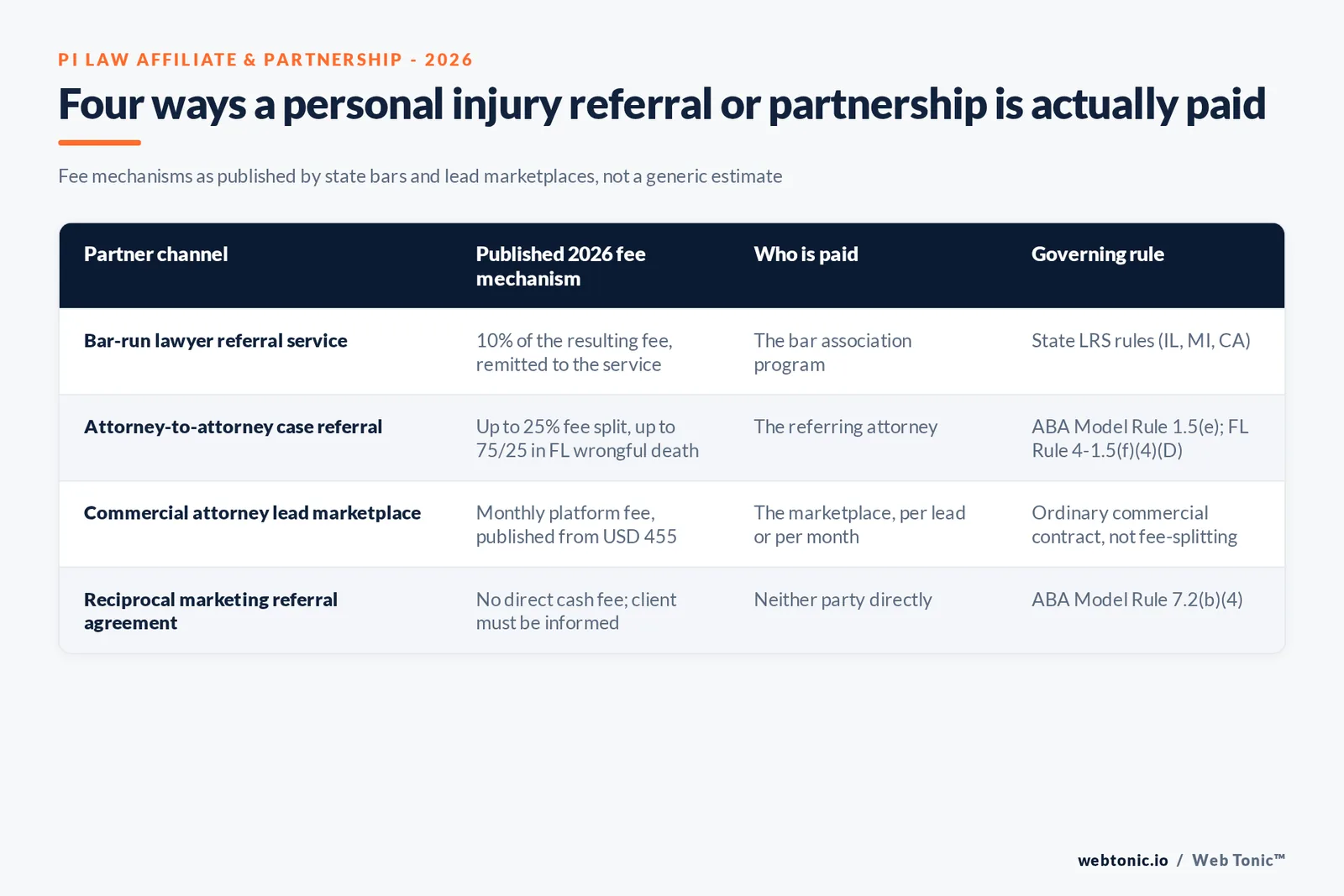
| Bar-run lawyer referral service | 10% of resulting fee | Referral service remittance | Exception (2) |
| Co-counsel case referral | Up to 25% (75/25 cap in FL wrongful death) | Fee division under Rule 1.5(e) | N/A - governed by Rule 1.5, not 7.2 |
| LegalMatch attorney lead gen | From USD 455/month | Advertising purchase | Exception (1) |
| Martindale-Avvo LeadDirect PI | Fixed cost per lead, published on request | Advertising purchase | Exception (1) |
| Reciprocal referral partnership | No direct cash fee | Cross-referral agreement | Exception (4), disclosure required |
The disclosure duty every reciprocal referral partnership owes the client
Even the one exception built for genuine cross-industry partnerships - a PI firm and a chiropractor, a body shop, or a financial planner agreeing to send business to each other - carries a condition most informal handshake deals skip: the arrangement cannot be exclusive, and the client has to be told it exists. That single sentence of disclosure is what keeps an otherwise reasonable referral relationship from crossing into an undisclosed kickback.
Beyond the bar rules, any public-facing endorsement - a chiropractor's website recommending a specific PI firm, or vice versa - still triggers ordinary FTC 16 CFR 255 disclosure if anything of value changes hands for the endorsement, on top of the bar-specific rule.
Client-facing solicitation is a separate rule from the partnership itself
None of the fee-splitting or referral-service rules above touch how a firm may contact an injured person directly - that is a separate area governed by ABA Model Rule 7.3 on solicitation. The partnership and referral-fee rules on this page govern the business relationships behind the scenes; Rule 7.3 governs the moment a firm reaches an actual prospective client, which is a distinct compliance question from anything a referral or partnership agreement can fix.
How PartnerStack-style partnership economics compare, outside law
It helps to see what a genuinely commission-based partnership channel looks like elsewhere, precisely because PI law cannot run one. PartnerStack's 2026 GTM survey found 69% of B2B SaaS companies increasing partnership investment, with 18% crediting partners as the primary source of qualified leads and referrals. That model - an affiliate or reseller earning an uncapped percentage of revenue for as long as the customer stays active - is exactly the arrangement Rule 7.2(b) forecloses for lawyers, which is why no legal-industry equivalent of a SaaS affiliate dashboard exists.
The absence of that model is not an oversight; it is the direct, intended effect of a rule written specifically to prevent client relationships from being bought and sold like SaaS trial signups.
| Channel characteristic | Typical B2B SaaS partnership (PartnerStack) | Personal injury law equivalent |
|---|---|---|
| Payment basis | % of recurring revenue, uncapped | Flat referral-service remittance (10%) or Rule 1.5(e) fee split (capped) |
| Who can be paid | Any registered affiliate or reseller | Only another lawyer, or specific 7.2(b) exceptions |
| Disclosure to end customer | Rarely required | Mandatory for reciprocal referral agreements |
| Program administration | Self-serve partner portal | Bar-run referral service or manual co-counsel agreement |
The one metric this niche cannot benchmark: cost per acquired case
Because fee-splitting is capped by rule rather than set by market competition, "cost per acquired case through the partnership channel" is not a number a PI firm can optimize the way a retail brand optimizes cost per acquisition. A referral that costs 25% of the fee is 25% whether the case is worth USD 10,000 or USD 1 million; there is no lever to negotiate that percentage down through better creative or targeting, because it is a bar rule ceiling, not a market price. The only real lever is which channel a firm routes a given relationship through - referral service, co-counsel split, or paid advertising - not the rate within any one of them.
Cross-referring outside the profession: the disclosure most firms skip
Every PI firm has some version of an informal cross-referral relationship with a chiropractor, a body shop, a financial planner, or a treating physician's office. Rule 7.2(b)(4) permits this, but only when the arrangement is not exclusive and the client is told it exists. In practice, that means a written intake disclosure - a single sentence noting the relationship - is the difference between a compliant reciprocal referral and an undisclosed inducement, even when no money changes hands in either direction.
| Condition under Rule 7.2(b)(4) | What satisfies it | What breaks it |
|---|---|---|
| Non-exclusivity | Both parties can refer to other providers too | An exclusive, locked-in referral deal |
| Client disclosure | Client is told the referral relationship exists | The relationship is never mentioned to the client |
| No direct cash fee | Value is reciprocal referrals, not payment | Money changes hands per referral |
What this means for structuring a partnership program today
Route consumer-facing endorsement deals through disclosed, non-exclusive reciprocal agreements. Route volume lead generation through a commercial marketplace priced as advertising, not as a fee split. Keep genuine co-counsel referrals inside Rule 1.5(e)'s consent and disclosure requirements, and check the state-specific cap - Florida's 75/25 wrongful death split is not universal. None of these paths resemble a retail affiliate commission program, and treating them as if they did is the fastest way to build an unenforceable, or disciplinable, arrangement. Our general affiliate marketing statistics page covers how the commission-per-lead model works everywhere it is actually legal, and our growth marketing team can review a referral or partnership structure before it launches; reach out if a current agreement needs a compliance read.
Frequently Asked Questions
Can a personal injury lawyer run an affiliate program like a retail brand?
Not in the commission-per-lead sense most industries mean. ABA Model Rule 7.2(b) prohibits a lawyer from compensating a non-lawyer for recommending their services, except for the reasonable cost of advertising, the usual charges of a legal service plan or a not-for-profit lawyer referral service, the purchase of a law practice, or a reciprocal referral agreement that is not exclusive and is disclosed to the client. A percentage-of-fee kickback to a random website or influencer falls outside every one of those exceptions.
How much does a bar-run lawyer referral service actually charge?
Where a state bar's own program is involved, the published remittance is consistently around 10% of the resulting fee: Illinois State Bar Association's Lawyer Referral Service charges panelists 10% of any fee of USD 500 or more; Michigan's State Bar Lawyer Referral Service program rules set the same 10% remittance on fees of USD 250 or more; a 1983 California State Bar ethics opinion describes an identical structure with a USD 300 minimum. These are administrative fees that fund the referral program, not commissions to a marketing partner.
What about lawyer-to-lawyer case referrals and co-counsel splits?
That is where real percentages move, and they are capped by rule, not by market rate. ABA Model Rule 1.5(e) permits fee division between lawyers not in the same firm under conditions including client consent, and Florida's Bar Rule 4-1.5(f)(4)(D) specifically caps a wrongful death case referral so the primary attorney keeps at least 75% and the referring attorney's share cannot exceed 25%, unless a court approves a different split.
Are commercial attorney lead marketplaces the same thing as a referral fee?
No, and that distinction is the reason marketplaces like LegalMatch and Martindale-Avvo's LeadDirect for personal injury exist at all. A marketplace charges the firm a subscription or per-lead fee for advertising placement and lead delivery - an ordinary commercial purchase - rather than taking a cut of the eventual legal fee, which keeps the arrangement outside the fee-splitting rules entirely. LegalMatch publishes pricing starting at USD 455 a month for its attorney lead generation service.
Does a reciprocal referral partnership between a PI firm and another business need disclosure?
Yes. ABA Model Rule 7.2(b)(4) permits a reciprocal referral agreement between a lawyer and another lawyer or nonlawyer professional, but only if it is not exclusive and the client is informed of the existence and nature of the agreement. That single disclosure requirement is the compliance line most PI firms miss when they set up an informal cross-referral relationship with a chiropractor, body shop, or financial planner.
Sources
North Carolina State Bar - Rule 7.2, Communications Concerning a Lawyer's Services
Illinois State Bar Association - Premium Lawyer Referral Service Rules
State Bar of Michigan - Lawyer Referral Service Program Rules
State Bar of California - Formal Opinion No. 1983-70
The Florida Bar - Ethics Opinion 89-1
The Florida Bar - Referral fee basics (Rule 4-1.5(f)(4)(D))
LegalMatch - Legal lead generation service for attorneys
Martindale-Avvo - LeadDirect for Personal Injury
eCFR - 16 CFR Part 255, Endorsement Guides