Table of contents

Between 60% and 80% of home-services leads arrive by phone, and the person assigning the lead source gets it wrong 30–50% of the time. A painting company does not have an attribution modelling problem in 2026 — it has an input problem, and no model fixes bad inputs.
Key Takeaways
- 60–80% of home-services leads come by phone rather than a web form.
- CSR-reported lead sources are inaccurate 30–50% of the time.
- Only 52% of users actually fill in the lead-source field in their CRM.
- Home-services businesses cannot attribute roughly 40% of phone leads to a specific source.
- Painting customers touch 3–7 marketing channels before calling; a CRM records one.
- Home services carries a 14% missed-call rate — about 42 of 300 monthly calls.
- 86% of consumers do not answer calls from unrecognised numbers, so call-backs fail too.
- 38% of answered home-services calls are genuine leads and 45% of those convert on the call.
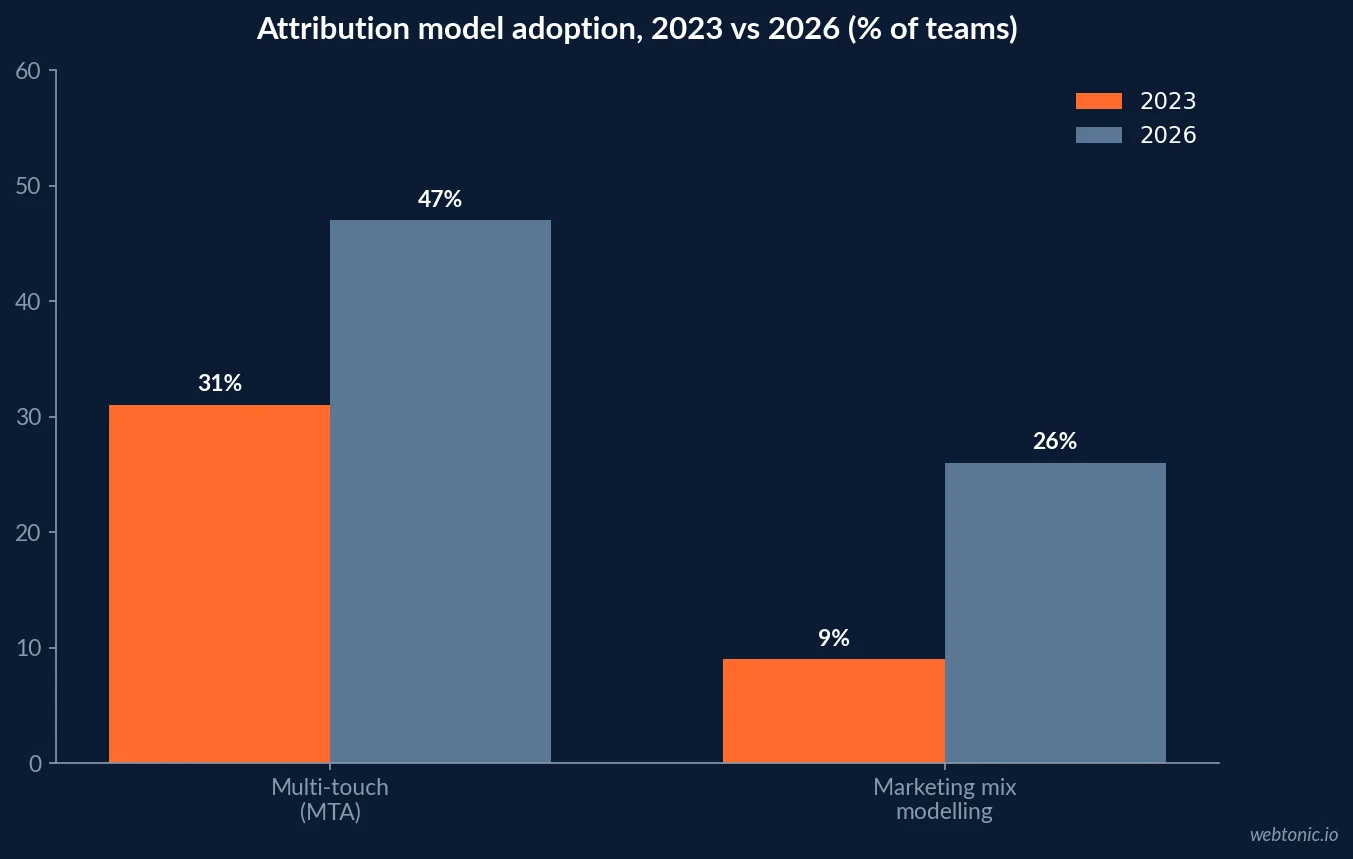
- Multi-touch attribution adoption reached 47% in 2026, up from 31% in 2023.
- Last-touch remains at 41%, MMM at 26% (from 9% in 2023) and first-touch at 19%.
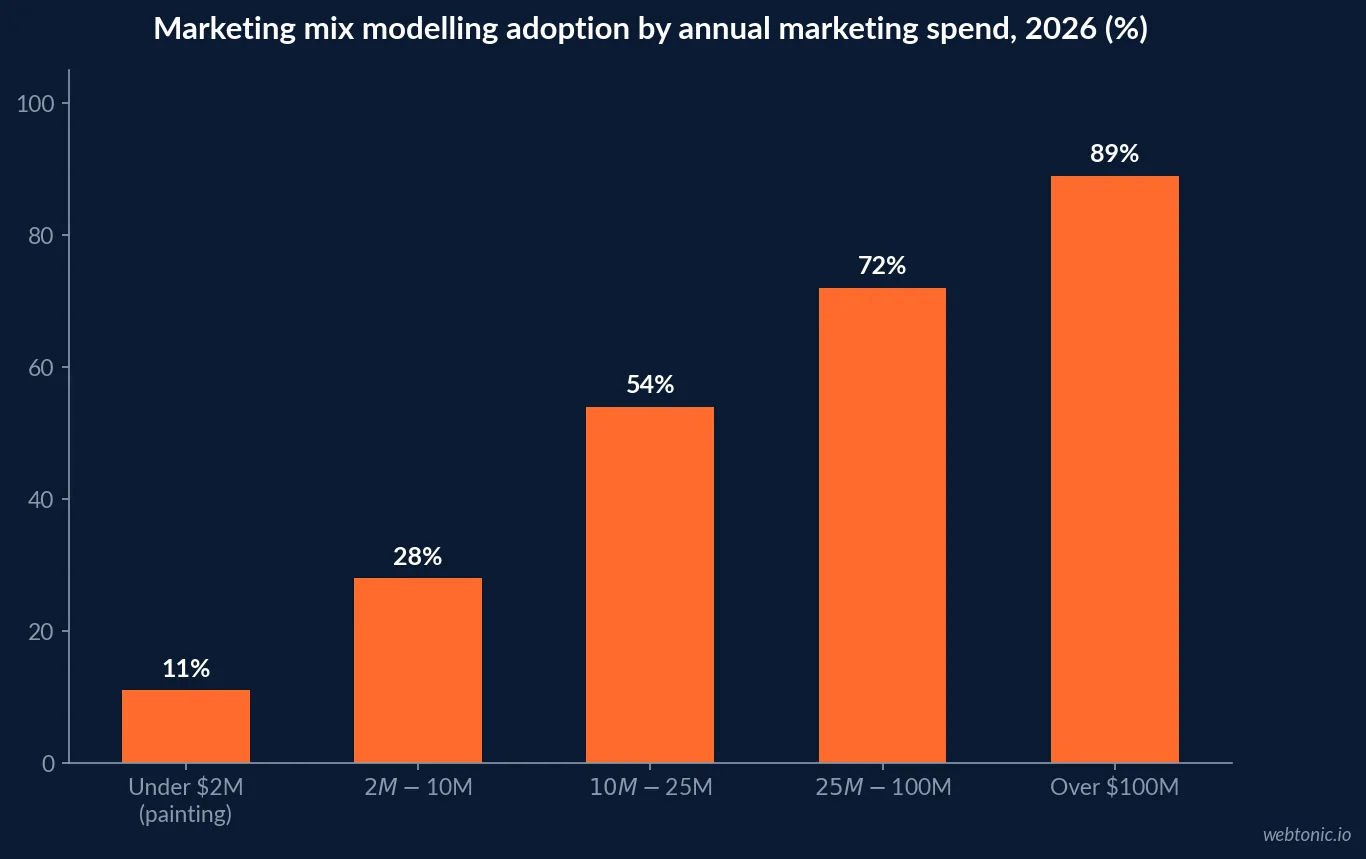
- MMM adoption is only 11% below $2M in annual marketing spend — the painting band.
- Incrementality testing runs at just 6% of advertisers under $2M spend versus 78% above $100M.
- Roughly 70.6% of AI-referred visits appear as Direct in GA4 and 22–32% as Unassigned.
- One contractor dataset found 98.5% of AI-referred leads invisible or misattributed in the CRM.
- Home-services CPL rose for 69% of businesses at an average of 10.51% year over year, with CPC up for 75%.
Where Painting Attribution Actually Breaks
The failure points are operational, and they occur before any dashboard is opened.
| Leak | 2026 data point | What it costs a painting company |
|---|---|---|
| Phone-first demand | 60–80% of leads arrive by call | Form-only tracking misses the majority of revenue |
| CSR source guessing | Wrong 30–50% of the time | Budget decisions made on coin-flip data |
| Empty source fields | Only 52% get filled | Half the attribution data never exists |
| Unattributed phone leads | ~40% of calls | Channels judged on partial evidence |
| Missed calls | 14% in home services | ~42 of 300 monthly calls lost |
| Unrecognised call-backs | 86% not answered | Recovery attempts fail as well |
| Multi-touch collapse | 3–7 touchpoints, 1 recorded | Demand channels look worthless |
Home-services attribution analysis is blunt about the first row: if you track web forms in analytics only, you are measuring the minority of your revenue. Channel attribution research adds the CRM discipline problem — only 52% of users fill the lead-source field at all, so half the data is missing before anyone argues about models.
The “How Did You Hear About Us?” Problem
This is the defining attribution error in painting, and it has a documented magnitude. Research across home-service CRM implementations finds CSR-reported lead sources are inaccurate 30–50% of the time. The mechanism is simple: a homeowner saw a Facebook ad two weeks ago, then searched the company name to find the phone number, and answers “Google”.
- Google is systematically over-credited because branded search is almost always the last action before a call.
- Facebook, mailers, yard signs, wrapped trucks and referrals are systematically under-credited because they rarely finish the journey.
- The “Other” and “Unknown” buckets hide real spend, and they grow every quarter the field stays optional.
- Switching off demand creation produces a delayed collapse. Contractors who cut brand advertising commonly see search leads fall 30–60 days later and cannot explain why.
For painting specifically, the under-credited list is the expensive part. Truck wraps, yard signs and neighbourhood reputation are the highest-margin demand sources in the trade, and they are exactly the channels a “how did you hear about us” field erases.
What the Model Adoption Data Says — and Who It Is For
Attribution methodology moved fast between 2023 and 2026, mostly among advertisers far larger than a painting company.
| Model | 2026 adoption | Direction | Fit for a painting company |
|---|---|---|---|
| Multi-touch (MTA) | 47% | Up from 31% in 2023 | Useful once call and form data are unified |
| Last-touch | 41% | Still the CRM default | Acceptable as a tracked, not asked, source |
| Hybrid MTA + MMM | 33% | Cutting edge | Overkill below $2M media spend |
| Marketing mix modelling | 26% | Up from 9% in 2023 | Not viable — needs 18–24 months of clean data |
| First-touch | 19% | Source-of-record use | Worth adding as a second field |
| Custom weighted rules | 18% | In-house models | Rarely worth the maintenance |
Tracking across 1,200+ teams reports multi-touch at 47% and MMM at 26%, with percentages summing past 100% because mature teams run two models in parallel. Model-mix data confirms the same ordering. The dark-funnel gap — pipeline no model catches — averages 38%.
Why MMM and Incrementality Testing Are Not Painting Tools Yet
The most useful thing a painting company can learn from 2026 attribution research is which techniques to ignore. Adoption breaks almost perfectly by spend band.
| Annual marketing spend | % running MMM | % running incrementality tests | Where painting sits |
|---|---|---|---|
| Over $100M | 89% | 78% | — |
| $25M–$100M | 72% | 62% | — |
| $10M–$25M | 54% | 41% | — |
| $2M–$10M | 28% | 19% | Largest regional franchise groups only |
| Under $2M | 11% | 6% | Effectively every painting company |
MMM adoption data puts the ROI crossover for modelling at roughly $10M in annual marketing spend, and the practical requirements confirm it: 18–24 months of clean weekly data, a statistics-capable analyst, and mid-market vendor costs of $30,000–$200,000 a year. Survey data on measurement reliability shows the same tools are what large advertisers trust most — 27.6% rate MMM the most reliable methodology, ahead of MTA at 19.4% — which is precisely why vendors market them to companies that cannot use them.
The honest recommendation for a painting company: skip MMM, skip geo-lift testing, and spend the same money on call tracking, CRM hygiene and offline conversion import. That is where the measurable return sits at this scale.
Calls Are the Revenue Channel, So Instrument Them First
Contractor attribution benchmarks quantify the call layer precisely. Home services runs a 14% missed-call rate — healthcare is worse at 32% and legal at 28% — which on 300 tracked calls a month means about 42 never reach a person. Because 86% of consumers do not answer unrecognised numbers, the call-back is not a reliable recovery path.
| Call metric | 2026 benchmark | Implication at painting economics |
|---|---|---|
| Share of leads by phone | 60–80% | Form-only tracking measures the minority |
| Missed-call rate | 14% | ~42 of 300 calls, ~$5,800 of purchased demand |
| Answered calls that are real leads | 38% | Volume alone is a vanity metric |
| Leads converting on the call | 45% | CSR script is a conversion asset |
| Call-back answer likelihood | 14% (86% ignore unknown numbers) | First-touch answer matters most |
| Phone vs form conversion | Phones convert 10–15x better | Prioritise call routing over form fields |
Home-services conversion benchmarks supply the two ratios that turn call volume into revenue: 38% of answered calls are genuine opportunities and 45% of those convert on the call. At painting’s $138.38 cost per lead, discarding 14% of calls is the most expensive line item nobody budgets for. This is the same measurement layer described in our painting analytics statistics.
The New Blind Spot: AI-Referred Leads
A measurement gap that barely existed two years ago now distorts painting reports. Analysis of AI-referred visits finds roughly 70.6% appear as Direct in GA4, another 22–32% as Unassigned or (not set), and only about 10% correctly attributed. A contractor-specific dataset is starker: 28.7% of AI-referred leads were actively misattributed to a different source, only 1.5% were correctly attributed, and 98.5% were either invisible or wrong in the CRM.
Combined with rising costs — CPL up for 69% of home-services businesses at an average 10.51% year over year, and CPC up for 75% — the practical risk is defunding a channel that is working because the reporting cannot see it. The cheap countermeasure is a specific CRM source option for AI assistants plus a “where did you first hear about us” question separate from “how did you reach us today”.
The Attribution Stack a Painting Company Should Actually Build
- Call tracking with dynamic number insertion. It converts 60–80% of your lead volume from anecdote into data.
- A mandatory CRM source field, filled at intake. Not later — the 52% completion rate is a process failure, not a software one.
- Two fields, not one: first-touch source and last-touch source, both carried onto the sold job record.
- Missed-call alerting. A 14% miss rate is the fastest payback in the stack.
- Offline conversion import. Push booked and sold jobs back into Google and Meta so bidding optimises on revenue, not form fills.
- Revenue rollup by source, monthly. Judge channels on sold revenue, not lead counts — painting close rates differ 2.5x between ad and referral leads.
- An explicit AI-assistant source option, given 98.5% of those leads are currently mislabelled.
- Accept a residual gap. The dark-funnel share averages 38%; size your reporting around it rather than pretending to eliminate it.
Everything on that list is unglamorous, and together it is worth more than any model upgrade. Painting companies that instrument calls, enforce one intake field and report on sold revenue can defend their budget with evidence; those running 30–50% wrong CSR data are guessing with real money. Our data intelligence team builds exactly this layer, and the channel decisions it enables are covered in our painting digital marketing statistics. If you want yours audited, start here.
Frequently Asked Questions
Why is marketing attribution so hard for painting companies?
Because the conversion happens on a phone call and the credit is assigned by a human from memory. Between 60% and 80% of home-services leads arrive by phone rather than a web form, and research across home-services businesses finds CSR-reported lead sources are inaccurate 30–50% of the time — customers say “Google” because they Googled the company name, even when a Facebook ad or a wrapped truck created the demand two weeks earlier. Fixing call tracking and a mandatory source field beats any attribution model.
What attribution model should a painting company use?
A tracked last-touch source plus a first-touch field, and nothing more sophisticated until the data is clean. Industry adoption in 2026 sits at 47% multi-touch, 41% last-touch, 26% marketing mix modelling and 19% first-touch, with most mature teams running two models in parallel. But MMM adoption is only 11% below $2M in annual marketing spend, and that is the band nearly every painting company sits in. MMM requires 18–24 months of clean weekly data and costs $30,000–$200,000 a year — it is not a painting-company tool.
How many touchpoints does a painting customer have before calling?
Between three and seven. A typical journey runs: sees a Facebook ad, visits the website, reads Google reviews, notices a wrapped truck in the neighbourhood, searches the company name, then calls. A CRM records one source, so up to six of those touchpoints get zero credit — which systematically over-credits capture channels like branded search and under-credits demand-creation channels. That is why painting companies that switch off brand advertising often see search leads fall 30–60 days later.
How much revenue do missed calls cost a painting company?
More than most media inefficiency. CallRail’s benchmark report puts the home-services missed-call rate at 14% — roughly 42 of 300 tracked calls a month never reach a person — and 86% of consumers do not answer calls from numbers they do not recognise, so call-backs fail too. Across home services, 38% of answered calls are genuine leads and 45% of those convert on the call. At a $138.38 painting cost per lead, a 14% miss rate on 300 calls is roughly $5,800 of purchased demand discarded monthly.
Is GA4 enough for painting attribution?
No, and it is getting worse rather than better. GA4 depends on referrer headers, click IDs and cookies; when those are stripped, traffic lands in Direct or Unassigned. Analyses of AI-referred visits find roughly 70.6% appear as Direct and another 22–32% as Unassigned, with only about 10% correctly attributed — and one contractor dataset found 98.5% of AI-referred leads were either invisible or misattributed in the CRM. For a painting company the fix is boring: call tracking, a required CRM source field, and offline conversion import back into the ad platforms.
Sources
Digital Applied — Marketing Attribution Statistics 2026
Bunker DB — MMM Adoption and the End of Single-Model Attribution
Presenc AI — MMM Adoption Rate 2026
RivetOps — Why Home-Service CRM Reports Do Not Match Reality
Skillmammoth — Marketing Attribution for Home-Service Contractors 2026
PipelineOn — Contractor Marketing Attribution Statistics
PipelineOn — Channel Attribution for Home-Service Contractors
Invoca — Home Services Lead Conversion Benchmarks 2026
The Data Driven Trades — AI-Referred Lead Attribution Analysis 2026
Machine Relations — AI Search Traffic Attribution Gap 2026
BaaDigi — Painting Contractor Marketing Benchmarks 2026
EMARKETER — FAQ on Incrementality 2026