Table of contents
PageRank never went away, but the number most SEOs quote today is not PageRank at all. It is one of at least four separate third-party metrics - Majestic's Citation Flow, Ahrefs' Domain Rating, Moz's Domain Authority - that approximate what PageRank was built to measure, using none of Google's actual data. Here is what each one is, what it is not, and what the correlation studies say backlinks are still worth in 2026.
Key Takeaways
- PageRank was defined in a 1998 Stanford paper by Larry Page and Sergey Brin.
- Google retired the public PageRank toolbar in 2016, ending visible scores.
- Leaked 2024 API documentation described PageRank as still present internally.
- Citation Flow is a pure quantity score, 0 to 100, per Majestic's own definition.
- Trust Flow measures closeness to a seed set of trusted sites, also 0 to 100.
- Ahrefs' Domain Rating and URL Rating both run 0 to 100 on a logarithmic scale.
- Ahrefs found a 0.255 Spearman correlation between referring domains and rank in a 1M-SERP study.
- Backlinko's 11.8M-result study found #1 pages average 3.8x more backlinks than #2-#10.
- 54.8% of 131 surveyed SEOs rank backlinks a top-3 factor in Zyppy's 2026 survey.
- Relevance/search-intent match scored higher, at 57.1%, in the same survey.
- Content quality came third at 47.6% in the same 13,665-data-point survey.
- Moz's Page Authority is a machine-learned model, not a fixed formula.
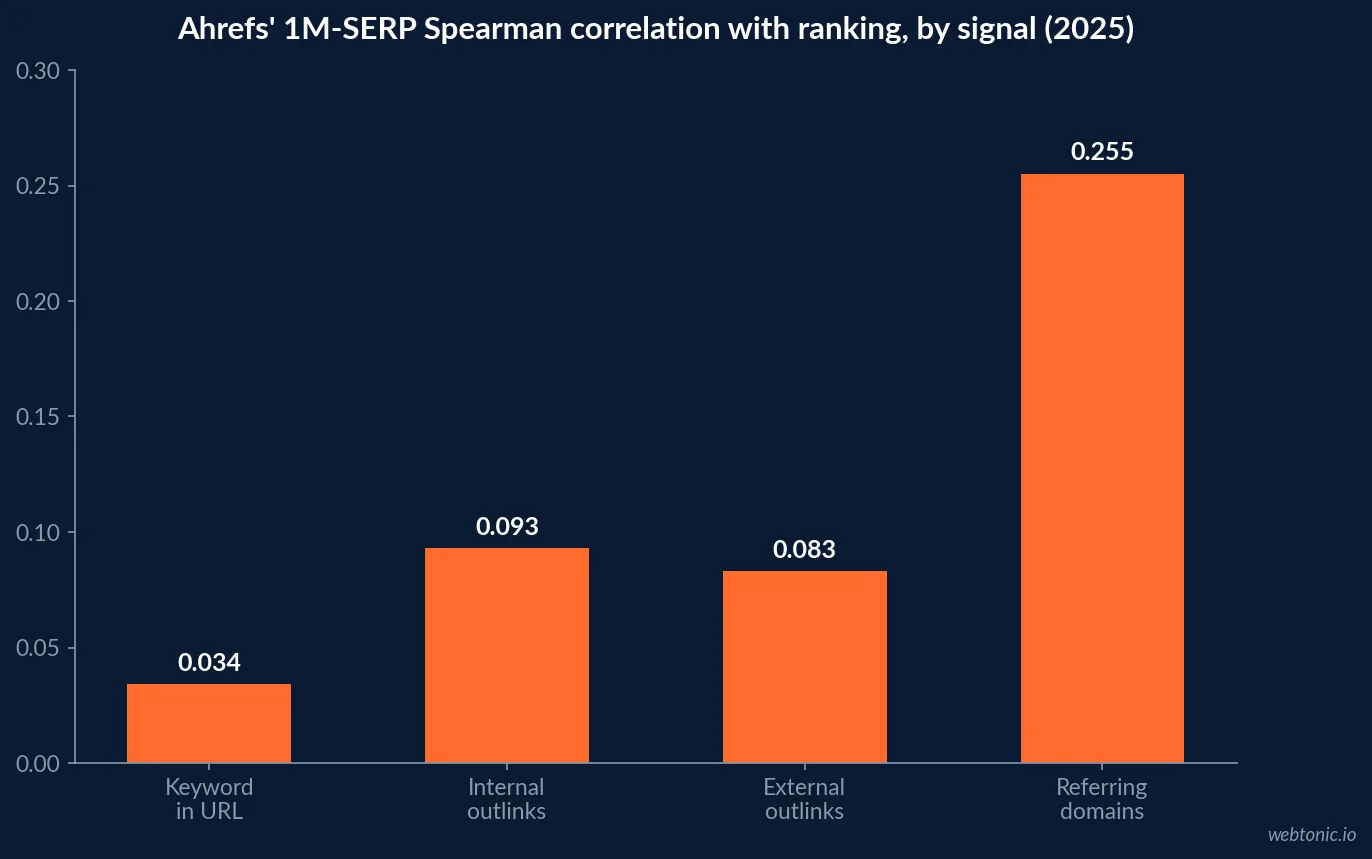
- Ahrefs' internal-links correlation is far weaker, near 0.117, than referring domains.
What PageRank actually is, in the words of the original paper
PageRank comes from a specific, citable source: Larry Page and Sergey Brin's Stanford paper, "The PageRank Citation Ranking: Bringing Order to the Web" (1998), and the accompanying method patent US6285999B1. The patent describes rank as "the probability that a surfer will be at the page after following a large number of forward links" - a model of how link structure distributes authority across the web, not a measure of content quality on its own.
Wikipedia's overview confirms the score is not, and has not been for years, the only algorithm Google uses to order results, though it remains the first algorithm the company shipped and the best known one by name. Google retired the public-facing PageRank toolbar score in 2016, which is why most SEOs correctly say "nobody has seen a real PageRank number in years" - the internal signal is a different question.
| Milestone | Year | Source |
|---|---|---|
| Original PageRank paper published | 1998 | Page & Brin, Stanford |
| Node-ranking patent filed (US6285999B1) | 1998 (filed) | Google Patents |
| Public PageRank toolbar retired | 2016 | Wikipedia / Google announcement |
| Leaked Search API docs describe internal PageRank features | 2024 | SparkToro / Search Engine Land |
Citation Flow and Trust Flow: Majestic's answer, not Google's
Majestic's own documentation is explicit about the split: Citation Flow is a score which reflects the quantity of links pointing at a URL, subdomain or domain, and it "does not care whether a link is of good-quality, or poor quality." Trust Flow is the counterweight - it measures how close a page sits to a manually reviewed seed set of trustworthy sites, so quantity and quality are reported as two separate 0-100 numbers instead of blended into one.
Neither metric uses Google's link graph or ranking data. They are Majestic's own crawl and its own trust model, which makes them useful for comparing your site against a competitor's inside the same tool, and much less useful as a stand-in for "how Google actually sees this page."
Domain Rating, URL Rating and Domain Authority: the other two scales
Ahrefs describes URL Rating as a page-level, 0-100 logarithmic score built purely from that page's own backlink profile, and Domain Rating as the same logarithmic approach applied at the domain level. Ahrefs also documents that "a linking domain splits its rating equally amongst the domains it links to," so a domain's own DR partly determines how much authority it can pass on - a mechanic that echoes PageRank's original link-distribution logic almost exactly, just recalculated on Ahrefs' own crawl.
Moz's Domain and Page Authority take a different approach: a machine-learned model trained to predict ranking ability from link data, refreshed periodically as Moz retrains it, rather than a fixed formula applied consistently over time. That means a DA number from 2023 and a DA number from 2026 are not strictly comparable even for the same site, because the underlying model changed in between.
| Metric | Owner | What it scores | Scale | Built from |
|---|---|---|---|---|
| PageRank (internal) | Link-based authority distribution | Not published | Google's own link graph | |
| Citation Flow | Majestic | Quantity of links only | 0-100 | Majestic's own crawl |
| Trust Flow | Majestic | Quality via seed-set proximity | 0-100 | Majestic's own crawl + seed set |
| Domain / URL Rating | Ahrefs | Backlink profile strength | 0-100 (log) | Ahrefs' own crawl |
| Domain / Page Authority | Moz | Predicted ranking ability | 0-100 (ML model) | Moz's own link index |
Do backlinks still correlate with rankings? The 2025-2026 data
Yes, moderately, and the size of the correlation has been remarkably stable across studies run years apart. Backlinko's analysis of 11.8 million Google results - 1,183,680 keywords, 10 million-plus unique URLs - found the #1 ranking position averaging 3.8 times more backlinks than positions #2 through #10 combined. Ahrefs' newer check, run across roughly one million SERPs after Google publicly said links "matter less," still found a 0.255 Spearman correlation for referring domains - the strongest single off-page signal in that dataset, ahead of raw backlink count and well ahead of on-page factors like keyword-in-URL (0.034).
| Study | Dataset | Key correlation / gap found |
|---|---|---|
| Backlinko, 2020 update | 11.8M results, 1.18M keywords | #1 position has 3.8x more backlinks than #2-#10 |
| Ahrefs, 2025 | ~1M SERPs, top-20 positions | Referring domains: 0.255 Spearman correlation |
| Ahrefs, 2025 (internal signals) | Same 1M-SERP set | Internal outlinks correlate far weaker, ~0.093-0.117 |
| Zyppy, Sept 2026 | 131 SEOs, 13,665 data points | 54.8% rate backlinks a top-3 Google ranking factor |
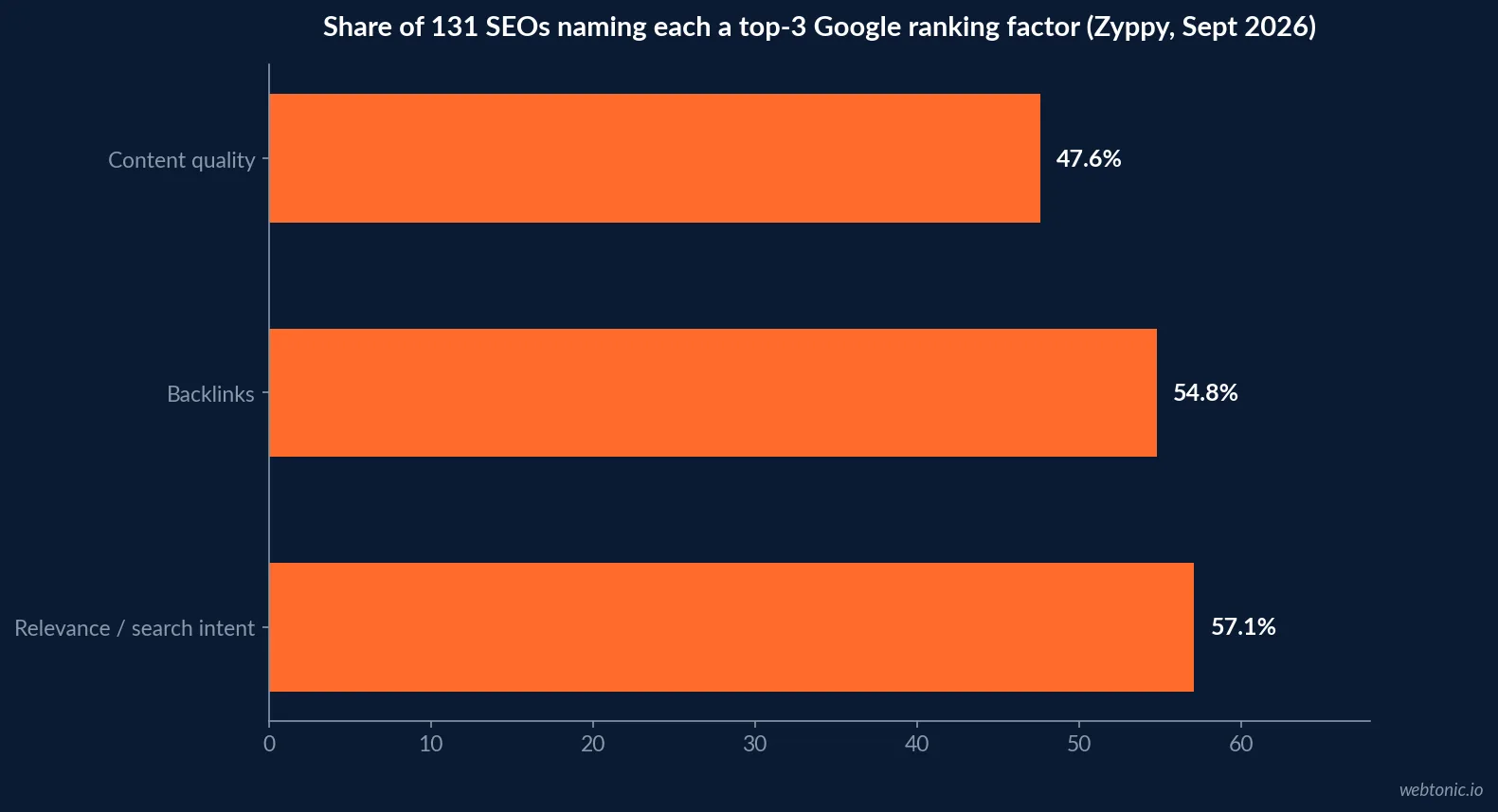
What practitioners believe versus what correlation studies measure
Those two kinds of evidence answer different questions, and conflating them is a common mistake. Zyppy's September 2026 survey of 131 practitioners asked for opinion, and got relevance/search-intent match at 57.1%, backlinks at 54.8% and content quality at 47.6% as the three most-cited top-three factors. The Ahrefs and Backlinko datasets above are not opinion - they are observed correlation between a measured input and a measured outcome, and they happen to agree with the survey's ranking of backlinks as significant but not singular.
The honest reading of both data types together: backlinks are one durable signal among several, the size of the effect has not collapsed the way some "links are dead" commentary implies, and no single third-party score - Citation Flow, Domain Rating or Domain Authority - is a direct read of what Google's internal PageRank-descended signal actually assigns to a page.
| Zyppy 2026 survey, top-3-cited factor | Share of 131 practitioners |
|---|---|
| Relevance / search-intent match | 57.1% |
| Backlinks | 54.8% |
| Content quality | 47.6% |
Reading a link profile audit without over-trusting one score
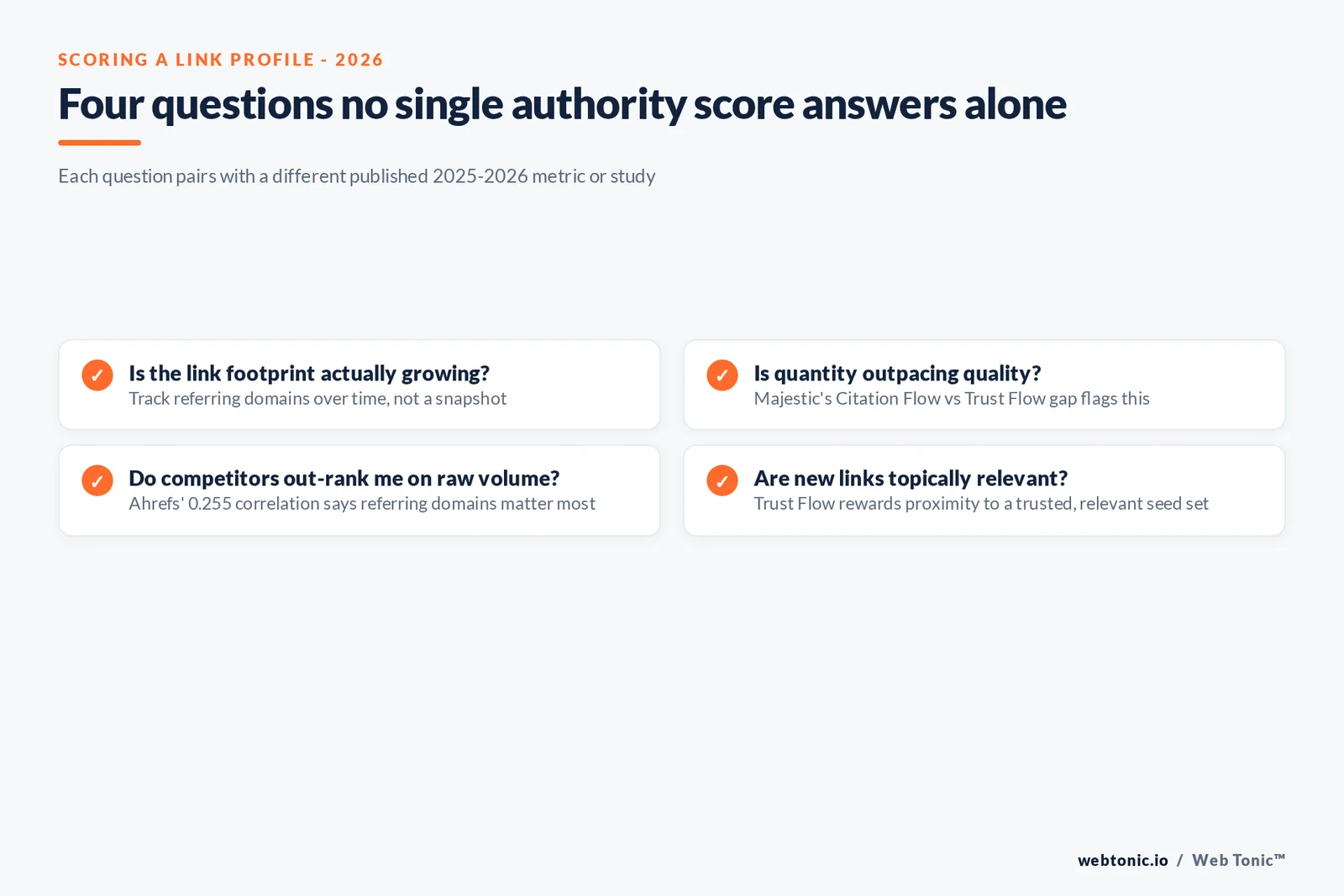
A practical audit checklist built from the data above looks less like "get DR above 50" and more like a set of separate questions, because no single score answers all of them at once.
| Question to ask | Metric that answers it | What a strong reading looks like |
|---|---|---|
| Is the overall link footprint growing? | Referring domains, tracked over time | Steady month-over-month growth, not one spike |
| Is link quantity outpacing quality? | Citation Flow vs Trust Flow gap | The two scores should move together, not apart |
| Does a competitor out-rank me on raw volume? | Backlink count, Domain/URL Rating | Compare against the same named competitor set each quarter |
| Are new links coming from relevant, trusted sources? | Trust Flow, topical relevance of referring domains | New domains match your topic, not a random directory |
What this looks like inside an actual SEO program
None of these scores are inputs you can directly dial up - they are outputs of link acquisition, content that earns citations, and technical crawlability that lets the links Google already knows about get credited to the right page. Treating a Domain Rating or Domain Authority target as the goal, instead of the acquisition and content work that produces it, is the most common way teams waste a quarter chasing a number three different tools calculate three different ways.
If you want a link-profile read against a named competitor set rather than a generic score, our SEO practice builds that comparison as part of a full audit, alongside the acquisition roadmap that actually moves referring-domain count in the direction the correlation studies above say still matters.
How to actually use these metrics in 2026
Pick one third-party metric per workflow and track its trend, not its absolute value - a jump from DR 24 to DR 31 tells you more than knowing your DR is 31 in isolation, since none of these scores map directly onto a Google ranking probability. Use referring-domain count and referring-domain quality as the primary lens, since that is what both the Ahrefs and Backlinko studies found carrying the strongest correlation, rather than optimizing for a vendor's composite score directly. And treat any claim that "links don't matter anymore" against the 2025-2026 data above: the correlation weakened from the 2016-era peak in some studies, but it did not disappear.
If your link profile needs an outside read, our backlink value breakdown goes deeper on acquisition strategy, or talk to us about auditing your current referring-domain mix against a named competitor set.
Frequently Asked Questions
Is PageRank still used by Google in 2026?
Yes, but not the toolbar score you might remember. Google retired the public PageRank toolbar in 2016, and Wikipedia's overview confirms PageRank is no longer the only algorithm Google uses to order results, though it remains the first algorithm the company used and the best known. The May 2024 leaked Google Search API documentation, reported by Search Engine Land, described PageRank scores as still present among Google's internal ranking features, including a PageRank value calculated for a site's homepage.
What is Citation Flow and how is it different from PageRank?
Citation Flow is Majestic's own metric, not Google's. Majestic's own explainer defines it as a 0-100 score reflecting the quantity of links pointing at a URL, subdomain or domain - it does not judge quality at all. Majestic pairs it with Trust Flow, which scores quality by measuring closeness to a seed set of manually reviewed trustworthy sites. The two together are meant to separate 'how many links' from 'how good are they', which PageRank's single score does not do on its own.
Do backlinks still correlate with Google rankings in 2026?
Ahrefs' most recent large-scale check, a 2025 analysis of roughly one million SERPs, found a Spearman correlation of 0.255 between referring domains and ranking position - moderate, and still the strongest off-page signal Ahrefs tested, even after Google statements that links matter less than they used to. Backlinko's earlier 11.8-million-result study found the #1 position averaging 3.8 times more backlinks than positions #2 through #10, which is a structural gap, not statistical noise.
Which third-party metric should I trust: Domain Rating, Domain Authority or Trust Flow?
None of them are Google metrics, so 'trust' should mean 'useful for comparison', not 'accurate to Google's internal score'. Ahrefs describes Domain Rating and URL Rating as logarithmic 0-100 scores built purely from its own link graph. Moz's Domain and Page Authority use a machine-learned model trained to correlate with actual SERP outcomes, and Moz has revised the underlying algorithm more than once. Majestic's Trust Flow is the one built from a curated seed set rather than a purely mathematical link count. Use whichever one your team already tracks consistently over time - the absolute number matters far less than the trend and the comparison to a specific competitor set.
Do practicing SEOs still rank backlinks as a top Google factor?
Yes. Zyppy's September 2026 survey of 131 SEO practitioners, producing 13,665 individual ranking-factor data points, found backlinks rated a top-three factor by 54.8% of respondents, behind only relevance and search-intent match at 57.1% and ahead of content quality at 47.6%. That is a practitioner opinion survey, not a correlation study, but it lines up with what the correlation data still shows.
Sources
Page & Brin - The PageRank Citation Ranking: Bringing Order to the Web (1998)
Google Patents - US6285999B1, Method for node ranking in a linked database
Wikipedia - PageRank
Majestic - Flow Metric Scores
Majestic - An Introduction to Majestic Trust Flow
Ahrefs Academy - Backlink metrics (UR, DR)
Ahrefs - Google Says Links Matter Less, We Looked at 1,000,000 SERPs
Backlinko - We Analyzed 11.8 Million Google Search Results
Moz - The Correlation Between Authoritative Links and Ranking
Zyppy - 2026 Google Ranking Factors Expert Survey