Table of contents
No study prices a TikTok ad budget for orthodontics, and WordStream does not break out TikTok performance by industry the way it does for Google and Facebook Ads. This page builds the case from what does exist: Pew's teen platform-use research, TikTok's own Branded Content Policy restrictions on dental content, and the closest paid-social cost data available as a labeled proxy.
Key Takeaways
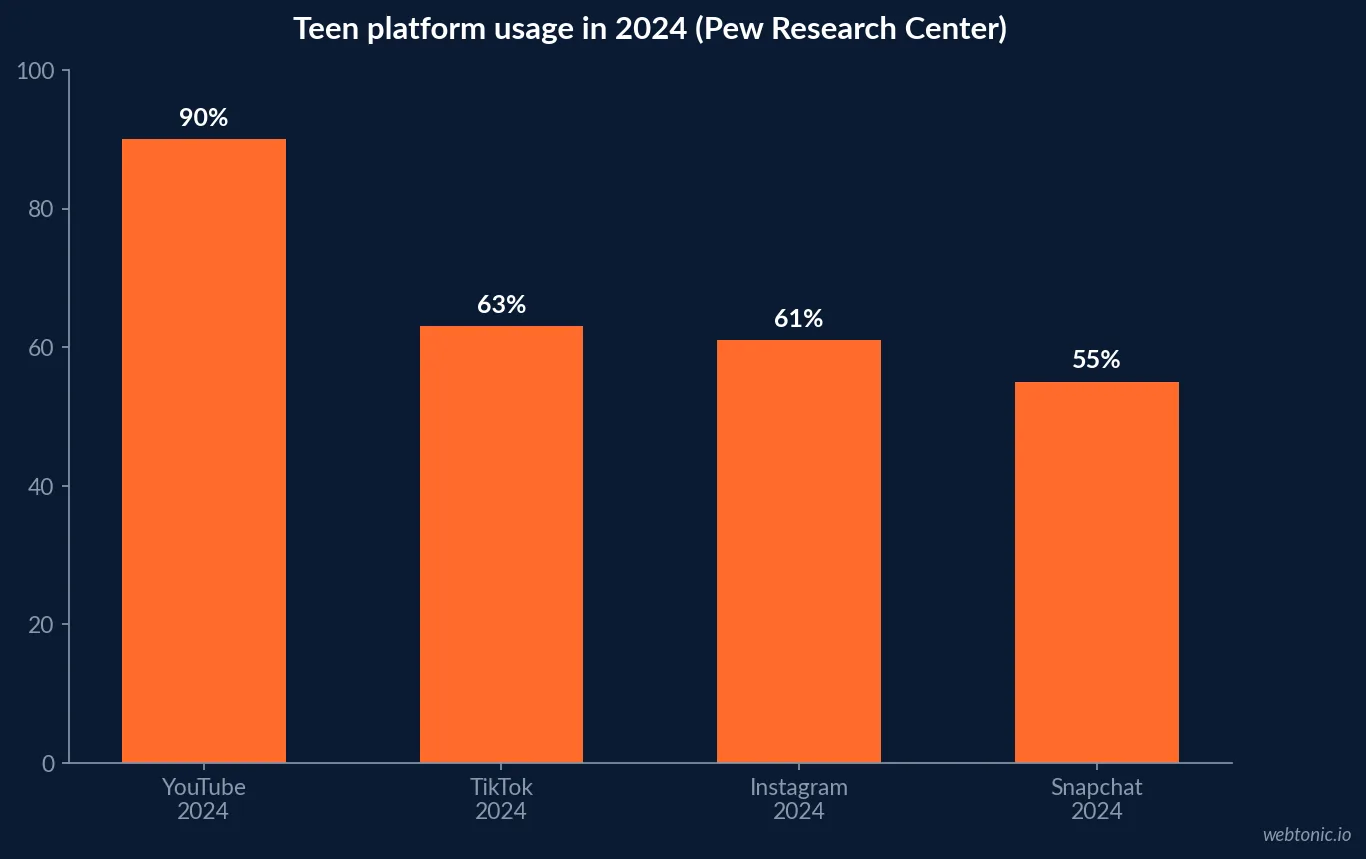
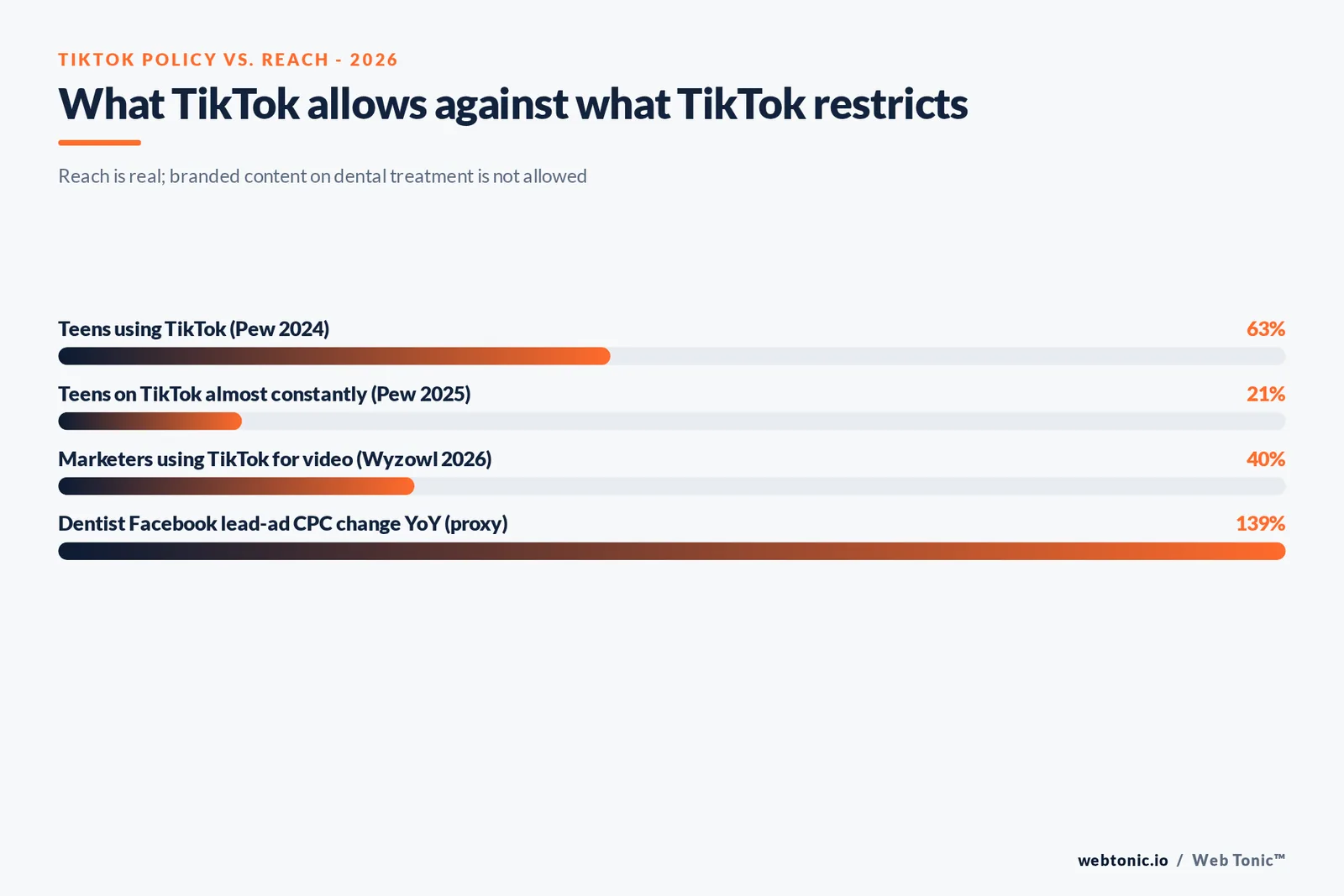
- 63% of US teens say they use TikTok, per Pew's 2024 survey - behind only YouTube (90%).
- 61% of teens say they use Instagram, roughly tied with TikTok.
- 55% of teens use Snapchat, 32% use Facebook, 17% use X.
- 21% of teens say they are on TikTok almost constantly in 2025, up from 16% in 2022.
- TikTok's Branded Content Policy explicitly restricts "dental surgeries" and "medical institutions, treatments or devices."
- No WordStream or LocaliQ report breaks out TikTok performance for dentists or orthodontics specifically.
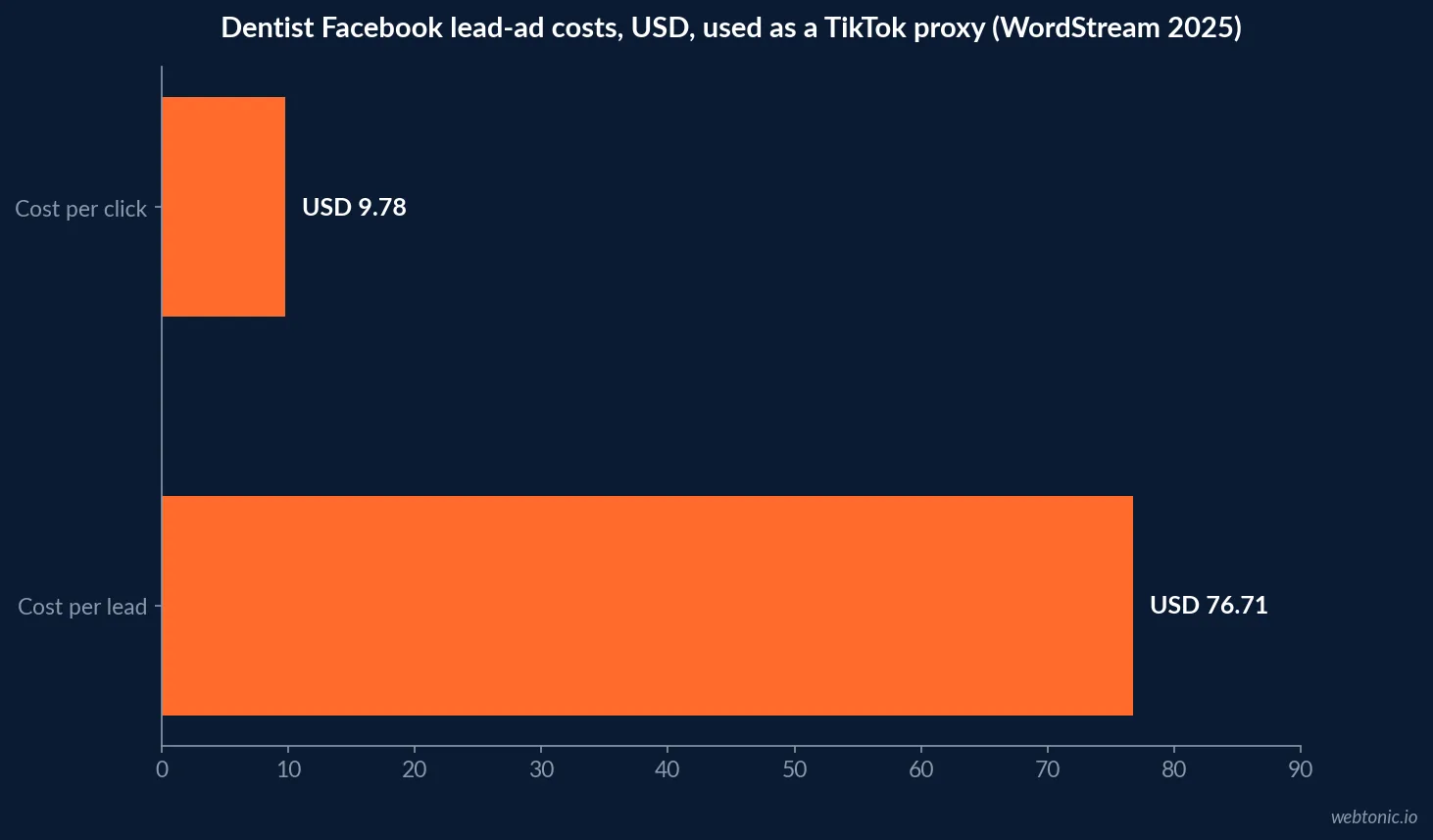
- The closest paid-social proxy, Facebook lead ads for dentists, runs a $9.78 average CPC - the highest of 20 industries WordStream tracks.
- That CPC rose 139% year-over-year, the largest CPC increase in WordStream's 2025 report.
- Dentist Facebook lead ads run a $76.71 average cost per lead, up 97% year-over-year.
- TikTok is the least-used major platform among video marketers at 40%, against 70% for YouTube.
- 85% of video marketers say video generated leads in Wyzowl's cross-industry 2026 survey.
- Teen and growing-patient orthodontic case starts rose 7.2% year-over-year to 240,000 cases (Align Technology, company data).
The audience TikTok reaches, honestly sized
Orthodontics markets to teens and their parents more than almost any other dental specialty, which makes teen platform habits directly relevant. Pew Research Center's Teens, Social Media and Technology 2024 survey of 1,391 US teens ages 13 to 17 found 63% say they use TikTok, essentially tied with Instagram at 61% and behind only YouTube at 90%. Snapchat trails at 55%, Facebook at just 32%, and X at 17%. Pew's 2025 follow-up found 21% of teens say they are on TikTok almost constantly, up from 16% in 2022 - meaning reach on the platform is not just wide, it is frequent.
None of this is an orthodontic-specific study; it describes teen behavior generally. But because teens and growing patients are a named, tracked segment in Align Technology's own investor data - case starts for that group rose 7.2% year-over-year to 240,000 in Q2 2026 - the overlap between where that segment spends time and where a practice advertises is a reasonable basis for a test budget, not a proven ROI case.
| Platform (Pew, % of US teens who use it) | 2022 | 2023 | 2024 |
|---|---|---|---|
| YouTube | 95% | 93% | 90% |
| TikTok | 67% | 63% | 63% |
| 62% | 59% | 61% | |
| Snapchat | 59% | 60% | 55% |
| 32% | 33% | 32% | |
| X (Twitter) | 23% | 20% | 17% |
What TikTok's own policy allows, and what it does not
Before budgeting creator or influencer spend on TikTok, the platform's own rules matter more than any performance benchmark. TikTok's Branded Content Policy lists prohibited categories for disclosed paid partnerships, including "any medical institutions, treatments or devices" and, specifically, "cosmetic clinics, cosmetic surgery and cosmetics making medicinal claims, including dental surgeries." That means a creator cannot run a disclosed branded-content post about orthodontic treatment, which rules out the influencer-partnership model many other verticals use on the platform. A practice's own paid ads, run directly through TikTok's advertising products rather than through a creator's branded-content tag, sit under separate advertising policies and are not covered by this specific restriction - but the distinction is one most practices and their agencies get wrong, and it changes where a TikTok budget should actually go: owned brand ads and organic content, not paid creator partnerships.
The cost data that actually exists, used as a labeled proxy
WordStream and LocaliQ, the two firms that publish the most detailed paid-social benchmarks by industry, do not break out TikTok performance for Dentists & Dental Services the way they do for Google and Facebook Ads. The closest available proxy is WordStream's Facebook Ads Benchmarks Report: dentists pay a $9.78 average cost per click on lead-generation ads, the highest CPC of the 20 industries tracked and up 139% year-over-year - the single largest CPC jump in the report - with a $76.71 average cost per lead, up 97% year-over-year. TikTok's ad auction is independent of Meta's, so these figures are a directional ceiling for a test budget, not a TikTok quote, and should be validated against a practice's own TikTok Ads Manager data within the first test cycle.
| Facebook lead-ad benchmark (WordStream 2025, used as a proxy) | Dentists & Dental Services | YoY change |
|---|---|---|
| Click-through rate | 1.05% | -23% |
| Cost per click | $9.78 | +139% (largest increase in report) |
| Conversion rate | 6.38% | n/a |
| Cost per lead | $76.71 | +97% |
Where video fits the budget, cross-industry
Wyzowl's 2026 State of Video Marketing survey found 85% of video marketers say video generated leads and 83% say it increased sales - but the same survey put TikTok at 40% usage among video marketers, the lowest of the major platforms it tracks, against 70% for YouTube and 69% for Instagram. For most practices, that argues for building a working video library on YouTube and Instagram first, then adapting the strongest performers into TikTok-native cuts, rather than commissioning TikTok-first creative before either channel has proven data.
What a TikTok ad account measures that a policy page cannot tell you
TikTok's Branded Content Policy governs disclosed creator partnerships, not the metrics inside a practice's own TikTok Ads Manager account - and no external report can substitute for the account's own delivery and cost data once a campaign is live. Before scaling past a test budget, a practice should confirm, inside its own account rather than from a benchmark: the actual CPM and CPC the auction returns for its specific geography and age targeting; whether Spark Ads (boosting an organic post) outperform standard in-feed ads, since Spark Ads inherit the organic post's existing engagement; and whether TikTok's Lead Generation objective, which keeps the user inside the app rather than sending them to a landing page, converts at a meaningfully different rate than the practice's own website funnel. None of these three questions has a published cross-industry answer specific enough to cite as a benchmark - they are exactly the gaps a $9.78-CPC-adjacent test budget exists to close.
| Question a test budget should answer | Why the policy page or a benchmark cannot answer it |
|---|---|
| What CPM/CPC does this specific geography and age range return? | TikTok's auction is not broken out by dental specialty in any published report |
| Do Spark Ads outperform standard in-feed ads? | Depends on the organic post's existing engagement, which varies by account |
| Does in-app Lead Generation convert better than a website funnel? | No published study compares the two specifically for healthcare advertisers |
None of that testing has to start from zero. A practice already running Google or Facebook lead ads has a working sense of what a qualified consultation request actually costs and converts at, and that number - not a cross-industry TikTok average that does not exist for this vertical - is the honest benchmark a first TikTok test campaign should be judged against for at least one full reporting cycle before any budget scales up.
Four things to decide before the first TikTok dollar
- Separate creator partnerships from owned ads - the branded-content restriction on dental surgeries applies to disclosed creator posts, not a practice's own paid campaigns.
- Treat the $9.78 Facebook CPC as a ceiling to beat, not a TikTok quote - validate against your own TikTok Ads Manager data in the first test cycle.
- Budget for teens and the parents scrolling alongside them - 63% teen usage is real reach, but it is not a purchase-decision maker on its own for most treatment plans.
- Repurpose proven YouTube/Instagram video before commissioning TikTok-native creative from zero, given TikTok's lower 40% marketer-usage share.
Our performance creative team tests paid-social creative against benchmarks like these, and our Facebook Ads ROI breakdown is a useful comparison read while a TikTok test budget is being scoped. Reach out before committing production budget to creator partnerships that TikTok's own policy may not allow to run as branded content.
Frequently Asked Questions
Does WordStream or LocaliQ publish TikTok ad benchmarks for dentists or orthodontics?
Not by industry. WordStream's benchmark reports cover Google Ads and Facebook Ads broken out by 20 business categories, including Dentists & Dental Services, but its TikTok coverage is limited to cross-industry commentary, not a per-vertical breakdown. Any dentist-specific TikTok CPC or CPL figure circulating online that cites WordStream is not sourced to an actual WordStream report.
How many teens actually use TikTok, and does that support an orthodontic TikTok budget?
Pew Research Center's Teens, Social Media and Technology 2024 survey of 1,391 US teens found 63% say they use TikTok, behind only YouTube (90%) and roughly tied with Instagram (61%). Pew's 2025 update found 21% of teens say they are on TikTok almost constantly, up from 16% in 2022. Teens are one part of an orthodontic audience - the AAO does not publish a patient age breakdown by marketing channel - so this supports TikTok as a plausible reach channel for teen patients and the parents who see their feeds, not a proven conversion channel.
Can an orthodontic practice actually run branded content or influencer posts about treatment on TikTok?
Restricted, by TikTok's own policy. TikTok's Branded Content Policy explicitly lists 'any medical institutions, treatments or devices' and 'cosmetic clinics, cosmetic surgery ... including dental surgeries' under prohibited branded content categories, meaning a creator cannot run a disclosed paid partnership post about orthodontic treatment. This restricts organic creator marketing more than it restricts a practice's own paid ads, which fall under TikTok's separate, less restrictive advertising policies for healthcare.
What should an orthodontic practice budget against if there is no TikTok-specific cost benchmark?
The closest available paid-social proxy is WordStream's Facebook Ads Benchmarks Report for Dentists & Dental Services: a $9.78 average cost per click on lead ads (the highest of 20 industries, up 139% year-over-year) and a $76.71 average cost per lead. TikTok ad auctions run independently of Meta's, so these numbers should be used as a directional ceiling for testing, not a TikTok-specific quote.
Is video content itself worth the investment on a platform like TikTok for this vertical?
Cross-industry, yes, by volume of self-reported results: Wyzowl's 2026 survey found 85% of video marketers say video generated leads and 83% say it increased sales, though TikTok is the least-used of the major video platforms among marketers at 40% usage, against 70% for YouTube - suggesting most practices should have a working YouTube/Instagram video library before building TikTok-specific creative from scratch.
Sources
Pew Research Center - Teens, Social Media and Technology 2024
Pew Research Center - Teens, Social Media and AI Chatbots 2025
TikTok - Branded Content Policy
WordStream by LocaliQ - Facebook Ads Benchmarks 2025
Wyzowl - State of Video Marketing 2026
Align Technology - Q2 2026 Earnings Call Transcript (The Motley Fool)
Web Tonic - Performance Creative
Web Tonic - Are Facebook Ads Worth It