Table of contents
Orthodontics is an unusually teen-heavy healthcare category, which changes which platforms matter before a single engagement-rate benchmark gets applied. This page pairs Pew Research's own teen platform-use survey with Hootsuite's healthcare, pharma and biotech engagement benchmarks, and is explicit about which figures are teen-specific and which are broad healthcare proxies.
Key Takeaways
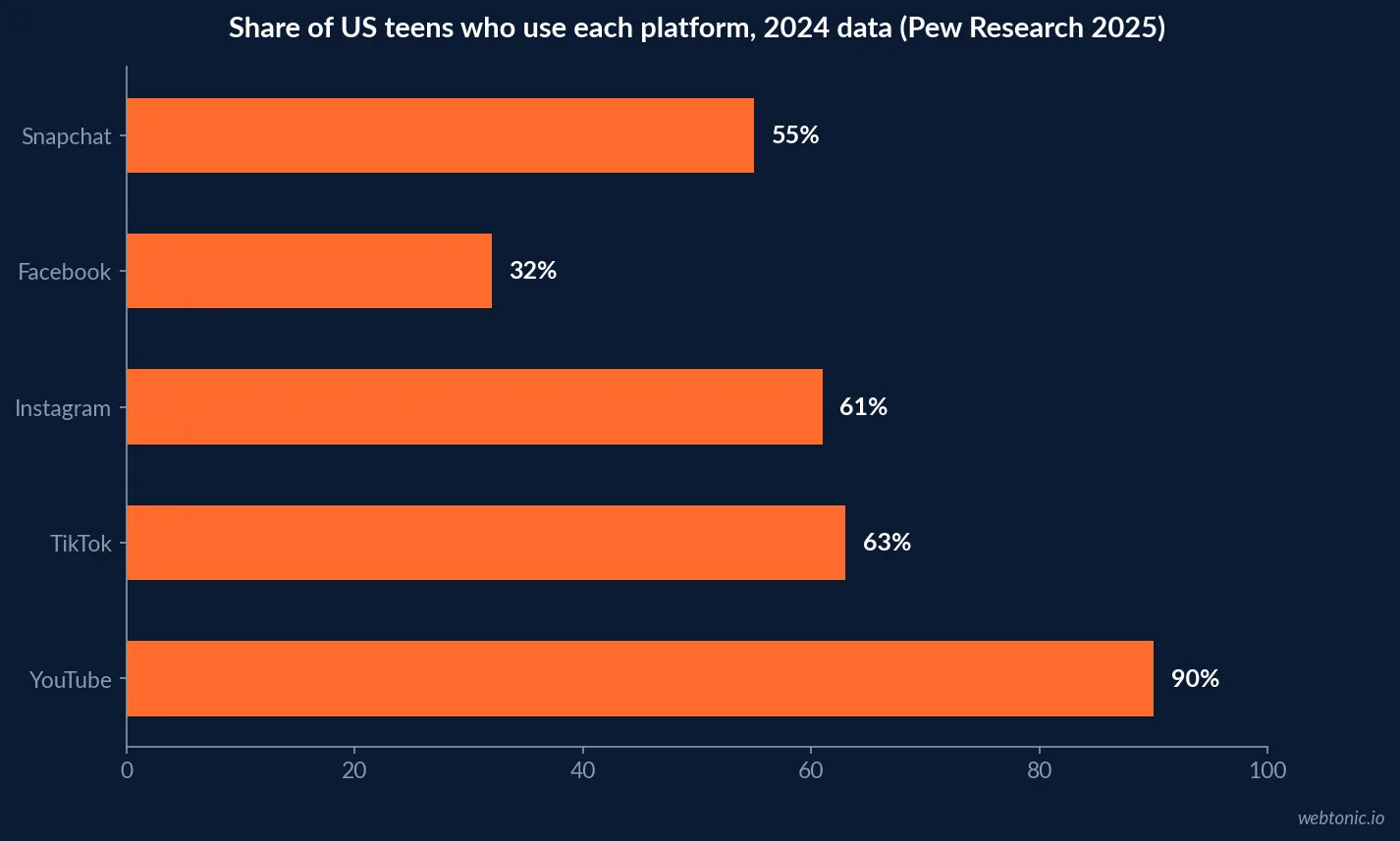
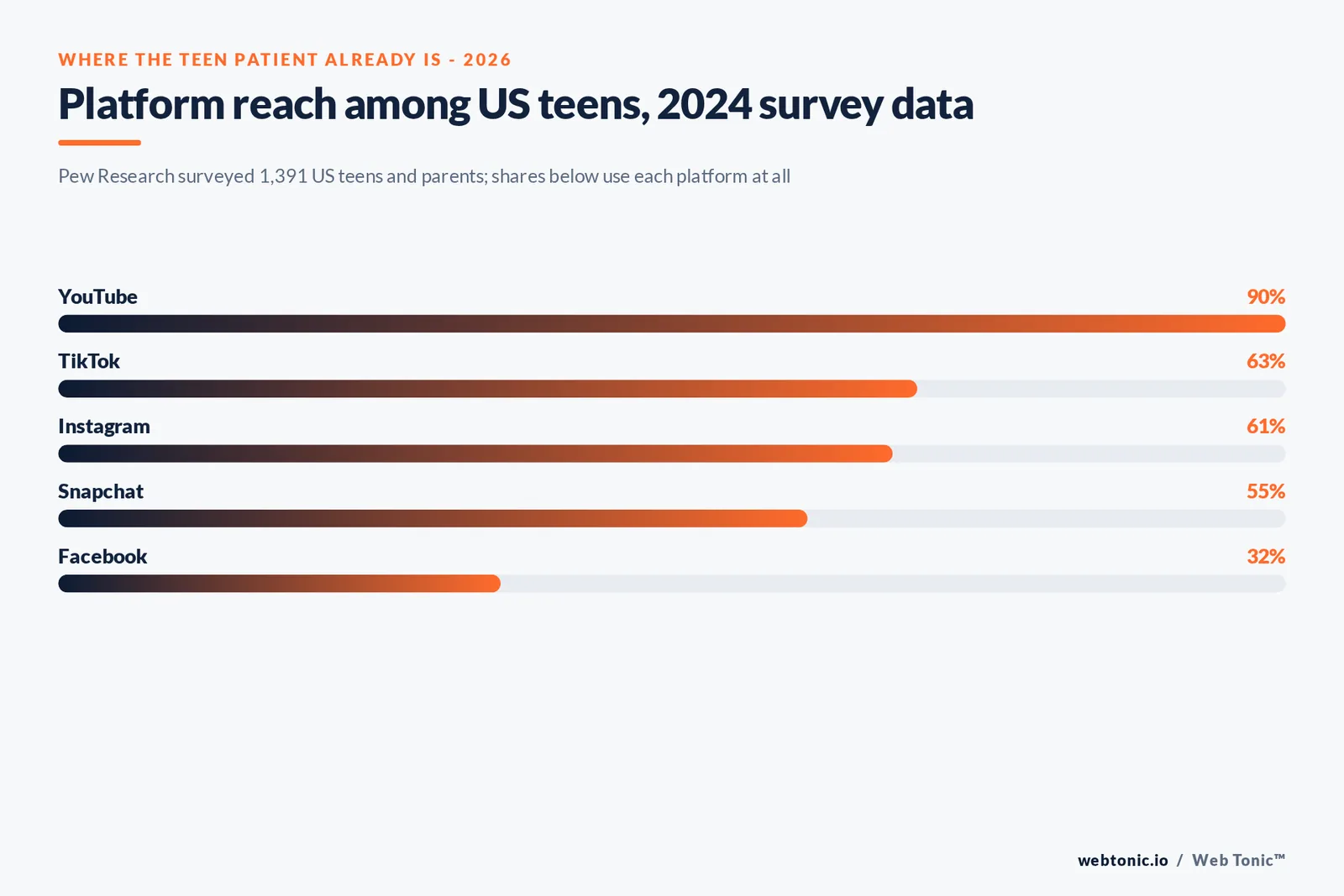
- 90% of US teens use YouTube, more than any other platform Pew tracked in 2024.
- 63% of teens use TikTok and 61% use Instagram.
- 55% of teens use Snapchat, still a majority of the patient-age cohort.
- Only 32% of teens use Facebook, down from 71% a decade earlier.
- A third of teens are on at least one platform almost constantly.
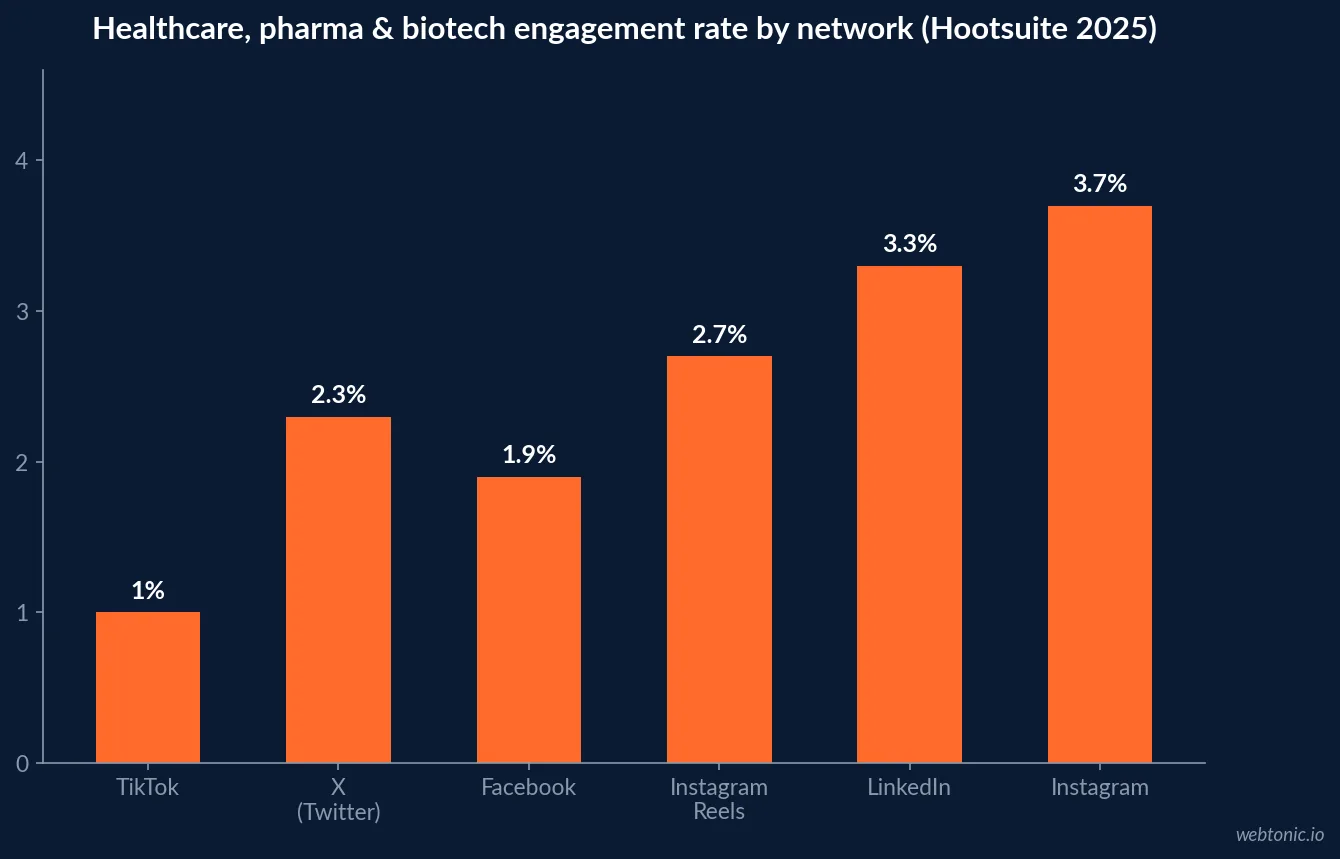
- Healthcare's average Instagram engagement rate is 3.7%, the highest of six tracked networks.
- LinkedIn engagement for healthcare averages 3.3%, ahead of Instagram Reels at 2.7%.
- TikTok has the lowest healthcare engagement rate tracked, at 1.0%.
- Facebook posts average 11.4 times a week in healthcare, more than any other network.
- Facebook follower growth for healthcare runs 10.11%, far ahead of other networks.
- TikTok follower growth for healthcare is 1.82%, LinkedIn just 0.94%.
- 66% of teen girls use TikTok versus 59% of teen boys, a gender split worth planning around.
- 696 active patients per member were reported in the AAO's 2025 survey, a record high.
Start with the audience, not the platform-performance table
Most healthcare social media benchmarks are built from providers treating adult patients, which makes them a poor starting point for orthodontics, where a substantial share of the patient base is 13 to 17 years old and the parent is the one making the appointment and payment decisions. Pew Research Center's 2024 survey of 1,391 US teens and parents found 90% of teens use YouTube, 63% use TikTok, 61% use Instagram, and 55% use Snapchat - while only 32% use Facebook, down from 71% in 2014-15.
| Platform | Share of US teens who use it (2024) | Daily/near-constant use |
|---|---|---|
| YouTube | 90% | 73% daily, 15% almost constant |
| TikTok | 63% | Majority daily, 16% almost constant |
| 61% | About half daily | |
| Snapchat | 55% | About half daily |
| 32% | 20% daily |
Where the engagement-rate benchmarks come from, and their real limits
No study publishes an orthodontics-specific engagement rate, so the nearest usable proxy is Hootsuite's 2025 healthcare, pharma and biotech benchmark research, current as of April 2025: Instagram at 3.7%, LinkedIn at 3.3%, Instagram Reels at 2.7%, X at 2.3%, Facebook at 1.9%, and TikTok at 1.0%, the lowest of the six. This proxy is broad healthcare - it blends hospital systems, pharma brands and biotech companies whose audience skews adult and professional, the opposite of orthodontics' teen-heavy patient base, so read the TikTok figure especially as a floor rather than a realistic ceiling for content actually built for a teen audience.
| Network | Healthcare/pharma/biotech engagement rate (2025) | Healthcare follower growth rate |
|---|---|---|
| 3.7% | 1.10% | |
| 3.3% | 0.94% | |
| Instagram Reels | 2.7% | n/a separately tracked |
| X (Twitter) | 2.3% | 0.00% |
| 1.9% | 10.11% | |
| TikTok | 1.0% | 1.82% |
Reading the two data sets against each other
Overlaying Pew's teen-reach numbers on Hootsuite's healthcare engagement numbers exposes a mismatch that matters for planning: the platform with the most teen reach (YouTube, 90%) is not one Hootsuite's healthcare set benchmarks for engagement at all, and the platform with the second-most teen reach (TikTok, 63%) has the category's lowest tracked engagement rate. The most plausible reading is not that teens dislike healthcare content on TikTok - it is that most healthcare TikTok content in that benchmark sample was not built for a teen audience the way orthodontics content plausibly could be, which makes the 1.0% figure a weak ceiling to plan around rather than a hard limit.
Facebook shows the inverse pattern: lowest teen reach (32%) paired with by far the highest healthcare follower growth rate (10.11%). That combination points toward Facebook working as the parent-facing channel - where the decision-maker actually spends time - rather than the patient-facing one.
A two-audience content plan, not one feed strategy
The data above argues for splitting orthodontics social content by audience rather than running one undifferentiated feed. Patient-facing content (treatment-day vlogs, before/after reveals, office culture) fits YouTube and TikTok, where teen reach is highest even if the tracked healthcare engagement rate is modest. Parent-facing content (financing options, insurance guidance, practice credentials, scheduling convenience) fits Facebook and Instagram, where healthcare's tracked engagement and follower growth are stronger and where the decision-maker actually spends attention.
One rule applies before any of this content goes to paid distribution: the FTC's COPPA compliance guidance restricts targeting and data collection aimed at users known to be under 13, and platforms including TikTok's own business policies set a minimum account age of 13 in the first place. Orthodontics' patient audience of 13-to-17-year-olds sits above that threshold but is still a minor audience, which argues for running paid distribution through the parent's account and consent rather than the teen's.
| Audience | Best-fit platform(s) | Content type | Supporting data point |
|---|---|---|---|
| Teen patient | YouTube, TikTok | Treatment vlogs, before/after, office culture | 90% / 63% teen reach, Pew 2024 |
| Parent / payer | Facebook, Instagram | Financing, insurance, credentials, scheduling | 10.11% FB follower growth, Hootsuite |
| Referring dentists / partners | Case outcomes, practice growth updates | 3.3% healthcare LinkedIn engagement | |
| Adult patient | Discreet aligner options, adult-specific offers | 3.7% healthcare Instagram engagement, highest tracked | |
| Community / local | Events, sponsorships, local reviews | 11.4 posts/week average, Hootsuite |
Posting cadence: what the healthcare benchmark actually recommends
Hootsuite's research found healthcare, pharma and biotech organizations post to Facebook an average of 11.4 times a week, more than any other network, but also found that engagement on Facebook depends more on content quality than volume - accounts posting twice a week saw engagement similar to those posting eight-plus times. On LinkedIn, the same research found the middle ground underperforms: accounts posting either twice a week or twenty times a week saw the highest average engagement, with nothing good happening in between. Neither finding is orthodontics- specific, but both argue against a "post daily everywhere" default without a content plan behind it.
| Network | Best-performing cadence (healthcare) | What to avoid |
|---|---|---|
| 2-8+ posts/week; quality matters more than volume | Posting purely to hit a frequency target | |
| At least 2 posts/week | Posting too frequently past that point (diminishing returns) | |
| 2 posts/week OR 20 posts/week | A middle cadence of 5-10 posts/week | |
| X (Twitter) | 2-6 posts/week OR 18-28 posts/week | The same middle-ground gap as LinkedIn |
What best time to post actually means for a teen-plus-parent audience
Hootsuite's healthcare research also publishes best-time-to-post windows: Tuesday and Friday afternoons (4-6pm) for Facebook, Tuesday and Friday mornings (8-10am) for Instagram, and Thursday mornings or evenings for LinkedIn. Those windows were derived from a broad healthcare sample skewed toward adult, professional audiences - not from teens on school schedules. A practice splitting content by audience, as recommended above, should treat the parent-facing Facebook and Instagram cadence as a reasonable starting point from this data, while testing after-school and evening windows for any YouTube or TikTok content aimed at the teen patient directly, since Pew's data shows teens' heaviest platform use skews to non-school hours.
Follower growth versus engagement: two different scoreboards
Hootsuite's healthcare data also separates follower growth rate from engagement rate, and the two do not move together. Facebook posts the lowest teen reach (32%, per Pew) but the highest healthcare follower growth rate at 10.11%, while TikTok has far higher teen reach (63%) but a follower growth rate of only 1.82% and the lowest engagement rate of the six tracked networks. A practice chasing follower counts alone would over-invest in Facebook; a practice chasing where its actual patient audience already spends time would over-invest in TikTok and YouTube. Neither instinct alone is correct - the point of splitting content by audience, as above, is to stop optimizing both goals on the same feed.
What this does not tell you
To be direct about the gap: neither Pew's survey nor Hootsuite's benchmark set measures orthodontic patient acquisition, appointment bookings, or brand recall from social content. They measure platform usage and average engagement respectively, across audiences and industries that are not orthodontics. Using them to plan a channel mix and a rough engagement floor is reasonable; quoting either as an "orthodontics social media statistic" without that caveat is not, and no source found for this page publishes a true orthodontics-specific social benchmark.
Our creative and content practice builds split audience plans like the one above for specialty healthcare brands; see our list of Facebook ads agencies if paid social needs to run alongside the organic plan, and our conversion rate benchmark data for what should happen once that content actually drives a click. Talk to us about building a channel-specific content calendar for a specific market.
Frequently Asked Questions
Which social platforms actually matter for an orthodontics practice?
Start from who the patient audience is, not from general best practices. Pew Research's 2024 survey of US teens found 90% use YouTube, 63% use TikTok, 61% use Instagram, and 55% use Snapchat - and orthodontics carries an unusually teen-heavy patient base compared with most healthcare categories. That argues for a YouTube-and-TikTok-first content plan aimed at the patient, paired with Facebook and Instagram content aimed at the parent who is actually paying and deciding.
What engagement rate should an orthodontics practice expect on social?
No study publishes an orthodontics-specific figure, so the nearest proxy is Hootsuite's 2025 healthcare, pharma and biotech benchmark set: LinkedIn at 3.3%, Instagram at 3.7%, Instagram Reels at 2.7%, X at 2.3%, Facebook at 1.9%, and TikTok at 1.0%. These are broad healthcare-category averages, not orthodontics-specific and not teen-audience-specific, so treat them as a floor rather than a target.
Should an orthodontics practice be on TikTok given how young the audience is?
The reach case is strong and the engagement-rate case is weak, and both are true at once. Pew found 63% of US teens use TikTok, more than any platform besides YouTube. But Hootsuite's healthcare-category benchmark shows TikTok has the lowest average engagement rate of the six networks it tracks, at 1.0%. The likely explanation is that most healthcare TikTok content is not made for a teen audience the way orthodontics content plausibly could be, which makes the category average a weak comparison either way.
Are there compliance rules around marketing to a teen audience on social media?
Yes, and they sit above the platform engagement data. Most major platforms, including TikTok and Instagram, set a minimum account age of 13, and the FTC's Children's Online Privacy Protection Act (COPPA) guidance restricts how a business can collect data from or target users known to be under 13. An orthodontics practice's teen audience is mostly 13 to 17, above the COPPA age threshold but still a minor audience, which is a reason to route paid targeting and consent through the parent's account wherever the practice runs paid social.
How often should a practice post, based on published healthcare benchmarks?
Hootsuite's healthcare, pharma and biotech research found organizations posting to Facebook an average of 11.4 times a week, more than any other platform in that category, but also found Facebook engagement depends more on content quality than posting frequency - accounts posting twice a week saw similar engagement to those posting eight or more times. On LinkedIn, the same research found posting either a little (twice a week) or a lot (twenty times a week) outperformed the middle ground.
Is there any orthodontics-specific social data, like from the AAO or Align Technology?
Not from a source this page could independently verify. The American Association of Orthodontists' 2025 Economics of Orthodontics survey documents patient volume and referral-source data but does not break out social media platform performance. Any specific orthodontics social media engagement rate or follower-growth figure circulating without a named, checkable study behind it should be treated as unsourced rather than repeated as fact.
Sources
Pew Research Center - 10 facts about teens and social media
Hootsuite - Healthcare social media benchmarks: 2025 research
American Association of Orthodontists - 2025 Economics of Orthodontics and Patient Census Survey
Federal Trade Commission - Complying with COPPA: Frequently Asked Questions
TikTok for Business - Official blog and policy updates