Table of contents
Dentist referral was the top reason patients picked an orthodontist for just 28% of respondents in the AAO's 2024 consumer study, down from 43% in 2021. No study prices what an orthodontic practice should spend on SEO, but this behavioral shift - away from referral and toward self-directed search - is the actual argument for where this year's budget should move.
Key Takeaways
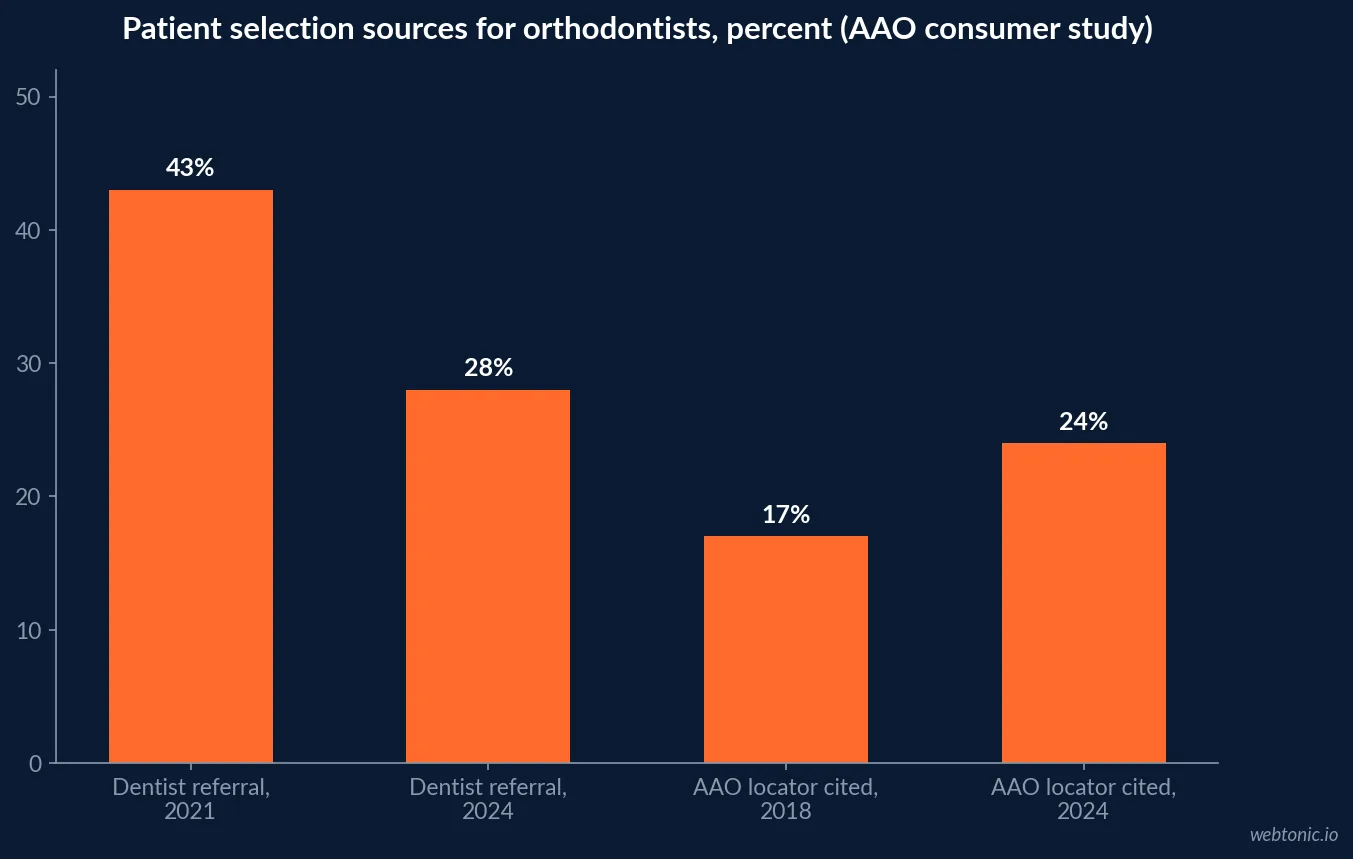
- Dentist-referral selection fell from 43% in 2021 to 28% in 2024, per the AAO.
- The AAO's Find an Orthodontist tool grew as a cited source from 17% in 2018 to 24% in 2024.
- That tool drove an estimated 44,000 exams and 28,000 treatment starts in 2024.
- Orthodontists now treat 70% of all patients in active treatment, up from 65% in 2022.
- Per-member patient count hit 696 in 2024, the highest in the survey's history since 1987.
- That is up from 574 in 2022 and over 10% above the prior record of 628, set in 2001.
- An estimated 6.66 million patients are in active treatment across the US and Canada.
- Adult patients reached roughly 1.91 million in 2024, up from 1.64 million in 2022.
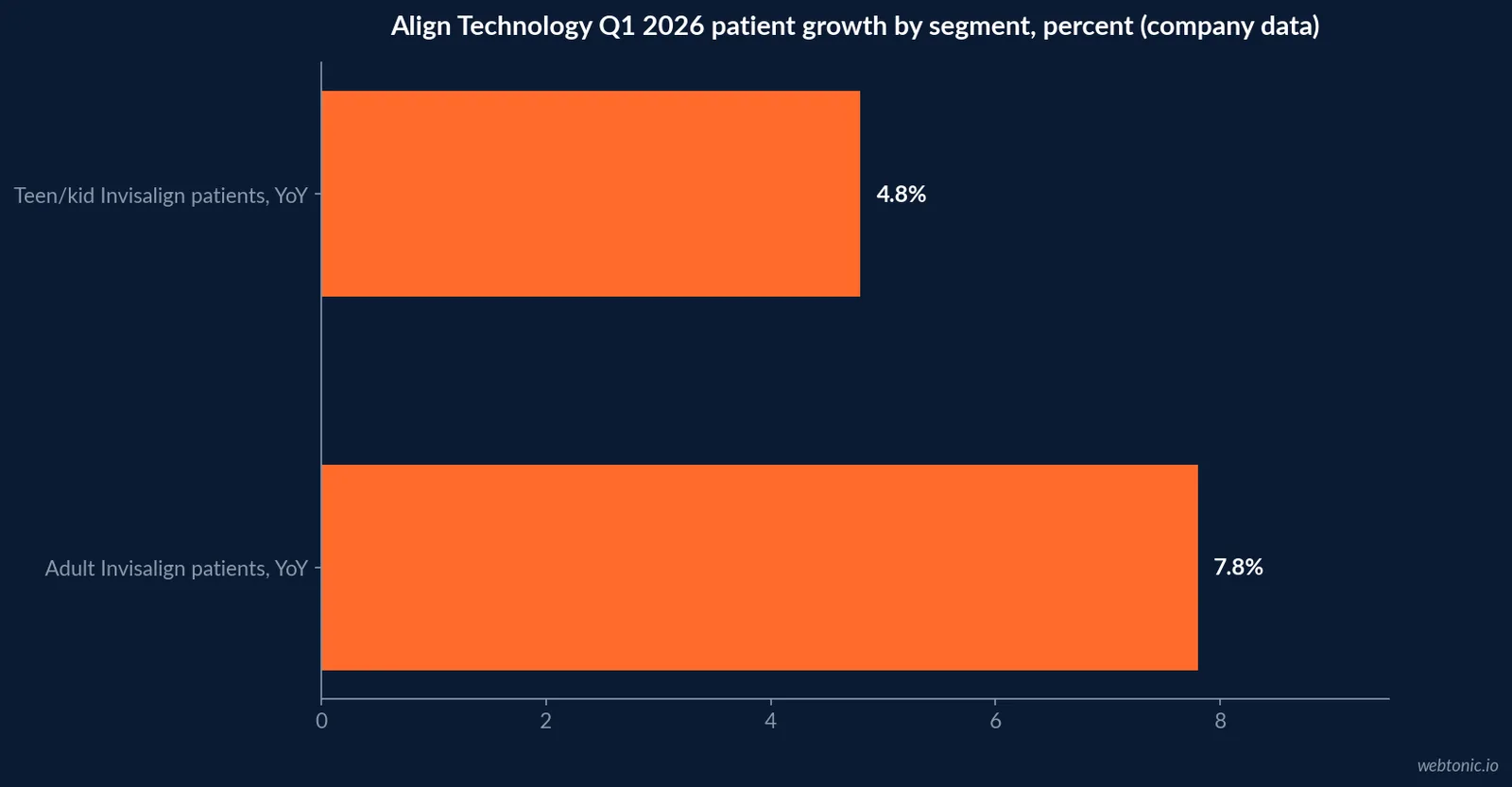
- Align Technology reported Invisalign adult patients up 7.8% year-over-year in Q1 2026.
- Teen and kid patients grew 4.8% in that same quarter, per Align's own Q1 2026 earnings call transcript.
- Teen and kid case starts reached 240,000 in Q2 2026, up 7.2% year-over-year.
- 86% of consumers believe orthodontists have more specialized training than general dentists.
- 83% trust orthodontist-provided treatment more than mail-order aligner companies.
- Consumers believe age 9.5 is the right age for a first consultation, against the AAO's recommended age 7.
- 97% of consumers read online reviews before choosing a business, per BrightLocal's 2026 cross-industry survey.
- 31% will only use a business rated 4.5 stars or higher, up from 17% the year before.
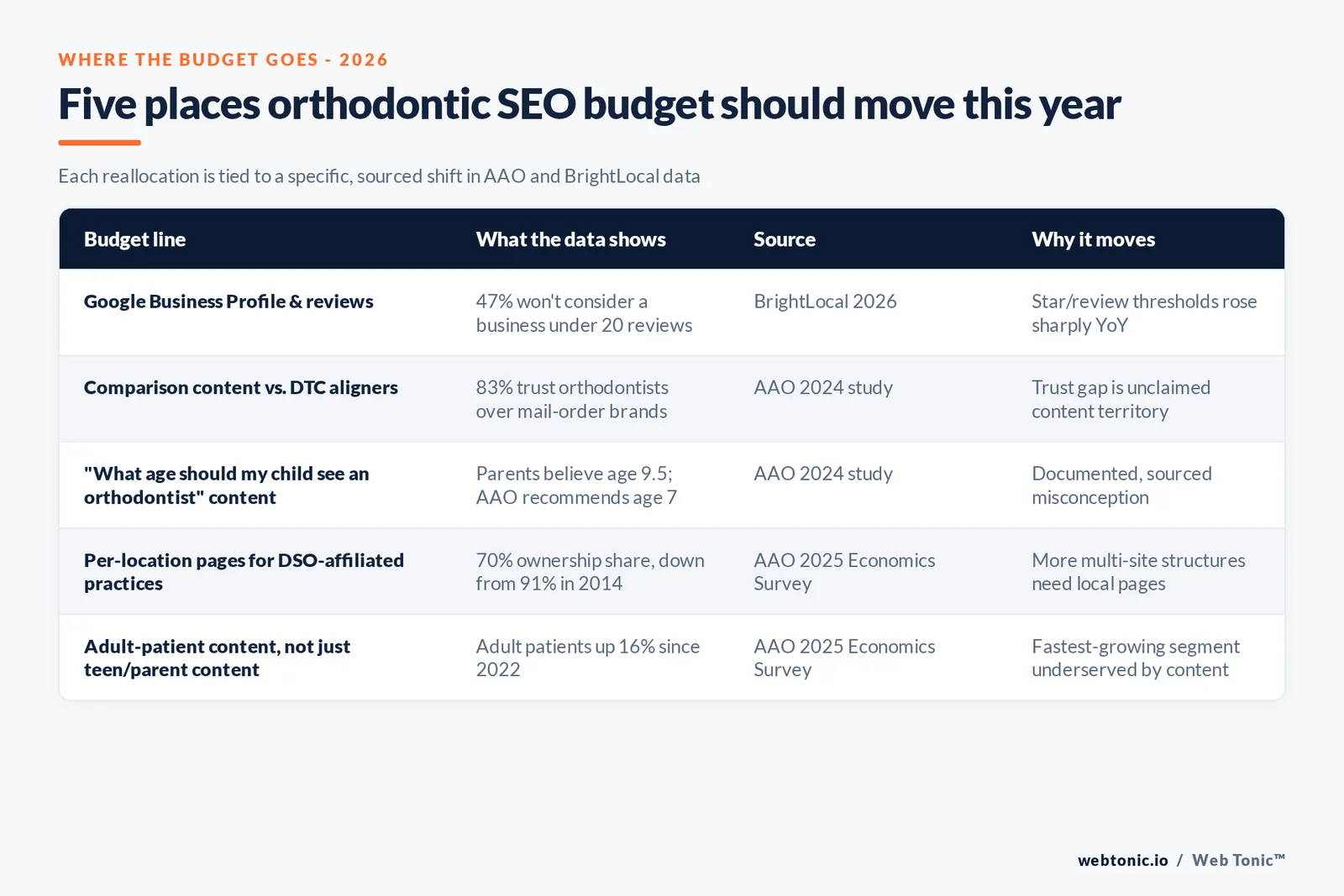
- 47% will not consider a business with fewer than 20 reviews.
- Orthodontist-owned practice share has stabilized at 70%, after falling from 91% in 2014.
Who patients trust to find an orthodontist is changing
The clearest signal for where SEO budget belongs comes from the American Association of Orthodontists' own 2024 Orthodontic Landscape Consumer Study. Dentist recommendation remained the single most-cited reason for choosing an orthodontist, but it covered only 28% of respondents in 2024, down sharply from 43% in 2021. In the same window, the AAO's own Find an Orthodontist locator grew as a cited referral source, from 17% of respondents in 2018 to 24% in 2024 - and the AAO estimates that tool alone drove 44,000 patient exams and 28,000 treatment starts in 2024. Referral cultivation has not disappeared as a channel, but it is losing share to exactly the kind of self-directed search behavior organic and local SEO are built to capture.
| Patient-selection metric | Earlier year | 2024 (AAO data) | Direction |
|---|---|---|---|
| Dentist referral as top selection reason | 43% (2021) | 28% (2024) | Down 15 points |
| AAO Find an Orthodontist cited as source | 17% (2018) | 24% (2024) | Up 7 points |
| Share of all patients treated by orthodontists | 65% (2022) | 70% (2024) | Up 5 points |
| Exams driven by Find an Orthodontist tool | n/a | ~44,000 (2024) | AAO estimate |
| Starts driven by Find an Orthodontist tool | n/a | ~28,000 (2024) | AAO estimate |
Demand is outpacing capacity, not shrinking
The AAO's 2025 Economics of Orthodontics and Patient Census Survey - 635 usable responses across the US and Canada, a 6.6% participation rate - found the average number of patients in active treatment per member reached 696 in 2024, the highest figure recorded since the survey began in 1987 and more than 10% above the previous record of 628, set in 2001. Scaled to the AAO's roughly 9,554-member database, that implies an estimated 6.66 million patients in active treatment across the US and Canada. Adult patients specifically reached approximately 1.91 million, up from 1.64 million in 2022.
None of that demand growth shows up automatically in a practice's own pipeline. It shows up for the practices whose sites and Google Business Profiles are positioned to catch a search that no longer starts with "who did your dentist recommend."
| AAO Economics Survey metric | 2022 | 2024 | Change |
|---|---|---|---|
| Patients in active treatment per member | 574 | 696 | +21% |
| Estimated total active patients (US + Canada) | Lower base | ~6.66 million | Record high |
| Estimated adult patients in treatment | 1.64 million | 1.91 million | +16% |
| Orthodontist-owned single/group practice share | 71% | 70% (stabilized) | Roughly flat |
What Align's own numbers say about search demand by segment
Company-reported data from Align Technology, Invisalign's manufacturer, adds a demand-side data point worth labeling clearly as company data rather than independent research. Align's Q1 2026 earnings call transcript reported Invisalign adult patients up 7.8% year-over-year against teen and kid patients up 4.8%, and by Q2 2026 teen and kid case starts reached 240,000, up 7.2% year-over-year. Adult demand growing faster than teen demand in the same reporting period is a real signal for content strategy: a practice's SEO content built primarily around parents searching for a child's first consultation is optimizing for the slower-growing half of the market.
The content gap between what parents believe and what the AAO recommends
The same 2024 AAO consumer study found parents believe, on average, that a child's first orthodontic consultation should happen around age 9.5, while the AAO's own clinical guidance recommends an evaluation by age 7. That roughly two-and-a-half-year gap between belief and guidance is a specific, sourced content opportunity: a page answering "what age should my child see an orthodontist" that cites the AAO's own age-7 recommendation directly addresses a documented misconception, not a generic keyword.
Defending against direct-to-consumer aligners in search results
Search is also where practices compete against mail-order aligner brands, and the AAO's own consumer research suggests the trust argument still favors licensed orthodontists if it is actually made: 86% of consumers believe orthodontists have more specialized training than general dentists, and 83% report more confidence in orthodontist-provided treatment than in a company that ships aligners to a patient's home. Content that makes that comparison explicitly - the kind of page a self-searching adult patient would actually read before choosing between a DTC aligner brand and a local orthodontist - converts that trust gap into a ranking asset instead of leaving it implicit.
| Consumer trust metric (AAO 2024 study) | Figure | SEO content angle |
|---|---|---|
| Believe orthodontists have more specialized training | 86% | Credential/training comparison pages |
| More confident in orthodontist treatment vs. mail-order aligners | 83% | "Orthodontist vs. DTC aligners" comparison content |
| Believed appropriate age for first consultation | 9.5 years (parent belief) | "What age should my child see an orthodontist" content citing the AAO's age-7 guidance |
| Share of all patients treated by orthodontists (vs. GPs/mail-order) | 70% | Category-authority content reinforcing orthodontist specialization |
Reviews and reputation are now a ranking and conversion input
None of the search behavior above matters if the local pack listing itself does not clear the review bar patients now expect. BrightLocal's 2026 Local Consumer Review Survey - cross-industry, not orthodontics-specific, but directly relevant to any local-search-dependent practice - found 97% of consumers read online reviews before choosing a business, with 41% saying they "always" read reviews, up from 29% the year before. Star-rating thresholds have also tightened fast: 31% of consumers will only use a business rated 4.5 stars or higher, up from just 17% a year earlier, and 68% will only use a business with four stars or more, up from 55%.
| BrightLocal 2026 metric (cross-industry) | 2025 | 2026 | Change |
|---|---|---|---|
| Consumers who read online reviews | High baseline | 97% | Near-universal |
| Consumers who "always" read reviews | 29% | 41% | +12 points |
| Will only use a business rated 4.5+ stars | 17% | 31% | +14 points |
| Will only use a business rated 4+ stars | 55% | 68% | +13 points |
| Won't consider a business with fewer than 20 reviews | Not tracked prior year | 47% | New threshold |
Regulatory attention reinforces the same content angle: in September 2026 the FDA published consumer guidance stating it has not authorized clear aligners sold directly to consumers without a prescription and supervision by a dentist or orthodontist. A practice's own comparison content can cite that guidance directly rather than paraphrasing a competitor's marketing claim.
| Patient-trust signal, source | What it measures | SEO/content use |
|---|---|---|
| FDA clear dental aligners consumer guidance (2026) | FDA has not authorized unsupervised DTC clear aligners | Supports content contrasting supervised vs. unsupervised treatment |
| AAO age-7 first-visit recommendation | Clinical guidance vs. parent belief (9.5 years) | Direct source for a dedicated FAQ/content page |
| AAO Find an Orthodontist locator growth (17% to 24%) | Self-directed search behavior | Argument for GBP and locator-adjacent optimization |
| BrightLocal 4.5-star threshold (17% to 31%) | Rising consumer expectations | Argument for active review generation, not passive collection |
What DSO growth means for how the SEO budget gets spent
The same 2025 AAO Economics Survey found orthodontist-owned single or group practice share stabilizing at 70%, after a decline from 91% in 2014 - meaning roughly three in ten respondents now practice inside a Dental or Orthodontic Service Organization. That structural shift changes the unit SEO budget should be allocated against: a multi-location DSO needs a location-page and Google Business Profile strategy priced and built per site, not a single practice-wide homepage trying to rank for every city its locations serve.
Where this year's budget should actually go
Put together, the data argues for redirecting SEO budget toward the channels that catch a self-directing patient rather than the channels built around a referral relationship: Google Business Profile and review generation (given the 47%-of-20-reviews and 31%-of-4.5-stars thresholds), comparison content that converts the AAO's own trust data into pages a searching adult or parent will actually read, and - for DSO-affiliated practices - per-location technical SEO rather than a single corporate domain. None of that is a guessed allocation; each line traces to a specific, sourced shift in how patients say they are actually finding a provider.
What this data does not tell you
To be direct about the limits: none of the sources here measure organic traffic, keyword rankings, or SEO spend against patient starts for orthodontic practices specifically. The AAO study measures stated patient behavior, not attributed marketing performance, and BrightLocal's review data is cross-industry. Treat the framework above as a sourced argument for reallocation, not a benchmark to hit. Our growth marketing team builds the attribution layer that would turn this into a measured number for a specific practice, and our guide to cost per lead by industry is a useful reference point once that tracking exists. Talk to us if you want that measurement built before the budget is reallocated, not after.
Frequently Asked Questions
Is there a published benchmark for orthodontic practice SEO ROI?
No. Neither the American Association of Orthodontists nor any dental-marketing vendor publishes a controlled SEO-spend-to-patient-start study for orthodontics specifically. What exists is patient behavior data - how people say they choose an orthodontist, and how much they trust reviews - which is what this page uses to reason about where budget should go, not a verified ROI multiple.
Why is dentist-referral selection declining?
The AAO's own 2024 Orthodontic Landscape Consumer Study does not state a cause, only the trend: dentist recommendation was the top reason for orthodontist selection for 28% of consumers in 2024, down from 43% in 2021. Over the same period, the AAO's own Find an Orthodontist locator grew as a cited referral source, from 17% of respondents in 2018 to 24% in 2024 - consistent with more patients self-directing their search rather than waiting on a referral.
Should an orthodontic practice worry about direct-to-consumer aligner brands in search results?
The AAO's consumer data suggests trust still favors licensed orthodontists: 83% of consumers report more confidence in treatment from an orthodontist than from a company that mails aligners directly, and 86% believe orthodontists have more specialized training than general dentists. That trust gap is an asset in search content, but only if a practice's site actually contains the comparison content that lets a self-searching patient find it.
How much does review volume and star rating actually matter for local search?
BrightLocal's 2026 Local Consumer Review Survey (cross-industry, not orthodontics-specific) found 97% of consumers read online reviews, 31% will only use a business with 4.5 stars or higher - up from 17% a year earlier - and 47% will not consider a business with fewer than 20 reviews. None of that is ortho-specific, but a practice competing on local pack visibility is competing inside those same consumer thresholds.
Does growing DSO/OSO ownership change how orthodontic SEO should be structured?
It changes the unit of optimization. The AAO's 2025 Economics Survey found orthodontist-owned single or group practices stabilizing at 70% after a prior decline from 91% in 2014, meaning roughly three in ten respondents now practice under a Dental or Orthodontic Service Organization. Multi-location DSO structures need a location-page and Google Business Profile strategy per site, not one practice-wide homepage competing for every city at once.
Sources
American Association of Orthodontists - 2024 Orthodontic Landscape Consumer Study
American Association of Orthodontists - 2025 Economics of Orthodontics and Patient Census Survey
Align Technology - Q1 2026 Earnings Call Transcript (StockAnalysis)
Align Technology - Q2 2026 earnings call transcript
BrightLocal - Local Consumer Review Survey 2026
American Dental Association - Health Policy Institute, Dental Care Market
U.S. Food and Drug Administration - Clear Dental Aligners consumer guidance