Table of contents
The Google map pack and organic search results reward different ranking signals, and Whitespark's 2026 Local Search Ranking Factors survey scores each set separately. This page applies that scoring to an orthodontics practice, alongside the American Association of Orthodontists' own referral-tool data and consumer review-behavior research.
Key Takeaways
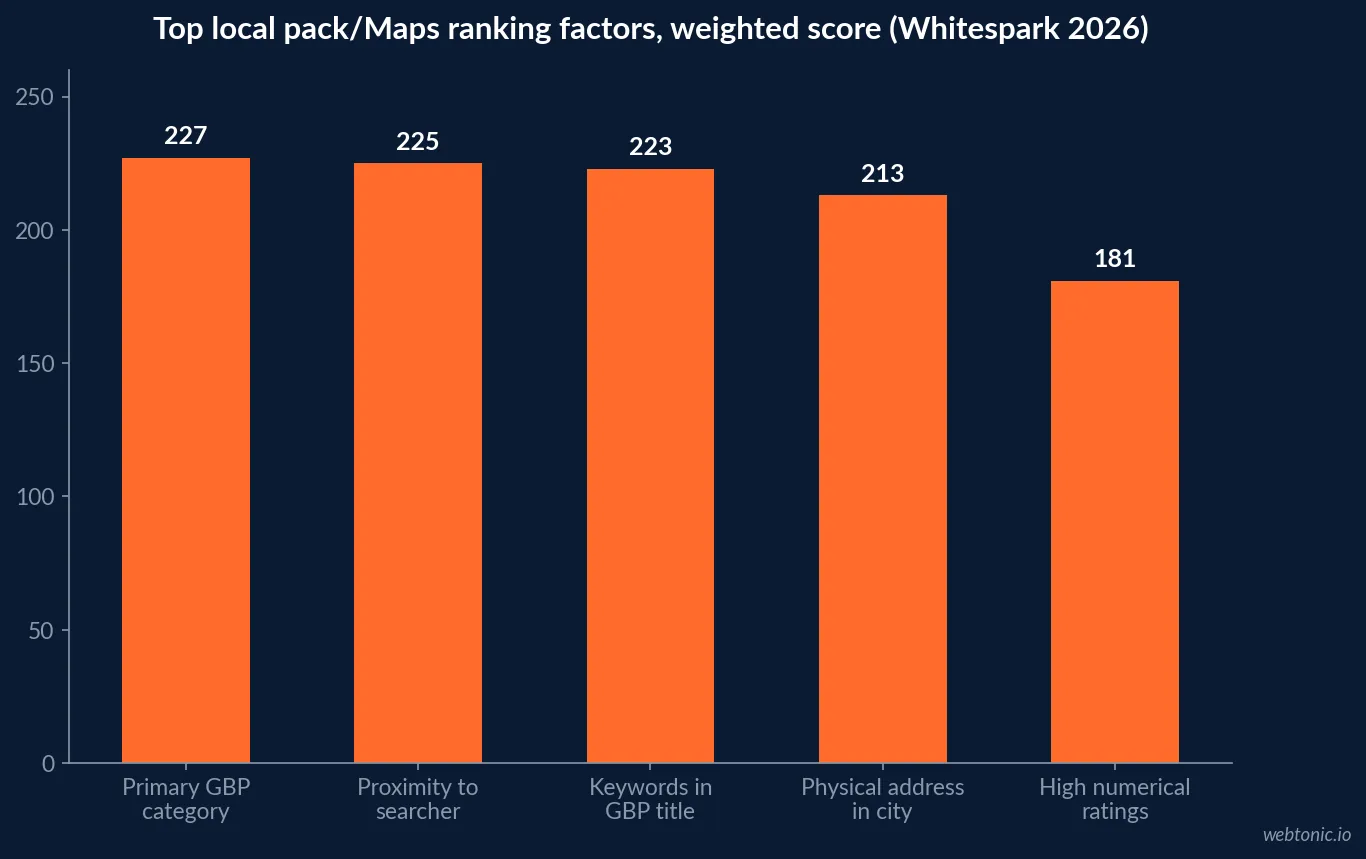
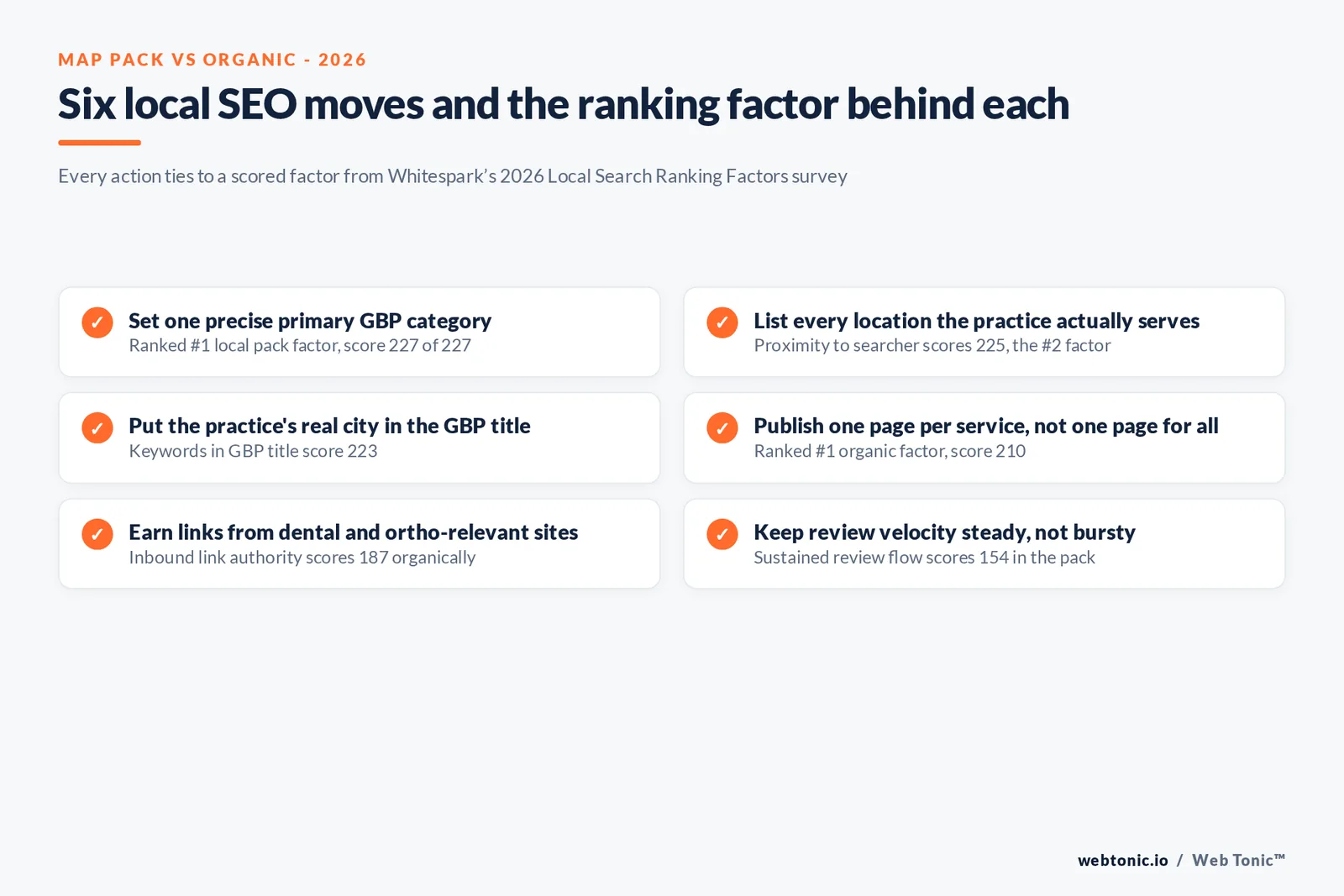
- Primary GBP category scores 227, the top local pack/Maps ranking factor for 2026.
- Proximity to the searcher scores 225, the #2 map pack factor.
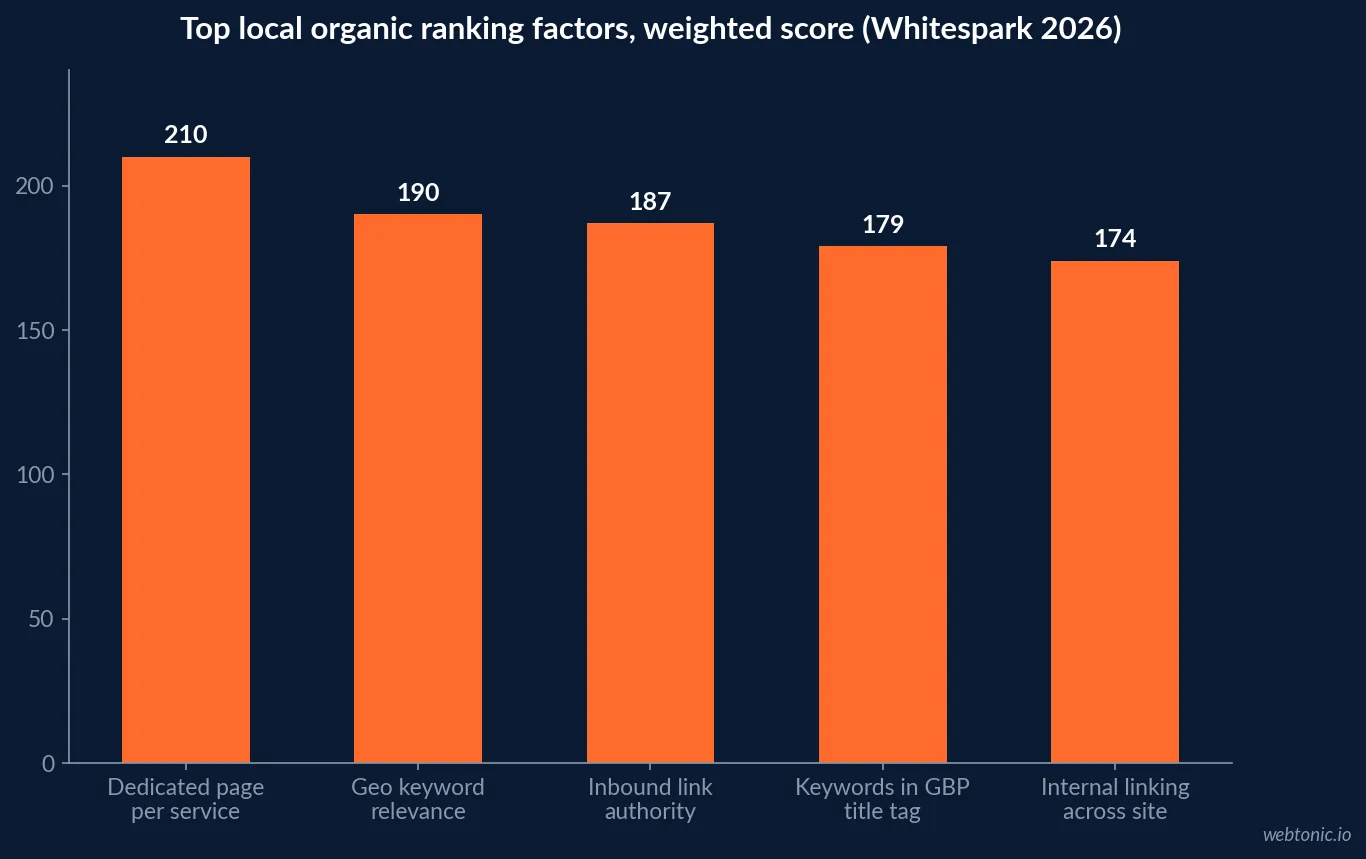
- A dedicated page per service scores 210, the #1 local organic ranking factor.
- Inbound link authority scores 187 for organic rankings but does not rank top-5 for the map pack.
- High numerical Google ratings score 181 as a map pack factor.
- 96% of consumers read online reviews at least occasionally, per BrightLocal 2025.
- Only 4% of consumers say they never read reviews, per the same survey.
- 81% of consumers use Google specifically to read reviews.
- 24% of AAO members cite their own referral tool as a patient source, up from 17% in 2018.
- An estimated 28,000 patients started treatment via that AAO tool in 2024 alone.
- 696 patients per member were in active treatment in 2024, an AAO survey record.
- A dental patient-review study covering 150,000-plus reviews linked shorter wait times to higher ratings.
- Click-through rate from the local pack scores 156 as its own ranking factor, not just an outcome.
- Sustained review flow over time scores 154, ahead of one-off review bursts.
Two different scoreboards, not one
Whitespark's 2026 Local Search Ranking Factors report, compiled from a panel of local search practitioners, publishes two separate factor lists: one for local pack/Maps rankings and one for local organic rankings. They overlap on some items - keywords in the GBP title tag appears in both - but the top of each list is built from different signals entirely. Treating "local SEO" as one undifferentiated task is the most common mistake this data set exposes.
| Rank | Top local pack/Maps factor | Score | Top local organic factor | Score |
|---|---|---|---|---|
| 1 | Primary GBP Category | 227 | Dedicated Page for Each Service | 210 |
| 2 | Proximity of Address to Searcher | 225 | Geographic Keyword Relevance of Content | 190 |
| 3 | Keywords in GBP Business Title | 223 | Quality/Authority of Inbound Links to Domain | 187 |
| 4 | Physical Address in City of Search | 213 | Keywords in GBP Landing Page Title Tag | 179 |
| 5 | Business Open at Time of Search | 189 | Inbound Links from Industry-Relevant Domains | 175 |
What that split means for an orthodontics practice specifically
An orthodontics practice usually competes for map pack visibility against a small, hyper-local set of other orthodontists and general dentists offering orthodontic services, where the primary category chosen on the Google Business Profile - specifically "Orthodontist" rather than the broader "Dentist" - is doing more ranking work than any single page of content, per Whitespark's #1-ranked factor. Multi-location practices also have a structural advantage here: proximity to the searcher, the #2 factor, rewards having a location near the query, which a single-location practice cannot manufacture. Google's own Business Profile help documentation confirms categories are what connect a listing "with customers who search for your products or services," which is the mechanism the #1 factor is actually measuring.
Organic ranking, by contrast, rewards the kind of content work that compounds - a dedicated page per service (clear aligners, traditional braces, retainers, adult orthodontics) rather than one general "services" page, geographic keyword relevance, and inbound link authority. None of those are configuration changes; they are a content and outreach program measured in months, not a form field in a GBP dashboard.
How patients actually behave once they see a listing
BrightLocal's 2025 Local Consumer Review Survey found that 96% of consumers read online reviews at least occasionally when researching a local business, and only 4% say they never do. 81% specifically use Google to find and read those reviews, reinforcing why review signals sit inside Whitespark's map pack factor set (high numerical ratings score 181; volume of reviews with text scores 170) rather than being a separate "reputation" line item.
A peer-reviewed mixed-methods study of US dental patient reviews, analyzing ratings tied to more than 150,000 reviews across over 71,000 dentists, found higher ratings statistically associated with shorter reported wait times and younger provider age. That is a dentistry-wide finding, not an orthodontics-specific one, but wait time and appointment friction are exactly the kind of experience detail an orthodontic patient - or a parent booking for a teen - would plausibly mention in a review.
| Consumer review behavior (2025) | Figure | Source |
|---|---|---|
| Read reviews at least occasionally | 96% | BrightLocal 2025 |
| Never read online reviews | 4% | BrightLocal 2025 |
| Use Google specifically for reviews | 81% | BrightLocal 2025 |
| Reviews analyzed in dental patient-review study | 150,000+ | JMIR-published study |
| Dentists covered in that same study | 71,881 | JMIR-published study |
What the AAO's own referral data adds
The AAO's 2025 Economics of Orthodontics and Patient Census Survey reports that 24% of member respondents cite the association's own consumer-facing Find an Orthodontist tool as a patient referral source, up from 20% in 2022 and 17% in 2018. Based on 2024 starts and the share of patients found through that tool, the AAO estimates roughly 44,000 patients were examined and 28,000 started treatment after locating their orthodontist that way.
That is a directory-referral statistic, not a Google local pack or organic ranking statistic, and the two should not be conflated. What it does confirm, independent of any Google-specific data, is that a meaningful and growing share of new patients are finding orthodontists through a structured online search tool rather than a personal referral - which is the underlying behavior both Google's map pack and organic results are also trying to serve.
How Google's Local Services Ads change the picture
The map pack and organic factors above only describe free listings. Google's Local Services Ads (LSA) product can place a paid, badge-verified listing above both the map pack and organic results for qualifying service categories, and orthodontics practices that qualify are competing on a separate ranking mechanism weighted toward review volume, responsiveness, and proximity - not the content and link factors that drive organic rank. A practice deciding where to spend its next budget dollar should treat LSA eligibility as a fourth lane, not a substitute for the map pack and organic work above, since it disappears the moment the ad budget stops.
| Listing type | Governed by | Cost to appear | Durability once earned |
|---|---|---|---|
| Local Services Ads | Google Ads auction + review signals | Pay per lead, ongoing | Stops the moment spend stops |
| Map pack / Local Pack | Whitespark's local pack factor set | Free, but time to configure + earn reviews | Persists with maintenance |
| Organic local results | Whitespark's local organic factor set | Free, but months of content/link work | Compounds and persists longest |
| Paid search (standard) | Google Ads Quality Score + bid | Pay per click, ongoing | Stops the moment spend stops |
The NAP-consistency problem multi-location groups create for themselves
Name, address and phone (NAP) consistency across every directory and citation source is a long-standing local SEO fundamental, and it gets harder to hold at scale for orthodontics groups operating under a DSO structure with a shared brand name across many individually addressed locations. Whitespark's factor set scores Physical Address in City of Search at 213 for the map pack, meaning an inconsistent or incorrectly geocoded address actively works against a location's own listing rather than merely failing to help it. A DSO managing a dozen locations has a dozen separate NAP records to keep correct, a materially different operational problem than a single-location practice has.
What to measure once the work is live
Whitespark's factor set treats click-through rate from the local pack itself as a ranking input, scoring it at 156, not only as an outcome to report on. A practice should watch its Google Business Profile's own click-through data as a leading indicator of ranking health, rather than waiting for a position tracker to show movement. Pairing that with review velocity - sustained influx of reviews over time scores 154, ahead of one-off review bursts - gives a practice two numbers it can check monthly without specialist local SEO tooling: how often the profile gets clicked once shown, and whether reviews are arriving on a steady drip rather than in bursts around a promotion.
| Metric to watch monthly | Why it matters | Whitespark factor it maps to |
|---|---|---|
| GBP click-through rate | A ranking input, not just an outcome | CTR from Local Pack/Maps (156) |
| Review arrival cadence | Steady beats bursty for ranking | Sustained Influx of Reviews (154) |
| NAP match rate across directories | Inconsistency actively suppresses rank | HTML NAP Matching GBP NAP (153) |
| Service pages published vs. services offered | Gaps leave organic factor #1 unclaimed | Dedicated Page for Each Service (210) |
A sequencing plan, not a to-do list
Given the map pack factors are largely configuration and proximity-driven while the organic factors compound over time, the practical order is: lock the GBP category and NAP consistency first (map pack, fast), build one dedicated page per service second (organic, medium), then pursue industry-relevant inbound links third (organic, slow). Running all three simultaneously with a fixed budget usually means none of them gets done well; sequencing them means the map pack presence is solid before the slower organic work needs to start compounding.
| Phase | Primary lever | Ranking factor it targets | Approx. time to signal |
|---|---|---|---|
| 1 - Map pack setup | Correct GBP category + full NAP | Primary GBP Category (227) | Days to weeks |
| 2 - Map pack reinforcement | Steady review acquisition | Native reviews with text (170) | Ongoing, monthly cadence |
| 3 - Organic foundation | One page per service line | Dedicated Page for Each Service (210) | 1-2 months to publish |
| 4 - Organic content depth | City/neighborhood-specific content | Geographic Keyword Relevance (190) | 2-4 months |
| 5 - Organic authority | Links from dental/ortho-relevant sites | Inbound Link Authority (187) | 4+ months, compounding |
Where this fits alongside paid channels
Local SEO and paid search are not substitutes for each other; the ranking factors above only apply to the free map pack and organic listings, not to Local Services Ads or paid search placements that can sit above both. A practice weighing where to put its next dollar should look at what a paid lead already costs in the channel it is competing against - see our data on cost per lead by industry - before deciding how much local SEO work is worth funding relative to paid acquisition. Our growth marketing practice builds that sequencing plan for healthcare and specialty-care clients, and you can talk to us about a specific market's competitive map pack.
Frequently Asked Questions
What is the single biggest ranking factor for an orthodontist in the Google map pack?
Primary Google Business Profile category, according to Whitespark's 2026 Local Search Ranking Factors survey, which scored it 227 out of a possible top score, ahead of proximity to the searcher (225) and keywords in the GBP business title (223). For an orthodontics practice this means the exact category chosen - Orthodontist, not the broader Dentist - is doing more ranking work than any single piece of on-page content.
Does ranking well in the map pack also mean ranking well in organic search?
Not automatically. Whitespark's survey scores local pack/Maps rankings and local organic rankings as separate factor sets. The top organic factor is having a dedicated page for each service (score 210), followed by geographic keyword relevance of content (190) and the quality and authority of inbound links to the domain (187) - none of which appear in the top five map pack factors. A practice can hold a strong map pack position on GBP signals alone while its organic listing lags for lack of service-specific content and links.
How much do online reviews actually affect where an orthodontist shows up?
Reviews influence both rankings and clicks, through separate mechanisms. In Whitespark's map pack factors, high numerical Google ratings score 181 and the quantity of native Google reviews with text scores 170. On the behavior side, BrightLocal's 2025 Local Consumer Review Survey found 96% of consumers read online reviews at least occasionally, with only 4% saying they never do, and 81% specifically use Google to read them. A peer-reviewed study of dental patient reviews similarly found shorter reported wait times associated with higher ratings.
Does the AAO's own data say how patients actually find an orthodontist?
Indirectly. The AAO's 2025 Economics of Orthodontics survey reports that 24% of member respondents cite the association's own Find an Orthodontist consumer tool as a patient referral source, up from 20% in 2022 and 17% in 2018, and estimates that tool alone drove roughly 44,000 exams and 28,000 treatment starts in 2024. That is a directory-referral figure, not a Google-ranking figure, but it confirms patients are actively searching for and choosing orthodontists through structured online tools rather than word of mouth alone.
Should a single-location practice prioritize map pack or organic ranking work first?
The map pack, because it is faster to move and more binary - a practice either shows in the local pack for its core search terms or it does not, and the top factors (GBP category, proximity, GBP title keywords) are configuration decisions rather than months of content and link work. Organic ranking factors like inbound link authority and volume of quality content compound over a longer timeline, which makes them the second phase once the map pack presence is solid.
Sources
Whitespark - 2026 Local Search Ranking Factors Report
BrightLocal - Local Consumer Review Survey 2025
American Association of Orthodontists - 2025 Economics of Orthodontics and Patient Census Survey
PMC / JMIR - Assessing Patient Experience and Healthcare Quality Using Patient Online Reviews
Google Business Profile Help - Manage your business category