Table of contents

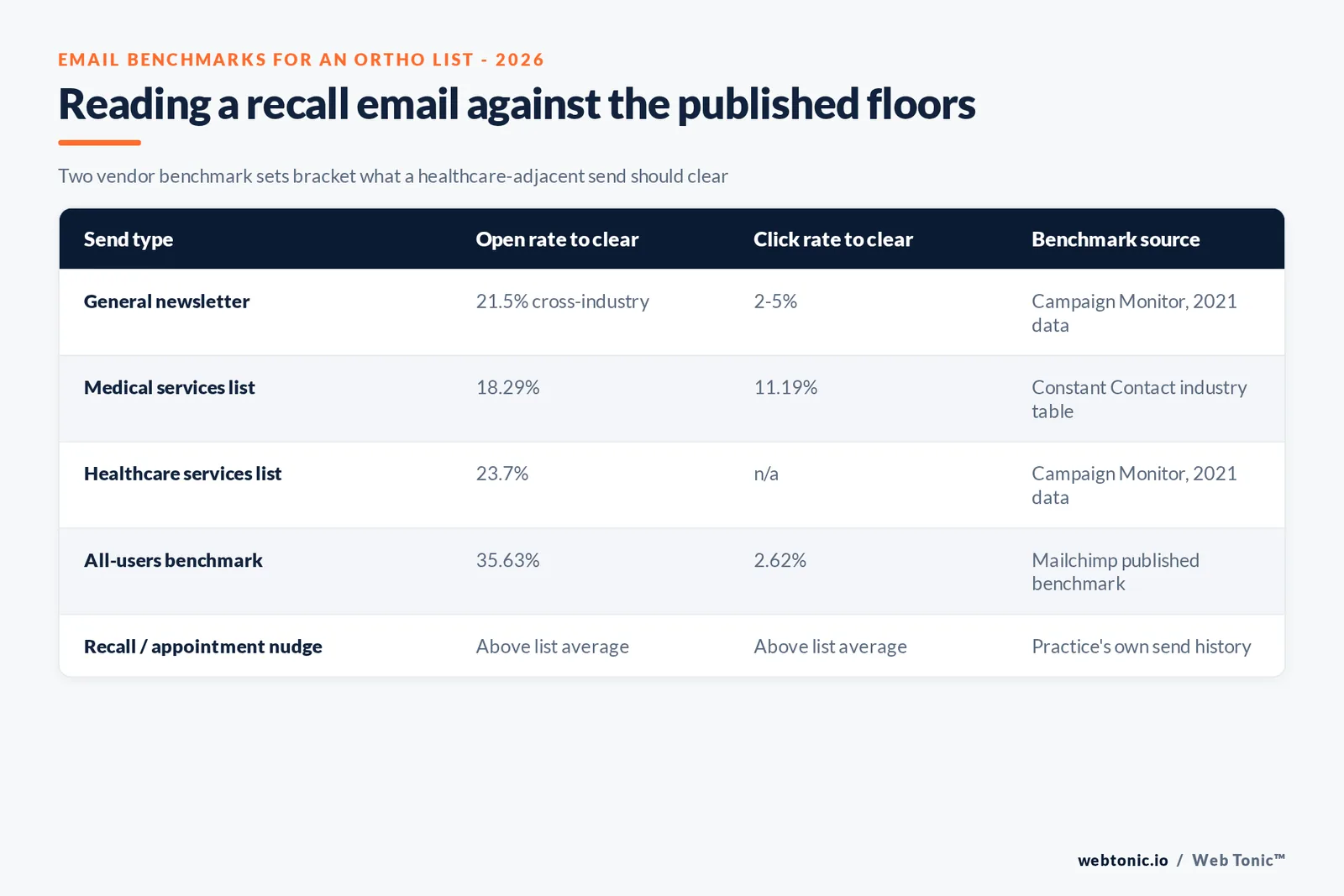
No email service provider publishes an orthodontics-specific benchmark, so this page brackets a recall or nurture send between the two nearest published categories - Constant Contact's Medical Services average and Campaign Monitor's Healthcare Services average - against the cross-industry Mailchimp floor, and states plainly where each number comes from.
Key Takeaways
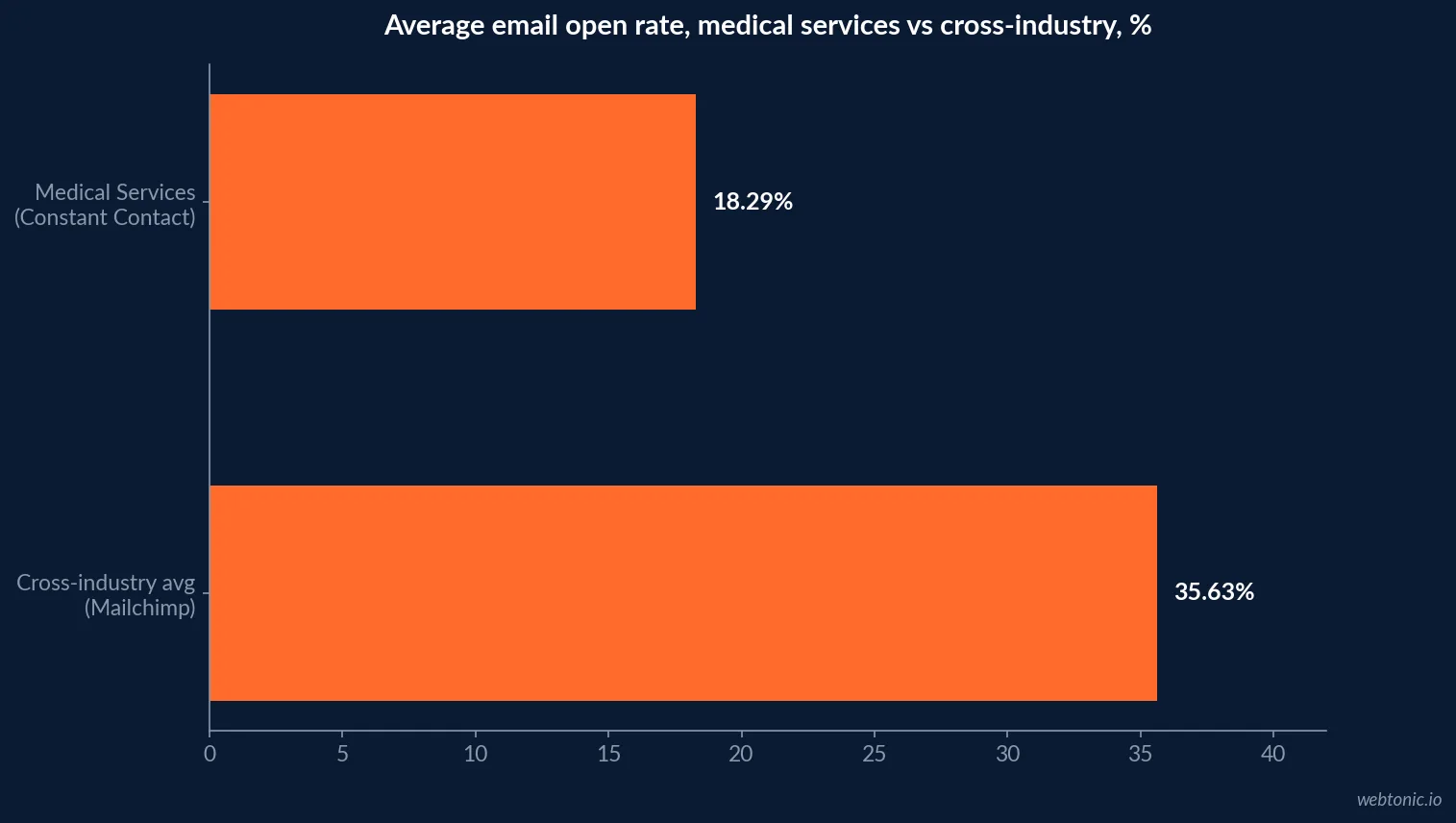
- Constant Contact's Medical Services open rate averages 18.29%.
- That category's click-through rate averages 11.19%, a strong open-to-click ratio.
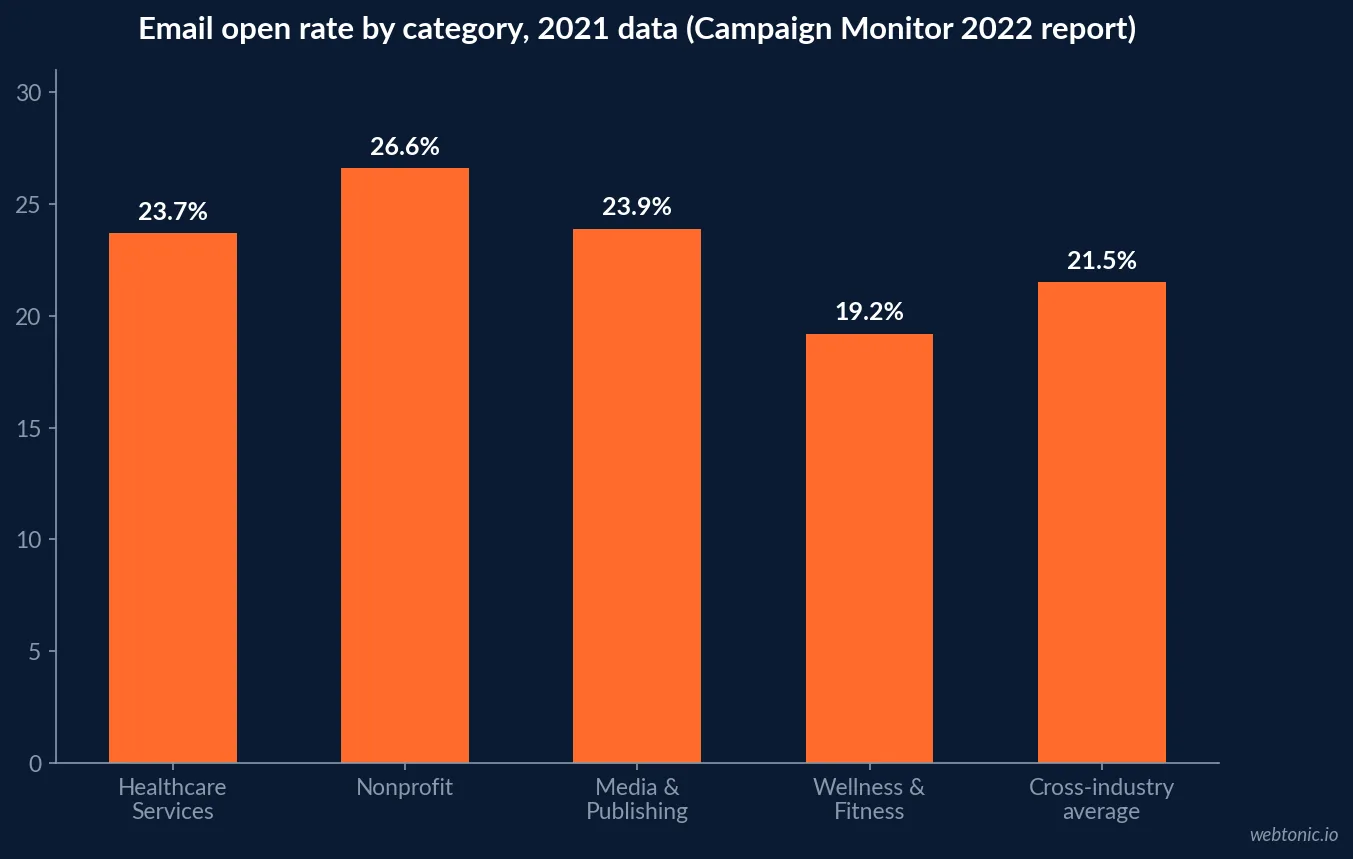
- Campaign Monitor's Healthcare Services open rate averages 23.7% in its benchmark report.
- Mailchimp's cross-industry All Users open rate is 35.63%, well above the medical categories.
- The cross-industry average click rate is 2.62%, versus 11.19% for Medical Services.
- Non-Profits post the highest tracked open rate at 40.04%, pulling the blended average up.
- Constant Contact's Medical Services bounce rate averages 10.06%.
- The unsubscribe rate for Medical Services averages 0.32%, above the 0.22% cross-industry rate.
- Per-member active orthodontic patients hit 696 in 2024, a survey record, per the AAO.
- Adult orthodontic patients reached 1.91 million, up from 1.64 million in 2022.
- Non-Profit - Health, a close proxy category, opens at 18.27%, nearly matching Medical Services.
- Campaign Monitor's report also tracks Wellness & Fitness at 19.2%, a third adjacent category.
Why "orthodontics email marketing statistics" is not a real data set
Every major email service provider that publishes industry benchmarks - Mailchimp, Campaign Monitor, and Constant Contact - segments by broad business type, not by dental specialty. The closest published categories are Medical Services (Constant Contact) and Healthcare Services (Campaign Monitor). Neither isolates orthodontics from general medical or dental practice, so this page treats both as brackets around a real answer rather than a single precise figure.
| Benchmark category | Open rate | Click-through rate | Source |
|---|---|---|---|
| Medical Services | 18.29% | 11.19% | Constant Contact industry averages |
| Non-Profit - Health | 18.27% | 11.56% | Constant Contact industry averages |
| Healthcare Services | 23.7% | n/a in that table | Campaign Monitor benchmark report |
| Wellness & Fitness | 19.2% | n/a in that table | Campaign Monitor benchmark report |
| Cross-industry, all users | 35.63% | 2.62% | Mailchimp published benchmark |
Why the medical-adjacent categories sit so far under the cross-industry average
The gap is structural, not a sign of underperformance. Mailchimp's 35.63% all-users figure is pulled upward by categories with naturally high-engagement subject matter - Non-Profits at 40.04% and Education and Training at 35.64% - where recipients often opted in around a specific cause or course and expect frequent, relevant contact. Medical and dental recipients, by contrast, are usually on a list built from a single office visit or a widely spaced recall cycle, so open rates settle lower even when the relationship and trust level is high, which is exactly the pattern Constant Contact's Medical Services category shows.
The click-through side tells the opposite story. Medical Services' 11.19% click-through rate is more than four times the 2.62% cross-industry click rate, which suggests that once a patient opens a medical or dental email, they are unusually likely to act on it - a sign the content itself is doing its job even where the open rate looks modest.
What this means for a recall and recare program specifically
Recall and recare emails - appointment reminders, retainer check-ins, treatment-progress nudges - are sent to an existing patient relationship, which should outperform a cold Medical Services average built from a broader mix of first-contact and promotional sends. A practice consistently landing at or below 18% on recall emails to its own active patient list has a deliverability or subject-line problem worth diagnosing, not a "healthcare emails just underperform" excuse to accept.
The AAO's 2025 Economics of Orthodontics survey reports 696 active patients per member in 2024, the highest per-member count in the survey's history, and 1.91 million adult patients nationally, up from 1.64 million in 2022. That is list-growth context, not an email-performance figure, but it does mean the addressable recall list for the average AAO-member practice has grown meaningfully, which raises the stakes on getting the open and click benchmarks right.
| Program type | Realistic open-rate target | Benchmark it should beat | Why |
|---|---|---|---|
| Recall / appointment reminder | 20%+ | Medical Services average (18.29%) | Existing patient relationship |
| Retainer / post-treatment check-in | 20%+ | Healthcare Services average (23.7%) | Recent, relevant contact |
| New-patient nurture sequence | 15-20% | Medical Services average (18.29%) | Cooler, pre-visit relationship |
| Practice newsletter | 18-24% | Wellness & Fitness average (19.2%) | Broad, lower-urgency content |
| Referral / partner outreach | 25%+ | Cross-industry average (35.63%) as a stretch | B2B-style relationship, not patient list |
Reading the unsubscribe and bounce numbers, not just the open rate
Constant Contact's Medical Services table also carries a 10.06% bounce rate and a 0.32% unsubscribe rate, both above the cross-industry figures Mailchimp publishes (0.22% unsubscribe, all-users). A bounce rate in double digits usually points to list hygiene - old patient email addresses collected once at intake and never re-verified - rather than content quality, and it directly suppresses the open rate figures above by inflating the denominator with addresses that were never going to open anything.
| List health metric (Medical Services, Constant Contact) | Figure | Cross-industry (Mailchimp) |
|---|---|---|
| Open rate | 18.29% | 35.63% |
| Click-through rate | 11.19% | 2.62% |
| Bounce rate | 10.06% | not published in the same table |
| Unsubscribe rate | 0.32% | 0.22% |
Segmenting the list by patient journey stage
The single biggest lever a practice controls is not subject-line copywriting - it is whether the list is segmented at all. A prospective-patient nurture sequence, an active-treatment recall series, and a post-treatment retainer-compliance program are three different relationships with three different baseline expectations, and blending them into one undifferentiated monthly newsletter is the most common reason a practice's open rate sits below even the 18.29% Medical Services floor. Each segment below should be measured against its own benchmark, not the blended practice-wide number.
| List segment | Relationship stage | Realistic send cadence | What good looks like |
|---|---|---|---|
| Prospective patient | Pre-consult, cold or lukewarm | 1-2 sends/month, longer gaps | Meets or beats Medical Services floor (18.29%) |
| Active treatment | Mid-treatment, regular contact | Tied to appointment cadence | Should exceed the floor meaningfully |
| Post-treatment / retainer | Compliance and recall | Quarterly or biannual | High open rate expected; low volume, high relevance |
| Referral source (dentists) | B2B-style relationship | Monthly or less | Benchmark against B2B categories, not patient list |
| Practice newsletter (all) | Broad, low-urgency | Monthly | Wellness & Fitness benchmark (19.2%) is the realistic floor |
Why list growth matters more than list size for this benchmark
The AAO's 2025 survey reporting 696 active patients per member in 2024, up from 574 in 2022, means the average practice's recall list has grown roughly 21% in two years - and every new addition starts as an unproven address with no send history. A growing list without active segmentation and re-permission work will show a declining blended open rate over time purely as a mechanical effect of diluting an engaged base with newer, unproven contacts, independent of any change in email quality. That is the most common false alarm in email reporting: a "declining" open rate that is actually a growing list doing exactly what a growing list does.
What content actually earns the click, once opened
Constant Contact's Medical Services category clicking through at 11.19% against an 18.29% open rate - a stronger open-to-click ratio than several higher-open categories in the same table - suggests the content itself, once seen, is doing real work. For a recall program specifically, that points toward content with a single clear action (schedule this appointment, confirm this retainer check) rather than a multi-topic newsletter format, since a recipient who already opened an email from their own orthodontist is primed to act on one specific ask rather than browse several.
| Email type | Primary click target | Why it should convert well |
|---|---|---|
| Appointment reminder | Confirm/reschedule link | Single, unambiguous action for an engaged recipient |
| Retainer compliance nudge | Book a check-up link | Directly tied to a known compliance concern |
| Treatment-progress update | View progress photos/portal | Curiosity plus an existing relationship |
| Financing/insurance reminder | Payment portal or consult link | Removes a known friction point to continuing care |
| General newsletter | Multiple, diluted | Lower expected click rate; use sparingly |
What to test before assuming the benchmark is the ceiling
Because the medical-adjacent categories above are broad averages across every kind of medical and dental office, not a curated best-practice sample, they represent a floor to clear, not a ceiling to accept. The clearest levers within a practice's control are segmentation (active patients versus completed-treatment alumni versus prospective patients get different messages), send-time testing against the practice's own appointment patterns, and re-permission campaigns that clean out the addresses driving that 10.06% bounce rate before they suppress every open-rate calculation going forward.
Every send above also has to clear the CAN-SPAM Act before a single benchmark matters: a truthful subject line, a physical postal address, and a working opt-out honored within 10 business days are federal requirements for a patient recall list the same as for any other commercial email.
Our growth marketing practice builds segmented recall programs against exactly this kind of benchmark; see our broader email marketing benchmark data for the cross-industry picture, or look at our list of email marketing agencies if the recall program needs outside execution. Talk to us about auditing a specific list's health before the next campaign.
Frequently Asked Questions
What is a good email open rate for an orthodontics practice?
No vendor publishes an orthodontics-specific figure, so bracket it between two adjacent published categories: Constant Contact's own Medical Services industry average of 18.29%, and Campaign Monitor's Healthcare Services average of 23.7%. A recall or appointment-reminder send to an existing patient list should land inside or above that 18% to 24% range; a cold acquisition send to a purchased or rented list should not be expected to.
How does that compare with the average across all industries?
It runs below it on the vendor that publishes an all-users figure. Mailchimp's published benchmark page puts its All Users average open rate at 35.63%, against a 2.62% click rate and 0.22% unsubscribe rate. The medical and healthcare figures above sit well under that blended average, which spans high-open categories like Non-Profits (40.04%) and Education and Training (35.64%) that pull the cross-industry number up.
What click-through rate should a recall email hit?
Constant Contact's Medical Services category averages an 11.19% click-through rate against its 18.29% open rate, a stronger open-to-click ratio than several higher-open categories in the same table. That suggests medical and dental-adjacent sends convert opens to clicks efficiently once opened, likely because the recipient already has a relationship with the practice, which argues for investing in subject-line and send-time testing to lift the open rate rather than assuming clicks are the weak link.
Is there any orthodontics-specific email data at all?
Not from a named study. What exists is adjacent: the American Association of Orthodontists' 2025 Economics of Orthodontics survey documents rising per-member patient counts (696 in 2024, a survey record) and growing adult patient volume (1.91 million), which is relevant context for list size and segmentation but says nothing about open rates, click rates, or send cadence. Any number claiming to be an 'orthodontics email benchmark' beyond the medical/healthcare proxy categories above should be treated as unsourced.
Should a recall campaign be measured on open rate or on booked appointments?
Booked appointments, once the list is large enough to measure it reliably. Open and click rates are useful diagnostic metrics for subject lines, send times and list health, but they are proxies. A practice with a strong 24%-plus open rate and a weak appointment-booking rate has a landing page or scheduling-friction problem that no amount of subject-line testing will fix, which is why the metric hierarchy should end at bookings, not opens.
Sources
Mailchimp - Email Marketing Benchmarks and Metrics
Campaign Monitor - What are good open rates, CTRs and CTORs for email campaigns?
Constant Contact - Industry Averages: How Do You Compare?
American Association of Orthodontists - 2025 Economics of Orthodontics and Patient Census Survey
Federal Trade Commission - CAN-SPAM Act Compliance Guide for Business