Table of contents
LinkedIn will never sell an emergency mold job to a homeowner. It reaches the people who sign multi-property vendor agreements — and 58% of property managers say they prefer restoration vendors with an active LinkedIn presence. The 2026 benchmark data also shows how a contractor can afford it: $2.29 median CPC on Thought Leader Ads versus $13.23 on single image ads.
Key Takeaways
- Thought Leader Ads post a 2.68% median CTR and $2.29 median CPC — about 5.8x cheaper per click than single image ads.
- Single image ads absorb 61.87% of LinkedIn budgets at a 0.42% CTR and $13.23 CPC — the category’s biggest misallocation.
- Video ads take 31.72% of spend at the lowest CTR of the paid formats, 0.24%, and the highest CPC at $15.61.
- Thought Leader Ads receive only 7–10% of the average budget despite a 9.5/10 efficiency score.
- Median LinkedIn CPM by format: text ads about $2, video $38.94, carousel $45.28, Thought Leader $49.37, single image $59.15.
- Average LinkedIn CPC reached $6.50 in 2026, up 8% from $6.02, driven by competition for senior targeting.
- Commercial real estate CPL runs $92–$135 at 0.46–0.69% CTR and 5.9–8.1% CVR; professional services $97–$140.
- About 32% of audited B2B LinkedIn spend is wasted — $903K of a $3M sample on audiences with no buying authority.
- Seniority mislabeling accounted for $662K and company-size leakage below 50 employees for $452K of that waste.
- Lead Gen Forms convert at about 10% on average and 6.1% on some measurements — roughly 2–5x off-platform landing pages.
- Median LinkedIn pipeline return is $5.21 per dollar spent, with median ROAS 1.62x and top performers at 2.79x.
- Independent attribution data puts LinkedIn ROAS at 121%, rising to 279% for top-quartile accounts against 133% for Meta and 138% for Google Search.
- CTR correlates slightly negatively with pipeline (rho −0.170) — high CTR often means a broad audience that cannot buy.
- Mold remediation LSA leads cost $90 low, $150 mid and $250+ high; inspection leads $40–$120; pay-per-lead $150–$400.
- Restoration LSA leads convert to jobs at 40–60% in most markets, and a $150 lead at a 25–35% close rate implies $450–$600 CAC on a $6,000 ticket.
- 58% of property managers prefer restoration vendors with active LinkedIn profiles.
- Restoration firms publishing case studies generate about 45% more commercial leads.
- LinkedIn has roughly 1.3B members, about 65M decision-makers, 10M C-level executives and 69M+ company pages.
- LinkedIn Marketing Solutions revenue grew 16% year over year in its most recent quarter — a seventh consecutive double-digit quarter.
The Only Job LinkedIn Should Have
The residential/commercial split in restoration is heavily lopsided — the most common contractor profile is around 90% residential and 10% commercial — and that mix is precisely the strategic problem LinkedIn addresses. Residential mold work is emergency demand captured at the moment of discovery, which is why 83% of restoration leads occur within 48 hours of the damage event. There is no LinkedIn campaign for that.
Commercial work is the opposite: procurement, not panic. A facility director does not search for a mold remediator during a flood; they call the vendor already on the emergency response list. Analysis of how restoration firms win commercial accounts makes the failure mode explicit: most losses come from single-threading — selling only to the property manager and missing the asset manager, risk manager or facilities engineer who actually controls vendor selection.
LinkedIn is the only advertising platform where that committee can be addressed by role. Restoration marketing data adds the demand-side confirmation: 58% of property managers prefer restoration vendors with active LinkedIn profiles, and firms publishing case studies generate about 45% more commercial leads. The channel’s job is to be the vendor a committee already recognises when the emergency-response list is written — not to generate calls.
Format Economics: The $11 Gap
The most actionable dataset in the channel comes from 211 B2B companies, 161,256 ads and $5.5M of spend across 29 countries. It shows a market spending almost all of its money on its worst-performing format.
| Ad format | Median CTR | Median CPC | Median CPM | Budget share |
|---|---|---|---|---|
| Thought Leader Ads | 2.68% | $2.29 | $49.37 | 7–10% |
| Event Ads | 0.55% | — | — | Under 1% |
| Document Ads | 0.43% | — | — | Under 1% |
| Single Image Ads | 0.42% | $13.23 | $59.15 | 61.87% |
| Carousel Ads | 0.32% | $13.30 | $45.28 | Under 1% |
| Video Ads | 0.24% | $15.61 | $38.94 | 31.72% |
| Text Ads | 0.02% | — | About $2 | Under 1% |
The gap is not marginal. At $2.29 per click, $1,000 of Thought Leader Ad spend buys roughly 327 clicks; the same $1,000 on single image ads buys about 71. The mechanism is that Thought Leader Ads promote a real person’s post rather than a company-page creative, so the feed algorithm and the reader both treat them as content. For a restoration firm this is close to ideal, because the credible voice in this trade is an operator explaining a job — not a brand explaining itself.

One caution before optimising for CTR. The same dataset finds CTR slightly negatively correlated with pipeline generation (rho −0.170), because high CTR usually signals a broad audience that clicks and never buys. A 0.35% CTR against 500 target properties is worth more than a 0.80% CTR against 50,000 strangers. Judge the campaign on named accounts reached and conversations opened, not on rate metrics.
What A Commercial Lead Costs Here
Cost benchmarks vary by dataset, so the honest read is the overlap. A $47M, 874-campaign dataset puts the 2026 average LinkedIn CPC at $6.50, up 8% from $6.02, and reports AI bid optimisation now managing 72% of spend. A separate benchmark set reads professional services CPC at $5.50–$9.00 with a $7.00 median — close enough to treat the ranges as consistent.
| Closest LinkedIn vertical | CPC range | CPL range | CTR range | CVR range |
|---|---|---|---|---|
| Commercial real estate | $5.20–$8.60 | $92–$135 | 0.46–0.69% | 5.9–8.1% |
| Professional services | $5.40–$8.90 | $97–$140 | 0.48–0.72% | 6.1–8.9% |
| Manufacturing | $4.80–$7.90 | $84–$125 | 0.52–0.78% | 6.5–9.2% |
| Healthcare and pharma | $6.90–$12.40 | $129–$175 | 0.38–0.58% | 5.1–7.2% |
| Financial services | $7.80–$15.20 | $148–$200 | 0.35–0.52% | 4.2–6.8% |
A mold remediation firm selling to property portfolios should plan against the commercial real estate and professional services rows: roughly $92–$140 per qualified lead. Set that against the residential channels in 2026 LSA pricing — mold remediation LSA leads at $90 low, $150 mid and $250+ in competitive metros, inspection leads at $40–$120 — and the numbers look similar. They are not comparable, though, and that is the entire point.
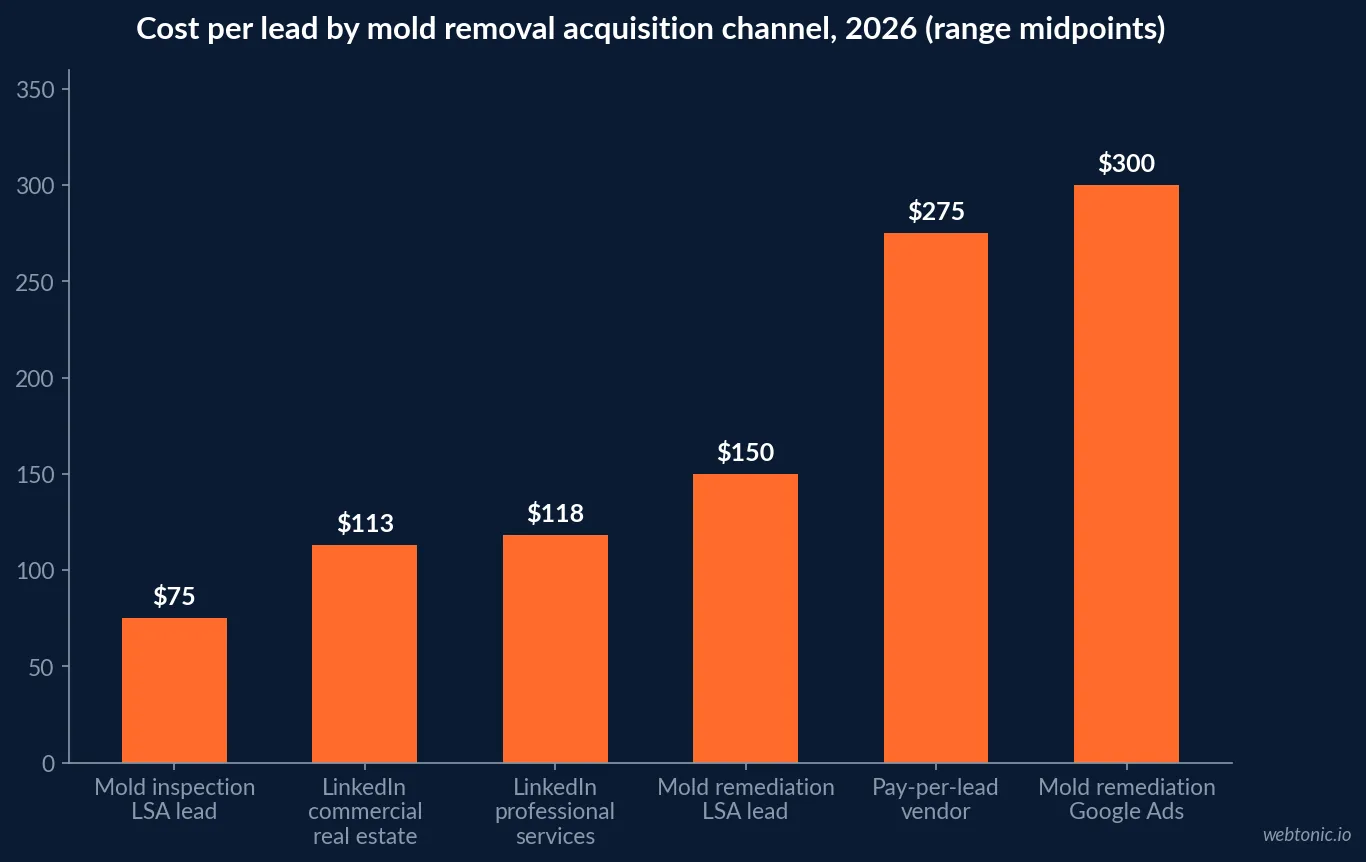
Channel-level contractor benchmarks put mold remediation Google Ads CPL at $200–$400 and water damage at $150–$300+, among the most expensive verticals in home services. Restoration LSA leads convert to jobs at 40–60%, and a $150 lead closing at 25–35% implies $450–$600 customer acquisition cost against a $6,000 average ticket. A LinkedIn lead at $113 that becomes a preferred-vendor agreement across nine properties is a different asset class from a single job — which is why LinkedIn should be measured on agreements signed, not leads collected.
The Waste Problem, Quantified
LinkedIn punishes sloppy audiences harder than any other platform because its inventory is expensive. An audit of $3M in B2B LinkedIn spend found about 32% wasted, and the breakdown is instructive for a contractor.
| Waste source | Amount of $3M audited | Restoration equivalent |
|---|---|---|
| Audiences with no buying authority | $903,000 | Targeting maintenance technicians, not directors |
| Seniority mislabeling | $662,000 | LinkedIn titles that overstate real authority |
| Company-size leakage under 50 employees | $452,000 | Single-property owners in a portfolio campaign |
| Total identified waste | About 32% of spend | Roughly one dollar in three |
The fix is unglamorous: build the audience from a named list of properties and management companies in the service radius, layer job function and seniority filters on top, and exclude small firms explicitly. For scale reference, the typical company running LinkedIn account-based campaigns targets about 9,875 companies in total and 6,423 target accounts per month — an order of magnitude beyond what a regional restoration firm needs. A few hundred properties, reached repeatedly, is the right shape.
At a $49.37 Thought Leader Ad CPM, delivering eight impressions to 500 target contacts costs roughly $200 in media per month. The binding constraint on a contractor’s LinkedIn programme is therefore never budget. It is having something worth saying every week, and a list precise enough to say it to.
Conversion Mechanics: Forms Versus Landing Pages
Lead Gen Forms are the default recommendation and the data supports it, with caveats. Average Lead Gen Form conversion sits near 10%, split sharply by ask: low-friction content offers convert at 10–15% while high-commitment asks such as a demo or meeting convert at 2–5%. A separate measurement puts the platform average at 6.1%, roughly 5x the conversion rate of off-platform landing pages, because pre-filled profile data removes the drop-off between page load and form fill.
| Conversion path | Typical rate | Best restoration use |
|---|---|---|
| Lead Gen Form — low-friction asset | 10–15% | Emergency response planning checklist |
| Lead Gen Form — average across offers | About 10% | Vendor capability one-pager |
| Lead Gen Form — high-commitment ask | 2–5% | Walkthrough or preparedness audit booking |
| Off-platform landing page | About 2.35% | Only when the CRM integration requires it |
| Document Ads | CPL about $256 | Case study distribution |
| Single Image Ads | CPL about $317 | Retargeting known accounts |
The asset that fits this trade best is a pre-loss one: an emergency response plan template, a portfolio moisture-risk checklist, or a documented mold response protocol. It is genuinely useful to a facilities director, it requires no admission of a current problem, and it opens the vendor conversation months before the flood. Our mold removal digital marketing statistics place that offer within the wider channel mix.
Return Expectations And Attribution
LinkedIn returns look poor on last-click and reasonable on pipeline, which is exactly the trap a contractor should avoid walking into. Median pipeline return in the ABM dataset is $5.21 per dollar spent, with median ROAS of 1.62x and top performers at 2.79x. Independent attribution data puts LinkedIn ROAS at 121%, up from 113% a year earlier, rising to 279% for top-quartile accounts — against 133% for Meta and 138% for Google Search.
Commercial restoration sales cycles run months and close over the phone or in a walkthrough, so platform-reported conversions will always understate the channel. Three measurement habits keep it honest: track named-account engagement rather than leads, log the first-touch channel in the CRM at the point of the first conversation, and evaluate on agreements and portfolio value per quarter rather than monthly CPL. Our mold removal SEO statistics cover the organic side of the same commercial motion, and our growth marketing team builds the measurement layer that connects them.
Platform-level trend is supportive rather than decisive: LinkedIn reported Marketing Solutions revenue growing 16% year over year, a seventh consecutive double-digit quarter, across a base of roughly 1.3B members, about 65M decision-makers and 69M+ company pages. Rising advertiser demand is why average CPC moved up 8% in a year — the format arbitrage in Thought Leader Ads will not stay open forever.
A LinkedIn Playbook For A Mold Remediation Firm
- Keep residential on LSA and search: at $90–$250 per lead with 40–60% job conversion, nothing on LinkedIn competes.
- Build one named list of property management companies, REITs, schools, healthcare facilities and hospitality in the service radius.
- Target the whole committee — facilities, asset, risk and operations — because single-threading is the documented reason commercial deals are lost.
- Exclude companies under 50 employees; that leakage cost $452,000 in one $3M audit.
- Run Thought Leader Ads from the owner’s profile at a $2.29 median CPC instead of company-page single image at $13.23.
- Cap single image and video to retargeting known accounts; together they take 93% of category budget at the worst CTRs.
- Lead with a pre-loss asset — emergency response plan, moisture-risk checklist — and expect 10–15% form conversion.
- Publish case studies: restoration firms that do generate about 45% more commercial leads.
- Ignore CTR as a target; it correlates slightly negatively with pipeline (rho −0.170).
- Report quarterly on agreements and portfolio value, not monthly CPL — the cycle is longer than the reporting period.
Used this way, LinkedIn is not a lead source for a mold removal company. It is the channel that moves the revenue mix off a 90/10 residential dependency, one vendor agreement at a time. If you want that programme built against these benchmarks, get in touch.
Frequently Asked Questions
Do LinkedIn Ads work for a mold removal company?
Not for residential emergency work — homeowners do not search for mold remediation on LinkedIn, and Local Services Ads deliver those calls at $90–$250 per lead. LinkedIn works for the commercial half of the business: property managers, facility directors, risk managers and asset managers who hold multi-property vendor agreements. Commercial real estate CPLs on LinkedIn run $92–$135 with 0.46–0.69% CTR, and 58% of property managers say they prefer restoration vendors with an active LinkedIn profile. The economics only work when the target is a standing agreement rather than a single job.
What is the cheapest way to advertise on LinkedIn as a contractor?
Thought Leader Ads, by a wide margin. Across 161,256 ads and $5.5M of spend, Thought Leader Ads posted a 2.68% median CTR and a $2.29 median CPC against 0.42% and $13.23 for single image ads — roughly 5.8x cheaper per click — while receiving only 7–10% of the average budget. For a restoration firm that means promoting a real post from the owner or operations lead, not a company-page ad. Single image ads still absorb 61.87% of category spend, which is the largest structural misallocation in the channel.
What does a commercial restoration lead cost on LinkedIn versus Google?
Google is cheaper per lead and LinkedIn is better at reaching decision-makers who cannot be found by search intent. Mold remediation Local Services Ads leads run $90 at the low end, about $150 mid-market and $250+ in competitive metros, with pay-per-lead vendors at $150–$400. LinkedIn commercial real estate CPLs sit at $92–$135 and professional services at $97–$140. The difference is what the lead is: a Google lead is one job, a LinkedIn lead is often a vendor conversation covering a portfolio.
How much LinkedIn ad budget does a restoration contractor need?
Enough to reach a defined account list repeatedly, not enough to run always-on lead generation. The typical company running LinkedIn account-based campaigns targets about 9,875 companies in total and 6,423 target accounts per month, but a regional restoration firm's realistic universe is a few hundred properties. At a $49.37 median Thought Leader Ad CPM, reaching 500 target-account contacts eight times a month costs roughly $200 in media — which is why the constraint is content and list quality, not budget.
What is the biggest way LinkedIn budget gets wasted?
Targeting people who cannot sign. An audit of $3M in B2B LinkedIn spend attributed $903,000 of waste to audiences with no buying authority, $662,000 to seniority mislabeling and $452,000 to company-size leakage into firms with fewer than 50 employees — about 32% of spend in total. In restoration the equivalent error is single-threading: selling only to the property manager while the asset manager, risk manager or facilities engineer actually controls vendor selection. Build the audience around the whole committee or expect the deal to stall.
Sources
ZenABM — LinkedIn Ads Benchmarks 2026 (211 companies, 161,256 ads, $5.5M spend)
Ryze — LinkedIn Ads CPC and CPL Benchmarks by Industry 2026 ($47M, 874 campaigns)
Dreamdata — LinkedIn Ads Benchmarks Report 2026
DigitalApplied — LinkedIn Ads Benchmarks 2026: CPC, CTR, CVR by Industry
MetadataONE — LinkedIn Ads Benchmarks 2026 by Industry
MarketScale — 32% of B2B LinkedIn Ad Budgets Wasted on Audiences That Cannot Buy
BuiltRight Digital — Mold Remediation Google LSA Cost: 2026 Pricing and Budgets
BlueGrid Media — Contractor Lead Costs by Channel (US, 2026)
Tygart Media — How Restoration Companies Are Winning Commercial Accounts in 2026
Marketing LTB — Restoration Marketing Statistics 2026
LinkedIn — Q4 Earnings and Business Highlights