



Table of contents
Key Takeaways
- 84% of restoration customers search online before contacting a mold removal company, making digital visibility the primary driver of new business.
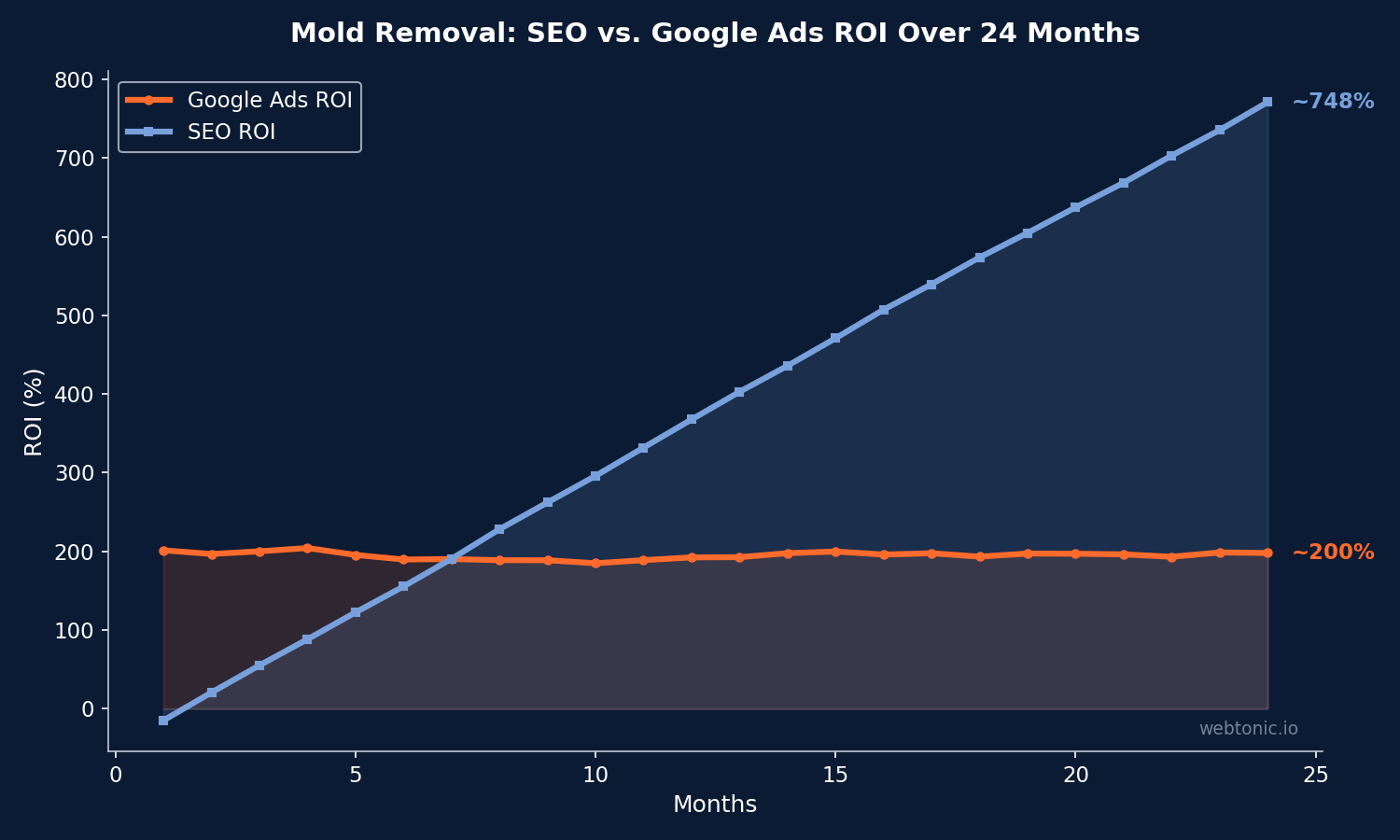
- SEO delivers 748% long-term ROI for mold remediation companies compared to roughly 200% from Google Ads, though PPC generates leads faster.
- Mold removal leads cost $50–$150 (shared) and $150–$400 (exclusive) through pay-per-lead channels, with SEO-generated leads costing 60–70% less over a 24-month horizon.
- Companies answering calls within 60 seconds book 391% more emergency jobs than slower responders, highlighting speed-to-lead as the highest-leverage conversion factor.
- Restoration businesses investing at least 7% of revenue in marketing grow 2× faster than those spending less, with the recommended budget split of 35–45% on paid search and 15–20% on local SEO.
Mold Removal Digital Marketing Overview
The mold remediation industry operates in a high-intent, emergency-driven digital landscape where 84% of customers search online before calling a company (Marketing LTB). Unlike elective home services, mold removal searches spike after water damage events, creating narrow windows where digital presence determines which company gets the call.
This report compiles 75+ verified statistics on how mold removal and remediation companies perform across digital marketing channels — from Google Ads and SEO to social media and email — with cost benchmarks, conversion data, and budget allocation frameworks drawn from industry studies published in 2025 and 2026.
| Digital Marketing Channel | Avg. Cost Per Lead | Typical CVR | ROI Timeline |
|---|---|---|---|
| Google Ads (PPC) | $55–$250 | 18%+ (water damage) | Immediate |
| Local Services Ads | $35–$85 | 35–45% close rate | Immediate |
| SEO (Organic) | $15–$45 (amortized) | 3–5% site-wide | 6–12 months |
| Facebook/Meta Ads | $30–$80 | 12–18% lead-to-job | 4–8 weeks ramp |
| Email Marketing | $5–$15 (nurture) | 24% open rate | Ongoing |
| Pay-Per-Lead (Shared) | $50–$150 | 15–25% close | Immediate |
| Pay-Per-Lead (Exclusive) | $150–$400 | 30–40% close | Immediate |
Search Engine Marketing Statistics
Google Ads cost-per-click for "water damage restoration" has increased over 35% since 2022 (Marketing LTB), reflecting intensifying competition in the restoration search landscape. Mold removal keywords specifically range from $15 to $40 per click (DYB Digital), with commercial mold remediation terms commanding premium CPCs.
Pay-per-click ads for water damage keywords convert at rates above 18% (Marketing LTB). This conversion rate significantly exceeds the 7.33% average for home services Google Ads (The Snow Media), driven by the emergency nature of mold and water damage searches.
81% of mold remediation searches include local intent terms like "near me" or city-specific modifiers (Marketing LTB). This local focus means Google Ads strategy must prioritize geographic targeting and Google Business Profile integration.
| Search Marketing Metric | Mold Removal | Home Services Avg. |
|---|---|---|
| Google Ads CPC | $15–$40 | $7.85 |
| Google Ads CVR | 18%+ (emergency) | 7.33% |
| Google Ads CPL | $55–$250 | $90.92 |
| Local Intent Searches | 81% | 46% (all industries) |
| Mobile Lead Share | 72% | 60–65% |
| CPC Increase Since 2022 | 35%+ | 20–25% |
SEO and Organic Search Performance
SEO produces 5.3× higher long-term ROI for restoration companies than print advertising (Marketing LTB). Over a two-year horizon, well-executed organic growth strategies generate mold removal leads at 60–70% lower cost than paid channels once rankings stabilize.
A documented case study showed a mold removal company achieving a 627% increase in organic traffic through targeted SEO (Logic Inbound). The campaign focused on city-specific landing pages and content targeting long-tail mold-related queries, demonstrating the compounding value of content investment.
Restoration businesses that rank in Google's top 3 local results capture nearly 68% of clicks (Marketing LTB). For mold removal companies, this means Google Business Profile optimization and local citation building are non-negotiable components of any digital marketing strategy.
The SEO vs. PPC comparison reveals a clear timeline tradeoff: Google Ads delivers ~200% ROI immediately, while SEO averages ~748% ROI by year two (DYB Digital). Most mold remediation companies benefit from running both channels simultaneously — PPC for immediate lead flow and SEO for compounding long-term value.
Lead Generation Cost Benchmarks
Mold remediation lead generation costs vary dramatically by channel and exclusivity. Shared leads cost $50–$150 per lead, while exclusive leads range from $150 to $400 depending on market size and job type (DYB Digital, Built Right Digital).
Google Ads management for mold remediation runs $1,500–$6,000+ per month, while SEO retainers typically range from $1,500 to $4,500 monthly (Built Right Digital). The key metric is not the monthly spend but the cost per booked job — a $250 exclusive lead that closes at 35% costs $714 per job, while a $75 shared lead closing at 18% costs $417 per job.
Local SEO generates 3× more qualified leads than broad national campaigns for mold removal companies (Marketing LTB). This is because mold remediation is inherently local — homeowners need a company that can respond within hours, not days.
Website and Conversion Rate Statistics
Restoration websites loading in under 3 seconds convert 2× better than slower sites (Marketing LTB). Given that 72% of restoration leads come from mobile devices during emergencies, mobile page speed is a direct revenue driver for mold removal companies.
Companies with 24/7 live chat convert 35% more website visitors into leads (Marketing LTB). When a homeowner discovers mold at 11 PM, the company with an available chat widget captures the lead that competitors lose to voicemail.
Restoration websites with before-and-after photos increase conversion rates by 43%, and video testimonials improve landing page conversions by 32% (Marketing LTB). These visual trust signals are particularly important for mold removal, where homeowners cannot easily evaluate service quality before hiring.
Speed-to-lead is the highest-leverage conversion factor: 79% of restoration customers expect a response within 15 minutes, and businesses answering calls within 60 seconds book 391% more emergency jobs (Marketing LTB). A fast website means nothing if the phone rings unanswered.
| Conversion Factor | Impact on Performance | Source |
|---|---|---|
| Page Load Under 3s | 2× higher conversion rate | Marketing LTB |
| 24/7 Live Chat | 35% more leads captured | Marketing LTB |
| Before/After Photos | 43% CVR increase | Marketing LTB |
| Video Testimonials | 32% landing page CVR lift | Marketing LTB |
| Call Answer Under 60s | 391% more bookings | Marketing LTB |
| Response Under 15 Min | Expected by 79% of leads | Marketing LTB |
| 100+ Google Reviews | 2.8× more calls | Marketing LTB |
| Online Booking Option | 28% higher lead conversion | Marketing LTB |
Social Media and Brand Awareness
Restoration companies active on social media generate 25% more branded searches (Marketing LTB). For mold removal businesses, social media functions primarily as a brand-building channel rather than a direct lead source — homeowners who see your content before an emergency are 2–3× more likely to convert when they later search Google (Clicks Geek).
Facebook ads for mold remediation average a 2.7% click-through rate (Marketing LTB), above the 2.1% home services Meta Ads average (Elev8 Operations). The average small business spends $2,000 to $5,000 per month on paid social, with competitive home service markets requiring $3,000 or more (WolfPack Advising).
Budget Allocation and Marketing Spend
Restoration businesses investing at least 7% of revenue in marketing grow 2× faster than those spending below that threshold (Marketing LTB). Established mold remediation companies typically spend 3–9% of revenue on marketing, while startups often invest 10–20% to build initial market presence (PushLeads).
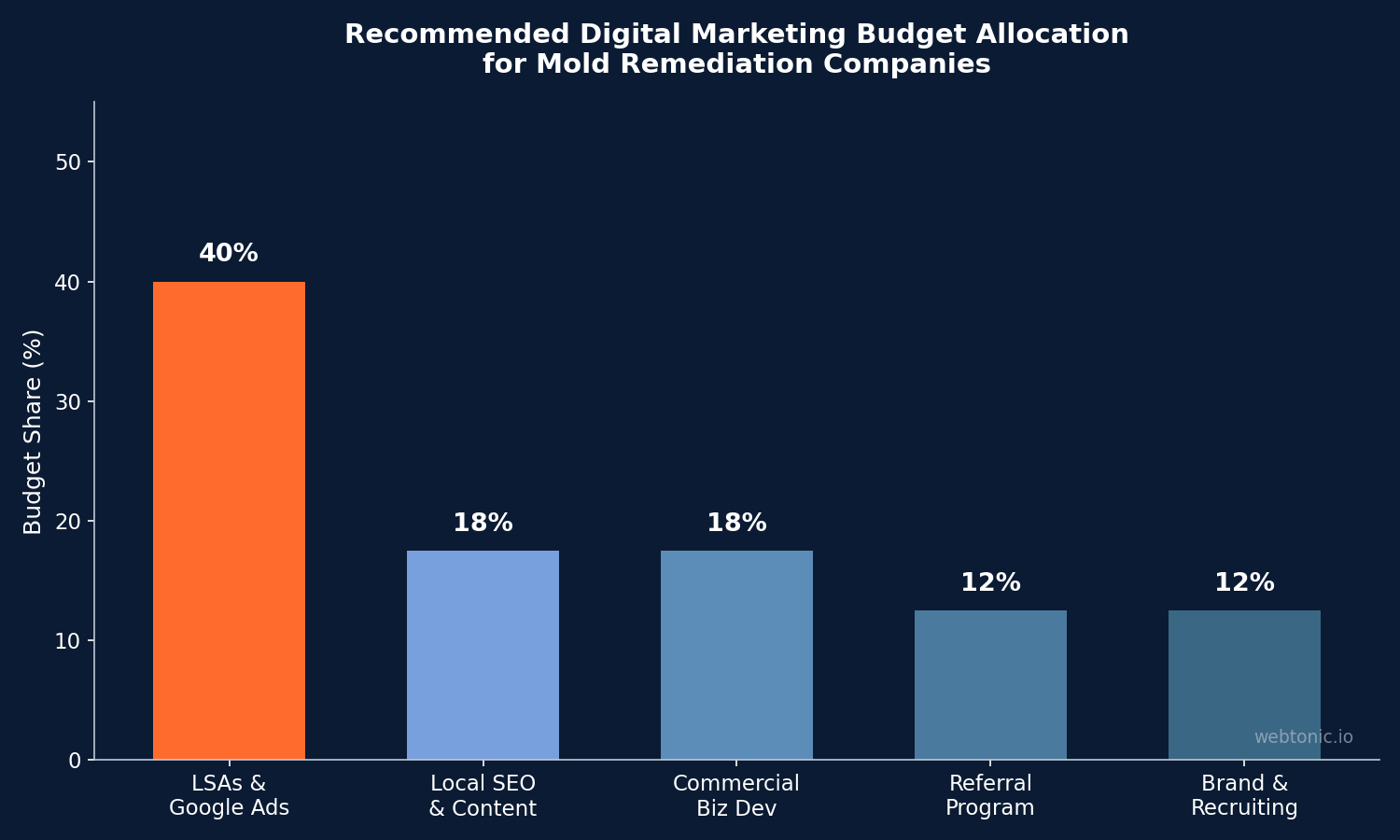
The recommended channel allocation for a mid-market mold removal company: 35–45% on LSAs and Google Ads, 15–20% on local SEO and content, 15–20% on commercial business development, and 10–15% on referral program maintenance (Tygart Media). The remaining budget covers brand building and recruiting.
46% of restoration businesses plan to increase their marketing budgets in 2026 (Marketing LTB). This increase is driven by rising Google Ads costs and growing recognition that digital channels deliver measurable ROI compared to traditional advertising.
Reviews, Trust Signals, and Reputation
61% of homeowners trust online reviews as much as personal referrals for restoration services (Marketing LTB). For mold removal — where the stakes include health concerns and property damage — reviews carry even more weight than in typical home services.
Mold remediation companies with over 100 Google reviews generate 2.8× more calls than competitors with fewer than 20 reviews (Marketing LTB). Review volume is a ranking factor in Google's local pack, creating a compounding advantage: more reviews → higher rankings → more clicks → more reviews.
57% of restoration companies say Google Business Profile is their top lead source (Marketing LTB). GBP combines local search visibility, review display, click-to-call functionality, and service area targeting in a single platform — making it the cornerstone of mold removal digital marketing.
Restoration companies using CRM software improve lead follow-up rates by 46% (Marketing LTB). In an industry where 70–85% of paid leads are never meaningfully followed up (Tygart Media), CRM adoption represents one of the highest-ROI digital investments available.
Industry Financial Benchmarks
Established mold remediation companies typically earn $1M to $4.9M in annual revenue with 70–80% gross margins on mitigation work and 30–40% on reconstruction (PushLeads). These margins make digital marketing spend particularly attractive — a $3,000 monthly investment in Google Ads generating 15 leads at a 30% close rate produces $45,000–$75,000 in revenue at typical job values of $3,000–$5,000.
According to the Restoration Industry Association's 2025 Financial Performance Study, 62% of restoration companies cannot accurately calculate job-level profit margins, 47% do not track cost per lead by marketing channel, and 38% cannot identify their most profitable service type (PushLeads). Companies that close this data gap consistently outperform competitors who rely on intuition alone.
| Financial Metric | Benchmark | Implication for Marketing |
|---|---|---|
| Annual Revenue (Established) | $1M–$4.9M | 3–9% = $30K–$441K budget |
| Mitigation Gross Margin | 70–80% | High margin justifies aggressive CPL |
| Reconstruction Margin | 30–40% | Lower margin; tighter cost discipline |
| Marketing Spend (Established) | 3–9% of revenue | Below 3% → stagnation risk |
| Marketing Spend (Startups) | 10–20% of revenue | Higher share needed for awareness |
| Track CPL by Channel | Only 53% do | Major optimization gap |
Frequently Asked Questions
How much should a mold removal company spend on digital marketing?
Established mold remediation companies typically invest 3–9% of annual revenue in marketing, with digital channels representing the majority of that spend. A company earning $2M annually should budget $60,000–$180,000 per year across Google Ads, SEO, social media, and email marketing. Startups often need to invest 10–20% to build initial market presence and brand recognition.
What is the average cost per lead for mold removal digital marketing?
Mold removal lead costs range widely by channel: $55–$250 through Google Ads, $30–$80 via Facebook Ads, $50–$150 for shared pay-per-lead services, and $150–$400 for exclusive leads. SEO-generated leads amortize to $15–$45 per lead once rankings are established, typically after 6–12 months of investment.
Is SEO or Google Ads better for mold remediation companies?
Both serve different timelines. Google Ads delivers ~200% ROI immediately and is essential for new companies needing instant lead flow. SEO averages ~748% ROI by year two and compounds over time. Most successful mold removal companies run both — PPC for immediate revenue and SEO to reduce long-term cost per acquisition.
What digital marketing channels work best for mold removal?
The highest-performing channels for mold remediation companies are Local Services Ads (lowest cost per acquisition), Google Search Ads (highest intent), Google Business Profile (57% of companies cite it as their top lead source), and local SEO (3× more qualified leads than national campaigns). Social media and email marketing serve as supporting channels for brand building and lead nurture.
How important are online reviews for mold removal marketing?
Critically important. 61% of homeowners trust reviews as much as personal referrals, and companies with 100+ Google reviews generate 2.8× more calls. Reviews also influence local search rankings, creating a compounding advantage. The best mold removal companies implement automated review request sequences after every completed job.
Sources
Marketing LTB — Restoration Marketing Statistics 2026
DYB Digital — Google Ads vs. SEO for Mold Removal
Built Right Digital — Mold Remediation Lead Generation Cost
Tygart Media — Complete Restoration Marketing Guide 2026
Tygart Media — Restoration Lead Nurture and Follow-Up
PushLeads — Restoration Company Financial Benchmarks 2026
Logic Inbound — Mold Removal SEO Case Study
The Snow Media — Home Services Ad Benchmarks
Clicks Geek — Facebook Ads for Mold Remediation
WolfPack Advising — Social Media Advertising Costs 2026
DYB Digital — Mold Removal Lead Generation: PPL vs SEO


