Table of contents
93% of restoration work still arrives by referral, almost 58% of contractors say experience and reputation are their only real differentiator, and 19% now run gross margins under 20%. In mold remediation, brand is not a marketing line item — it is the margin.
Key Takeaways
- Referrals remain the dominant lead source for 93% of restoration contractors, barely down from 95% a year earlier.
- Almost 58% name experience and reputation as their primary differentiator; low-cost provider is statistically negligible.
- Adjuster and insurance-agent relationships fell to 55% as a channel, down from 68% in 2025.
- 19% of restoration firms report gross margins under 20%, up from 12% a year earlier, while 22% clear 50%+.
- Margin and profitability overtook staffing as the industry’s top concern in 2026; labour still scores 4.55 and cash flow 4.36 on weighted concern.
- Only about 3% of contractors are paid by carriers within one to two weeks; over 18% wait more than eight weeks.
- Mold remediation is the second most profitable service line, cited by 19% of respondents, behind water damage at 52%.
- 96% of homeowners say a recognisable brand matters when hiring a home services company; 79% still prefer a company perceived as local.
- Consistent logos and vehicle wraps improve recall by about 80%; memorable slogans lift ad recall by 22%.
- Restoration firms with professional branding command roughly 18% higher average ticket values.
- 88% of consumers read at least three reviews before choosing a restoration contractor and 71% trust firms with verified Google reviews more.
- 83% of restoration leads occur within 48 hours of the damage event and 66% of consumers compare at least two companies.
- 75% of customers prioritise speed over price when damage is severe, while 77% expect transparent pricing online.
- Campaigns mentioning insurance assistance improve conversion by about 36%; transparent guarantees lift confidence by 37%.
- Franchises spend 3–5% of revenue on marketing; independents typically spend 6–10%, and firms investing 7%+ grow about twice as fast.
- Mold-focused franchise brands are the cheapest entry in restoration: MOLDMAN at a $10K initial fee and $33K investment midpoint against an industry mean of $55K and $221K.
- The average US mold removal job is $2,368, with most projects between $1,200 and $3,750 and black mold adding 25–50%.
- 84% of home services bookings start on mobile, yet 65.13% still complete offline — usually by phone.
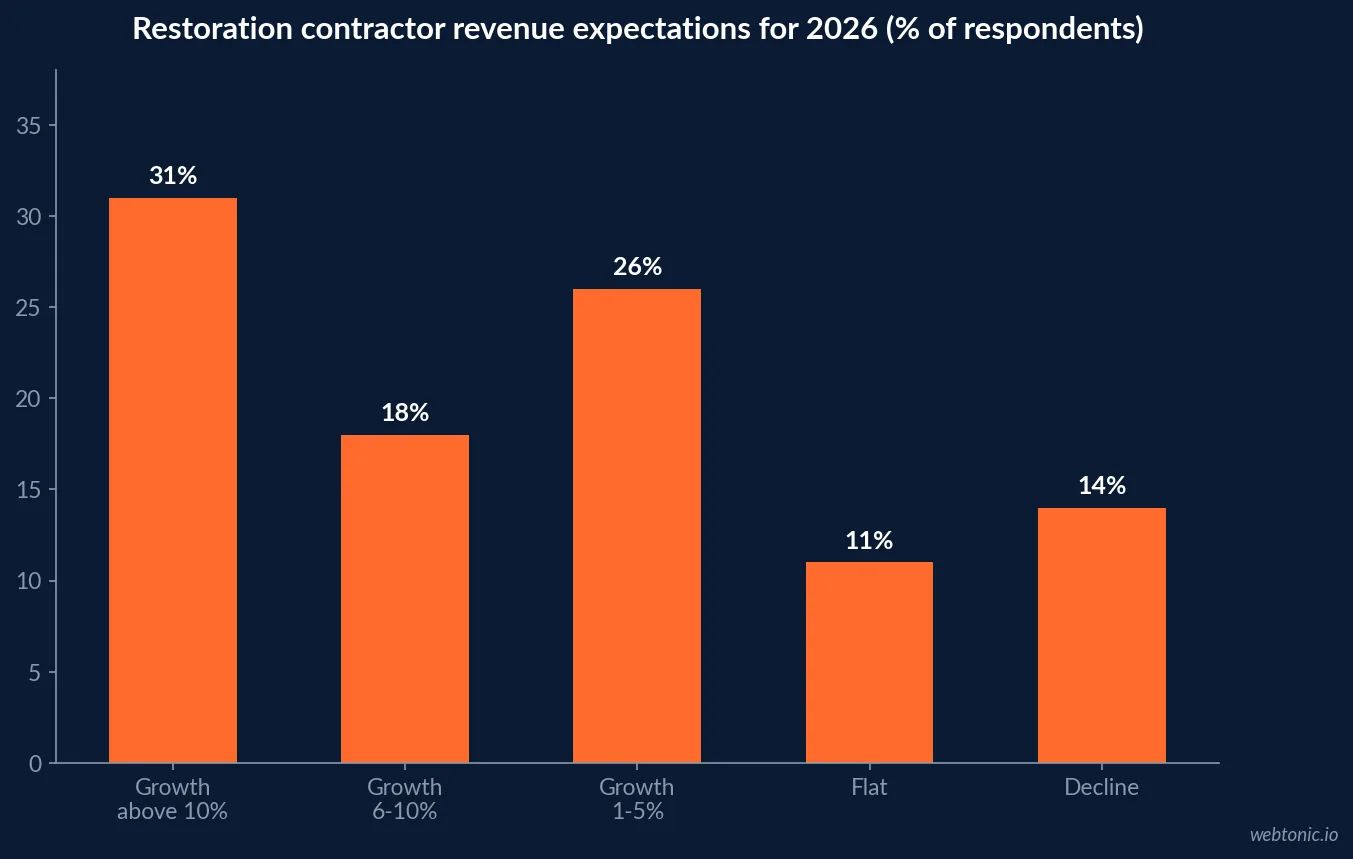
- Nearly three-quarters of restoration contractors expect growth in 2026: 31% above 10%, 18% at 6–10%, 26% at 1–5%.
Why Margin Pressure Is A Branding Statistic
The 2026 restoration benchmarking survey — drawn from contractors, full-service firms and a growing group of mold assessors, with owners and corporate management making up nearly 79% of respondents — recorded a telling inversion. Maintaining margins and profitability moved into the top concern slot, edging past recruiting and retaining staff, which had held the position the previous year.
| 2026 survey finding | Figure | Year-over-year |
|---|---|---|
| Gross margin under 20% | 19% of firms | Up from 12% in 2025 |
| Gross margin above 50% | 22% of firms | Stable |
| Labour concern (weighted average) | 4.55 | No longer the top concern |
| Cash flow concern (weighted average) | 4.36 | Driven by carrier payment delays |
| Paid by carrier within 1–2 weeks | Just over 3% | Majority wait 3–8 weeks |
| Waiting more than 8 weeks for payment | Over 18% | Structural, not seasonal |
| Most common revenue bracket | $1M–$2.9M (28%) | 10% exceed $10M |
Read that alongside the differentiation data and the branding case writes itself. When almost 58% of firms compete on experience and reputation and virtually nobody competes on being cheapest, the practical question is not whether to invest in brand but whether the brand you have is doing any pricing work. A firm with no recognisable identity has only one lever left when a homeowner asks why the bid is $6,550 instead of $4,000 — and that lever is discounting into a sub-20% margin.
The carrier relationship makes it sharper. Adjuster and insurance-agent referrals dropped from 68% to 55% in a single year, which contractors attribute partly to a more adversarial claims climate and partly to a deliberate move away from insurance-dependent pipelines. Every point of channel share that leaves the adjuster desk has to be replaced by consumer-direct demand, and consumer-direct demand is bought with brand.
What Homeowners Are Actually Judging
Mold buying behaviour is compressed and defensive. Restoration marketing data puts 83% of leads inside 48 hours of the damage event, with 66% of consumers comparing at least two companies and 48% making contact outside normal business hours. There is no consideration funnel to nurture. There is a phone, a search result, and two minutes.
| Trust signal | Figure | Brand implication |
|---|---|---|
| Read at least three reviews first | 88% of consumers | Volume and recency beat a perfect average |
| Trust verified Google reviews more | 71% of homeowners | Profile completeness is a brand asset |
| Trust reviews as much as referrals | 61% | Reviews are the referral at scale |
| More likely to contact a firm with recent reviews | About 4x | Review recency needs a weekly process |
| Say a recognisable brand matters | 96% of homeowners | Recognition precedes the call |
| Prefer a company perceived as local | 79% | National polish plus local proof |
| Expect transparent pricing online | 77% | Published bands, not “call for quote” |
The thresholds behind those percentages are concrete. Jobber’s 2026 trends report finds its top-performing service businesses maintain a Google rating of 4.5+ stars with 50+ reviews, and contractor marketing benchmarks put 97% of consumers searching online for local businesses and 76% reading reviews before contacting a home service firm. A mold brand that is invisible at 4.5 stars and 50 reviews is not competing on reputation — it is absent from the comparison.
Home services demand data resolves the apparent contradiction between those last two rows: homeowners want the accountability of a local operator with the reliability signals of a large one. That is precisely the brand position a well-run independent can occupy and a national franchise cannot fully claim.
The channel mechanics matter too. 84% of home services bookings initiate on mobile while 65.13% still complete offline, overwhelmingly by phone. Brand work in mold removal is therefore mostly about what survives compression to a phone screen and a voice: a legible mark, a promise a homeowner can repeat, and a phone number answered by a human. Firms with 24/7 answering capture roughly 2x more leads — the cheapest brand investment in the trade is answering.
The Trust Stack, Priced
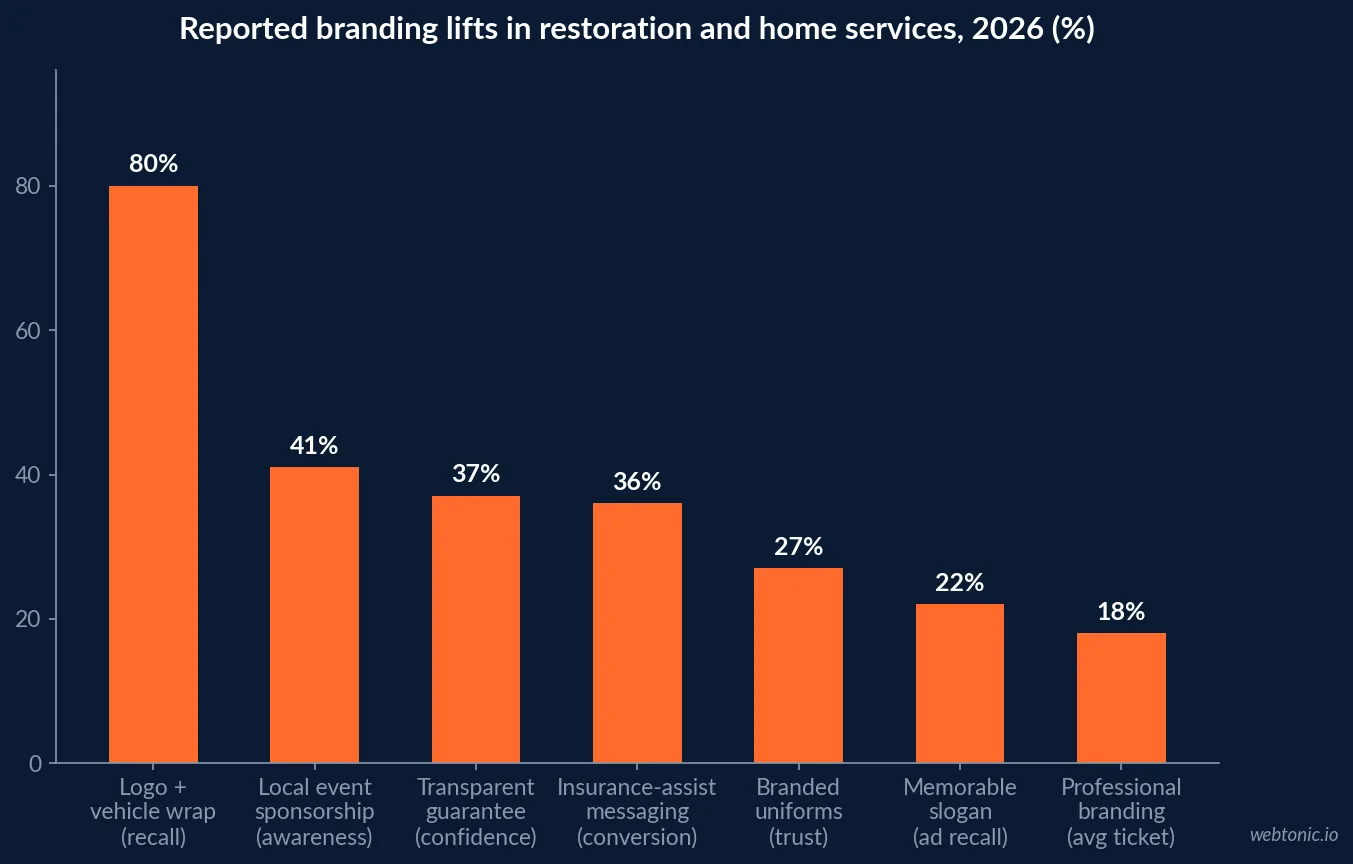
Reported branding lifts should be read as directional rather than causal, but they cluster consistently around the same few assets — and the cheap ones perform.
| Brand asset | Reported effect | Rough cost profile |
|---|---|---|
| Consistent logo and vehicle wrap | About 80% recall improvement | One-time, per vehicle |
| Local event sponsorship | About 41% awareness lift | Low, recurring |
| Transparent guarantee | About 37% confidence lift | Free — an operational commitment |
| Insurance-assistance messaging | About 36% conversion lift | Free — copy and training |
| Branded uniforms | About 27% trust lift | Low, per technician |
| Memorable slogan | About 22% ad recall lift | One-time creative |
| Professional branding overall | About 18% higher average ticket | The compounding one |
The last row is the one that pays for the rest. On the average $2,368 mold job reported by 2026 cost data — a figure SERVPRO also cites — an 18% ticket premium is roughly $425 per job. A firm running 200 jobs a year is looking at about $85,000 of gross margin attributable to being the recognisable option, which is more than most independents spend on marketing in total.
That premium is also what makes technical pricing defensible. Mold work bills $10–$25 per square foot on accessible surfaces, $15–$30 where wall cavities must be opened, with black mold adding 25–50%, inspections at $300–$1,000 and mandatory clearance testing at $300–$800. Every one of those line items looks like padding to a homeowner unless the brand has already established that this firm does things properly. Our mold removal ad creative statistics cover how that gets expressed in campaign assets.
Market Size: Read The Scope Before The Number
Mold remediation market estimates diverge by more than 3x, and the difference is definitional rather than factual. Quoting the wrong one in a pitch deck is an avoidable credibility problem.
| Source and scope | Baseline | Forecast | CAGR |
|---|---|---|---|
| Stellar MR — mold remediation services | $1.55B (2025) | $2.02B by 2032 | 3.8% |
| Verified Market Reports — US mold abatement | $1.4B (2024), $1.5B (2025) | $1.9B by 2033 | About 4.5% |
| Morgan Reed — broad mold remediation services | $4.8B (2026) | $8.39B by 2035 | 6.40% |
The narrow definitions count dedicated remediation revenue; the broad one folds in adjacent inspection, environmental and reconstruction work. For a branding decision the number that matters is not the aggregate at all — it is that the trade is growing steadily rather than explosively, which means share is taken from competitors rather than absorbed from new demand. In a share-taking market, recognition is the whole game.
Contractor sentiment is consistent with that: nearly three-quarters of respondents expect to grow, with 31% projecting more than 10%, 18% at 6–10% and 26% at 1–5%, and only 14% expecting any decline.
Buying A Brand: The Franchise Comparison
A franchise fee is a brand purchase with a financing schedule attached. Cohort data across 45 restoration brands shows mold-focused concepts clustered at the cheap end of the category, which is exactly why they are the most common on-ramp for a solo operator.
| Brand or cohort | Initial fee | Total investment midpoint | Scale |
|---|---|---|---|
| MOLDMAN | $10K | $33K | Lowest entry in the cohort |
| Mold Medics | $25K | — | Mold-specialist concept |
| ZeroMold | — | $137K | Equipment-heavier model |
| Restoration industry mean | $55K | $221K | 44 brands disclosing |
| Servpro | $100K | — | 2,354 outlets |
| ServiceMaster Restore | $36K–$72.5K | — | 1,910 outlets |
| Paul Davis Restoration | $65K–$208K | — | 277 outlets |
The recurring cost is where the comparison turns. Mean royalty across disclosing restoration brands is about 6.9% of gross revenue, and Item 19 disclosures put the industry mean top revenue figure at $1.54M, with the top-10 brand cohort averaging $2.30M. At $1.5M of revenue, a 6.9% royalty is roughly $104,000 a year — permanently, and rising with revenue.
Set that against independent marketing benchmarks of 6–10% of revenue and the decision becomes legible: a franchise converts an unpredictable brand-building cost into a fixed tax on growth, and it is the right trade only for operators who will not do the brand work themselves. Note too that outlet count is not brand strength — ServiceMaster Restore’s 1,910 outlets contracted 2.2% in the most recent reporting period while Paul Davis grew 13.1% from a base of 277.
What A Mold Brand Has To Say
Positioning in this trade has a narrow viable range, because two of the obvious options are foreclosed by the data. Cheapest is off the table — low-cost provider is a negligible self-reported differentiator, and 75% of customers prioritise speed over price on severe damage. Fear is also off the table, or at least self-defeating: a homeowner who has been frightened into calling is a homeowner primed to distrust the invoice.
What remains is process legibility. The firm that wins the compressed comparison explains, before anyone asks, what happens after the first call: what the inspection includes, who does the lab identification, why clearance testing exists, how the insurance conversation is handled. Insurance-assistance messaging lifting conversion by 36% and transparent guarantees lifting confidence by 37% are the same finding twice — homeowners are buying certainty about the process, not the mold removal itself.
| Brand promise | Evidence required | Where it lives |
|---|---|---|
| We handle the carrier | Named process, documentation standard | Homepage, phone script, GBP posts |
| We test, we don’t guess | Independent lab ID, clearance test policy | Service pages, estimates |
| We fix the water, not just the mold | Moisture-source diagnosis in every scope | Estimate template, reviews |
| We answer, always | 24/7 human answering | Every ad and profile |
| Our price is the price | Published per-square-foot bands | Pricing page |
| We are from here | Local reviews, event sponsorship, wrapped fleet | Local SEO and community assets |
Those promises only work if the digital shelf reflects them consistently. Our mold removal local SEO statistics cover the profile and review mechanics that carry a local brand, and our mold removal digital marketing statistics set the channel context around it.
Where AI Is Changing Brand Operations
One shift in the 2026 survey is worth flagging because it affects how brands sound. Contractors reporting no AI implementation fell from 50% to about 30% in a year, with just over 37% in early exploration and 24% reporting partial integration. Cost perception flipped too: 28% now call the cost manageable and are actively investing, while only 9% still see it as a significant barrier. Usage clusters in marketing content, estimate drafting, report writing and SOP development.
The brand risk is homogenisation. If a third of a local market is generating service-page copy the same way, differentiation moves back to the assets AI cannot manufacture — real job photography, named technicians, specific local proof, and a documented process. One respondent flagged the sharper edge: carriers are also using AI to dispute scope and pricing, which means documentation quality is becoming a commercial weapon rather than paperwork.
A Branding Checklist For A Mold Removal Firm
- Price the recognition gap: an 18% ticket premium on a $2,368 average job is about $425 per job.
- Wrap every vehicle consistently — the reported 80% recall lift is the cheapest awareness in the trade.
- Publish per-square-foot pricing bands; 77% of consumers expect pricing information online.
- Put insurance-assistance language in the first screen — about a 36% conversion lift.
- Run a weekly review-generation routine: 88% read three or more, and recency drives roughly 4x contact likelihood.
- Answer the phone 24/7 with a human; 48% of enquiries land outside business hours.
- Uniform the crew for a reported 27% trust lift at effectively zero marginal cost.
- Document the process publicly — lab ID, clearance testing, moisture-source repair — and use it in estimates.
- Benchmark spend at 6–10% of revenue as an independent, and against a 6.9% mean royalty if a franchise is on the table.
- Keep the human assets AI cannot copy: real job photos, named technicians, specific local proof.
The trade is professionalising under margin pressure rather than retreating from it, and brand is the mechanism that decides which firms get to keep their prices. If you want the brand and demand side built together, our performance creative team does exactly this work — or just get in touch.
Frequently Asked Questions
Does branding actually matter for a mold removal company?
It is close to the only thing that differentiates one. In the 2026 restoration benchmarking survey, almost 58% of contractors named experience and reputation as their primary differentiator, while low-cost provider was statistically negligible. On the demand side, 96% of homeowners say a recognisable brand is important when hiring a home services company and 79% still prefer a company they perceive as local. Restoration firms with professional branding are reported to command roughly 18% higher average ticket values, and consistent logo and vehicle branding improves recall by about 80%.
How much should a mold remediation company spend on marketing?
Restoration franchises average 3–5% of revenue on marketing while independents typically spend 6–10% because they are buying the brand recognition a franchise fee provides. Firms investing at least 7% of revenue are reported to grow roughly twice as fast. The relevant sanity check is margin: with 19% of restoration contractors now reporting gross margins under 20% — up from 12% a year earlier — marketing spend has to be measured against booked job value, not lead count.
What do homeowners actually check before calling a mold company?
Reviews and recency, in that order. About 88% of consumers read at least three reviews before choosing a restoration contractor, 71% of homeowners trust companies with verified Google reviews more than those without, 61% trust online reviews as much as personal referrals, and consumers are roughly 4x more likely to contact a company with recent reviews. Because 66% compare at least two companies and 83% of restoration leads happen within 48 hours of the damage, the brand has to be legible in a single glance on a phone.
Is buying a mold franchise brand cheaper than building one?
It is cheaper to start and more expensive to run. Mold-focused franchise brands sit at the low end of the restoration cohort — MOLDMAN discloses a $10K initial fee and a $33K total investment midpoint, Mold Medics a $25K fee — against a restoration-industry mean initial fee of $55K and a mean total investment midpoint of $221K. The trade is a mean royalty near 6.9% of gross revenue for life, on Item 19 revenue whose industry mean top figure is $1.54M. An independent building its own brand keeps the royalty and pays for recognition in marketing spend instead.
What is the biggest branding mistake mold removal companies make?
Leading with fear and price instead of process and proof. About 75% of restoration customers prioritise speed over price when damage is severe, and 77% expect transparent pricing information online — so the winning brand promise is legibility, not a discount. Campaigns that mention insurance assistance are reported to improve conversion rates by roughly 36%, and firms with transparent guarantees lift customer confidence by about 37%. Scare-first advertising erodes exactly the trust that lets a firm charge the 25–50% black-mold premium without a fight.
Sources
Cleanfax — The 2026 Restoration Benchmarking Survey Report
Marketing LTB — Restoration Marketing Statistics 2026 (92+ data points)
Leads4Build — Home Services Industry Statistics 2026
FranchiseDepth — Restoration Franchise Cohort Report (45 brands, 2026 FDDs)
Stellar Market Research — Mold Removal Services Market Size and Growth Trends
Verified Market Reports — Mold Abatement Service Market Size and Forecast
Morgan Reed Insights — Mold Remediation Service Market Size and Forecast 2026–2035
UseCalcPro — Professional Mold Removal Cost 2026: Real Prices by Room, Type and State
SERVPRO — How Much Does Mold Remediation Cost?
Jobber — 2026 Home Service Trends Report
Elev8 Operations — Contractor Marketing Statistics 2026