Table of contents

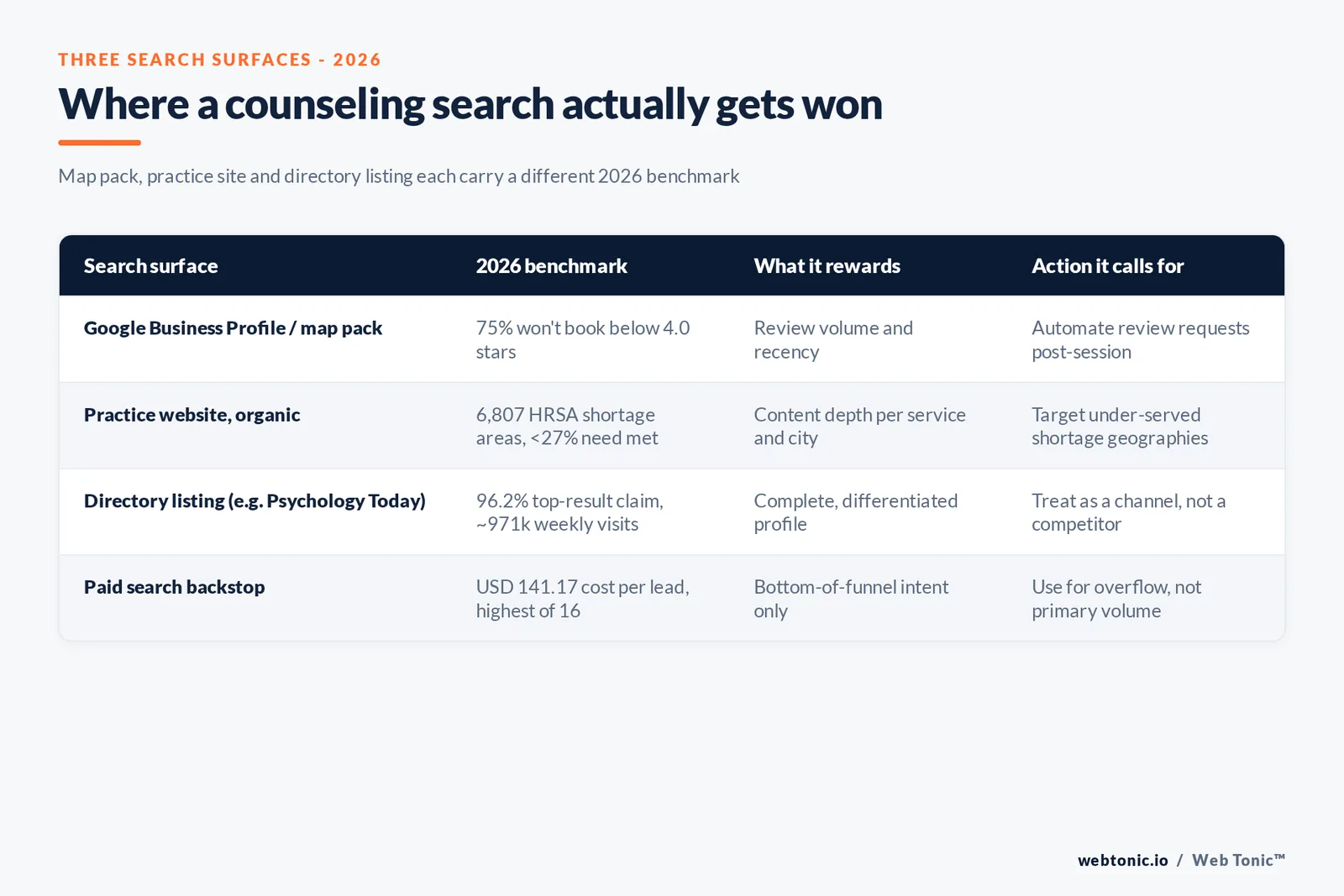
A mental health search rarely ends at one result: it moves between the map pack, a practice's own site, and a directory like Psychology Today, often in the same session. This page benchmarks all three surfaces with the most recent 2026 data available and states plainly where a figure is mental-health-specific and where it is a cross-industry healthcare proxy.
Key Takeaways
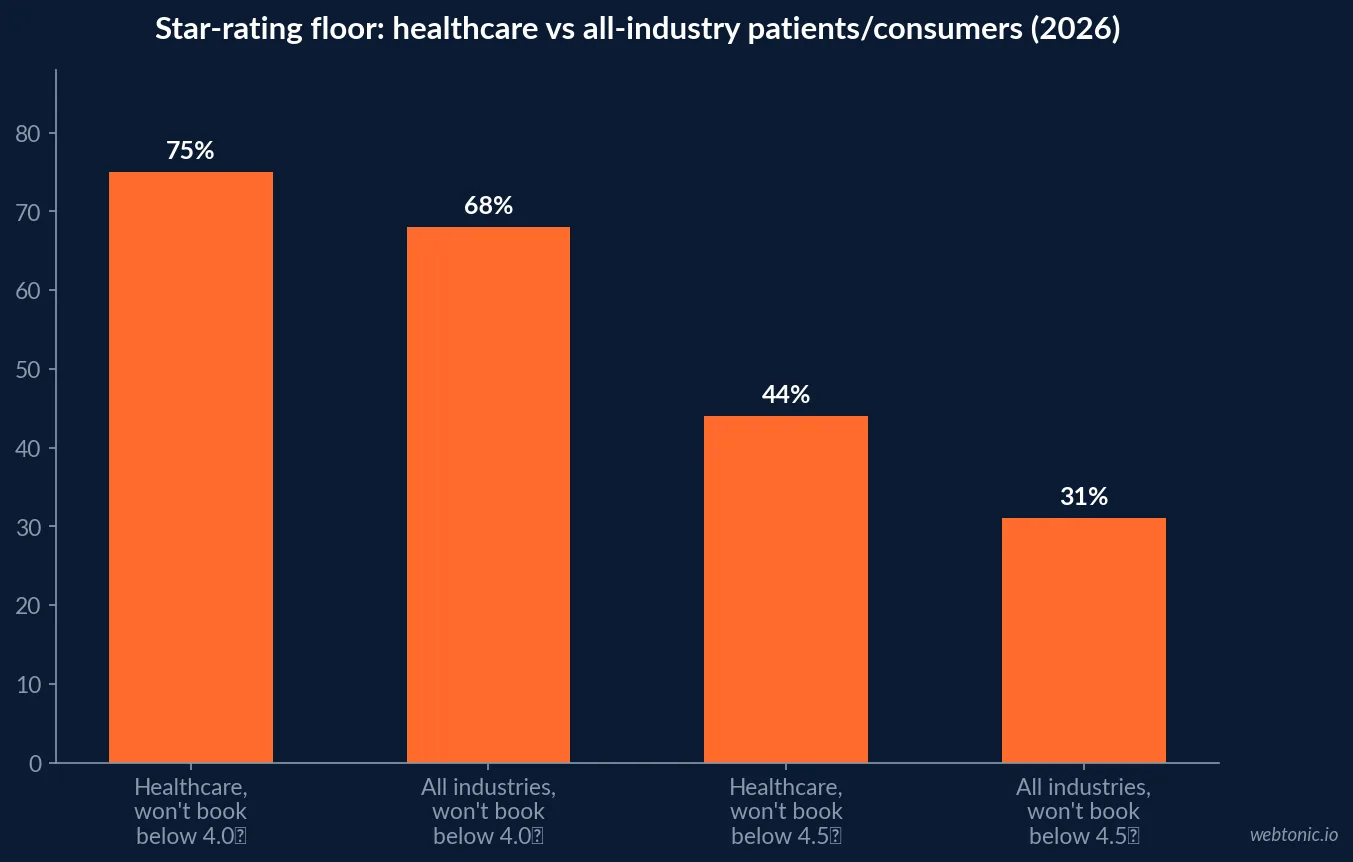
- 75% of patients won't book below a 4.0-star rating, versus 68% across all industries.
- 44% won't book below 4.5 stars, versus 31% across all industries.
- Psychology Today ranks #1 for therapist-seeker queries 96.2% of the time by its own data.
- The directory draws about 971,000 unique weekly visitors, per its own published figures.
- HRSA counts 6,807 designated Mental Health Care shortage areas, covering roughly 137 million people.
- Under 27% of mental health need is met in those shortage areas nationally.
- Mental Health has the lowest search-ads CTR of 16 healthcare specialties, at 4.46%.
- Its search-ads conversion rate is 1.85%, the second-lowest of the 16.
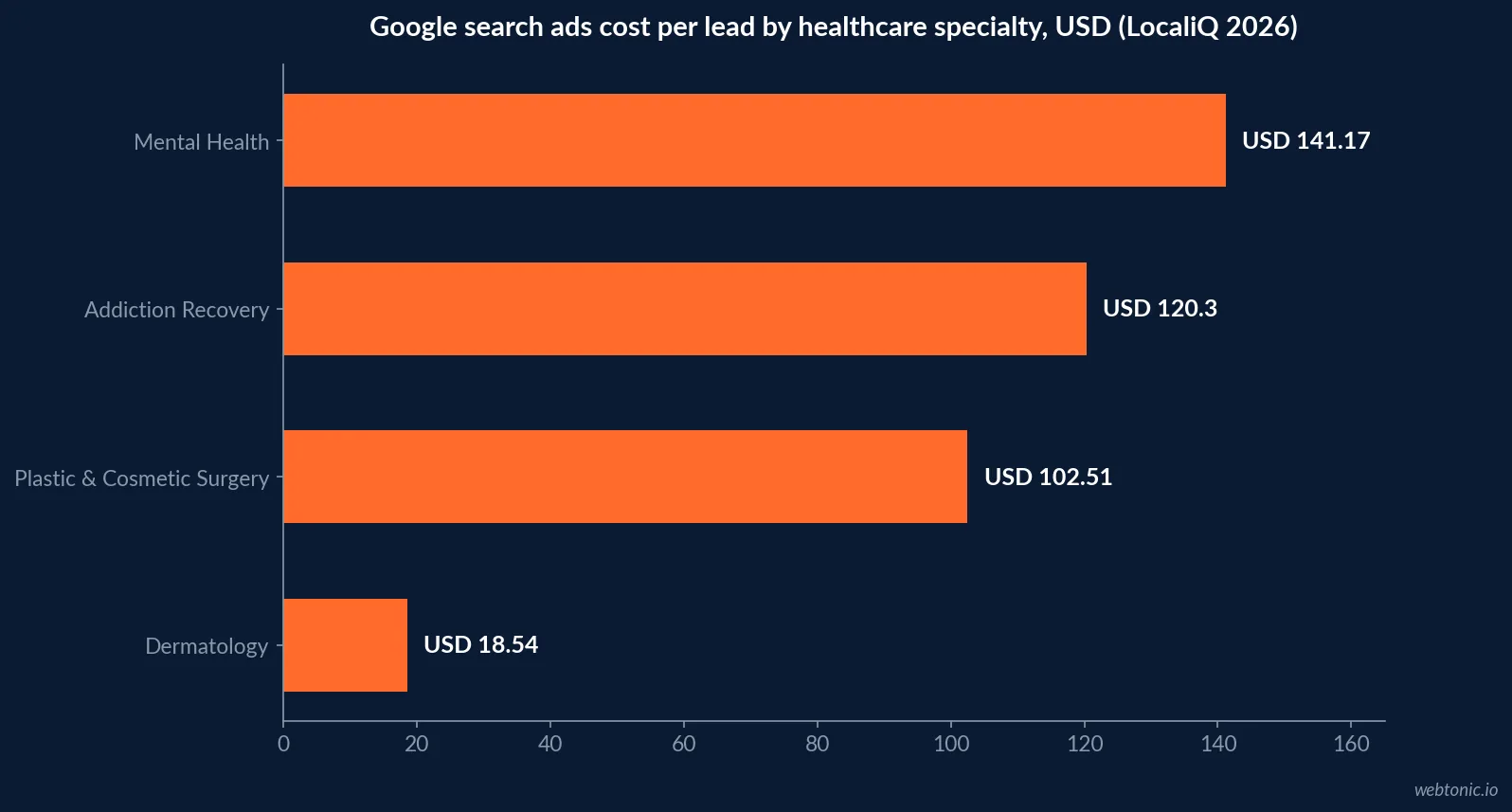
- Its cost per lead is USD 141.17, the highest of the 16, up 146% year over year.
- Online reviews are cited by 42% of patients as a top-three provider-choice factor.
- 56% of psychologists reported no openings for new patients in 2023.
- 69% of psychologists with a waitlist reported an average wait of up to three months.
- 397,880 mental health and substance abuse counselors were employed nationally as of May 2023.
- Employment for the occupation is projected to grow 17-19% through the early 2030s.
The review floor that decides who even gets called
Local search for mental health care runs on trust signals before it runs on keywords. rater8's 2026 Patient Choice Report, surveying nearly 1,000 patients, found a materially higher bar for healthcare than BrightLocal's all-industry Local Consumer Review Survey baseline: patients won't consider a provider below 4.0 stars at 75% against an all-industry 68%, and won't consider one below 4.5 stars at 44% against an all-industry 31%. That is a 13-point gap at the tighter threshold, and it is the single number that should set the review target for any counseling practice's Google Business Profile.
| Star-rating threshold | Healthcare (rater8, 2026) | All industries (BrightLocal, 2026) | Gap |
|---|---|---|---|
| Won't book below 4.0 stars | 75% | 68% | +7 pts |
| Won't book below 4.5 stars | 44% | 31% | +13 pts |
| Reviews cited as top-3 choice factor | 42% | Not separately reported | - |
Directories still win a lot of the first click
Before a map pack listing or an organic result gets evaluated, a large share of therapy-seekers land on a directory. Psychology Today's own published statistics claim the directory shows as the top Google result 96.2% of the time for therapy-seeker queries and draws roughly 971,000 unique visitors to its US directory every week. Those are the platform's own claimed figures, not an independent audit, and should be read as a vendor's stated performance rather than a neutral benchmark -- but the practical implication holds either way: a practice's own local SEO has to win the click a second time, after the directory, not instead of it.
Where the map pack is thinnest: shortage-area geography
Local competition for mental health search terms is not even across the map. HRSA's Health Professional Shortage Area data, cross-referenced with KFF's state health facts summary, counts 6,807 designated Mental Health Care shortage areas covering roughly 137 million people, with under 27% of the mental health need in those areas currently met. A practice inside one of those shortage areas is optimizing a map pack listing with far less established local competition than a practice in a saturated metro, which changes the ranking math even before content quality enters the picture.
| Shortage-area metric (most recent HRSA count) | Figure | Source |
|---|---|---|
| Designated Mental Health Care shortage areas | 6,807 | HRSA / KFF State Health Facts |
| Population covered by those shortage areas | ~137 million | HRSA / KFF State Health Facts |
| Share of mental health need met nationally | Under 27% | HRSA / KFF State Health Facts |
| Practitioners needed to remove all shortage designations | ~6,800 | HRSA / KFF State Health Facts |
What the paid-search numbers say about urgency
The same LocaliQ dataset that supplies the review-adjacent healthcare context also tracks Google search ads by specialty, and Mental Health is the weakest performer of the 16 healthcare categories it covers: the lowest click-through rate at 4.46%, the second-lowest conversion rate at 1.85%, and by far the highest cost per lead at USD 141.17, up 146% year over year. Those numbers describe paid search specifically, not local SEO, but they explain why practices increasingly treat organic local visibility as the primary channel and paid search as a supplement rather than the reverse.
| Google search ads, Mental Health specialty (2026) | Figure | Rank of 16 healthcare specialties |
|---|---|---|
| Click-through rate | 4.46% | Lowest |
| Conversion rate | 1.85% | 2nd lowest |
| Cost per lead | USD 141.17 | Highest |
| Cost per lead, year-over-year change | +146% | Largest increase |
Workforce context that shapes demand at the map-pack level
Demand pressure on local listings tracks the workforce numbers directly. The Bureau of Labor Statistics counted 397,880 substance abuse, behavioral disorder and mental health counselors employed as of May 2023, at a mean annual wage of USD 60,080, with employment projected to grow 17% to 19% through the early 2030s depending on the projection cycle used. APA's 2023 Practitioner Pulse Survey found 56% of psychologists had no openings for new patients and 69% of those with a waitlist reported an average wait of up to three months. A local listing that converts well is not competing against unlimited supply; it is competing for a limited number of open slots that patients are actively searching to find.
Google Business Profile fields that carry the most weight
Category selection, service-area configuration, and review response cadence do more for a counseling practice's map-pack ranking than most content decisions on the site itself. Because the review-floor gap runs 7 to 13 points above the general BrightLocal baseline, response cadence in particular functions as a trust signal patients actually read before booking, not just a ranking input search engines weigh.
| Google Business Profile field | Why it matters more for this category |
|---|---|
| Primary category (e.g. Mental Health Service, Counselor) | Determines which map-pack queries the listing is even eligible for |
| Service-area vs storefront setting | Telehealth-heavy practices need the service-area model set correctly |
| Review response time and rate | Reviews are weighted more heavily here than in most local categories |
| Hours and appointment-booking link accuracy | Directly tied to the 26% who cite appointment availability as a choice factor |
| Q&A section pre-seeded with common questions | Reduces call volume for repetitive intake questions |
Directory profile quality, not just presence
Being listed on Psychology Today or a similar directory is table stakes; a complete, differentiated profile is what actually converts once the directory has already won the click. Given the vendor's own claim of roughly 971,000 weekly directory visits and a 96.2% top-result rate for therapy-seeker queries, a thin or generic profile on that surface is a larger missed opportunity than a thin page on the practice's own site would be, simply because of where the traffic volume already sits.
Reading the HRSA gap alongside referral behavior
The 6,807 HRSA shortage designations and the roughly 971,000 weekly directory visitors describe two ends of the same funnel: a large national pool of people already searching, and a workforce that a growing share of the country cannot access locally. A practice's local SEO strategy has to account for both -- claiming a specific city or neighborhood in site content matters more in a shortage area where organic competition is thin, while directory optimization matters more everywhere, because the directory captures demand regardless of local competitive density.
| Local search factor | Matters most in a shortage area | Matters everywhere |
|---|---|---|
| City/neighborhood-specific service pages | Higher impact (less existing competition) | Some impact |
| Google Business Profile completeness | High impact | High impact |
| Directory profile depth (Psychology Today etc.) | Moderate impact | High impact (~971k weekly visits) |
| Review velocity and response rate | High impact | High impact |
Paid search as a signal of local demand, not a local SEO substitute
The same Google dataset that supplies the paid cost-per-lead figures also confirms local intent is real and searchable: Mental Health specialty search volume is high enough to produce 3,500+ tracked campaigns in LocaliQ's benchmark sample, even though the category converts poorly and costs the most per lead of any specialty tracked. That combination -- high volume, poor paid conversion, high cost -- is itself an argument for local SEO: organic map-pack and website visibility captures the same search volume without paying per click for a channel that already converts at 1.85%.
How to prioritize the work
Fix the Google Business Profile category, hours and review velocity first -- it is the cheapest lever against the highest-weighted trust signal. Build directory presence as a parallel channel rather than a competitor to the site. Then invest organic content in the specific service lines and locations where HRSA's shortage data shows the least existing competition. Our growth marketing team can map that shortage-area data against a specific service area, and our cost-per-lead benchmarks by industry put the USD 141 healthcare figure above in a wider context. If a practice needs the review, profile and directory workflow actually built rather than just benchmarked, talk to us, or see how our data and analytics practice tracks map-pack position against real booking volume.
Frequently Asked Questions
Why do mental health patients demand a higher star rating than other local searches?
rater8's 2026 Patient Choice Report, surveying nearly 1,000 patients, found 75% won't book with a provider rated below 4.0 stars and 44% draw the line at 4.5 stars, both meaningfully above BrightLocal's all-industry benchmarks of 68% and 31% for the same thresholds. A mental health search is a higher-trust decision than most local searches, and the review floor reflects that.
Does a counseling practice compete more with the map pack, organic results, or directories?
All three, and directories often win the click first. Psychology Today reports its own directory appears as the top Google result for therapy-seeker queries 96.2% of the time and draws roughly 971,000 unique weekly visitors, by the platform's own published figures. A practice's Google Business Profile and website still have to win the click once someone leaves the directory, or clicks through to a specific listing, which is where local SEO work pays off.
What does HRSA's shortage-area data say about where local search demand is highest?
As of the most recent designation count, HRSA lists 6,807 Mental Health Care Health Professional Shortage Areas covering roughly 137 million people, with under 27% of the mental health need in those areas currently met. Areas with the largest gaps are also the areas where a well-optimized Google Business Profile faces the least local competition for the same search terms.
Is paid local search a better use of budget than organic local SEO for this industry?
They answer different timelines. LocaliQ's 2026 healthcare benchmarks put Mental Health search-ads cost per lead at USD 141.17, the highest of 16 healthcare specialties and up 146% year over year, which argues for treating paid search as a short-term booster rather than the primary acquisition channel while organic local SEO and the Google Business Profile carry the durable volume.
What local search behavior is actually mental-health specific versus a general healthcare pattern?
The near-me search growth and the 77% of patients who research online before booking are cross-industry healthcare figures, not mental-health-specific ones, and should be labeled that way. What is specific to the category is the review-floor gap (44% vs 31% for a 4.5-star cutoff) and the 42% CPC increase and record cost per lead Google's own healthcare benchmarks show for Mental Health specifically.
Sources
rater8 - 2026 Patient Choice Report
LocaliQ - Healthcare Search Ads Benchmarks for 16 Specialties, 2026
Psychology Today - Directory traffic and ranking statistics
HRSA - Health Workforce Shortage Areas dashboard
KFF - Mental Health Care Health Professional Shortage Areas, State Health Facts
American Psychological Association - 2023 Practitioner Pulse Survey press release
U.S. Bureau of Labor Statistics - Occupational Employment and Wage Statistics, May 2023
U.S. Bureau of Labor Statistics - Occupational Outlook Handbook