Table of contents

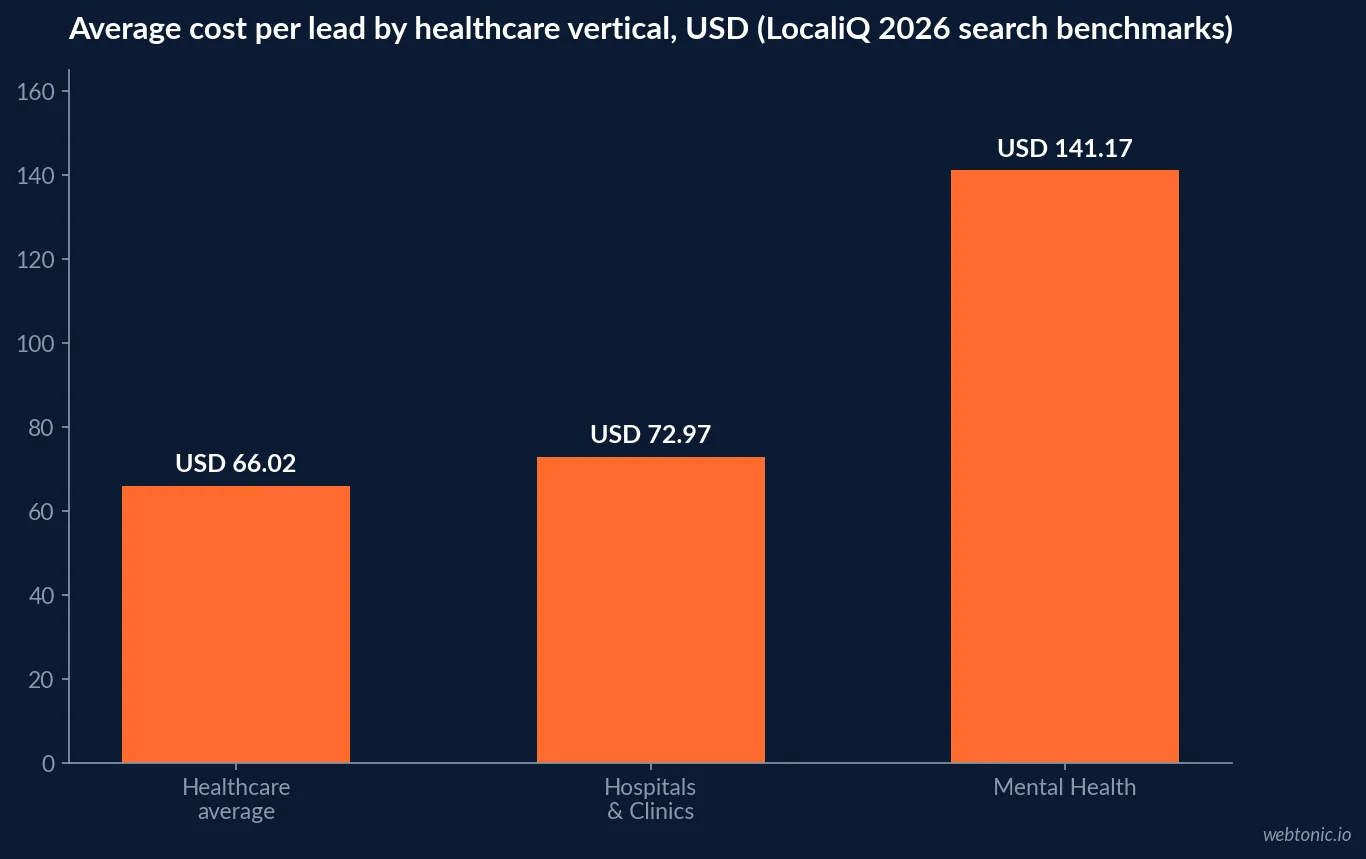
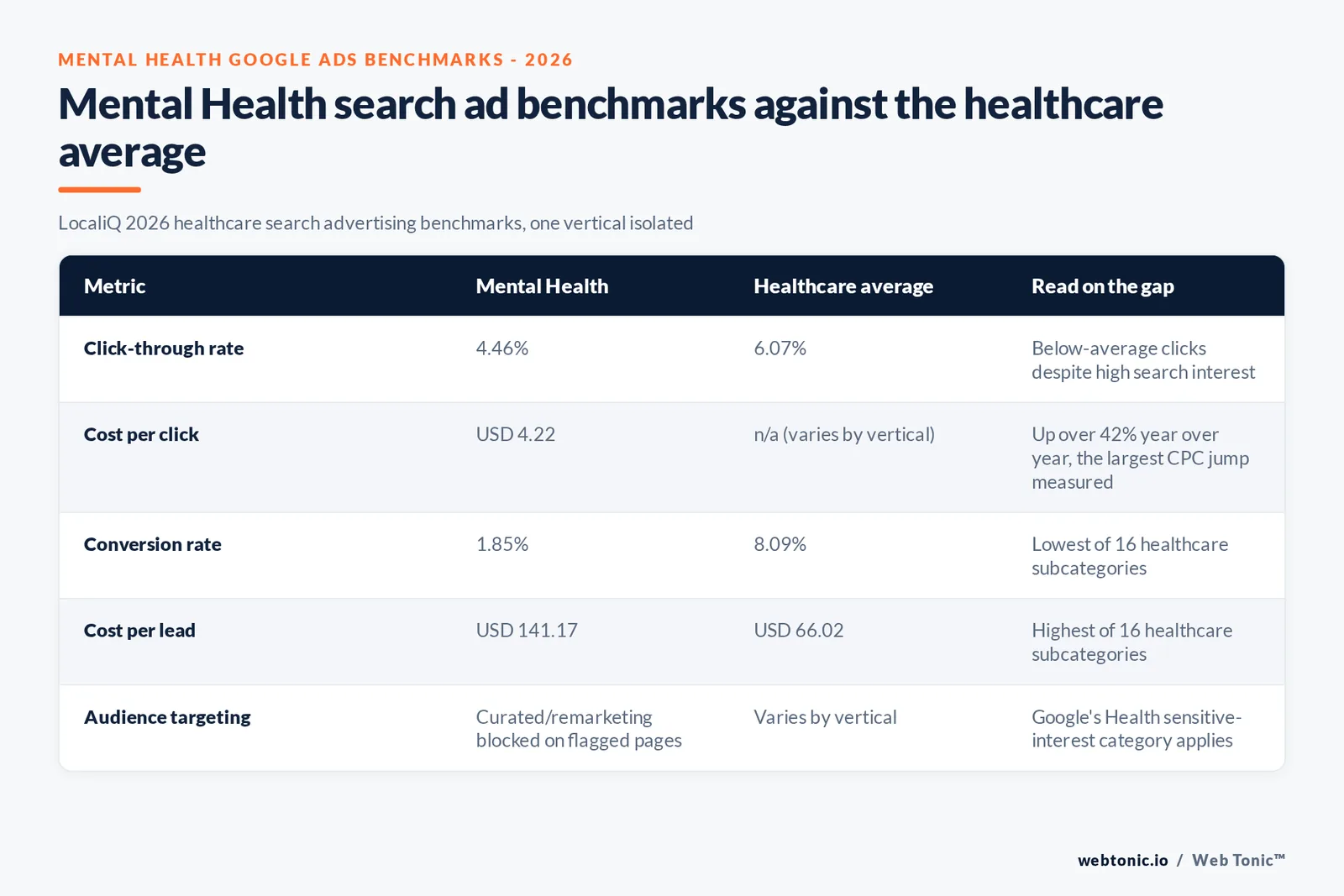
Mental Health carries the highest cost per lead of sixteen healthcare subcategories in Google's 2026 search benchmarks, at USD 141.17, driven by the lowest conversion rate (1.85%) and the largest year-over-year CPC increase (over 42%) in the category. This page covers what that paid-search data means for a counseling account, alongside the Google Ads policy restrictions and FTC precedent that shape what a mental health Google Ads account can actually target.
Key Takeaways
- Mental Health's average cost per lead is USD 141.17, the highest of 16 healthcare subcategories.
- That is more than double the USD 66.02 healthcare average cost per lead.
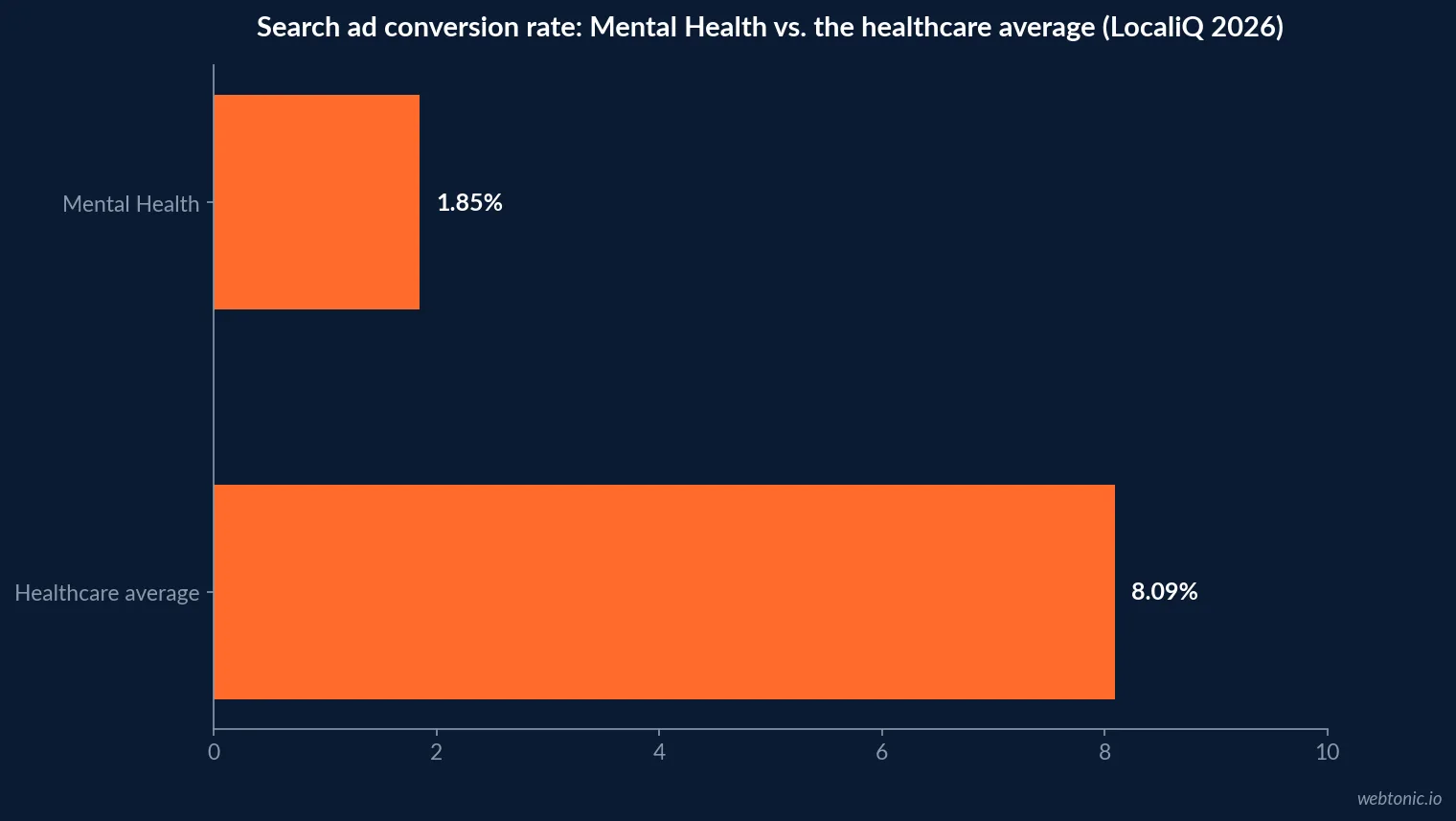
- Mental Health's conversion rate is 1.85%, the lowest of the sixteen subcategories.
- Cost per click rose more than 42% year over year for Mental Health, the largest CPC jump measured.
- Mental Health's average CPC is USD 4.22 and click-through rate is 4.46%, both below the 6.07% healthcare CTR average.
- Google lists "physical or mental health conditions" under its Health sensitive-interest category.
- Advertiser-curated audiences, including remarketing, are blocked on flagged pages.
- BetterHelp paid $7.8 million to settle FTC charges over sharing mental health data with ad platforms (2023).
- Cerebral was ordered to pay more than $7 million in a similar action (2024).
- Addiction-recovery ads require LegitScript's Addiction Treatment Certification before they can run.
- 23.0% of all adults received mental health treatment in the past year (2023 NSDUH), the demand base behind these campaigns.
- 46% of psychologists report no openings for new patients, a capacity constraint paid traffic runs into.
Why Mental Health is the most expensive healthcare vertical to acquire a lead
Per LocaliQ's 2026 healthcare search advertising benchmarks, Mental Health's average cost per lead reached USD 141.17 in 2026 - the highest of sixteen healthcare subcategories measured, and more than double the USD 66.02 healthcare average. Two figures compound to produce that number: Mental Health's conversion rate is only 1.85%, the lowest of the sixteen, and its cost per click rose more than 42% year over year, the largest CPC increase LocaliQ recorded in the category. Click-through rate, at 4.46%, also trails the 6.07% healthcare average - meaning the category underperforms the healthcare norm at every stage of the funnel except one: raw click volume is not the constraint, conversion is.
| Healthcare subcategory | CTR | CPC | CVR | CPL |
|---|---|---|---|---|
| Mental Health | 4.46% | USD 4.22 (+42% YoY) | 1.85% | USD 141.17 |
| Healthcare average | 6.07% | n/a (varies) | 8.09% | USD 66.02 |
| Hospitals & Clinics | 7.00% | USD 4.90 | 6.10% | USD 72.97 |
| Assisted Living, Elder & Home Care | 6.35% | USD 6.30 | 5.51% | USD 74.44 |
| Dermatology (for contrast, highest CVR) | 5.91% | USD 4.90 | 25.33% | USD 18.54 |
The audience-targeting rule that shapes every mental health campaign
Google's Health sensitive-interest category explicitly lists "physical or mental health conditions" alongside diseases and chronic conditions. On a page discussing a specific condition, predefined Google audiences remain usable, but advertiser-curated audiences cannot be used - a category that includes remarketing lists built from a practice's own site visitors, customer match uploads from a CRM, and any lookalike or similar segment built from either. That single rule is the practical reason a mental health Google Ads account cannot retarget the way a home-services or retail account can: the conversion pixel may still fire, but the audience it would normally build cannot legally be targeted back on a flagged page.
| Targeting feature | Usable on a flagged mental-health page? | Source |
|---|---|---|
| Predefined Google audiences | Yes | Google Ads Health policy |
| Advertiser-curated audiences (remarketing) | No | Google Ads Health policy |
| Customer match uploads | No | Google Ads Health policy |
| Lookalike/similar segments built from the above | No - inherits the restriction | Google Ads Health policy |
| Contextual/keyword targeting | Yes, unaffected | Google Ads Health policy |
| Addiction-recovery-specific ads | Requires LegitScript certification | LegitScript / Google Ads policy |
The clinician-capacity constraint a media plan has to account for
A Google Ads account cannot outrun a capacity ceiling. APA's 2025 Practitioner Pulse Survey found 46% of psychologists report no openings for new patients, though 87% can now see new patients within three months, an improving trend since 2021. For a paid-search account, that means a portion of clicks and even conversions will land on a practice with no near-term capacity - a structural reason the category's conversion rate trails the healthcare average independent of ad quality. Building landing pages and ad copy around telehealth or group-practice capacity, rather than a single solo practitioner's calendar, is one of the few levers a paid account has to convert leads a capacity-constrained landing page would otherwise lose.
| Capacity signal (APA 2025) | Value | Paid-search implication |
|---|---|---|
| Psychologists with no openings | 46% | A share of paid clicks will hit zero near-term capacity |
| Psychologists maintaining a waitlist | 40% | Ad copy should set a waitlist expectation honestly |
| Providers seeing new patients within 3 months | 87% | Most practices do have a workable timeline to advertise |
| Without a waitlist, no capacity to manage one | 22% | Group-practice/telehealth routing may convert better than solo-practice pages |
Why the FTC's BetterHelp and Cerebral orders matter for a Google Ads account
Both the BetterHelp order (2023) and the Cerebral order (2024) centered on disclosing sensitive personal health data to ad platforms, including Google, for targeting purposes. BetterHelp paid $7.8 million to consumers; Cerebral was ordered to pay more than $7 million. Neither case found fault with running ads themselves; both found fault with what data fed the targeting pipeline behind those ads. For a Google Ads account, the practical exposure sits in the Customer Match list or conversion import: if that feed includes diagnosis, treatment type, or other identifiable health information, it carries the same theory of harm the FTC applied in both settlements.
| Case | Year | Ad platforms named | Payment |
|---|---|---|---|
| BetterHelp | 2023 | Meta/Facebook, Snapchat, Pinterest, Criteo | $7.8 million to consumers |
| Cerebral | 2024 | Unspecified ad platforms (health data broadly) | $7 million+ (proposed order) |
What the underlying demand data means for account structure
The paid-search weakness is not a demand problem. SAMHSA's 2023 data shows 22.8% of adults (58.7 million people) had any mental illness in the past year, and KFF's shortage-area tracker shows only 27.29% of the mental health workforce need is met nationally - both signs of deep, unmet demand. A Google Ads account performing at a 1.85% conversion rate against that backdrop is more likely constrained by targeting restrictions, a longer decision cycle, and capacity-matching friction than by a lack of search volume. That argues for structuring the account around multi-touch attribution and a realistic cost-per-lead target closer to the category's own USD 141.17 benchmark, rather than benchmarking against lower-CPL, faster-decision verticals like dermatology.
| Demand signal | Value | What it argues for in account structure |
|---|---|---|
| Adults with any mental illness (2023) | 22.8% (58.7M) | Search volume is not the constraint |
| Percent of workforce need met | 27.29% | Capacity-matching, not just lead volume, is the bottleneck |
| Psychologists with no openings | 46% | Landing pages should set realistic wait/first-session expectations |
| Category cost-per-lead benchmark | USD 141.17 | Budget against this, not a cross-industry average |
What a well-built mental health Google Ads account should actually optimize for
Given a 1.85% conversion rate and a 141.17 cost per lead, the honest optimization target is not "more clicks" - click-through rate is already close to the healthcare norm - it is conversion efficiency and lead quality within a policy-restricted targeting set. That means leaning on contextual and keyword targeting (unaffected by the sensitive-category rule), building landing pages that set an honest first-session expectation given 46% of psychologists have no current openings, and keeping any Customer Match or conversion import free of diagnosis-level detail. Concretely, that means a smart bidding strategy set to target the category's real cost-per-lead ceiling rather than a cross-industry benchmark, ad copy that sets an honest first-session and availability expectation up front, and a quarterly review of which keywords and audiences actually clear the sensitive-category restrictions above rather than assuming last year's setup still qualifies. See how the category compares to other paid channels in our cost-per-lead benchmarks by industry, and our Google Ads strategy guide for the underlying account-structure fundamentals. Talk to us about structuring a compliant, cost-efficient account.
Frequently Asked Questions
Why is mental health the most expensive healthcare vertical for cost per lead?
LocaliQ's 2026 healthcare search advertising benchmarks put Mental Health's average cost per lead at USD 141.17, the highest of sixteen healthcare subcategories and roughly double the USD 66.02 healthcare average. Two factors compound: the conversion rate is only 1.85%, the lowest of the sixteen, and cost per click rose over 42% year over year, the largest CPC increase LocaliQ measured in the category. A low conversion rate multiplied against a rising cost per click produces the highest cost-per-lead figure in the dataset almost mechanically.
Can a counseling or mental health practice use remarketing in Google Ads?
Not on pages that discuss a specific mental health condition. Google's Health sensitive-interest category explicitly lists "physical or mental health conditions" alongside diseases and chronic conditions. On a flagged page, predefined Google audiences remain available, but advertiser-curated audiences - remarketing lists built from your own site visitors, customer match uploads, and lookalike segments built on either - are blocked. A general "we offer counseling services" page may sit outside the restriction, but a page about anxiety, depression, or a specific diagnosis is squarely inside it.
Does a mental health practice need LegitScript certification to advertise?
Only for addiction-recovery-specific services. Google requires LegitScript's Addiction Treatment Certification before ads for recovery-oriented drug and alcohol addiction services can run at all, a requirement that also applies on Meta, Microsoft Ads and Nextdoor per LegitScript's own certification page. General counseling, talk therapy, or psychiatric services are not covered by that specific certification requirement, but remain subject to the broader Health sensitive-interest audience restriction above.
What do the BetterHelp and Cerebral FTC cases mean for a Google Ads account specifically?
Both cases centered on sharing identifiable health data with ad platforms, including Google, for targeting - not on running ads themselves. BetterHelp's 2023 order and Cerebral's 2024 order both barred the companies from disclosing sensitive health data to ad platforms and required multimillion-dollar payments. For a Google Ads account, the practical implication is about what feeds a Customer Match list or a Google Ads conversion import: if that data pipeline includes diagnosis, treatment type, or other sensitive health information tied to an identifiable person, it carries the same exposure the FTC flagged in both cases, independent of whether Google itself was a named party.
Is Google Ads even worth running for mental health given the low conversion rate?
The 1.85% conversion rate is the lowest of sixteen healthcare subcategories, but that reflects a longer, more considered decision cycle typical of mental healthcare, not necessarily a broken channel - LocaliQ's healthcare average also sits well above pure retail conversion norms. The more useful question is whether the account is built for that cycle: multi-touch attribution, honest first-session-expectation landing pages, and audience targeting compliant with the sensitive-category rule above, rather than a generic e-commerce-style campaign structure expecting a fast, single-click conversion.
Sources
LocaliQ - Healthcare search ads benchmarks for 16 specialties, 2026
Google Ads Help - Health in personalized advertising policy
Google Ads Help - Healthcare and medicines policy
LegitScript - Addiction Treatment Certification requirements
Federal Trade Commission - BetterHelp order and press release, 2023
Federal Trade Commission - Cerebral order and press release, 2024
SAMHSA - 2023 National Survey on Drug Use and Health, key indicators
American Psychological Association - 2025 Practitioner Pulse Survey