Table of contents

No study prices email performance specifically for mental health and counseling practices, so this page states the closest proxy benchmarks plainly and spends the rest of the space on the one place email actually earns its keep here: keeping a waitlist warm without adding clinical risk.
Key Takeaways
- No benchmark study breaks out email metrics for this industry specifically.
- Mailchimp's all-user average open rate is 35.63%, click rate 2.62%.
- MailerLite reports a 47.81% open rate for its Health & Fitness category proxy.
- Brevo's Nonprofit & NGO row opens at 27.03% under its 2026 methodology.
- 56% of psychologists had no openings for new patients in APA's 2023 survey.
- 69% of psychologists with a waitlist reported an average wait up to three months.
- 38% said their waitlist grew in the past year, against 17% who said it shortened.
- BetterHelp paid USD 7.8 million in 2023 over data shared with ad platforms.
- Cerebral paid more than USD 7 million in 2024 for a similar pattern.
- Roughly 3.2 million consumers' data reached LinkedIn, Snapchat and TikTok in that case.
- HHS OCR's tracking guidance was partly vacated in June 2024, with no replacement issued.
- 397,880 mental health and substance abuse counselors were employed as of May 2023.
- Employment for the occupation is projected to grow 17-19% through the early 2030s.
- 988 Lifeline contacts now exceed 600,000-700,000 a month, more than double pre-launch volume.
The benchmark gap, stated plainly
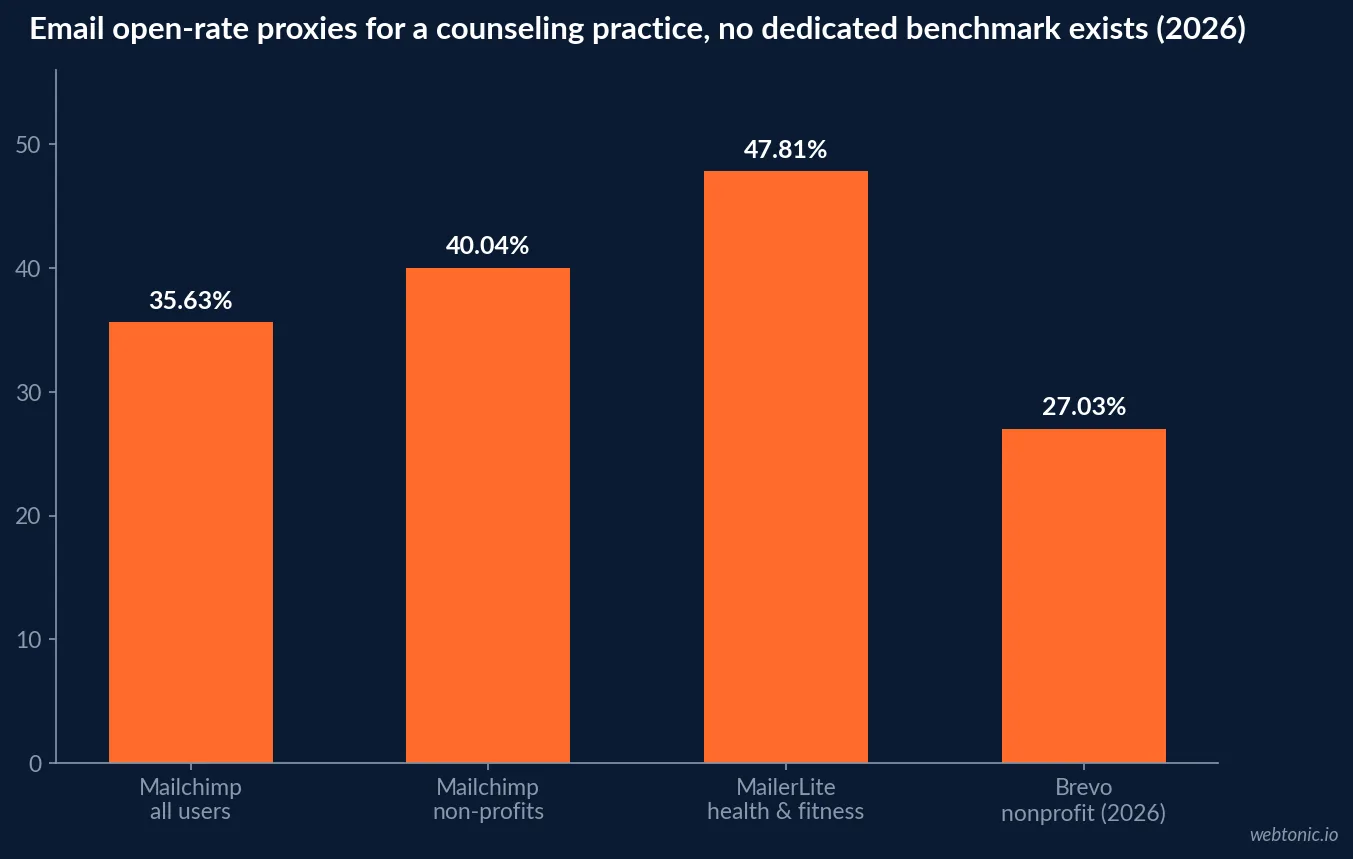
Every major email platform publishes industry benchmark tables, and none of them has a row for mental health or counseling practices. The closest proxies come from adjacent wellness categories, and they disagree with each other enough that quoting one as "the" benchmark would be misleading. Mailchimp reports an all-user average of 35.63% open and 2.62% click; MailerLite's Health & Fitness row runs notably higher at 47.81% open; Brevo's 2026 Nonprofit & NGO row, using Apple Mail Privacy Protection-adjusted methodology, opens at 27.03%. Use a range, not a single number, when setting a target.
| Platform (2026 benchmark) | Category used as proxy | Open rate | Click rate |
|---|---|---|---|
| Mailchimp | All users (no health-specific row) | 35.63% | 2.62% |
| Mailchimp | Non-Profits | 40.04% | 3.27% |
| MailerLite | Health & Fitness | 47.81% | Not separately confirmed |
| Brevo | Nonprofit & NGO (2026 methodology) | 27.03% | 3.10% |
| Brevo | Professional Services & Consulting | 22.74% | 34.37% CTOR |
What automation should actually do here
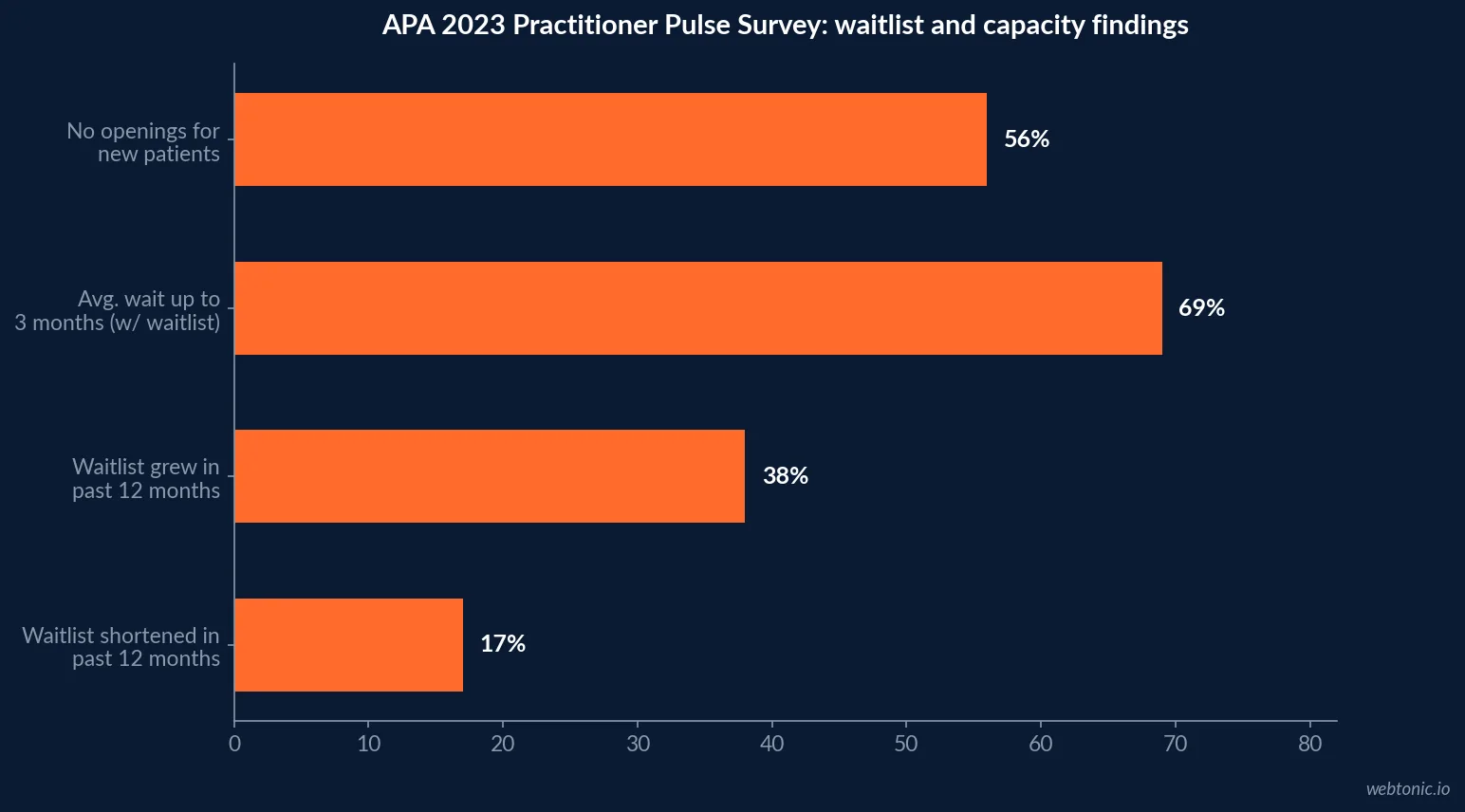
The case for automation is a waitlist problem before it is a marketing problem. APA's 2023 Practitioner Pulse Survey found 56% of psychologists had no openings for new patients, and among those keeping a waitlist, 69% reported an average wait of up to three months while 38% said the waitlist had grown in the past year against only 17% who said it had shortened. Automated, templated status emails -- "you're still on the list," "a slot opened, respond within 48 hours" -- solve exactly this kind of repetitive, non-clinical communication load without adding to a clinician's already-stretched hours. The alternative, a manual process run by an already-overbooked front desk, is precisely the kind of task that slips first when a practice is at capacity, which turns a communication gap into a client-experience problem before any clinical issue ever enters the picture.
| Waitlist metric (APA 2023 Practitioner Pulse Survey) | Figure |
|---|---|
| Psychologists with no openings for new patients | 56% |
| Psychologists with a waitlist reporting avg. wait up to 3 months | 69% |
| Waitlists that grew in the past 12 months | 38% |
| Waitlists that shortened in the past 12 months | 17% |
Where automation should stop
The FTC's two recent settlements draw a clean line between operational automation and data misuse. The 2023 BetterHelp order covered sharing email addresses and questionnaire answers with ad platforms over six years, for a USD 7.8 million consumer payout. The 2024 Cerebral order, at more than USD 7 million, covered roughly 3.2 million consumers' data reaching LinkedIn, Snapchat and TikTok through tracking tools. Neither case involved a manual mistake by a clinician; both involved marketing infrastructure -- pixels, integrations, list-sharing settings -- doing something the platform's default configuration allowed. Any automation vendor evaluation for this industry should start by asking what the platform does with open-tracking and click-tracking data by default.
The unresolved HIPAA question
There is still no settled tracking-technology rule to lean on. A federal court in the Northern District of Texas vacated part of HHS OCR's online-tracking guidance in June 2024, and OCR withdrew its appeal that September without publishing a replacement -- a gap that, per legal trackers following the litigation, remains open as of this writing. Until that changes, the conservative standard for email is the same one that applies to Meta and Google tracking: keep diagnosis, service line, and treatment-status language out of subject lines and preview text, and out of any parameter a click-tracking link would log.
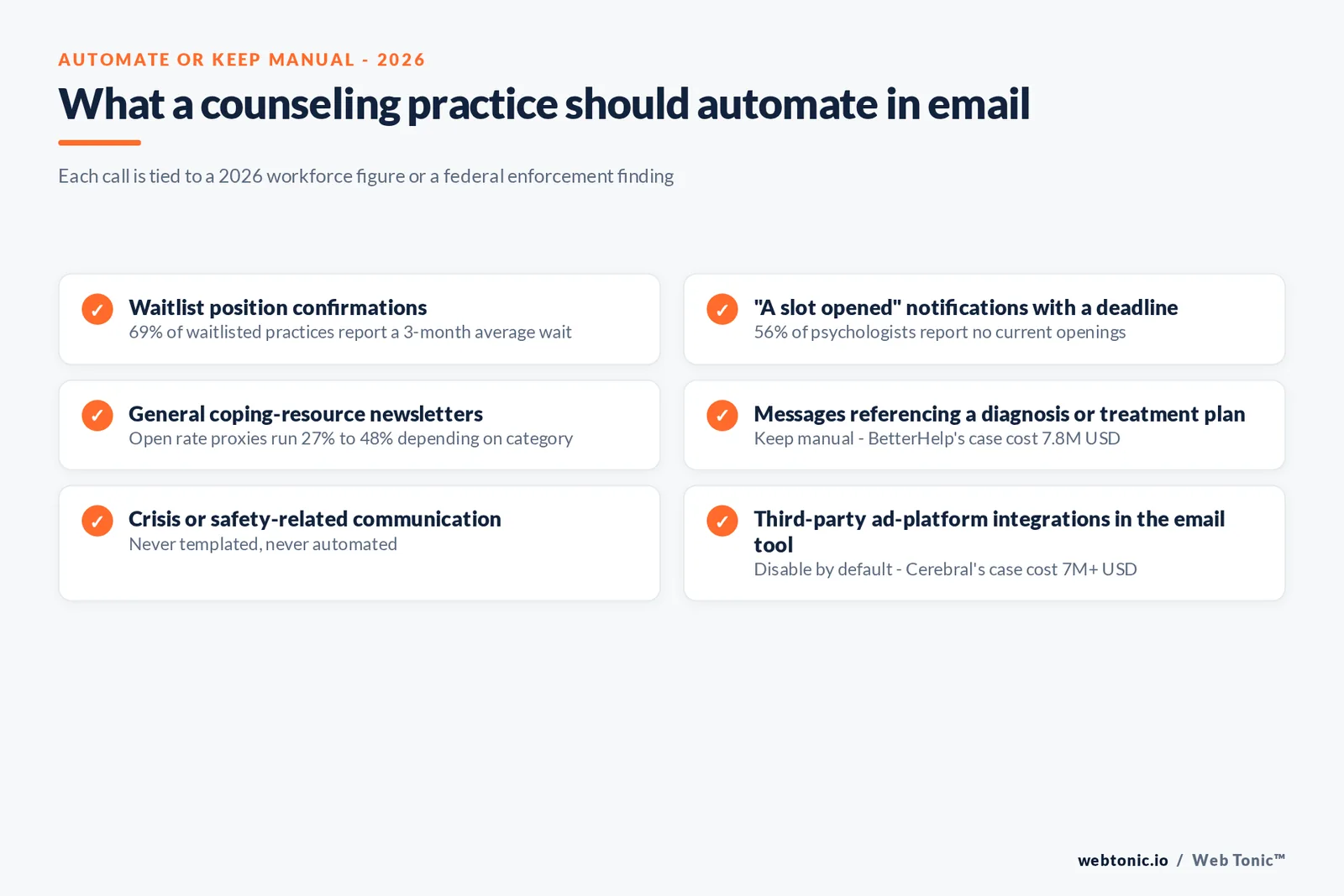
| Automation decision for a counseling practice's email program | Automate or keep manual? |
|---|---|
| Waitlist position confirmation | Automate |
| "A slot has opened" notification with a response deadline | Automate |
| General newsletter on stress, coping resources, office updates | Automate |
| Any message referencing a specific diagnosis or treatment plan | Manual, clinician-reviewed |
| Crisis or safety-related communication | Manual only, never templated |
| Third-party ad-platform integrations inside the email tool | Disable by default, review before enabling |
What a compliant automated sequence looks like
A practical waitlist sequence separates status updates from anything clinical: a confirmation email when someone joins the list, a periodic check-in asking whether the need is still current, an opening-slot notice with a firm response deadline, and a final resource email for anyone who leaves the list unplaced -- pointing to 988 or a directory of colleagues with openings rather than leaving the relationship to end silently.
| Sequence step | Trigger | Content type |
|---|---|---|
| Waitlist confirmation | Intake form submitted | Automated, templated |
| Still-interested check-in | 30-45 days on the list | Automated, templated |
| Slot-opened notice | Clinician marks capacity available | Automated, with a response deadline |
| Non-placement resource email | 60-90 days without a match | Automated, links to 988 and referral directory |
| Any reply mentioning risk or urgency | Patient response | Routed to a clinician, never auto-replied |
List hygiene and consent, not just deliverability
Standard email deliverability practice (double opt-in, easy unsubscribe, sender authentication) applies here exactly as it does anywhere else, but consent language carries more weight for a counseling list: a subscriber should know, in plain language, what a practice's email platform does with tracking pixels and whether any third-party integration is enabled, given the FTC's stated concern in both settlements above. That disclosure is a compliance safeguard and, increasingly, a trust signal that differentiates a practice from the platforms that got fined.
Segmentation without inference
A practice can still segment a list usefully without inferring anything about a subscriber's condition: by referral source (directory, search, word of mouth), by list status (active client, waitlisted, past client), or by stated preference (in-person vs telehealth, weekday vs weekend availability). None of that segmentation requires -- or should ever include -- a diagnosis field, which keeps the list architecture aligned with the same conservative posture the FTC cases argue for.
| Segmentation variable | Safe to use? | Why |
|---|---|---|
| Referral source | Yes | Operational, not clinical |
| List status (waitlisted / active / past client) | Yes | Operational, not clinical |
| Stated modality preference (in-person / telehealth) | Yes | Self-declared logistics preference |
| Inferred diagnosis or condition category | No | Not disclosed by the subscriber for this purpose |
| Engagement score (opens/clicks) | Yes, for send cadence only | Standard deliverability practice |
How this compares with the practice's other channels
Email is the lowest-cost channel in this comparison by a wide margin -- most platforms charge a flat monthly fee regardless of list size at this scale, versus per-lead or per-click costs on paid search and Meta -- but it only works on people already in the funnel: a waitlist, a past-client list, a newsletter signup. It cannot generate new demand the way local SEO or paid search can, which is why the strongest programs in this category pair automated email retention with the acquisition work covered elsewhere in this series rather than treating email as a stand-alone growth channel. It is also the channel where a practice has the most direct control over compliance, since there is no ad-platform algorithm deciding delivery -- every decision about tracking, segmentation and content sits inside the practice's own configuration.
Sizing the opportunity against workforce reality
The Bureau of Labor Statistics counted 397,880 substance abuse, behavioral disorder and mental health counselors employed as of May 2023, with the occupation projected to grow 17% to 19% through the early 2030s -- faster supply growth than most occupations, but still behind documented demand: SAMHSA and KFF both track 988 Lifeline contacts now running 600,000 to 700,000 a month, more than double the 277,407 monthly contacts recorded before the line's 2022 launch. Automated retention email is a small lever against numbers that size, but it is one of the few levers that does not require hiring another clinician to use. Our breakdown of top email marketing agencies and our broader email marketing statistics page cover the cross-industry picture if you want to benchmark beyond this vertical, and our growth marketing team can help set up the sequence above with the tracking-hygiene guardrails this category needs -- reach out if you want that reviewed before launch.
Frequently Asked Questions
What email open and click rates should a counseling practice expect in 2026?
No published benchmark study breaks out a dedicated "mental health and counseling" row, so the honest baseline is the cross-industry health-adjacent proxy: Mailchimp's all-user average sits at 35.63% open and 2.62% click, while MailerLite's Health & Fitness category reports a notably higher 47.81% open rate. Treat the higher figure as an upper bound driven by warm, opted-in wellness audiences rather than a guarantee, and benchmark your own list against both.
Should intake and waitlist emails be automated given how stretched practices are?
The workforce numbers argue yes for logistics, no for clinical judgment. APA's 2023 Practitioner Pulse Survey found 56% of psychologists had no openings and 69% of those with a waitlist reported an average wait of up to three months, which is exactly the kind of repetitive status update -- "you're still on the list," "a slot opened" -- that automation handles well. Anything that touches clinical triage, urgency assessment, or a specific diagnosis should stay manual and reviewed.
Does the FTC's action against BetterHelp apply to a solo practice's email platform?
The mechanism the FTC objected to, not just the company size, is what matters. BetterHelp's 2023 USD 7.8 million settlement covered sharing email addresses and mental-health questionnaire answers with ad platforms; Cerebral's 2024 settlement covered similar data reaching LinkedIn, Snapchat and TikTok. Any practice using an email platform's built-in ad-retargeting integrations, or embedding third-party open-tracking pixels, is using the same category of mechanism at a smaller scale.
Is there a settled HIPAA rule for tracking pixels inside marketing emails?
No. A federal court in Texas vacated part of HHS OCR's online-tracking guidance in June 2024, and OCR withdrew its appeal in September 2024 without issuing replacement guidance. That leaves email tracking pixels governed by general HIPAA and FTC Act principles rather than a specific rule, so the safer default is to keep clinical content out of subject lines and body copy that a tracking pixel or forwarded email could expose.
What is the actual case for automation here, beyond saving time?
Consistency under a workforce shortage. With 397,880 mental health counselors nationally and demand outpacing that supply per BLS's growth projections, a manual follow-up process is the first thing that slips when a practice is at capacity. Automated, non-clinical status emails keep a waitlist warm without adding to clinician workload, which is a retention lever more than an acquisition one.
Sources
Mailchimp - Email Marketing Benchmarks and Industry Statistics
MailerLite - Email marketing benchmarks by industry and region, 2026
Brevo - Email Marketing Benchmarks, Region and Industry Data 2026
American Psychological Association - 2023 Practitioner Pulse Survey press release
Federal Trade Commission - FTC order against BetterHelp, 2023
Federal Trade Commission - FTC order against Cerebral, 2024
eCFR - 45 CFR Part 164, HIPAA Privacy Rule (definition of protected health information)
U.S. Bureau of Labor Statistics - Occupational Employment and Wage Statistics, May 2023
SAMHSA - 988 Lifeline Performance Metrics
KFF - 988 enters its fourth year as demand grows